Last updated on June 12th, 2026
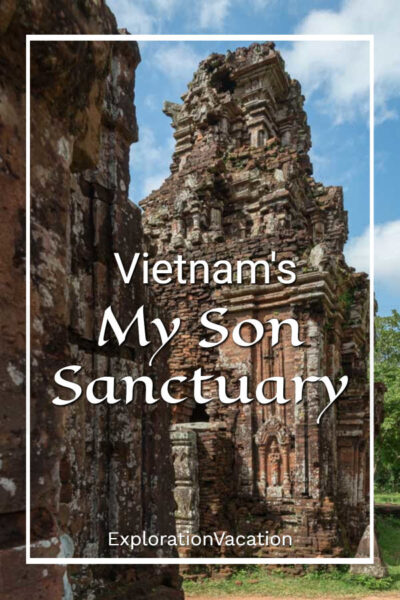
Vietnam’s My Son Sanctuary UNESCO World Heritage site preserves beautiful ruins that once formed the spiritual heart of the Champa Kingdom. These ancient Hindu temples are the largest and oldest ruins in the country.
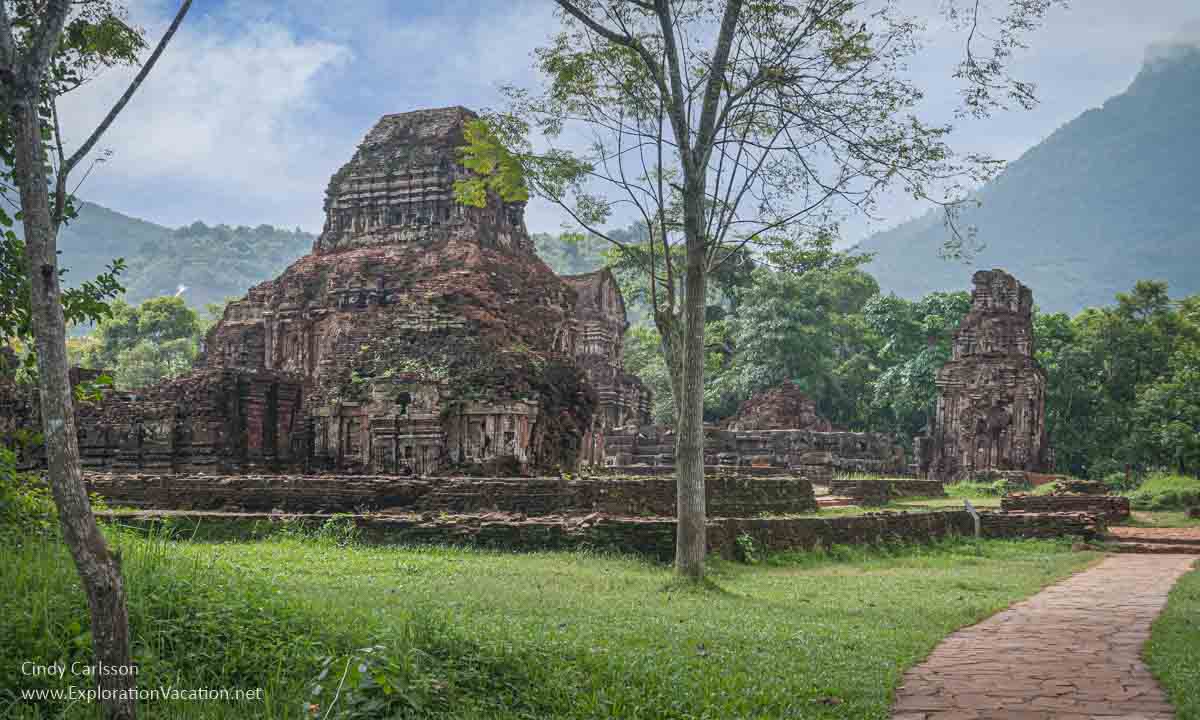
The intricate ruins of My Son Sanctuary in Vietnam are similar to those at Angkor Wat.
This story has affiliate links. I use links to provide additional information, but a few also pay me a small amount if you use them to make a reservation or purchase. You don’t pay extra, but it helps keep this website running without intrusive ads. To learn more, see my policies and disclosures.
Who are the Cham?
Roughly 2000 years ago a seafaring people began arriving in what is now Vietnam from Indonesia and/or Malaysia. Once in Vietnam, they created a distinct culture of their own. We know these people as the Cham.
Between the 2nd and 17th century the Cham ruled the central and southern coastal regions of what is now Vietnam. Within that region, My Son (Mỹ Sơn, which means “beautiful mountain” and is pronounced “Me Sun”) served as the kingdom’s spiritual center for over 1000 years.
The Cham were sea-going traders. As such, they regularly interacted with others from southern Asia, India, and China. Those interactions influenced their culture, which is clearly seen in their religious art and architecture.
Ancient Cham religious practices
China’s influence in the region meant that most of the area’s population practiced Buddhism. However, Cham religious practices drew heavily on Indian Hinduism with a bit of ancestor worship and a few brief Buddhist interludes.
👉 Read more about the Cham people
Shiva was the central god in Cham religious practices, although many others in the Hindu pantheon also appear. Although often called “the destroyer,” but as lord of the universe, Shiva also creates and protects. As in other Hindu cultures, Cham art often depicts Shiva in human form with a snake around his neck, prayer beads, and/or with a third eye.
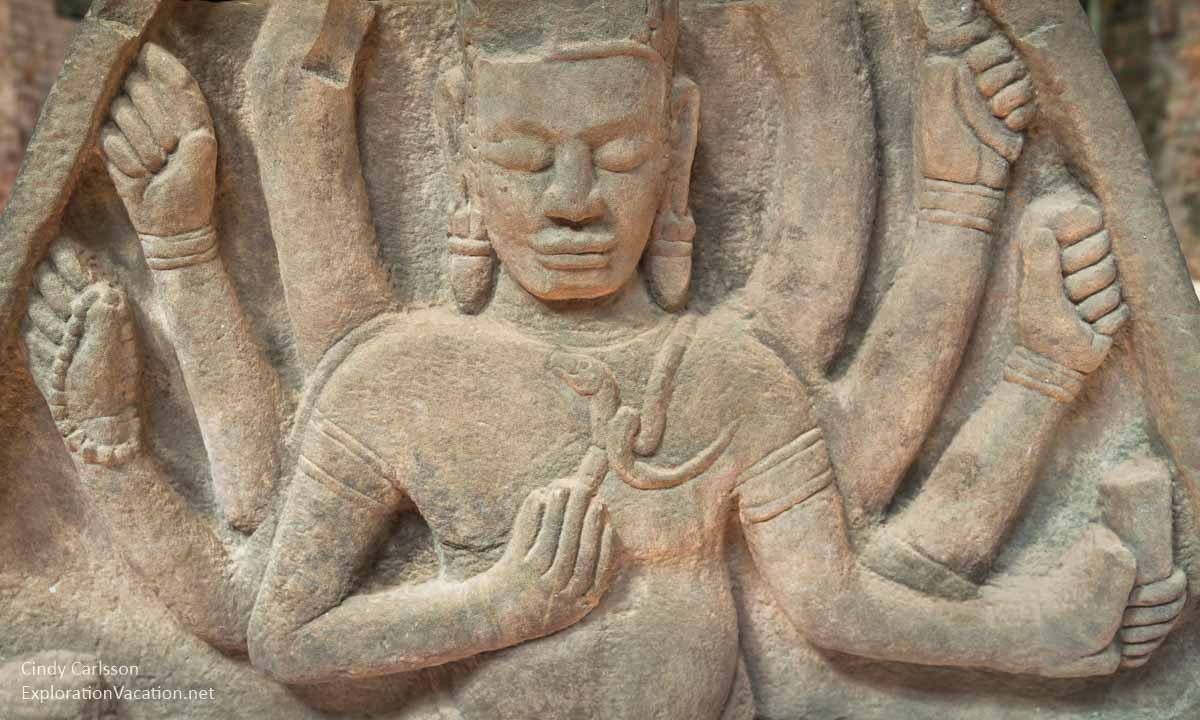
Shiva is recognizable here by the snake draped over his shoulder and the beads in his hand.
But Shiva also very often appears in non-human form as a linga – a phallic sculpture symbolizing the power to create and/or universal truth.
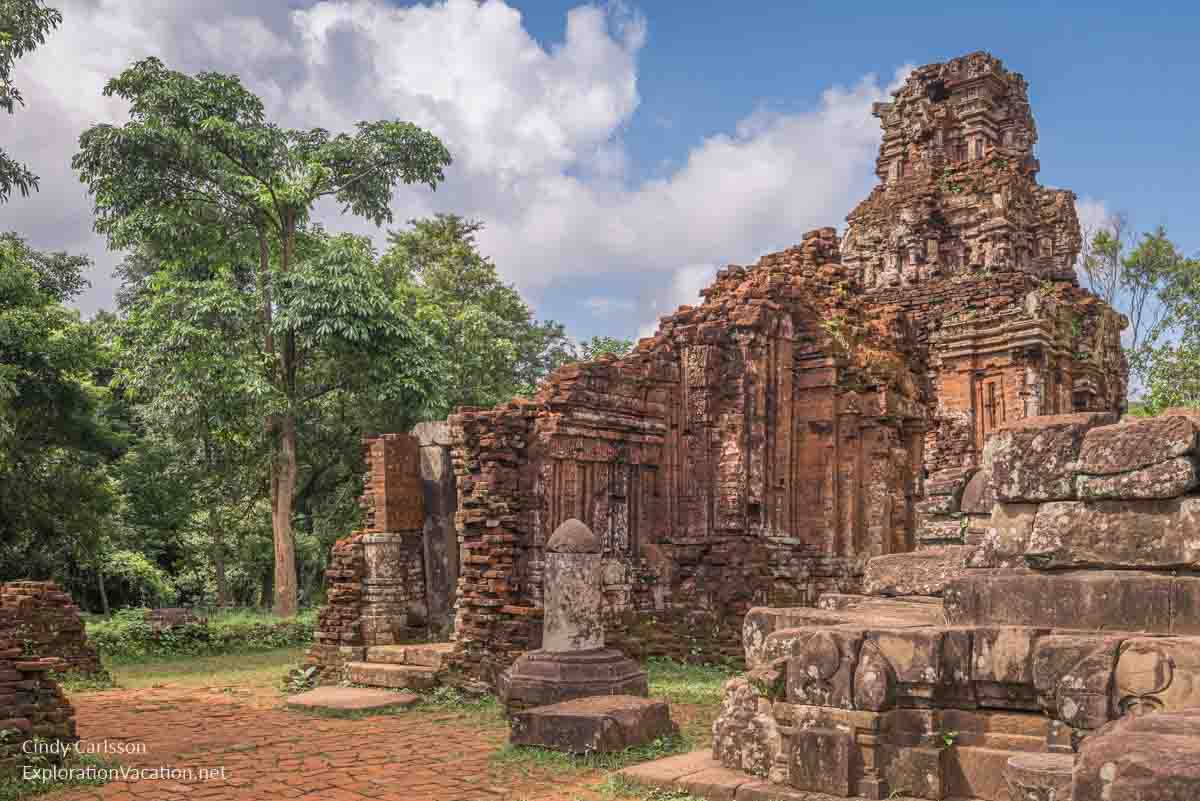
This Group B temple was dedicated to the elephant-headed Ganesha, but the very large linga that now sits alongside it represents Shiva.
At My Son, Shiva seems to have been represented in the temple by a linga far more often than in human form. The linga used for worship was also sometimes (often?) set in a stone water basin called a yoni that represents both Shiva’s wife and the female life force generally. As the stone lingq have withstood the destructive forces of time and war better than the temples, today they stand in what seem like rather random locations all over the site!
The Cham people today
The Cham kingdom collapsed by the 15th century. With the loss of power, many Cham people tried to stay ahead of the new rulers by moving farther south or into neighboring Cambodia. As they moved, they were introduced to Islamic beliefs that either replaced or were simply added to their existing mix of beliefs.
Cham people still live in both Vietnam and Cambodia. However, they are a very small, marginalized population in both countries. In Cambodia, Cham people faced genocide under the Khmer Rouge during the 1970s, when many were killed. In both countries they tend to live together in their own villages or neighborhoods.
Traditionally, Cham society is matriarchal, with women having authority over marriages and family property. A custom that has often put them at odds with government authorities.
The Cham people that remain in central Vietnam are generally Hindu. Once a year many gather to celebrate Kate, a festival that honors ancient deities, important ancestors, and recently deceased family members. Those living farther south, as well as those in Cambodia, Thailand, and Malaysia are mostly Muslim. A small number in Vietnam are Buddhist.
Some Cham groups in Vietnam hold a festival called Kate each fall to honor the gods, ancestors, and deceased family members. Once a month-long festival, it’s now a three-day event.
👉 Read less
A brief history of My Son Sanctuary
We have a lot more information about My Son’s ancient history than one might expect. Like many other ancient cultures, the Cham erected large stone tablets (called stele) to document important events and personal achievements. Fortunately, many of these still exist.
More than 30 steles were found at My Son. All come from the 5th–12th centuries and include text in both Sanskrit and Cham. And many document the construction of new temples at My Son.
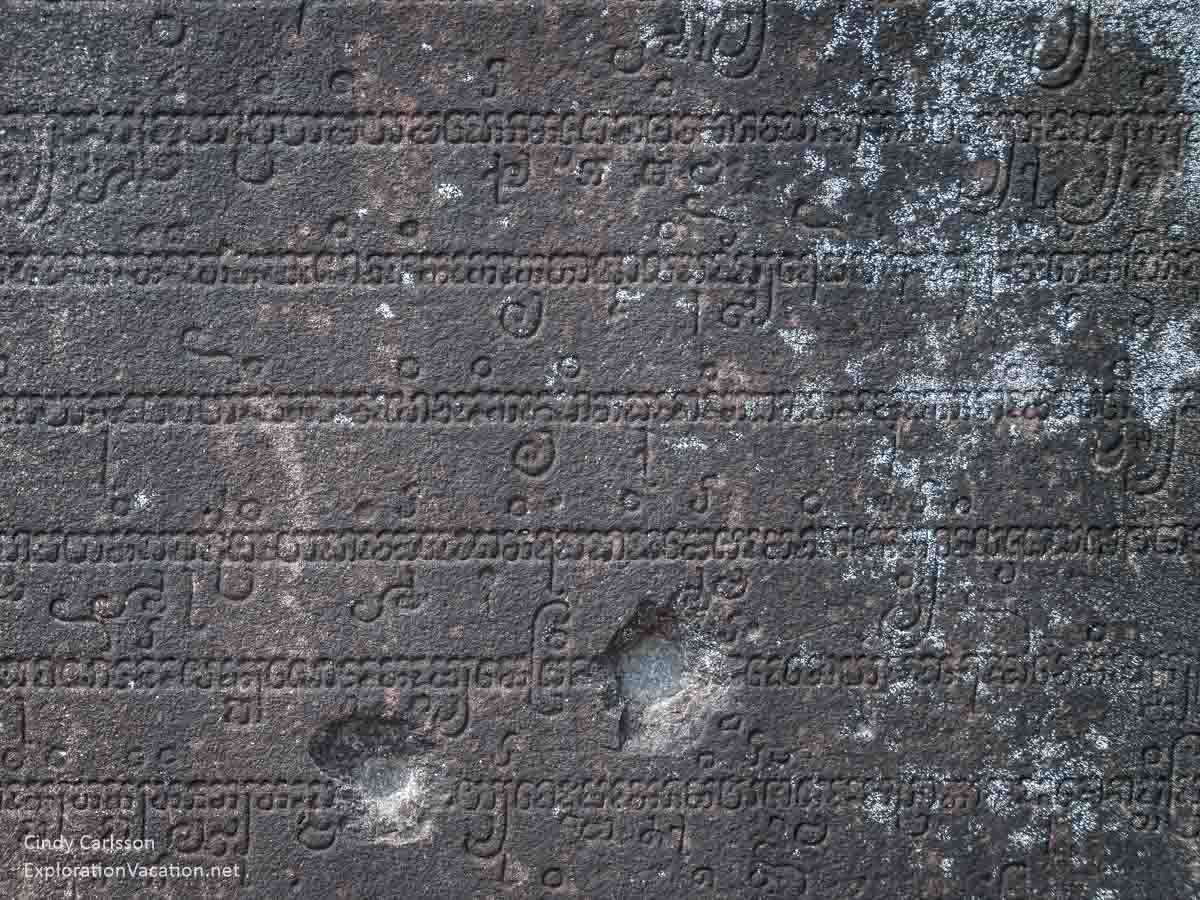
Detail of a stele with Cham script and bullet holes.
While various historical records indicate that the Cham built incredibly beautiful palaces and other buildings, those were built from wood. Only religious buildings were deemed worthy of brick construction, so only religious buildings remain today.
Located in a valley along a sacred river that flows to the sea at the trading port of Hoi An, the site had both spiritual and practical advantages. While most other remaining Cham temples are located on hill tops, My Son’s site deep in a valley was protected, but also easy to reach from the port. The site also mirrors facets of Hindu celestial geography, which gives it spiritual importance.
Construction at My Son
It’s thought that the Cham began building at My Son as early as the 4th century. However, the earliest remaining structures were built in the 7th century, likely to replace earlier wood temples destroyed in what was described as a huge fire sometime earlier.
The new structures were made of heavily carved fired brick. It’s a building style unique to the Cham in Vietnam, although similarly elaborate brick structures were built at the same time in India. The neighboring Khmer also briefly experimented with carved brick, a technique they probably first learned from the Cham.
The last temple built at My Son was constructed in the 13th century. By this point the area controlled by the Cham had been reduced through years of skirmishes with their Khmer neighbors. But now the Dai Viet people of the north were free of Chinese rule and looking to expand their own kingdom. That meant moving southward into what remained of the Cham’s land. With larger armies at their command, they pushed the Cham south, forcing them farther and farther from My Son.
Abandonment and destruction
Over time, My Son was abandoned and overtaken by the jungle.
👉 Read more about My Son Sanctuary's history
Famed French archaeologist Henri Parmentier often gets credit for discovering My Son. However, it was actually discovered by French cartographer and explorer Camille Paris in 1889, probably while scouting locations for a telegraph line. Parmentier got to the site by 1901, when he began clearing and documenting it. He also gathered artifacts for safekeeping (they eventually went to various museums, including the wonderful Champa Museum in Da Nang) and completed a bit of basic restoration work to stabilize structures before moving on to other Cham sites.
In 1937 a young French architect began a project to repair and “restore” My Son. That project ended a few years before the Japanese took control of Indochina in 1945.
When the next war (what Americans call the Vietnam War) came around, the North Vietnamese Viet Cong used My Son as a military base to support various hideouts deep in the jungle. In response, during one week in August 1969, the USA carpet-bombed the entire site. In the process, more than 50 of the 70-plus remaining structures were destroyed or severely damaged. This includes the site’s largest and most elaborate temple, which withstood the aerial attacks until an entire load of bombs was dumped directly on it.
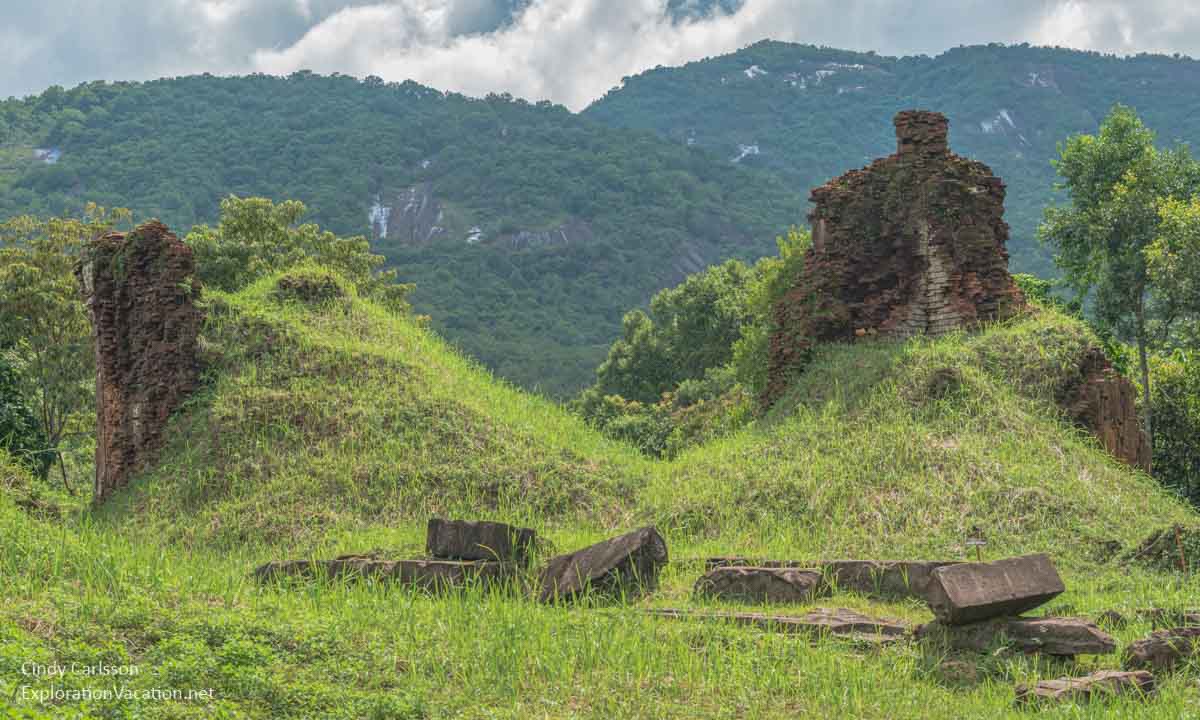
Group A once had the most magnificent Cham temple in Vietnam, but there wasn’t much left after an American bomber set out to destroy it.
Craters created by American bombs are still visible in many parts of My Son today. Some are being preserved as a sad reminder of how the destruction here occurred. Meanwhile, unexploded ordnance (both bombs and land mines) remains hidden in unexcavated areas – a dangerous hindrance to ongoing archaeological work.
UNESCO World Heritage designation
A Polish-Vietnamese team led by architect Kazimierz Kwiatkowski began clearing the site of vegetation and explosives, stabilizing and restoring the temples in 1981. Kwiatkowski was the visionary, driving force, and lead worker on the ground behind both decisions to preserve of the My Son, Hoi An, and Hue as UNESCO sites AND their actual restoration.
My Son Sanctuary became a UNESCO World Heritage Site in 1999 as an example of cultural interchange and adaptation and to represent the ancient Cham as an important element in the political and cultural history of Southeast Asia.
Italian and Indian teams started work soon after the UNESCO designation. (Americans remain notably absent.)
Current efforts at My Son focus on clearing unexploded munitions, identifying and preserving scattered fragments of structures and art, and stabilizing what still stands.
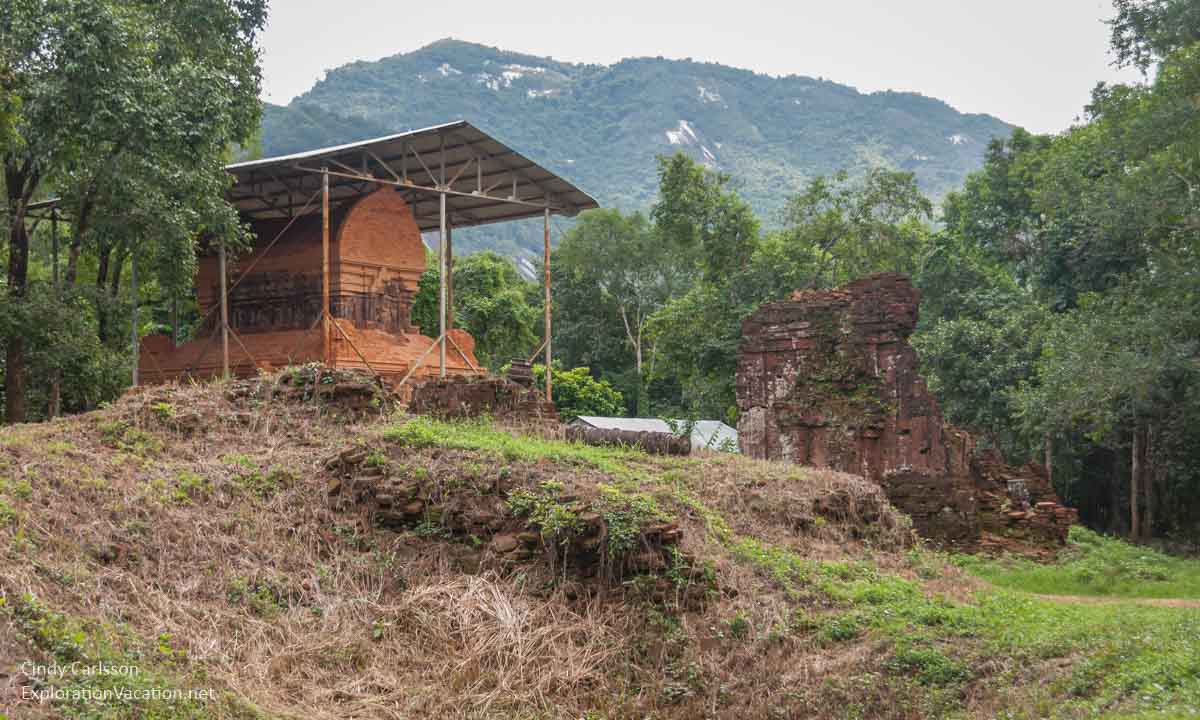
This building in Group E was a kosagrha used to store sacred books and temple offerings. It was rebuilt by Italian archaeologists in the early 2000s.
However, only a very few buildings have been, or are likely to ever be, fully restored or reconstructed.
👉 Read less
Visiting My Son Sanctuary
Early in the 20th century, French archaeologist Henri Parmentier created detailed records of 72 towers. Most were severely damaged or destroyed in 1969.
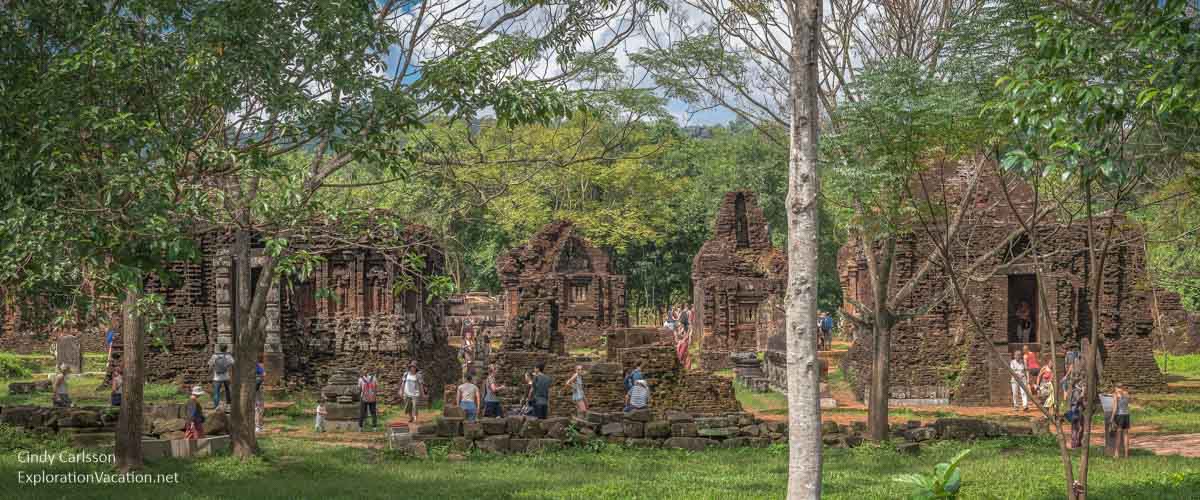
Tourists visit damaged towers in a section of My Son Sanctuary
But there is still plenty to see.
Cham religious architecture
While far smaller than sites like Angkor Wat in Cambodia or Bagan in Myanmar, My Son Sanctuary is still a relatively complex site. This isn’t just one temple with its associated buildings. It’s about ten of them. With each having buildings that served different purposes and built (or remodeled) at different times in different architectural styles.
That means that, even with some informational signage, walking around My Son is a little bewildering. Between the ruins that still stand, there’s a maze of collapsed buildings, foundations, and sculpture. From the ground, it can be hard to see how it all fits together!
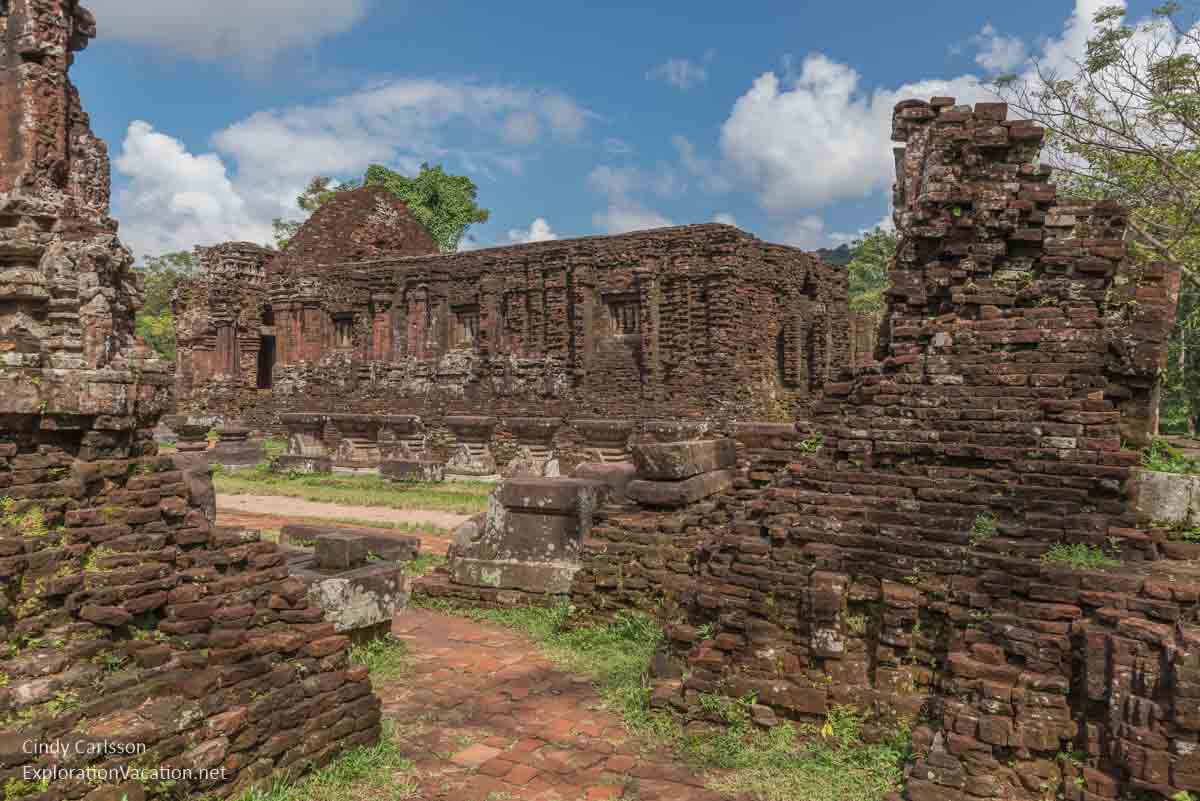
A gate, hall, and the remains of several other structures at of My Son Sanctuary.
All the ruins at My Son Sanctuary are part of one temple or another. However, each temple consists of several structures, most of which were once enclosed within a low wall.
Some of these temples are well separated from others, some are very close together, and a few share some structures with a neighboring temple.
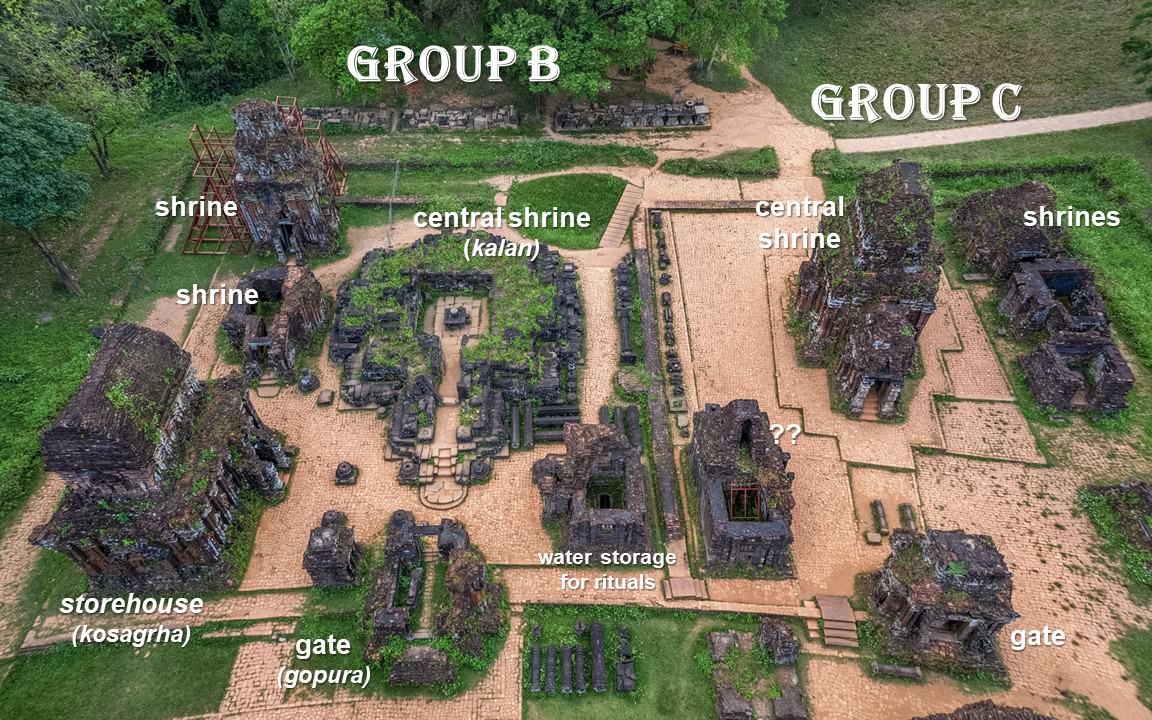
Each temple at My Son had a gate, storehouse, at least one kalan (shrine), and a reception hall worshippers and priests used before entering the shrine. The reception halls are just out of sight below the frame of this image. (Annotation by ExplorationVacation on an aerial photo © 2019 Hien Phung via Shutterstock.)
Fortunately, you can appreciate the architecture without really understanding how all of it all fits together. But it’s more fun if you can identify the function of some of the remaining buildings. And some aren’t too hard to spot.
👉 Read more about Cham temples at My Son Sanctuary
The heart of the temple is the kalan
A religious shrine at My Son is a kalan. This is the focal point of each temple, as it is where the deity is housed. But most temples have more than one kalan, with a primary one (usually dedicated to Shiva) along with ones dedicated to a variety of other gods.
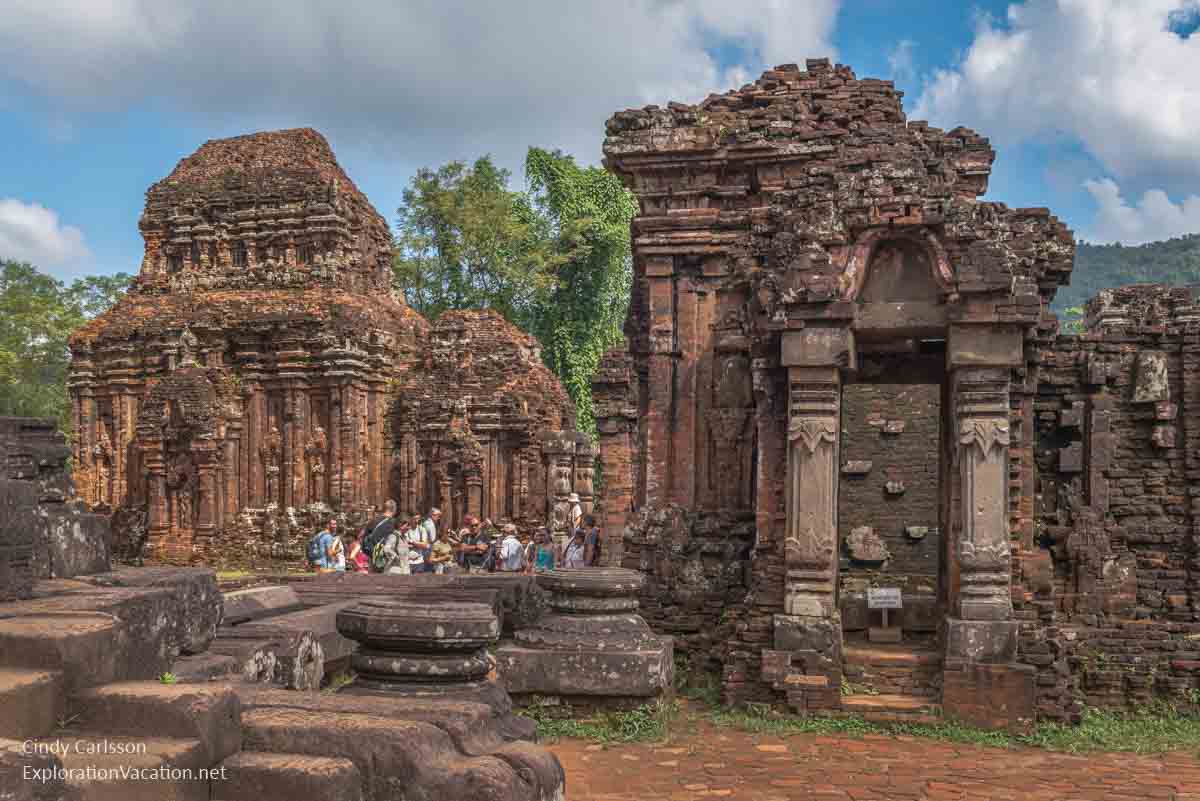
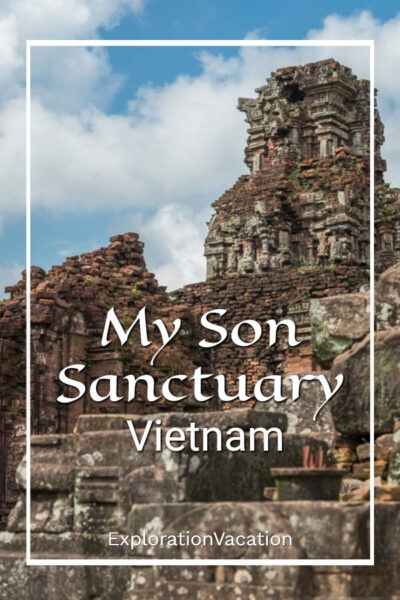
The building on the left is a kalan dedicated to Siva – the only one with a boat-shaped roof. The tower on the right is one of several shrines from another temple.
Almost all the shrines at My Son were hollow towers with three distinct layers:
- The base represents the earth. It is decorated with carved patterns, humans, and animals.
- The center or body represents the spiritual world. It features columns and vertical decoration.
- The top represents the top of Mount Meru, the spiritual realm between heaven and earth. It is decorated with figures of mythical creatures and holy men.
None of the shrines have much space inside. They were built to honor Siva (or another Hindu god, Buddha, a king, or an ancestor) with a representation of a god housed inside. There was no altar, just a pedestal for a figure. Priests and/or worshippers walked in a circle around the holy figure – there really wasn’t space for much more than that.
Other parts of the temple
The central kalan a was the primary structure in each temple. However, several other buildings were usually found in each.
The mandapa is a covered walkway or hall outside the walled temple compound. It served as a reception hall where worshippers and/or priests meditated before entering the kalan to perform sacred rituals. (Worshippers may not have been allowed to enter the kalan. They may have remained in the mandapa to pray while the priest performed ceremonies inside the kalan.)
A couple of these large halls remain at My Son. As large rectangular buildings with lots of windows, they are pretty easy to spot. The museum is housed in two of them.

An entrance gate and the mandapa or reception hall where worshippers meditated and prayed.
The gopura is a tower (like the kalan towers) that served as an entrance gate. It stood between the mandapa and the primary kalan This was the only access to the walled temple complex.
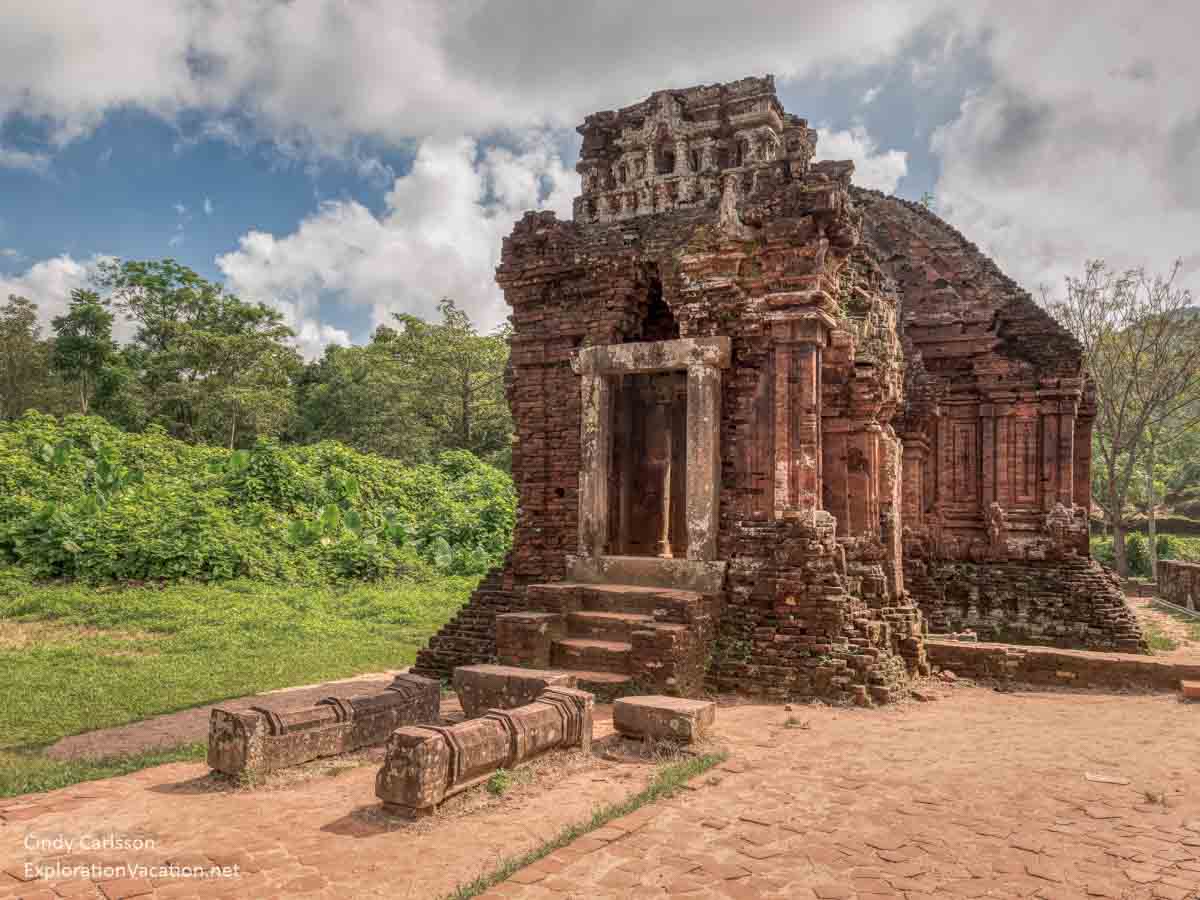
The same buildings as in the previous photo, but viewed from inside the remains of the walled compound looking out toward the gate. (The mandapa hall is barely visible behind it.)
The kosagrha with its dramatic saddle-shaped roof is the most distinctive structure at My Son. But this isn’t a shrine. It’s a storehouse where sacred texts and other valuables related to the deity were kept. This is also where food for the deity was cooked, so it is sometimes called the “firehouse.”
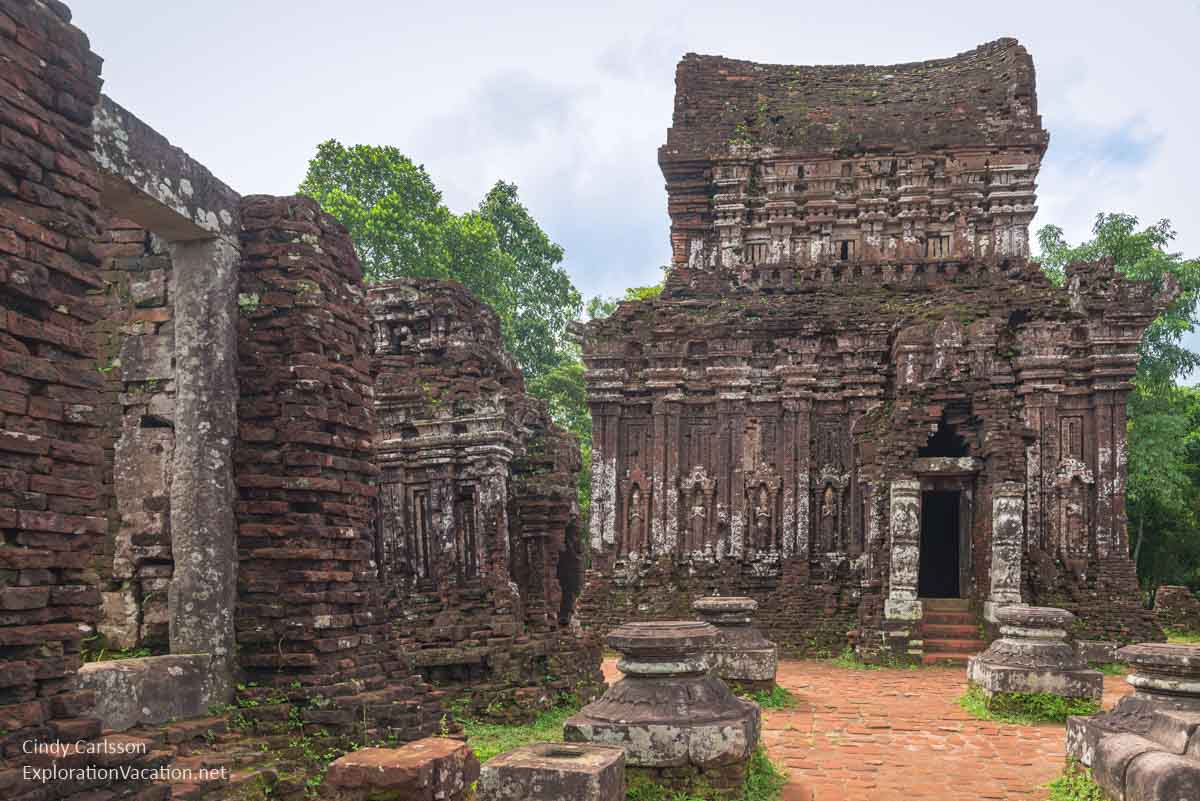
The storehouse in My Son Group B is one of the site’s most beautiful and best-preserved buildings.
A pośa, a small pavilion that protected the temple’s foundation stele, is also found in most groups.
👉 Read less
Unique construction techniques
All the buildings at My Son are built using fired red brick. It LOOKS like the bricks are just stacked together without mortar. However, they are essentially glued together using a plant resin commonly used to seal boats. The walls are very thick, with either two layers of brick set directly against each other or with brick rubble between them. The size of the brick also varies, depending on where it is used. This make for sturdy structures, but the resin seems to be the magic touch that both held everything together and preserved it by locking out moisture.
(Some think resin was also applied to the walls as a final sealant to preserve the carved reliefs. And some think the completed building was given a final firing in a giant “kiln” made by piling dirt around it and setting it on fire. Firing the building this way would harden both the bricks and the resin, but raises other issues. It seems, aside from the resin, no one knows exactly how these buildings were created, as the bricks had to be soft enough to carve in fine detail yet hard enough to withstand the weight of the tower and centuries of humidity. Traits that don’t generally exist simultaneously.)
Sandstone was used only for pillars, richly carved lintels, and a few other decorative features. Cham structures also had carved stucco decorations both inside and out. Most of those are long gone, leaving only traces of plaster. What remains are the stone trim and the elaborately carved brick exteriors.
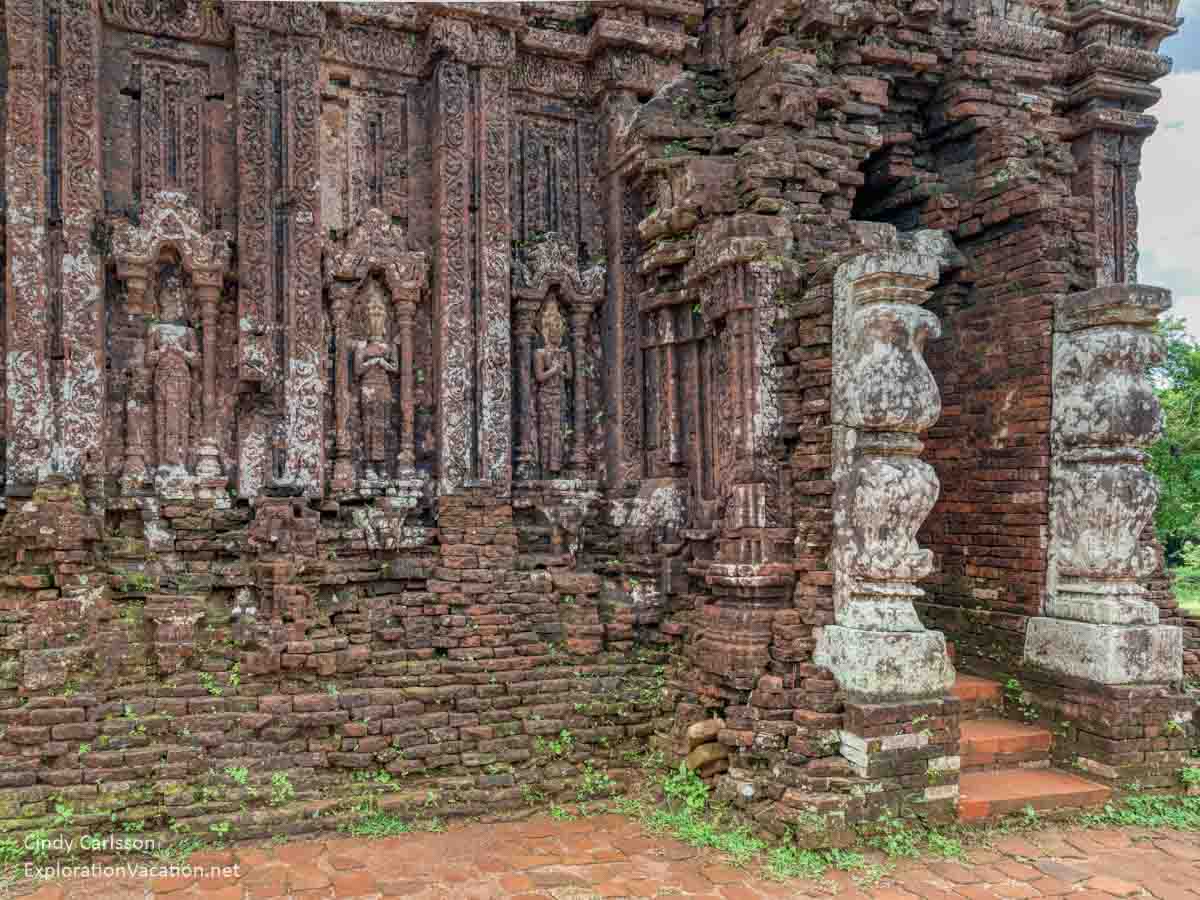
The goddess of prosperity was carved right in the brick walls of a storehouse.
There are stylistic differences in Cham temples based on when they were built. Archaeologists have named these based on where each style first developed. Two originated at My Son, but several others were also used here.
The temples of My Son Sanctuary
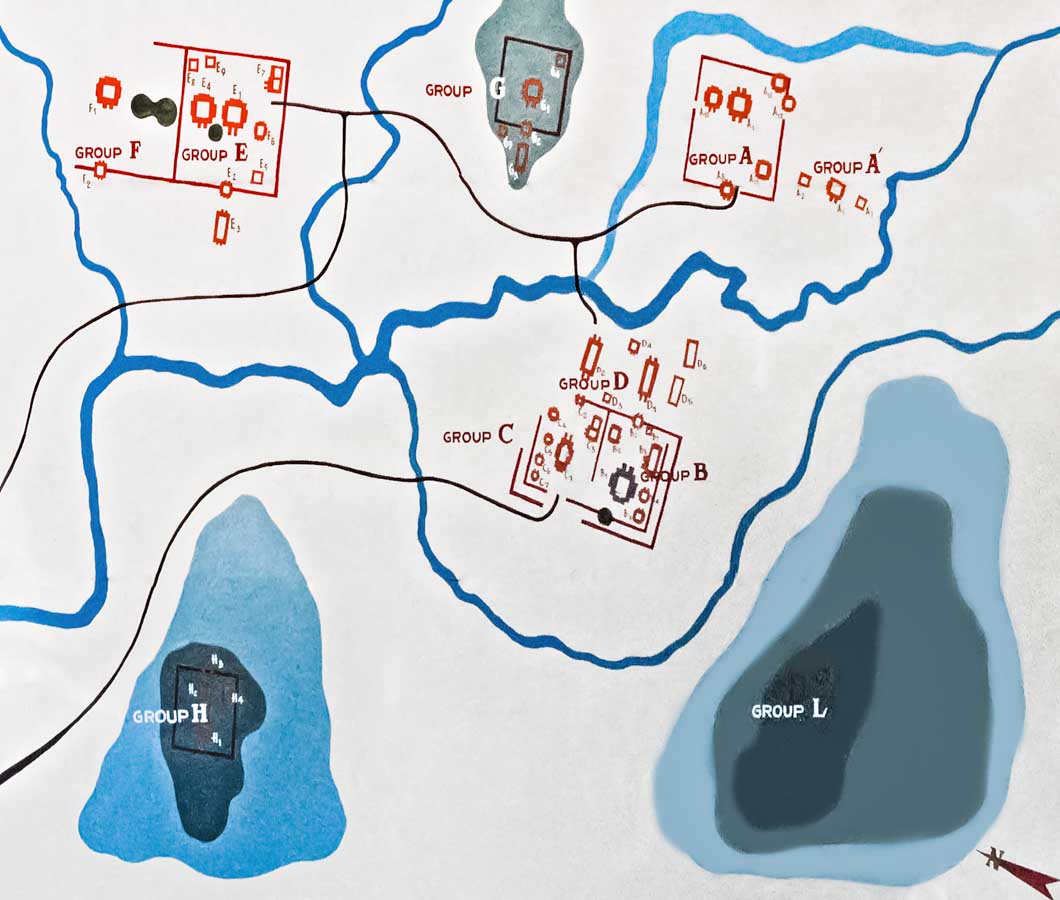
French archaeologists identified eight distinct groups of temples based on the location of the walls around each. They then assigned each group a letter between A and K. Since that time, it seems an additional group, called L, has been identified. (There is no Group I.) There’s likely a lot more to discover, but this is what we have now.
Visitors can see and even walk around in most of the excavated sites.
The ruins at My Son are linked by walking paths that take visitors to the excavated temples.
So, let’s take a closer look at what you can see in each group.
Groups BCD
If you only have time to see one site at My Son, you need to slow down and spend more time in Hoi An. But seriously, if your time is short, start at Group BCD. These are located very close to each other and have some of the most beautiful and best-preserved ruins. A few sculptures and other artifacts from around the site are also displayed in small museums in this group, so you can see a little of everything in one place.
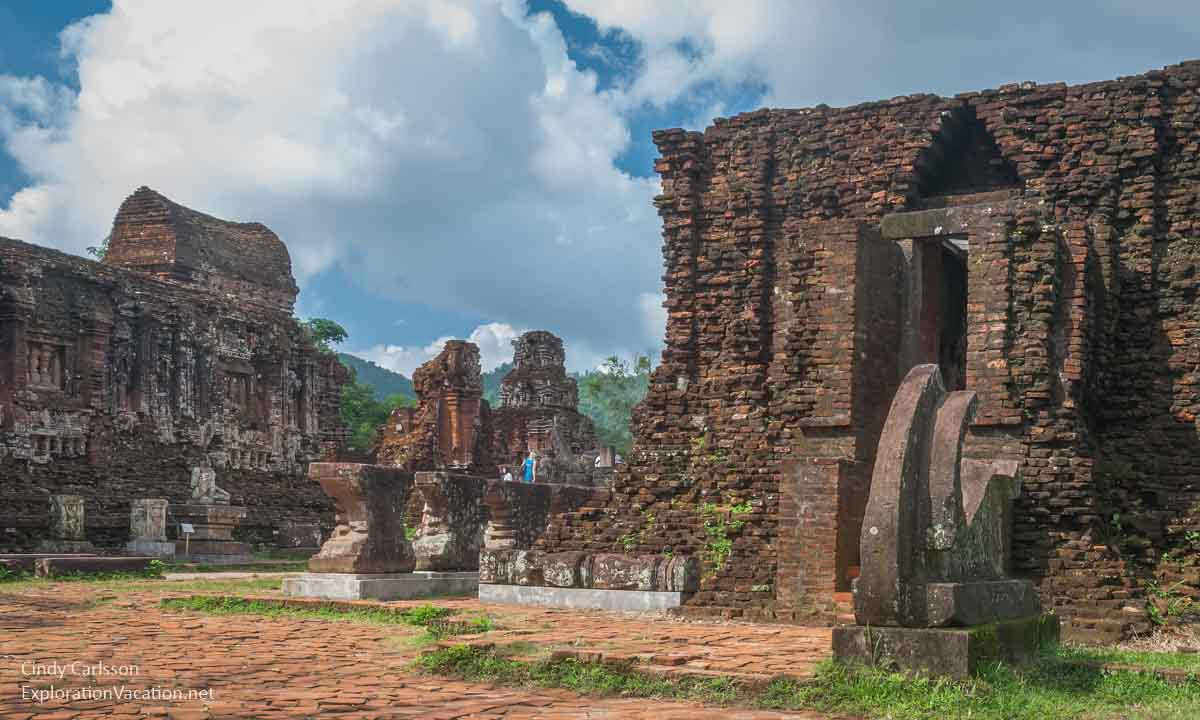
The reception halls in Group C and D share a courtyard. The halls now serve as museums.
Group B is the center of the My Son complex. The main kalan is basically gone, but many other buildings remain. (See the aerial photo above for the layout of groups B and C.) One of the most spectacular is the elaborate storehouse.
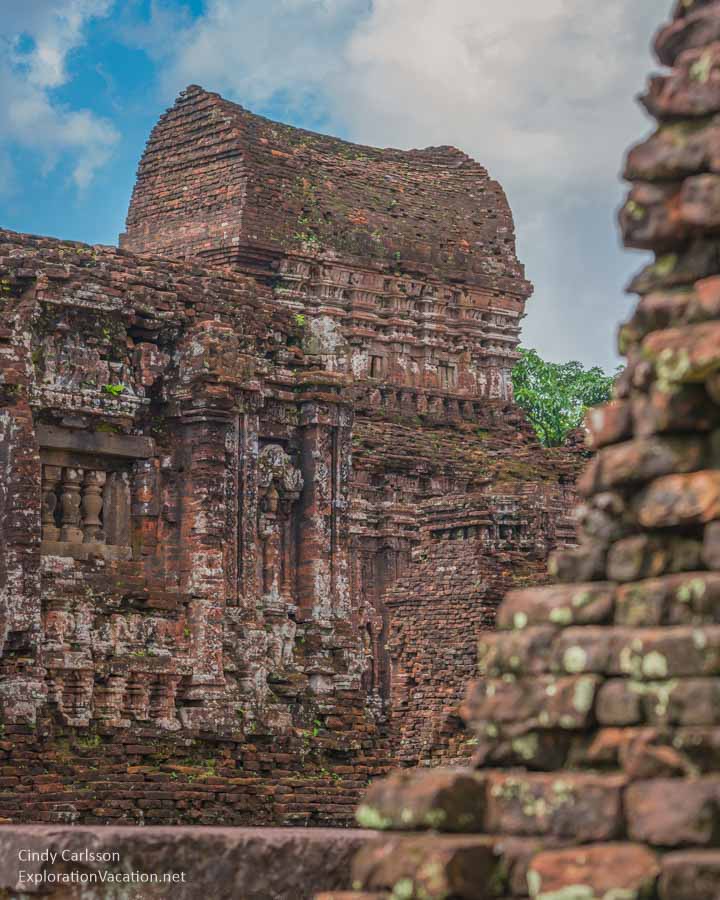
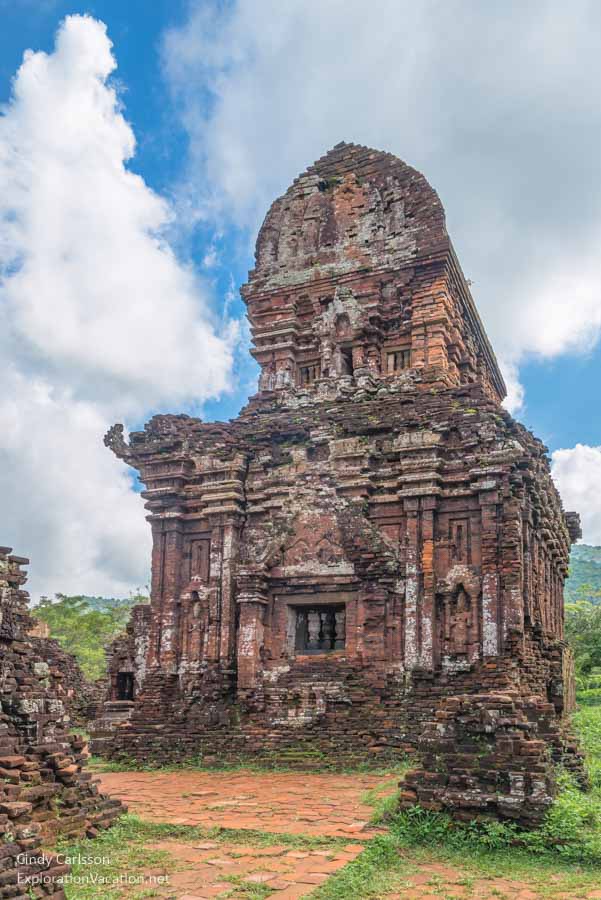
The kosagrha once held the temple’s sacred books and other valuables.
But this group has a lot of picturesque and interesting ruins.
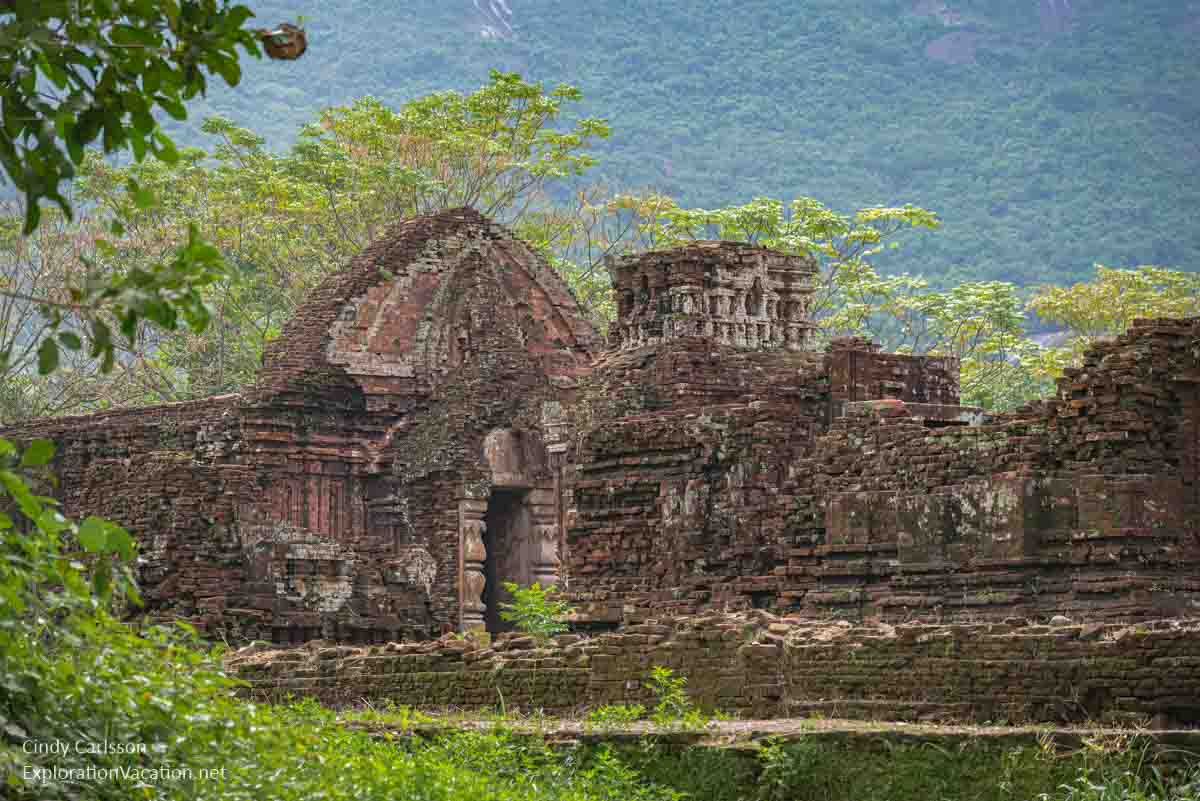
Ruins of a gatehouse and reception hall.
Group A
From BCD it makes the most sense to head over to Group A.
However, those who want to save the best for last should start at A and then do a little back-tracking to work your way back to BCD. That’s because Group A this is among the more depressing sights at My Son.
Until the summer of 1969, the finest Champa temple in all of Vietnam was in Group A.
At 90 feet tall with two entrances and six subsidiary temples, this 10th century temple had the largest kalan at My Son. But more than that, it was also considered to be the most beautiful and the most finely crafted. It was such a perfect example of the finest Cham architecture that an entire architectural style was named for it. And, remarkably, it was also the best-preserved temple at My Son.
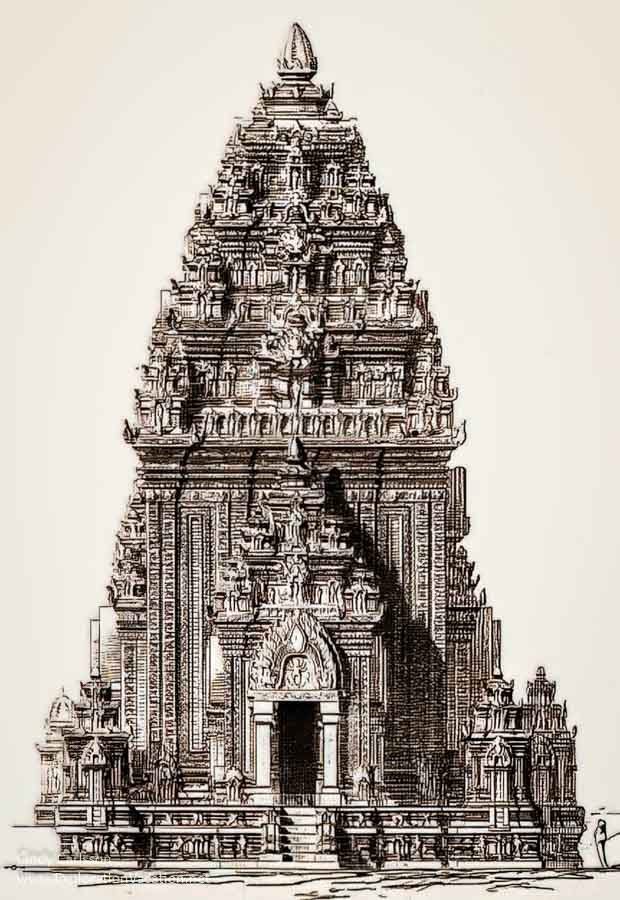
Champa tower A1 in an early 20th century drawing by French archaeologist Henri Parmentier.
It was successfully targeted and destroyed by a load of American bombs after a week of carpet bombing the area failed to destroy it.
Today the temple and its surrounding towers are mostly lumpy fields of uneven rocky mounds covered with grass. The exceptions include a few richly decorated bits of the temple’s foundation and the central pedestal where the yoni-linga once stood.
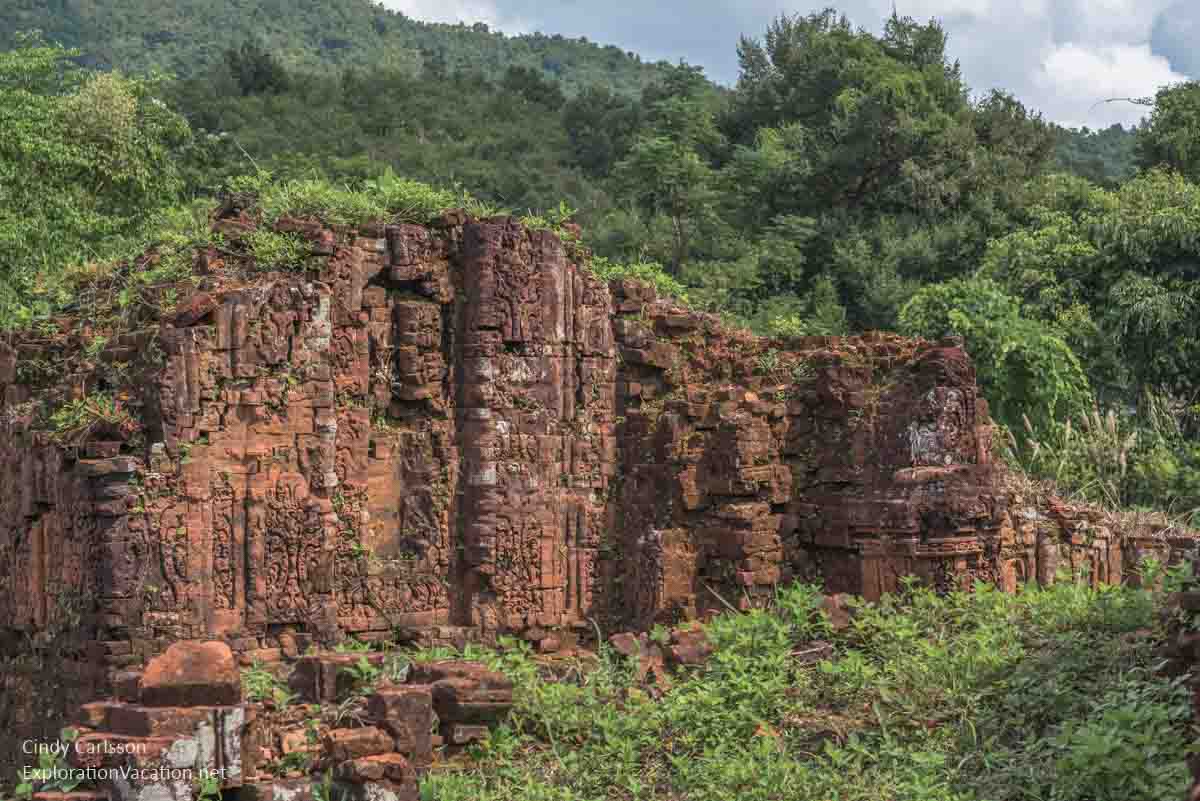
Almost nothing remains of what was once the finest Champa temple in Vietnam.
Group G
Group G was built in the 12th century, making it one of the newer temples at My Son. However, the central kalan was already collapsing early in the 20th century. Time and war facilitated that process. Still, this is an interesting ruin.
Restoration work in 2003-2004 stabilized and partially reconstructed what remained of the kalan, although none of the actual tower remains.

Temple G was partially restored.
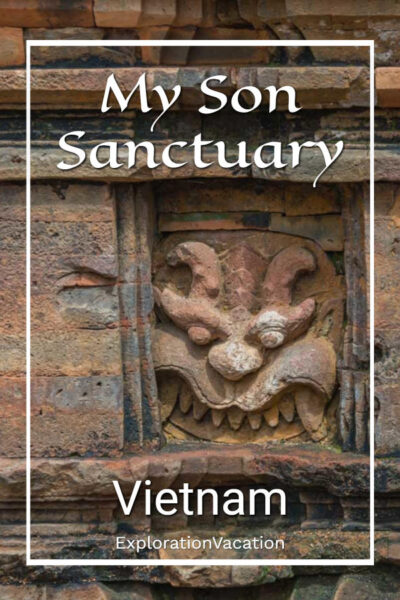
What I found most interesting at this site are the 52 terracotta masks, each with a unique grimacing expression, that surround the temple’s base. (These were the temple’s divine protectors, a duty they evidently didn’t take very seriously.)
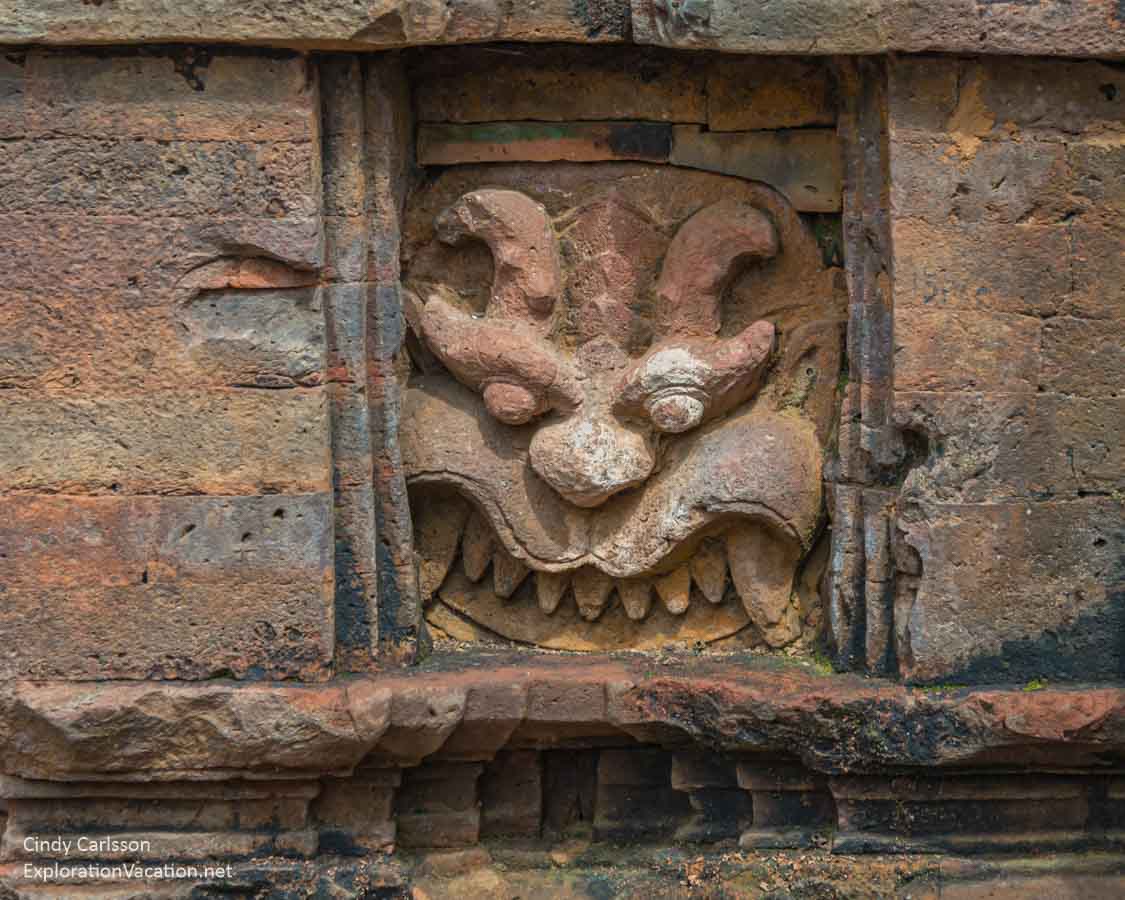
Just one of 52 faces, each with a unique grimace.
The temple also has a mythical creature described as a standing lion on each corner.
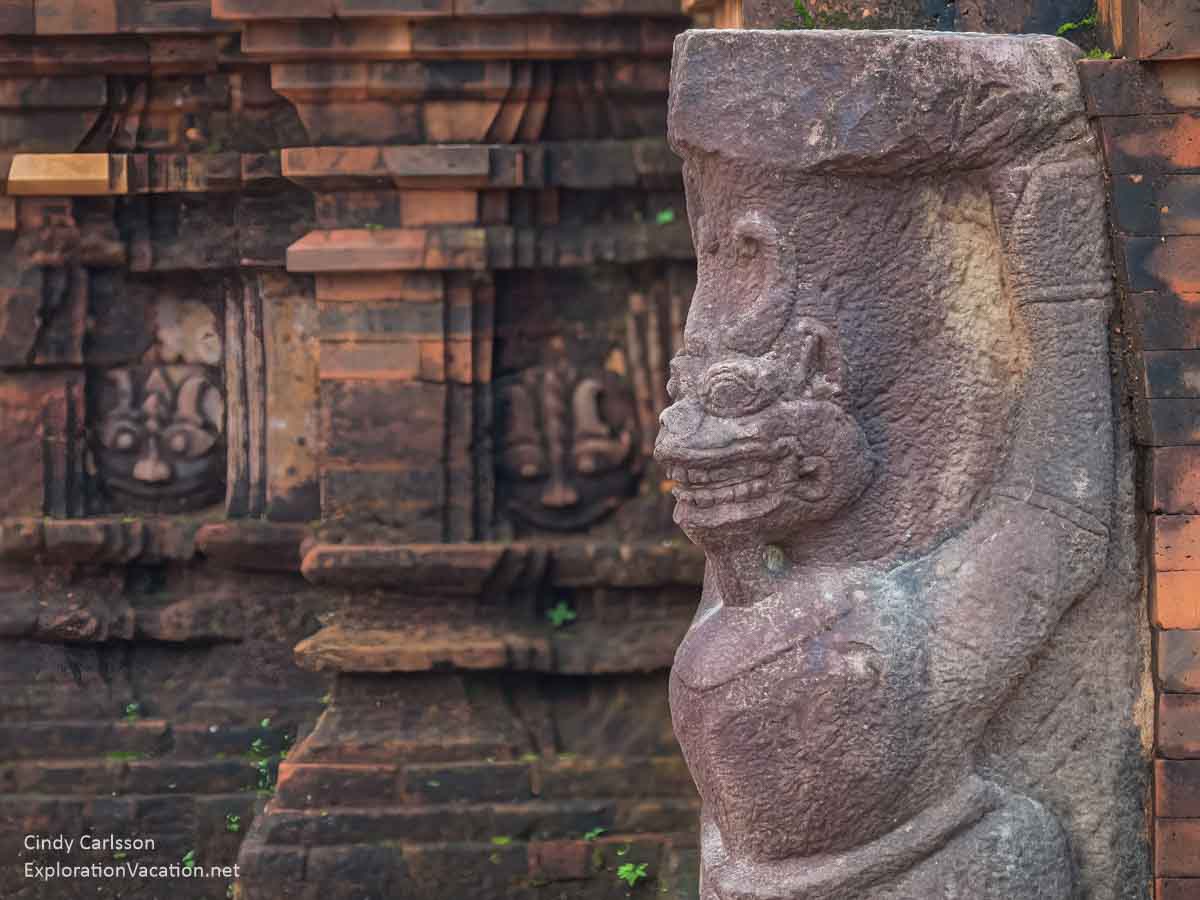
Not your ordinary lion.
Group EF
Groups E and F include the oldest of My Son’s temples, one of which has a stele from 658. These temples were later renovated and expanded before the Cham abandoned the site. They were almost completely destroyed in 1969, making this another depressing site.
Italian archaeologists used the drawings made by French archaeologist Parmentier in the early 1900s to completely restore (rebuild) the storehouse in Group E. But the kalans were mostly destroyed.
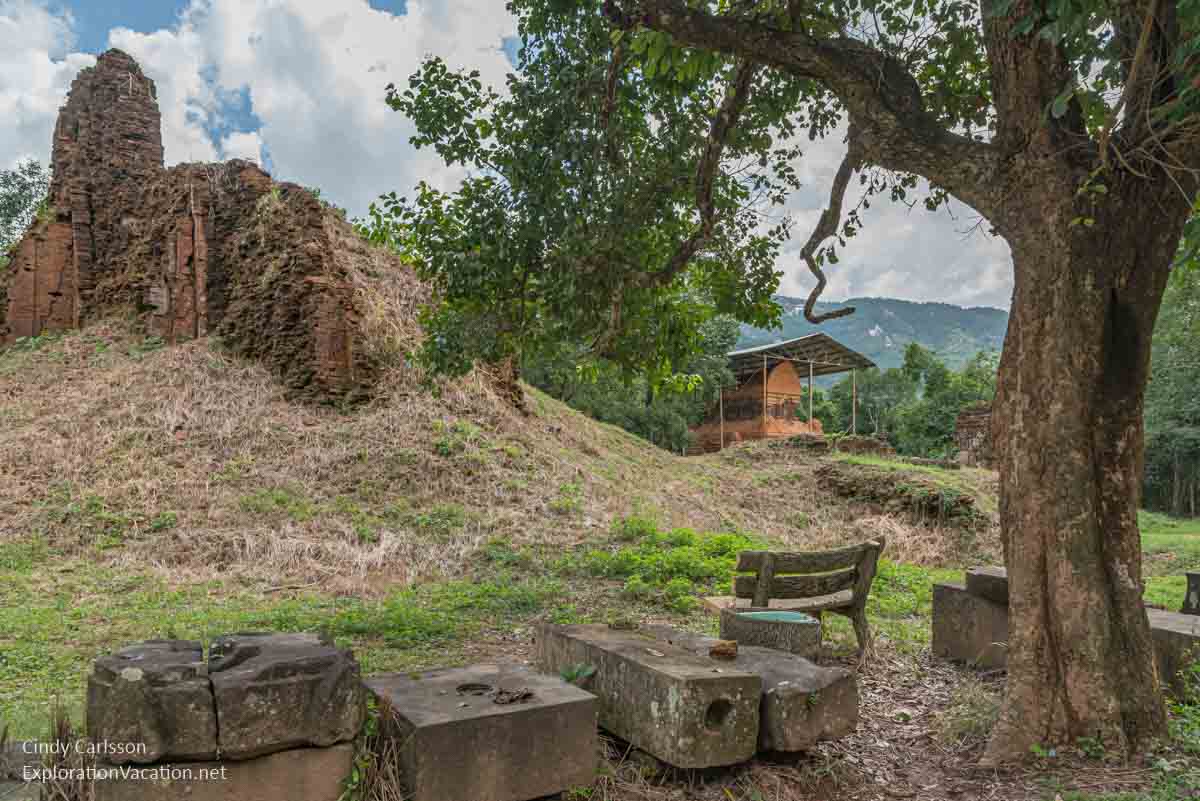
A kalan in Group E is mostly a grass-covered mound of brick. The restored storehouse is visible in the background.
Visitors aren’t allowed to enter the storehouse, but you can take a good close look at it.
Part of a kalan and gate from Group F still stand, but both are in a precarious state. And neither would still be standing without support.
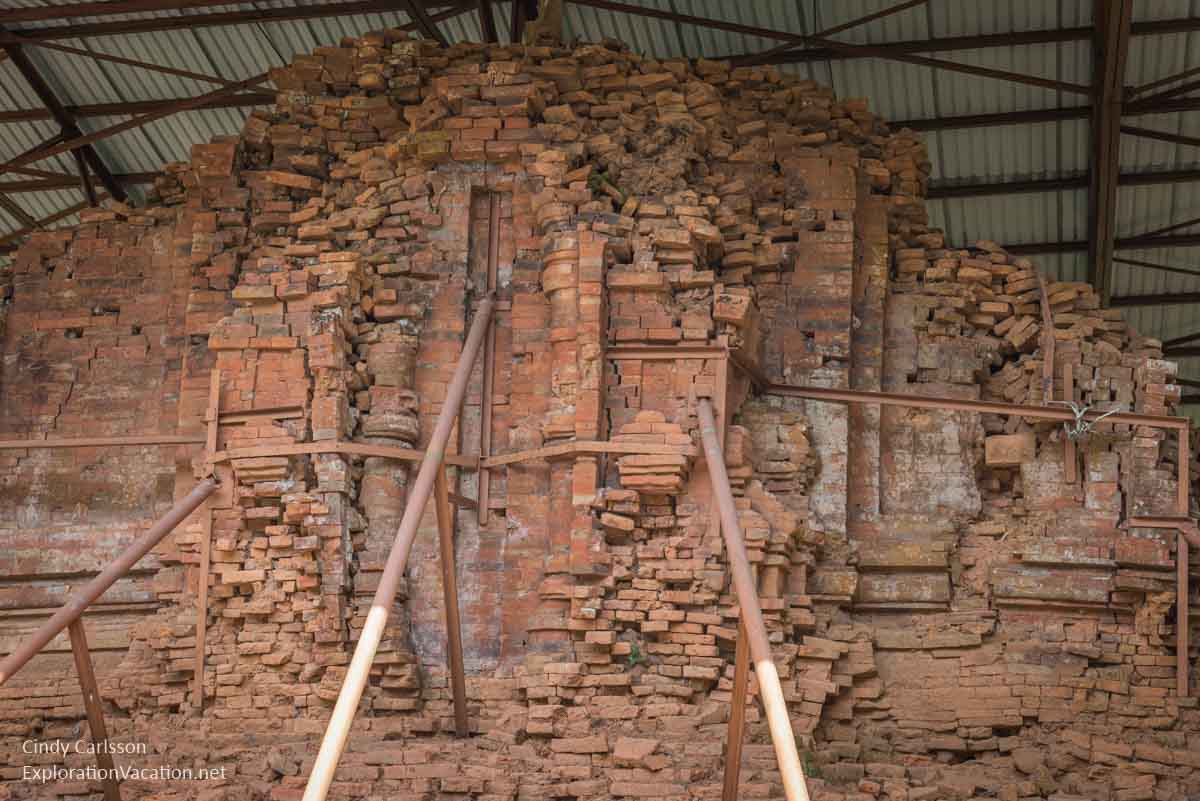
The remains of the kalan from Group F is kept standing and protected from rain.
Cham Art at My Son
Most of the surviving artwork from ancient Champa resides in museums, with a particularly fine collection at the Champa Museum in nearby Da Nang. But there is a small museum at My Son and some sculpture is scattered throughout the site itself.
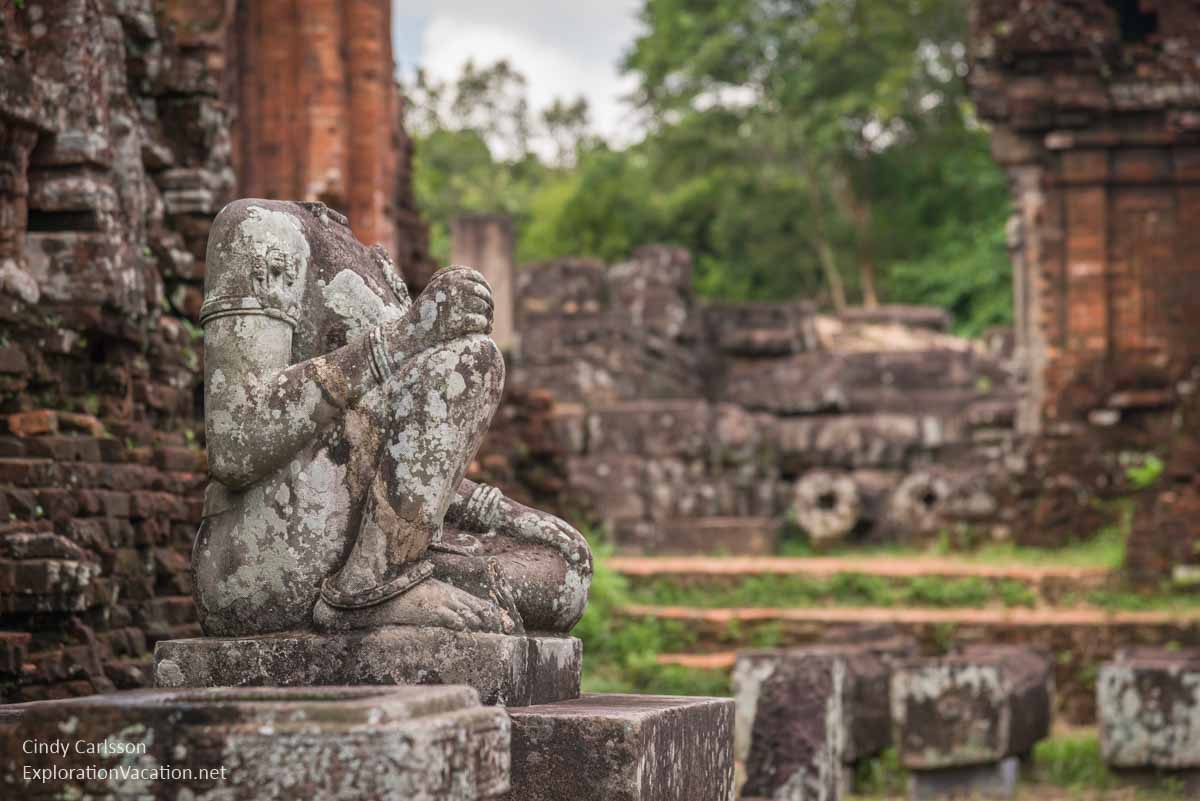
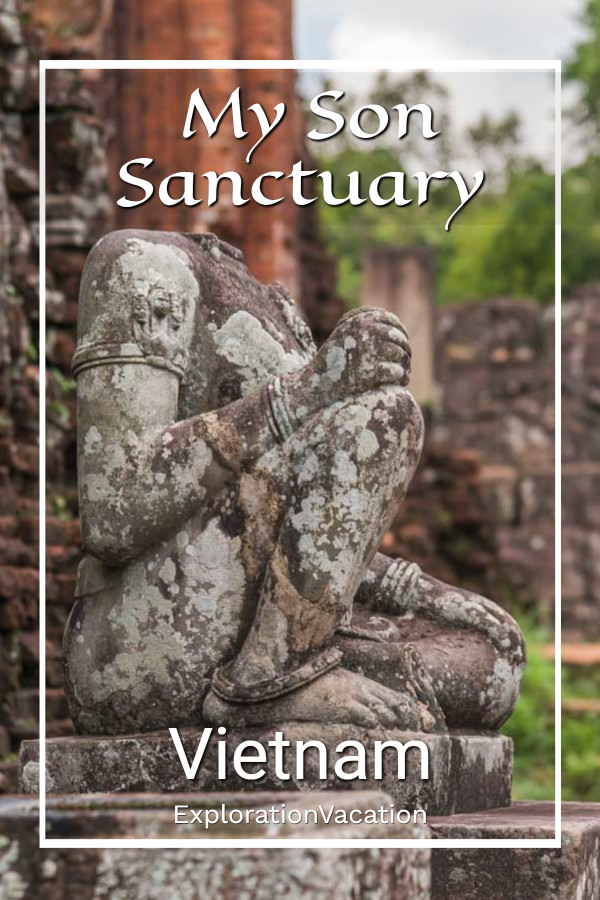
A headless shiva remains in the courtyard between mandapas from Groups C and D.
My Son’s museums
While there are a few pieces of sculpture (and a lot of lingas) remain in some temple groups, most of the sculpture on display at My Son is housed in one of the site’s small museums. Most of these pieces are architectural fragments, three-dimensional sculptures, and base-relief carvings that once decorated the elaborate Cham towers and other structures.
When I visited in 2015, My Son had small museums inside the mandapa halls for Groups C and D. There were a few nice pieces displayed, but it did seem rather makeshift.
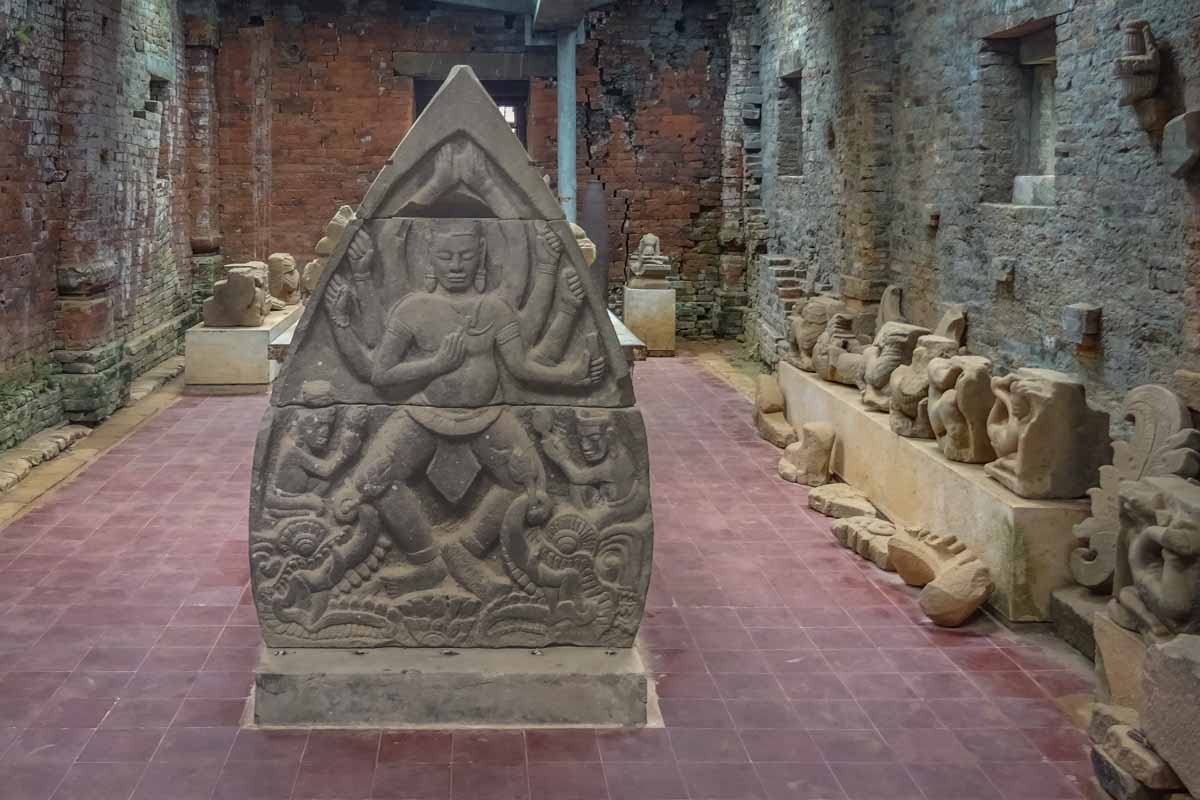
Carving with Shiva in My Son’s museum, edited version of a photo by Christophe95, CC BY-SA 4.0, via Wikimedia Commons.
Cham cultural performances
The Cham are not gone, but Cham culture has changed over the centuries since My Son was abandoned.
Still, elements of ancient Cham culture remain today, especially in this part of Vietnam. But how they were expressed a thousand years ago is hard to really know. So, while I really enjoyed My Son’s “traditional” Cham music and dance, I also regard it with a bit of skepticism.
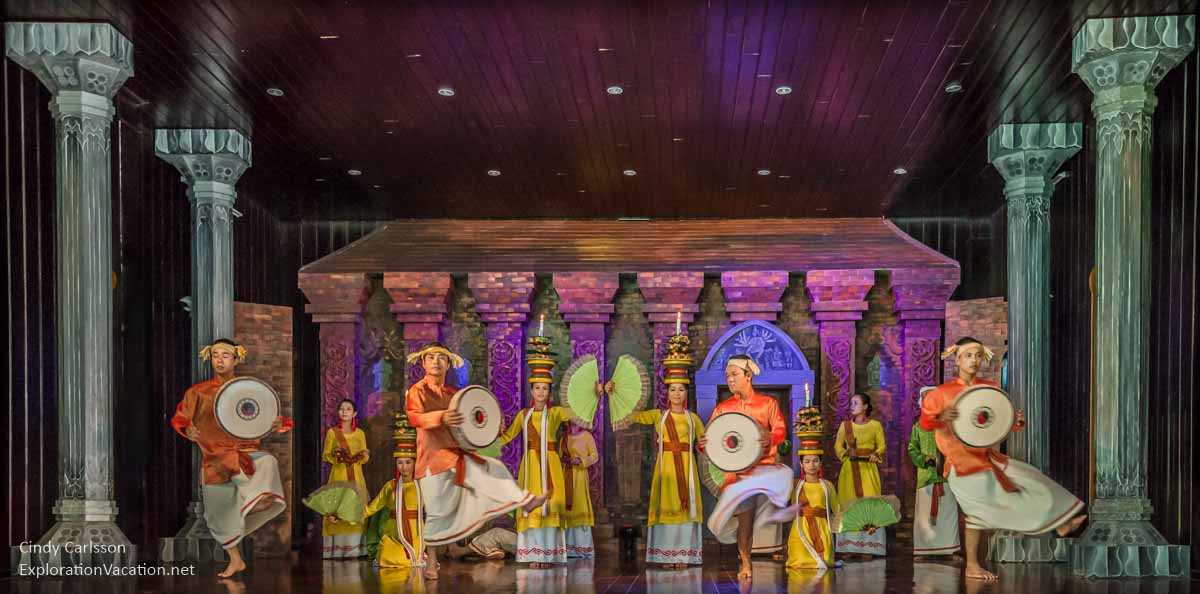
Musicians and dancers bring a colorful bit of Cham culture to life each day.
From their art, we know what instruments the ancient Cham used. Most of these are still in use in some form. And, while we don’t know what songs may have been played long ago, it’s likely that remnants of those ancient pieces still exist in traditional Cham music today. I can easily believe an ancient Cham king may have enjoyed music similar to that performed at My Son.
I’m not as convinced when it comes to the dancers.
As with ancient musical instruments, ancient Cham art also depicts dancers.
Some of the dances performed at My Son today are relatively literal interpretations of the costumes and poses depicted in Cham temple art. But I wonder, does the artwork actually portray human dancers, or are they divine dancers performing for the gods? Was there a difference?
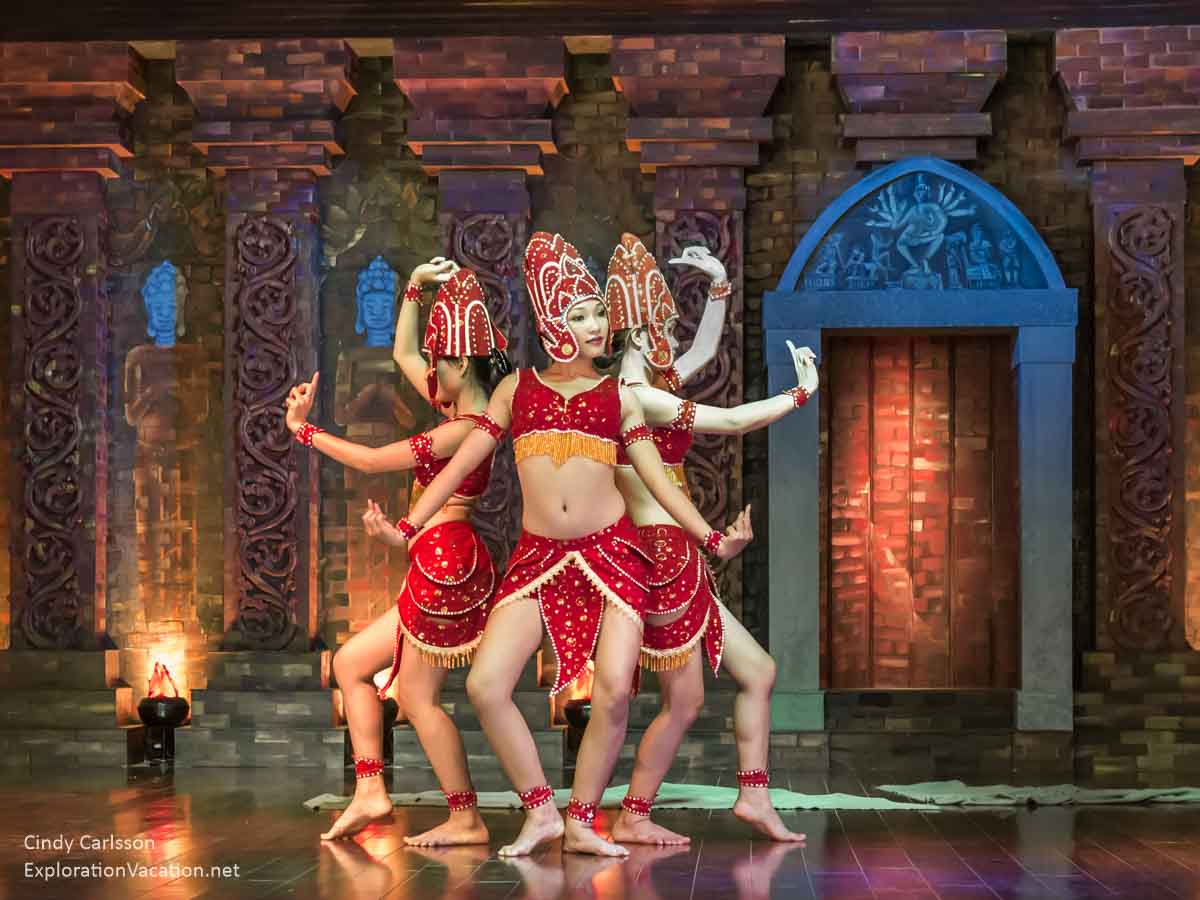
Celestial dancers brought to life on stage.
It feels a bit like a Las Vegas stage show. And contemporary Cham women are noted for their extreme modesty. . . .
Whatever the level of authenticity, it is entertaining. And, more importantly, it’s an opportunity to think of Cham culture as a living entity instead of something dead that only exists in the still silence of brick and stone.
Plan your visit to the My Son world heritage site
The My Son Sanctuary World Heritage site introduces visitors to a small bit of the rich culture of an ancient kingdom that is largely forgotten today. And it is located in a beautiful history-rich area with plenty of things to do.
Where is My Son?
My Son Sanctuary is located in Vietnam’s central coastal Quang Nam province. It’s about 30 miles inland from the Hoi An World Heritage site and just a little farther from the beach resorts of Da Nang. There’s even another world heritage site farther up the coast in Hue.
👉 Read more about planning a trip to My Son Sanctuary
From Hoi An
The drive to My Son from Hoi An takes about an hour by car. You can easily hire a car and driver or a motorbike taxi. Ask your hotel for a recommendation. Of course, there are also lots of day tours of variable quality available – some are excellent and some are not.
From Da Nang
Da Nang and Hoi An are both about the same distance from My Son. However, a trip by private car from Da Nang can cost twice as much as what you would pay to visit My Son from Hoi An.
There are bus and rail connections between Da Nang and the Hoi An area, but both require a taxi or other vehicle to actually get to My Son.
Many websites reference a “shuttle bus,” but this is a tour, not a scheduled bus service. There are plenty of tours available, the best of which spend an hour or two at My Son and then the afternoon in Hoi An, with something like four hours on the road. You’d be better off spending a night in Hoi An.
When to visit
My Son is open from around sunrise to just before sunset all year, including holidays.
When is the best weather?
February through April have the most reliable mix of dry weather and comfortable temperatures in this part of Vietnam. (It’s also less crowded than in summer.) The sunniest time of year is May-July, but the temperature really starts to rise as summer approaches.
- February through September are the driest time of year, but summer gets very hot.
- October and November are usually the rainiest time of year
- December and January are the coolest time of year, but this is still the rainy season.
That means it’s best to avoid October and November, as Hoi An sometimes floods during this time of year. (Although I visited the second week of November, the weather was fine. However, it was very wet just a week earlier.)

HOI AN, DA NANG, VIETNAM – DECEMBER 17, 2016: Boats on flooded street in the historic old town of Hoi An. (Copyright 2017 trang trinh/Shutterstock)
What time of day is best?
My Son opens right around sunrise at 6 or 6:30 a.m. This is a great time to visit, as it is the coolest time of day and you can watch the fog burn off the mountains as the sun rises. It gets busy pretty fast though.
Most tours from Hoi An don’t begin arriving until closer to 8 a.m. Tour buses from Da Nang usually get there by 10. That makes late-morning through mid-day the busiest time of day. It’s also hot by then!
The ruins are open until 5 pm and there are usually few visitors later in the afternoon. However, it’s also hot at this time of day. And the museum/visitor center closes about a half-hour earlier, so don’t leave it for last.
After you arrive at My Son
Parking is available for a small charge just outside the entrance. A few nearby restaurants will usually let you park for free if you eat there.
The visitor center/museum is just beyond the entrance gate and ticket booth. This is mostly informational, with lots of signage about the site and the Cham. Most artifacts still seem to be displayed in the halls in the Group BCD ruins.
At this point you are still about a mile from the ruins. An electric shuttle (included in your ticket price) takes you to where the walking path through the ruins starts. The shuttle runs about every 15-30 minutes, depending on how busy the site is. It’s a pleasant ride through the jungle for about 10 minutes to get to the drop-off point.
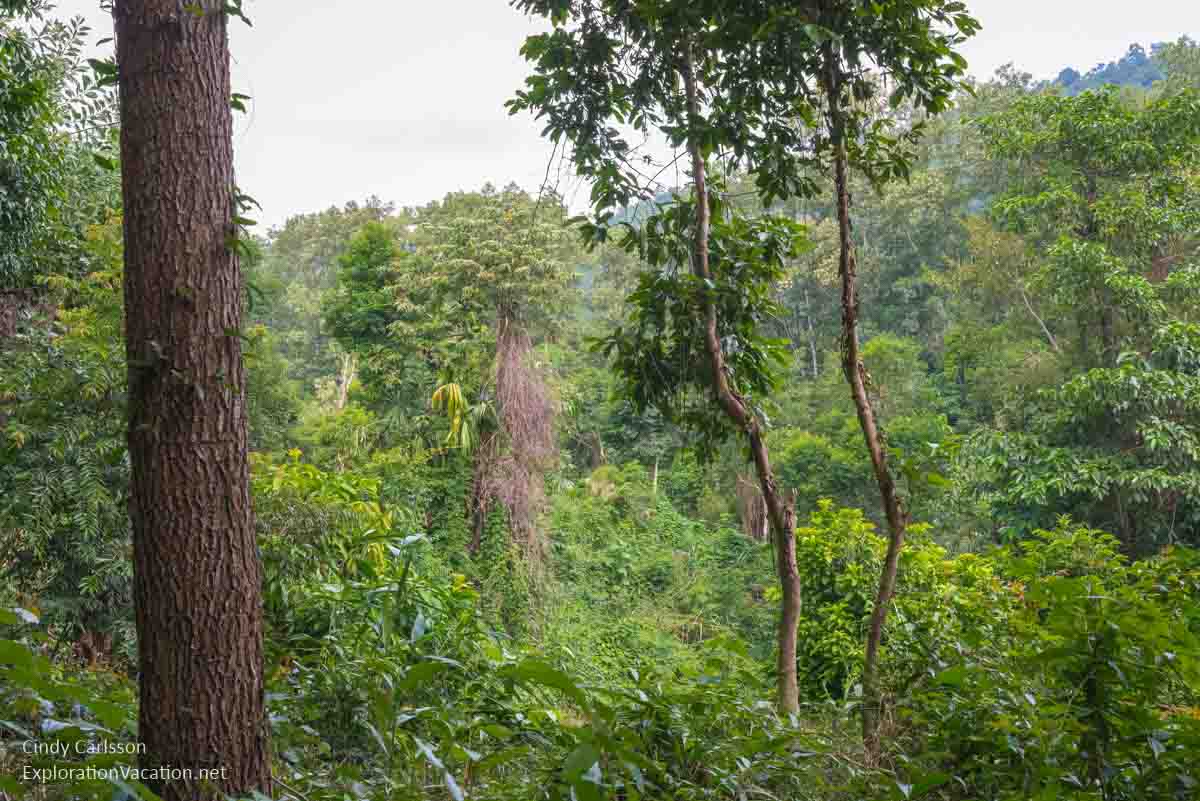
Jungle growth along the path leading to the ruins at My Son
You aren’t required to take the shuttle, but keep in mind that you’ll being doing a fair amount of walking through a hot, humid site.
From the drop-off point, the current configuration of paths is pretty much the same as on the older map pictured above. It is a loop, so you can walk it in either direction. If you go through the site clockwise (to the left of where the shuttle stops), you’ll start with the most heavily damaged ruins and end with the most intact ones.
The path itself is mostly flat and a lot of it is paved. Benches are also available along the way.
The pavilion where the cultural shows are held is just before you get to the BCD group of ruins. There’s also a souvenir shop nearby. Sometimes food (or at least beverage) vendors set up in this area as well.
Cost to enter My Son
The entrance fee as 2022 begins is still under $7. (Have cash.) Check for changes on the My Son webpage.
Don’t miss the cultural performance
Cultural performances are usually held daily at two different locations. Shows last 20 minutes and are held every few hours through most of the day. Check the website for the performance schedule.
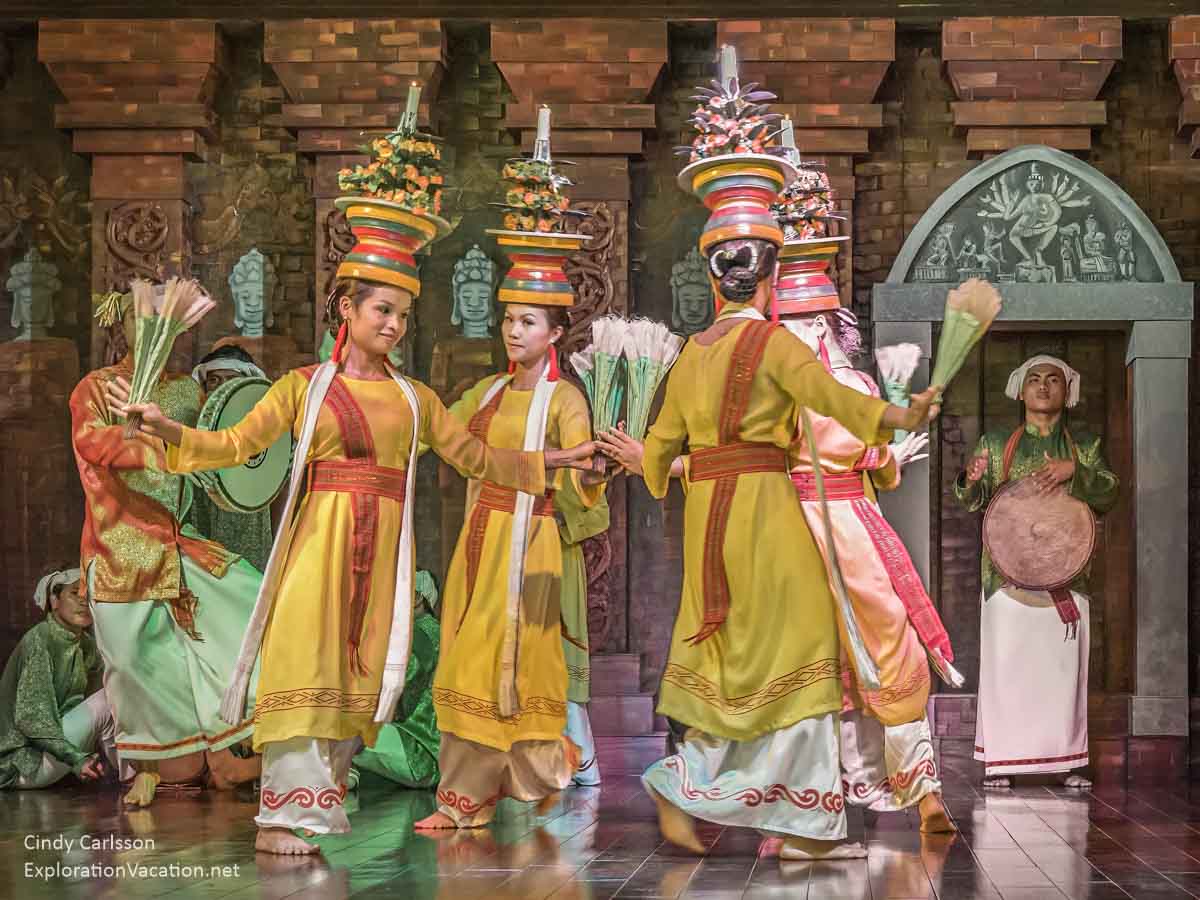
Traditional Cham dancers perform several times each day
Most performances are held at a pavilion near the shuttle stop, but twice a day they do a show at the Group G temple. (Weather permitting.) If you really want to see the outdoors show, have your guide or hotel contact the site in advance to verify times, as it’s unclear how often the website is updated.
Tips for a better visit
Stay on the paths. While every attempt has been made to clear the lawns around the main ruins of unexploded ordinance, it’s still safer to stay on designated paths. And don’t even think about heading off to explore the jungle on your own.
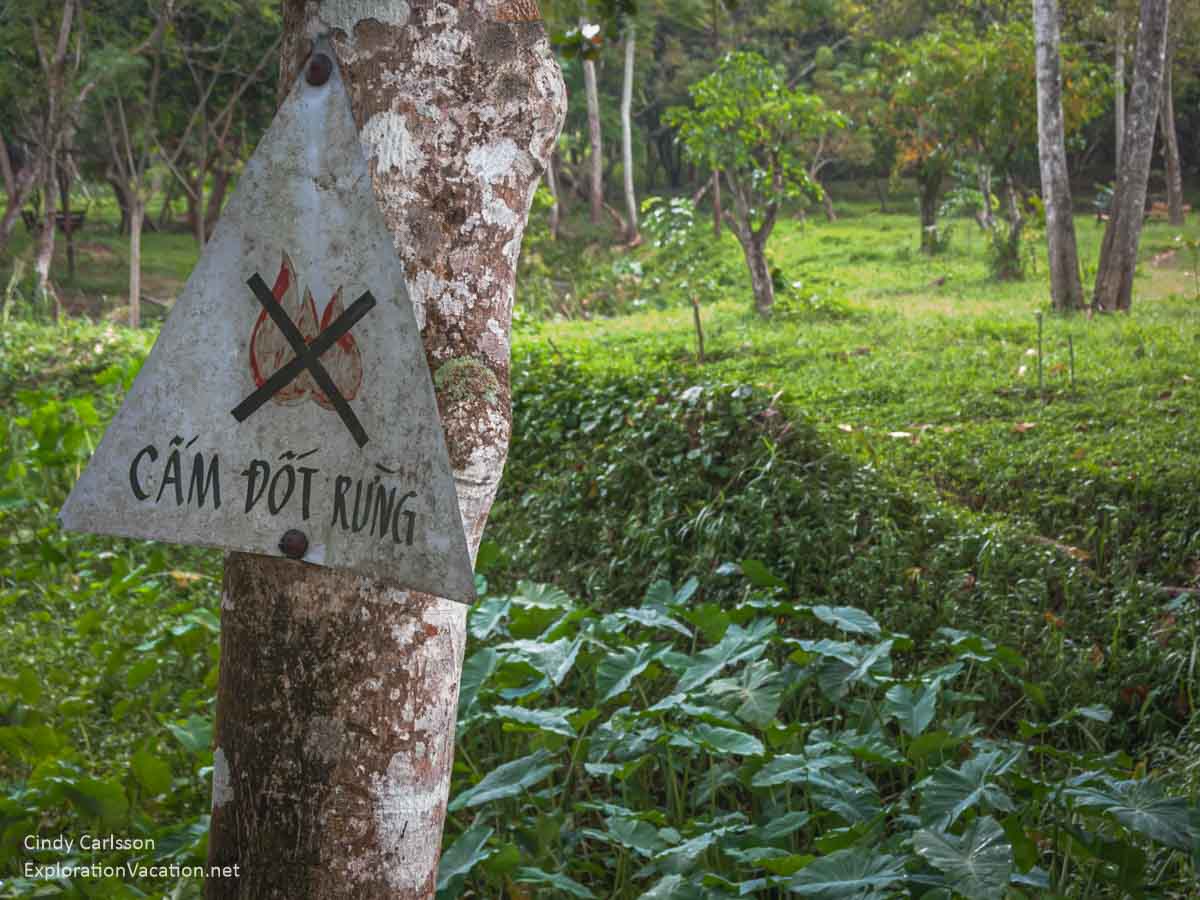
I’m not sure what this sign means, but it seems like a good idea to just stay out of this area
Bring water. My Son is located in a valley that often feels hotter and more humid than the surrounding area. (There are no ocean breezes here.) Sometimes vendors are here to sell beverages, but not always. Don’t count on being able to buy something to drink after you arrive.
Likewise, a hat and sunscreen are highly recommended, as much of the site is in the open.
There’s no requirement that you cover your knees and shoulders, but it’s respectful to dress as you would to visit any other religious site in Vietnam.
There is English language signage at the site, but that doesn’t mean it will be where you need it or answer the questions you have. If you want more information, you can hire a guide for a minimal charge once you get off the shuttle. There is little or no detailed printed info available.
Lots of tours to My Son are available from both Hoi An and Da Nang. Quality varies considerably and many of the cheapest include only an hour at My Son with a lot of time spent waiting or visiting businesses of questionable quality.
👉 Read less
Spend time in Hoi An
Most of the coast between Hoi An and Da Nang is loosely classified as China Beach. The large beach resorts are closer to Da Nang, and Da Nang is also a cool city and a great place to visit.
However, staying in Hoi An gives you the best of everything: Two World Heritage sites, the most charming shops anywhere, and good beaches. Stay in or just outside the historic district to wander through the World Heritage site at any time of day or night or hang out by the beach and travel into town when you want to see the historic sites, shop, and eat. Hoi An is one of my very favorite places in Southeast Asia. It’s hard to imagine anyone not finding something to love about it!
We stayed just outside the historic district at the gorgeous Ha An Hotel. From there it was a short walk to the historic district.
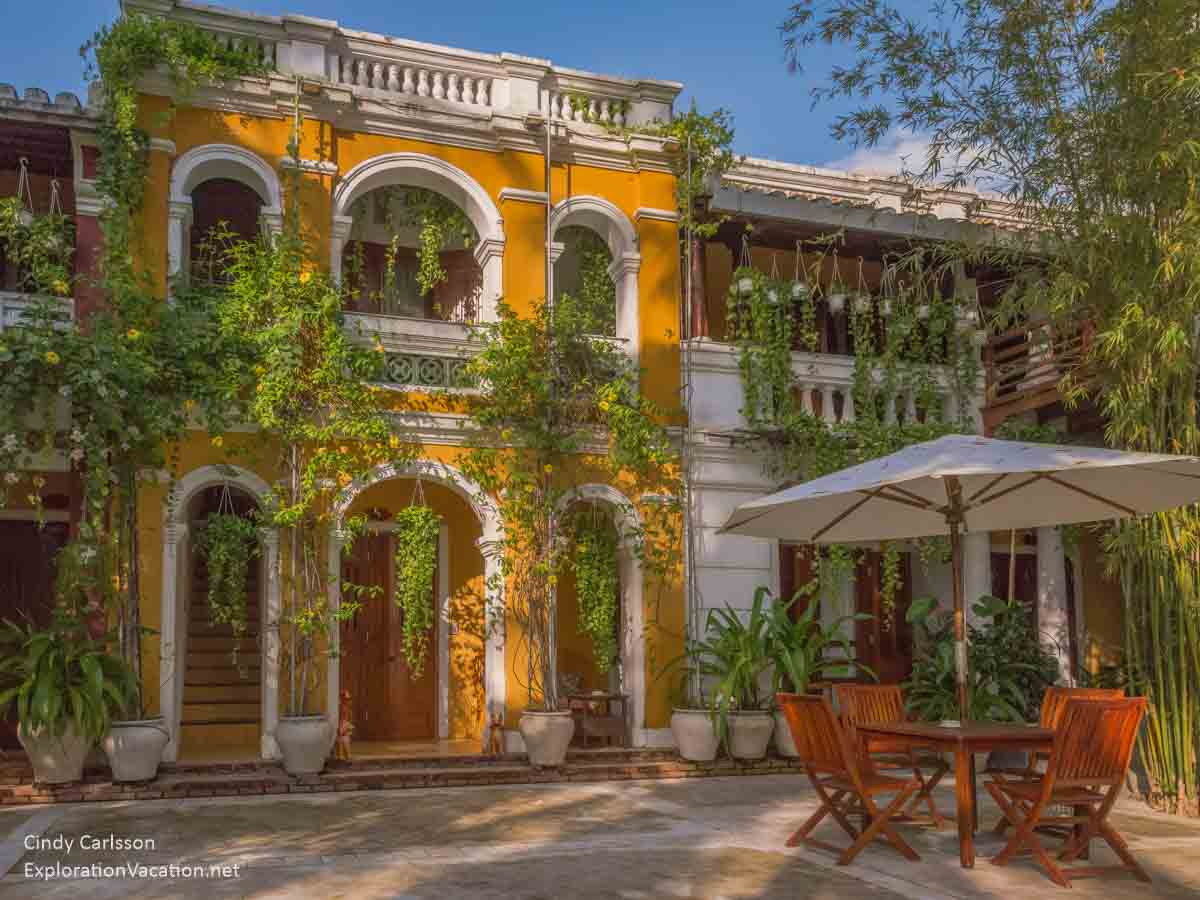
I would VERY happily stay at the lovely Ha An Hotel in Hoi An again.
There are lots of other options too, including beach resorts and a few locations in old Hoi An. Check them out and book on TripAdvisor, Expedia, or Booking.
Other places to connect with the ancient Cham in Vietnam
Cham people still live in Vietnam, but very little of their ancient architecture remains. And recent reports from the community indicate that what does remain is being deliberately destroyed. But there are places to connect with this ancient culture and marvel at their art and architecture.
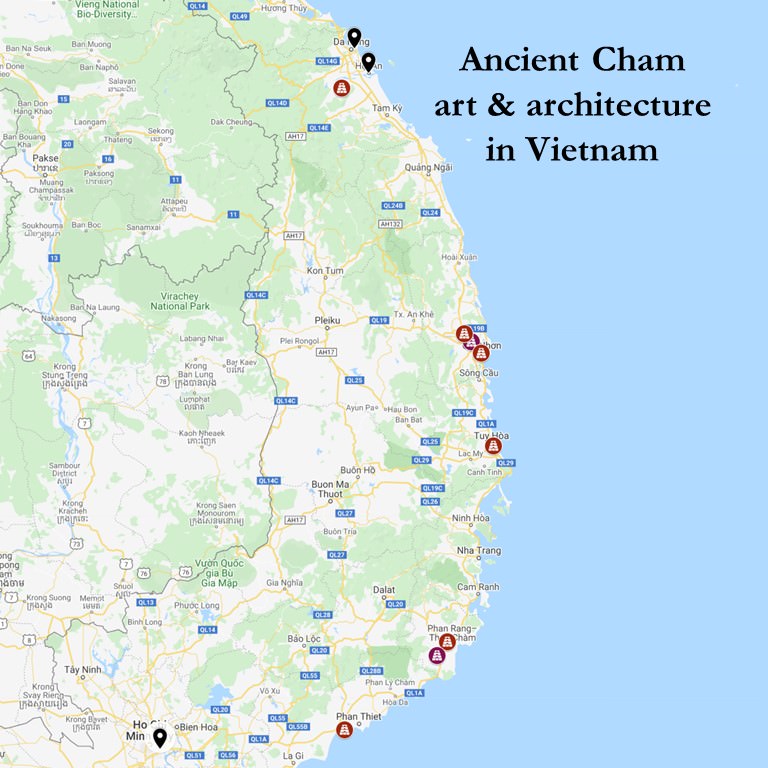
Map of some of the more popular ancient Cham sites in Vietnam. (Click on the map to view.)
Da Nang Museum of Cham Sculpture
Many sculptures and other artifacts French archeologist Henri Parmentier collected at Champa sites around Vietnam are in the Da Nang Museum of Cham Sculpture, a museum he championed. Several expansions over the decades resulted in large airy rooms filed with sandstone sculptures and other objects. It’s the best place to see Cham sculpture.
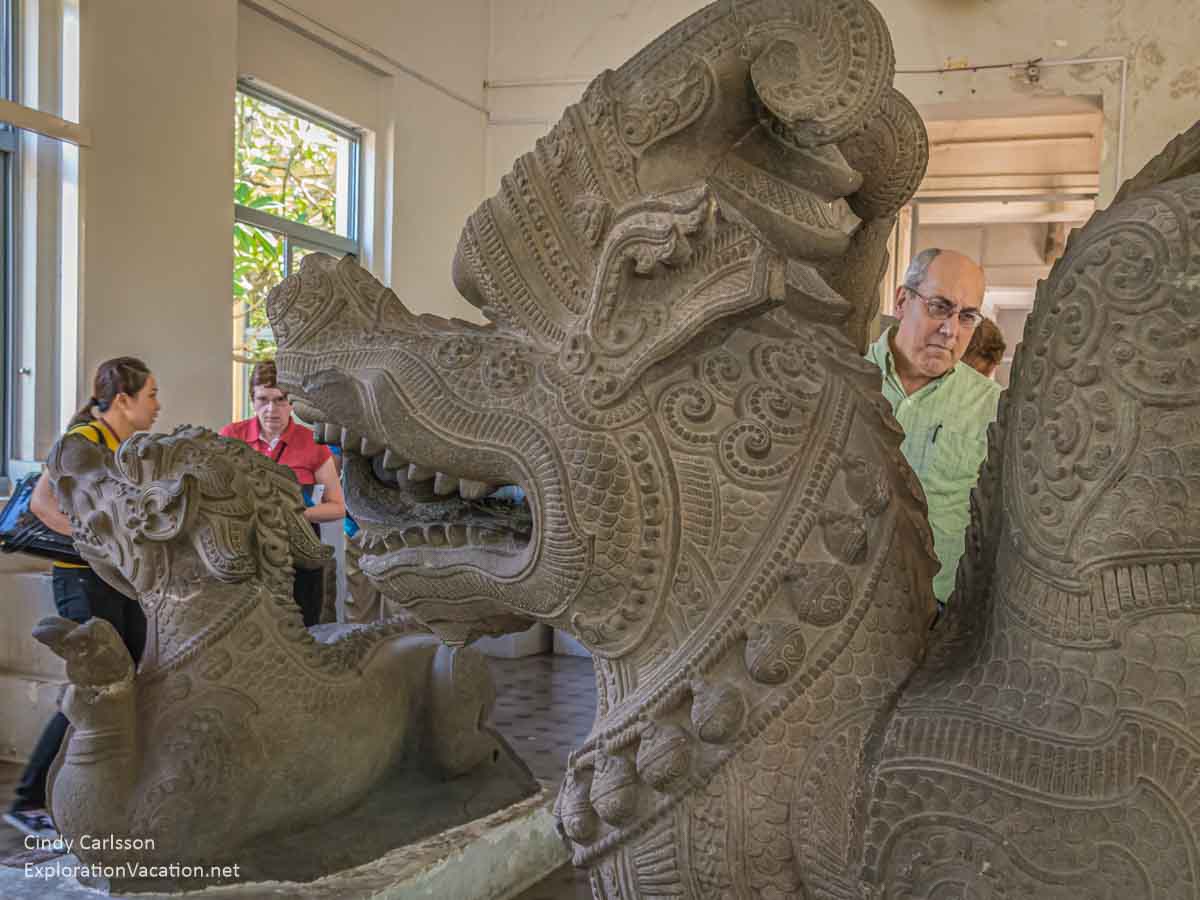
The Da Nang Museum of Cham Sculpture is the place to go for ancient Cham art
The museum’s website is down as of early January 2022. For a brief overview of the museum check their Google story.
Vietnamese History Museum of Ho Chi Minh City
The Vietnamese History Museum of Ho Chi Minh City has a large collection of Champa art. I recall seeing a lot of pieces, including large pieces, when I visited, although it appears most of the Champa work is exhibited in one room.
Other ancient Cham shrines
My Son isn’t the only place where you can see ancient Cham towers. Moving south along the coast from My Son, these are few of the more well-known sites:
Binh Dinh province has a number of Cham sites. Quy Nhon has two Cham towers right in town. Thap Doi sits in town and consists of two well-preserved brick towers located next to each other. Thap Banh It has four restored tours on a hilltop in a rural area. Further from the city, another tower stands at Canh Tien, near the citadel of the ancient Cham capital Vijaya.
In Phu Yen province, the well-known Thap Nhan tower stands on a hill high above the river. After nearly being destroyed, the tower was restored in 1960
Po Nagar Cham Towers (also refered to as Ponagar Pagoda or Thap Ba) are a few miles north of Nha Trang. This looks to be a stunning Cham temple that is still an active temple. It’s also the site of a spring festival that includes religious and cultural activities.
Ninh Thuan province has several Cham temples that are the focus of the annual Kate Festival. They are the Phan Rang sites of Po Klong Garai, which has three towers, including a storehouse, and Po Ro Me, which is farther from town and on top of a very high hill with good view of the area. In addition, Po Shanu near Phant Thiet, which has three towers on a hill, is also a festival site.
The Kate Festival
The Kate Festival (Mbang Kate) is an annual event where Cham people honor those who have died during the year along with heroes of the past. Kate is a month-long period, but public activities are now conducted over three days, usually in late September or early October. Kate includes religious ceremonies, cultural activities, and lots of food and socializing. For visitors, it’s an opportunity to see how ancient Cham beliefs and culture are part of the lives of contemporary Cham people.
Learn more about My Son Sanctuary and Cham culture
I have done my best to sort through information that is often out-of-date, contradictory, or just plain wrong. However, I am not an expert on ancient Asian cultures – I’m sure there are things I have wrong too. And really, there’s a lot that no one really knows for sure and what we do know changes regularly as scholars continue to research this ancient culture.
Below are a few of the potentially more credible (and readable) resources I found beyond Wikipedia. If you are interested in learning more about the people and buildings of My Son, these are a good place to begin.
The UNESCO World Heritage website for My Son has background information and documentation, although none of the documents are easy to sort through.
If you are interested in the initial discovery of My Son, the Bulletin of the History of Archaeology has a detailed story on the French archaeological program that carried out this work in Southeast Asia.
The Architecture of the Temple-Towers of Ancient Champa (pdf) from the book Champa and the Archaeology of My Son has a lot of information on how the towers were built and is actually readable. It’s available on Academia.edu – a website that has loads of great material, but that also seems a little spammy.
Two sources explain how Group G was preserved, including one that goes into great detail on how digital imaging was used to understand the site. These are only for real engineering geeks.
- The Preservation of Temples in My Son (PDF) originally published in the Structural Analysis of Historical Constructions explains the physical process.
- A detailed description of the digital imaging process used to reconstruct Group G structures (pdf) is available on Academia.edu.
The Arts of Southeast Asia featured the Art of Champa in their fall 2020 edition, parts of which are available online with gorgeous photographs.
For more stunning photos (but at a much higher price), consider the book Vibrancy in Stone: Masterpieces of the Danang Museum of Cham Sculpture by Vo Van Thang and Peter Sharrock.
See more photos from My Son Sanctuary on CindyCarlsson.com