Last updated on June 11th, 2026
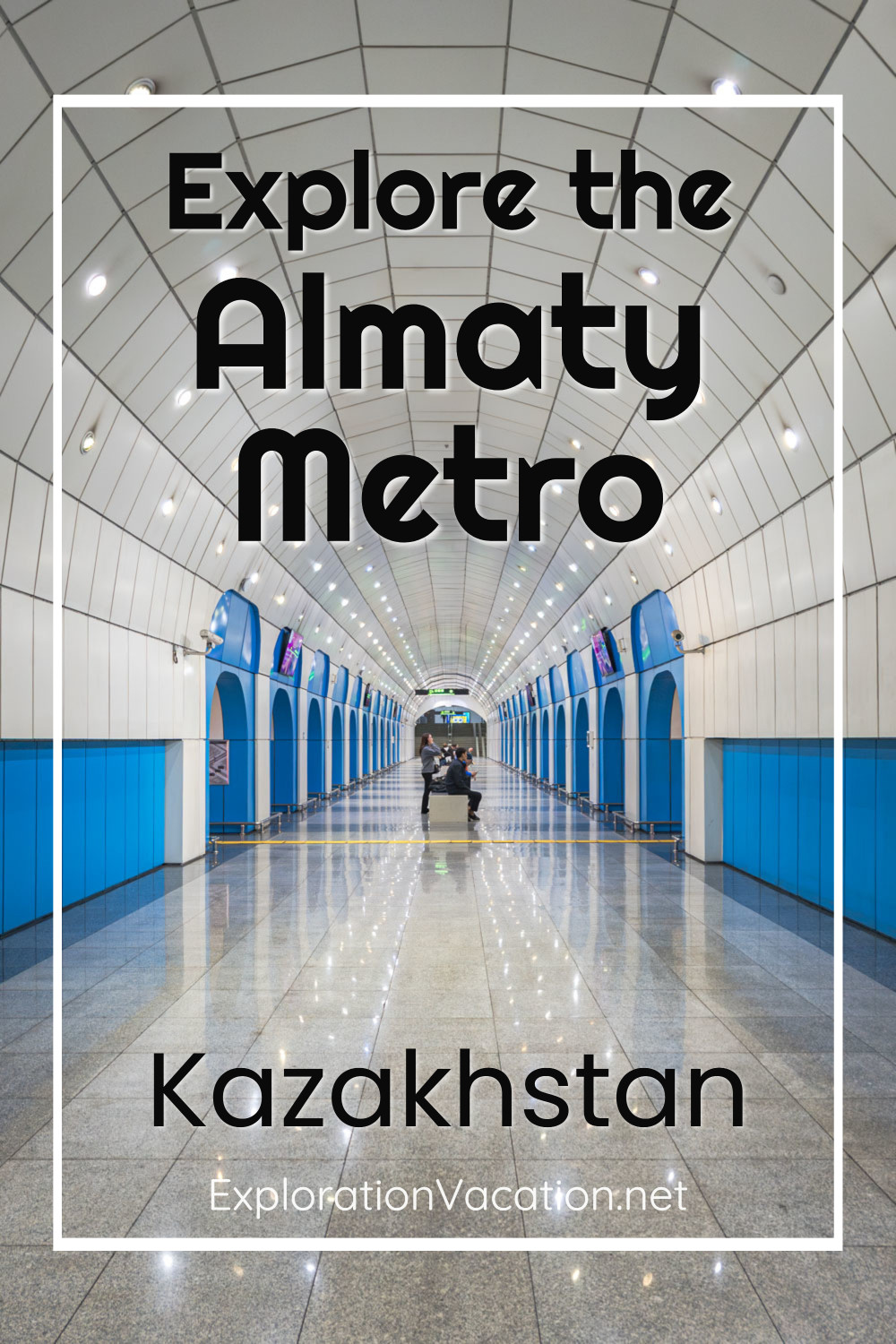
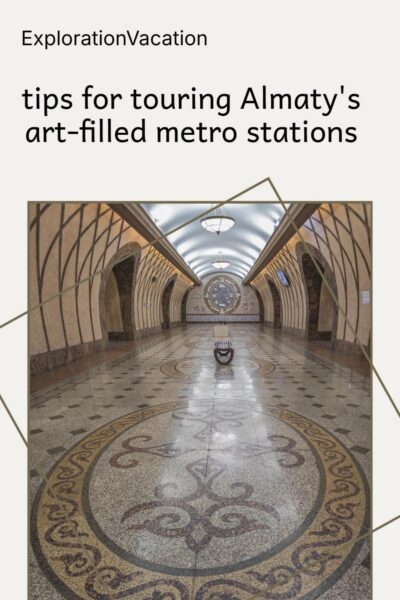
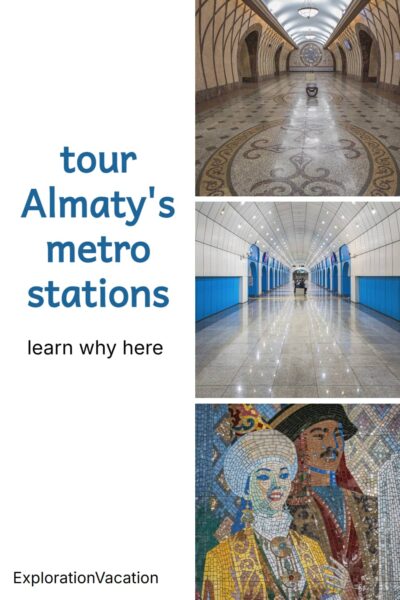
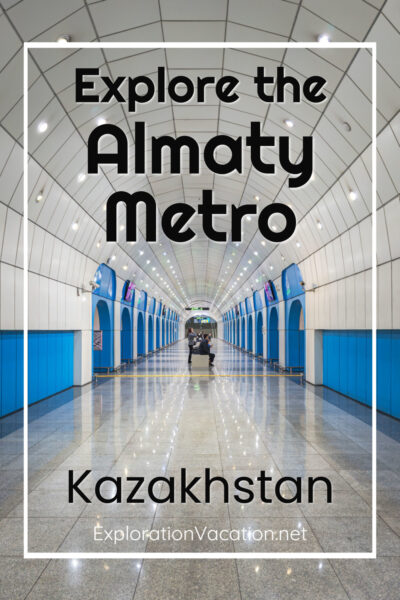
Metro stations in Almaty, Kazakhstan, highlight Kazakh history and culture. The metro system currently has 11 stations, each of which tells a different story. That makes an Almaty metro tour an easy, art-filled way to learn a little about the region.
Keep reading to get all the info you need to plan your own Almaty metro tour, including what you’ll find at each metro subway station and which are “don’t miss” stops.
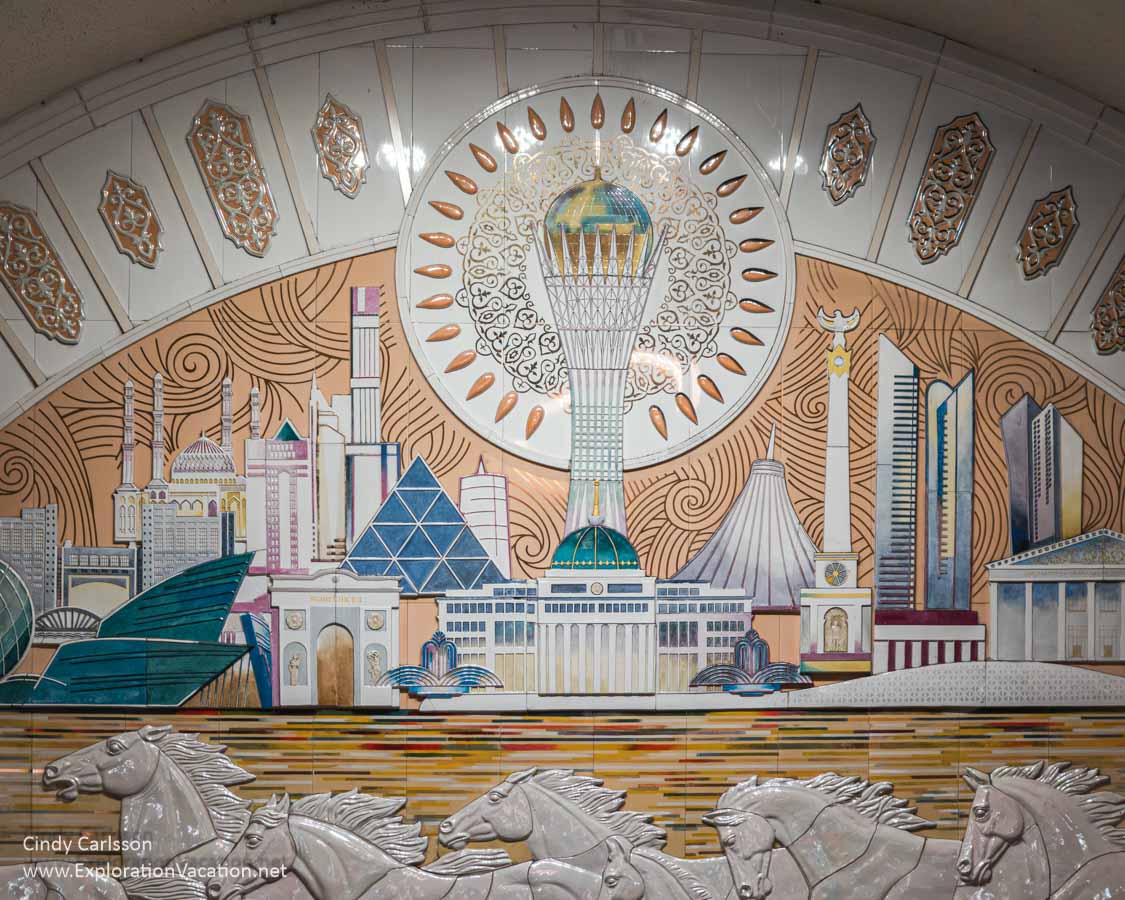
Artwork depicting Kazakhstan’s capital, Astana, and a herd of horses in the steppes.
While not as grandiose as Moscow’s legendary metro stations (or maybe even neighboring Tashkent’s), the Almaty subway stations are definitely worth seeing.
Friends and I recently rode the Almaty Metro from end to end (currently there’s just one line) on a self-guided tour. Here’s what we found and why you should visit at least a couple of stations while in the city.
This story may have affiliate links. I use links to provide additional information, but some also may pay me a small amount if you use them to make a reservation or purchase. You don’t pay extra, but it helps keep this website running without intrusive ads. To learn more, see my policies and disclosures.
Here’s what you can see on an Almaty metro station tour
When I toured the Almaty Metro in spring 2025, the subway system had 11 stations on one line. That line is the Red Line, which is planned to have two more stations in the near future and (eventually) several connecting lines.
While each metro station celebrates some aspect of Kazakh history or culture, each is unique.
Almaty’s metro stations are listed here from one end of the Red Line to the other. I’ve listed them using the Kazakh names in both Latin (Roman) and Cyrillic script. However, be aware that the Latin spelling is not very consistent. I’ve tried to include the most common variations, but there could be more.

The 2025 Almaty Metro station map has station names in Kazakh (in Latin and Cyrillic script) and Russian.
A few stations are pretty impressive above ground too. However, I only have photos of the interiors. That’s mostly because we stayed underground for our entire tour. (And because I didn’t think to photograph outside the stations where we entered and exited.)
Sadly, I’ve been unable to find out who actually designed and created most of the artwork used in the Almaty Metro stations. If you know, I’d love to hear from you!
Raiymbek Batyr / Райымбек батыр Station
The Raiymbek Batyr/Райымбек батыр Station honors the great 18th-century Kazakh hero Muizziddin Muhammed Rahim-Bek. A skilled warrior with a “strategic mind,” he played a critical role in halting invasions by Mongol Dzungar tribes. Those actions won him the title Batyr (Bahadur), which means “hero.”
This station has some nicely detailed arches, but the artistic highlight is an intricate mural above the entrance/exit to/from the lower-level platform. Like the various statues you’ll see of Raiymbek Batyr as you travel in Kazakhstan, he’s heroically portrayed on horseback.
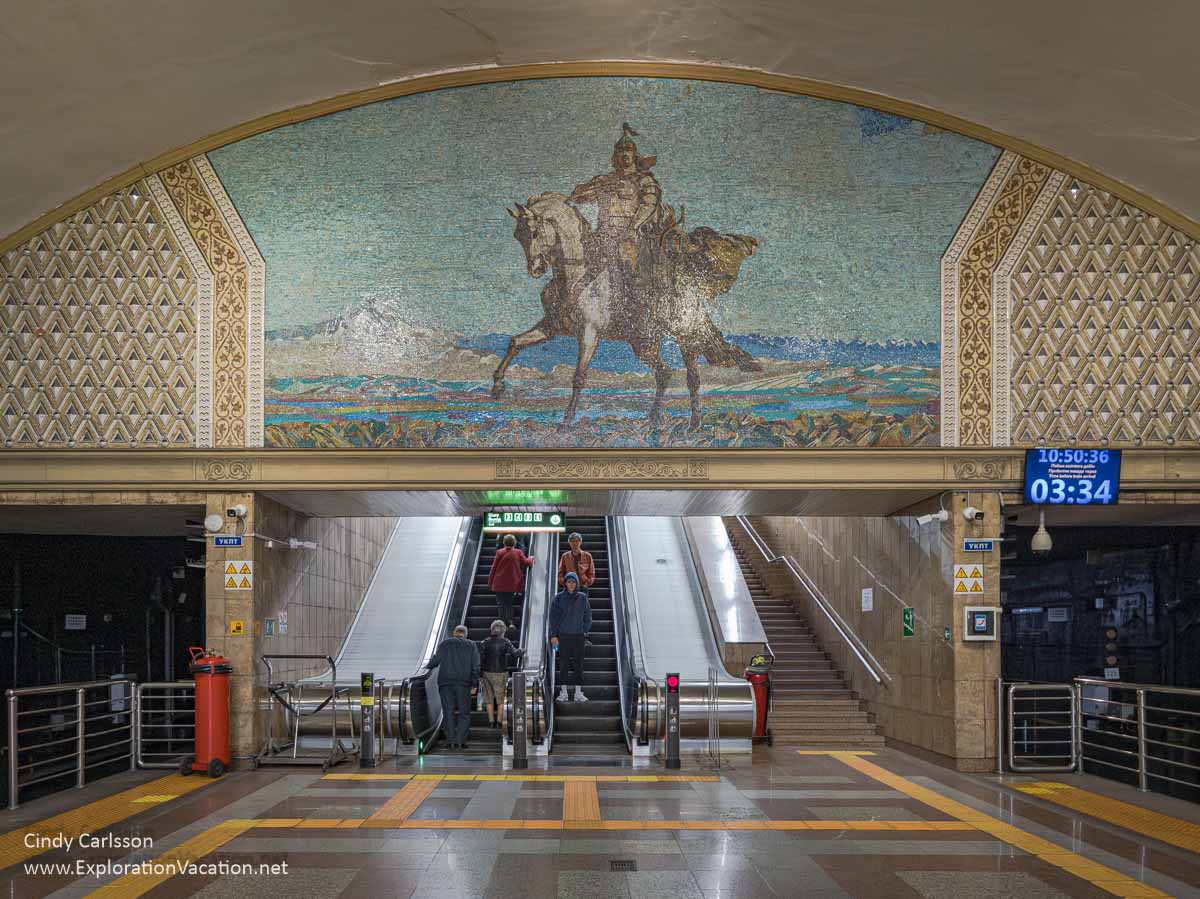
Instead of the usual statue of Kazakh hero Raiymbek Batyr, the Almaty Metro has a mural.
Raiymbek Batyr was one of the original stations that opened at the end of 2011. It is a shallow station with a single wide hall with tracks on either side. Original designs and construction photos (slow to load) show how plans for this station changed over time.
Zhibek Zholy (Jibek Joli) / Жібек Жолы Station
Zhibek Zholy is the “Silk Road” station. Perhaps fittingly, it’s the most elaborate of Almaty’s metro stations, with large ceramic panels featuring Central Asian trade routes and their connections (real and imagined) to the rest of the world.
You can find four large ceramic mosaics here: One is on the station’s upper level above the escalator, one at each end of the central corridor below, and one of a caravan that I missed.
Entrance mural
A large ceramic mural above the escalators greets visitors heading down to the rail platform.
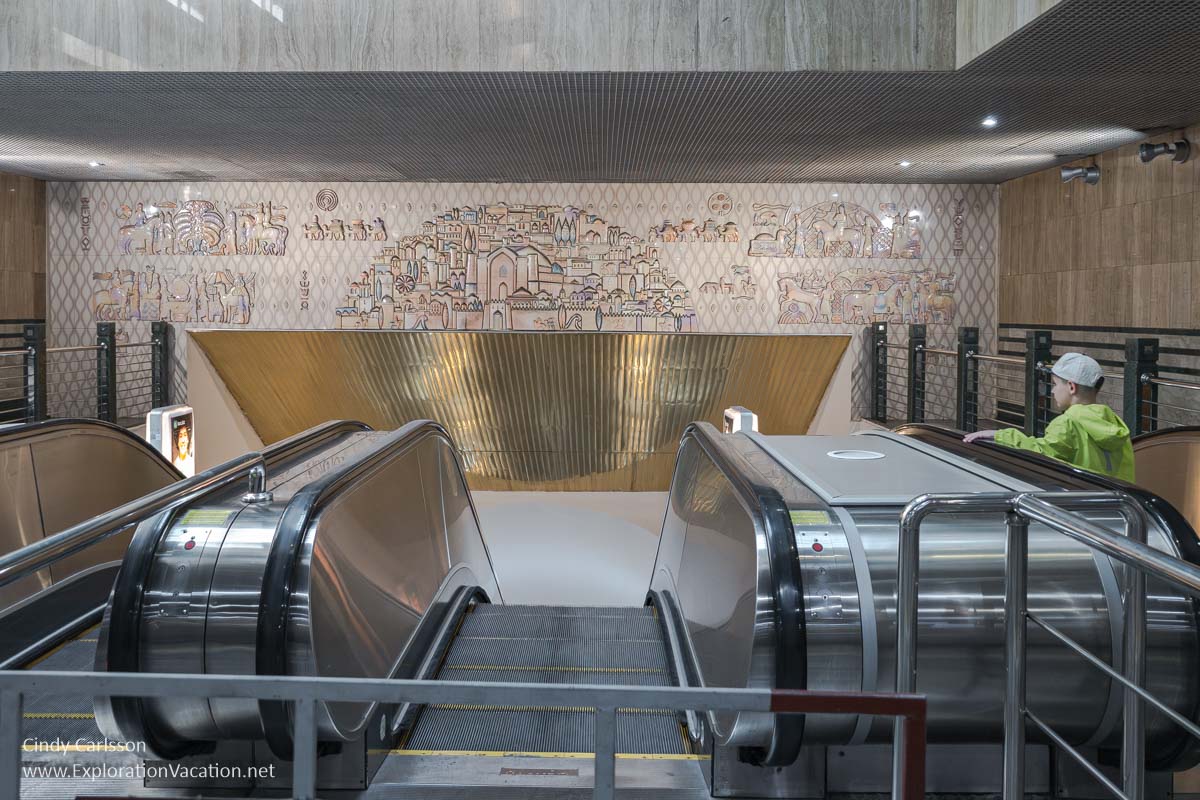
The first “Silk Road” mural you’ll see is at the Zhibek Zholy station in Almaty.
Almaty was an important trade, craft, and agricultural center on the Silk Road. I can’t find information on this particular mural, but I’m guessing it depicts Almaty as the wealthy city it was at that time and the caravan routes that came through it.
But mostly I was struck by the pastel colors, something I didn’t often see in any of the ‘Stans I visited. And, since I was here on Easter, I couldn’t stop thinking that those simplified shapes and pastel pink, blue, peach, and yellow would look fabulous on Easter eggs!
The central hall
The Zhibek Zholy station has a long central hall with side halls along each platform. All of that space is decorated. Besides the murals in the central hall, all the granite floor tiles are set in traditional Kazakh patterns. Walls mimic the supporting lattice inside a traditional yurt.
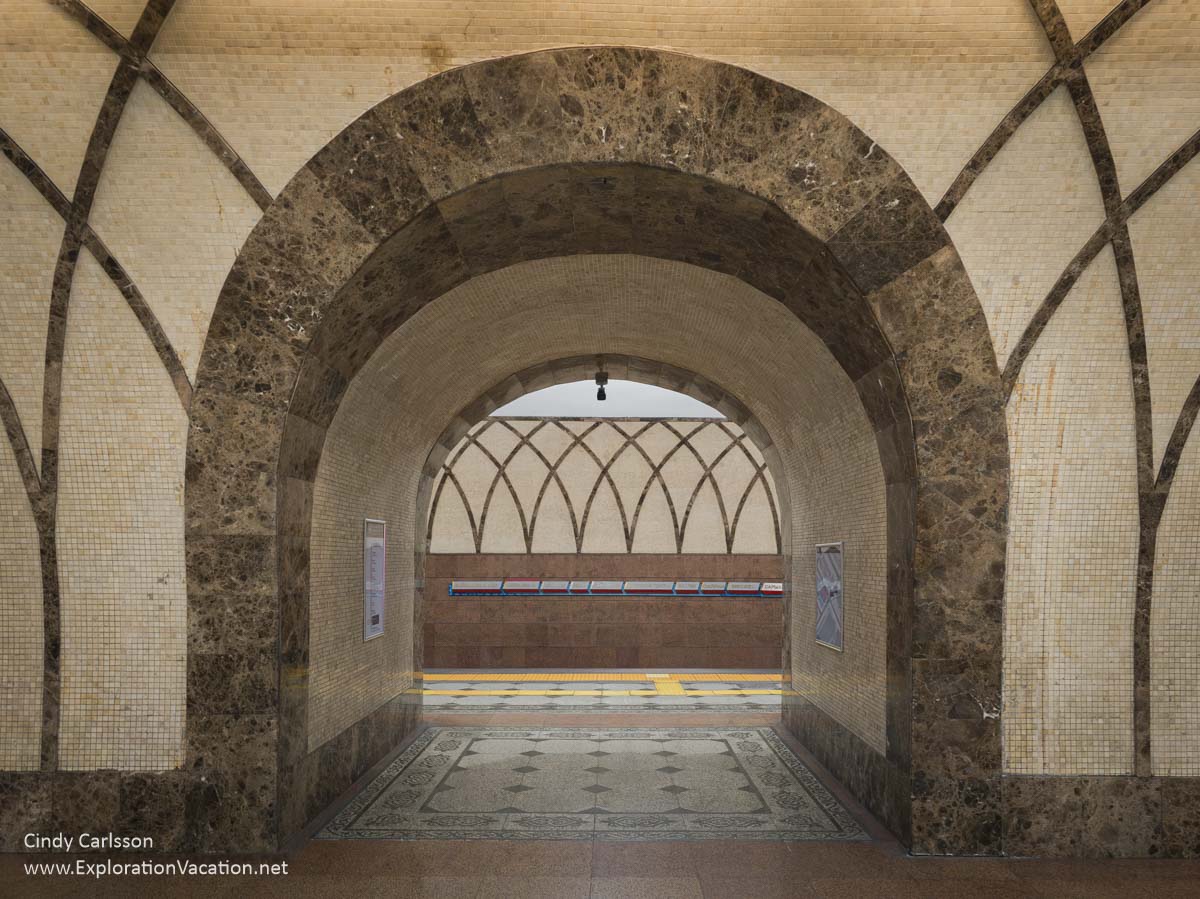
Looking out toward the platform from the main hall, the station reminds me of the latticed walls and decorative rugs found in a traditional yurt.
And then there are the elaborate ceramic murals at each end of the central hall.
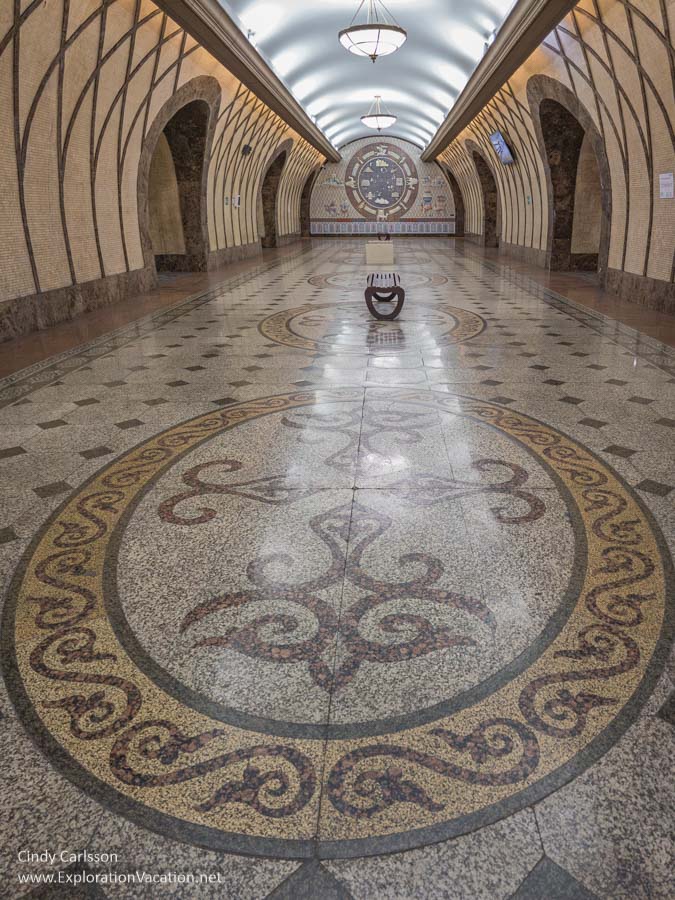
Looking from one end of the central hall toward the round mural.
👉 Read more about Zhibek Zholy Station
While there are murals at each end of the hall, this round one is the only one I can find information about.
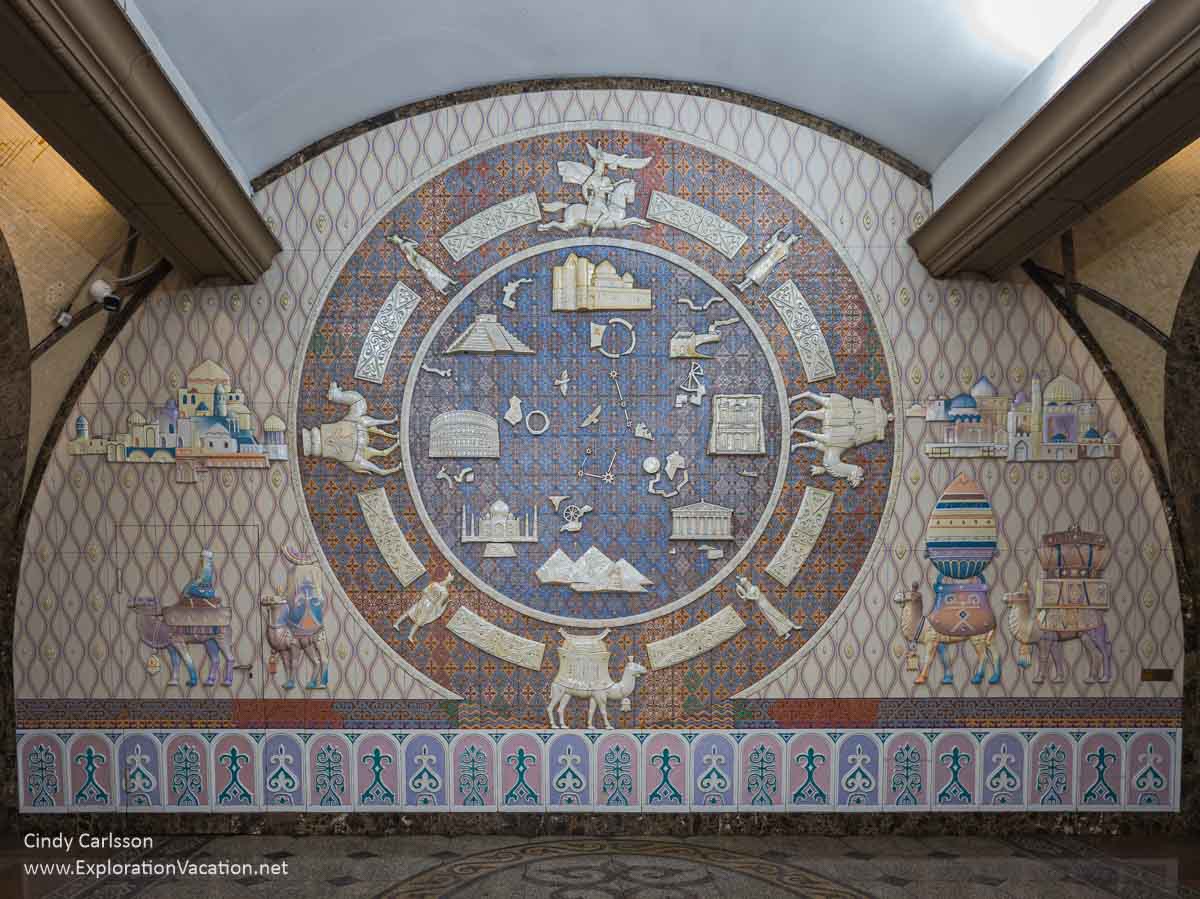
A mural with buildings that (mostly) represent cities connected by the Silk Road. . . and more of those pastel caravan images from the mural at the station entrance.
On the end wall of the central hall of the platform there is a decorative panel in the form of two circles, depicting the most famous symbols of the countries through which the Great Silk Road passed: The Indian Taj Mahal, the Great Wall of China, the Mausoleum of Khoja Ahmed Yasawi [in southern Kazakhstan], the Egyptian pyramids, the Roman Colosseum, the Athenian Parthenon, the Monastery of Ed-Deir in Jordan.” (Metropolitan Almaty City, translated by Google from Russian)
That description goes on to remark on the fact that the mural includes the Pyramid of Kukulkan (El Castillo) at Chichen Itza in the Mexican Yucatan – a site literally on the other side of the planet from Almaty and the Silk Road!
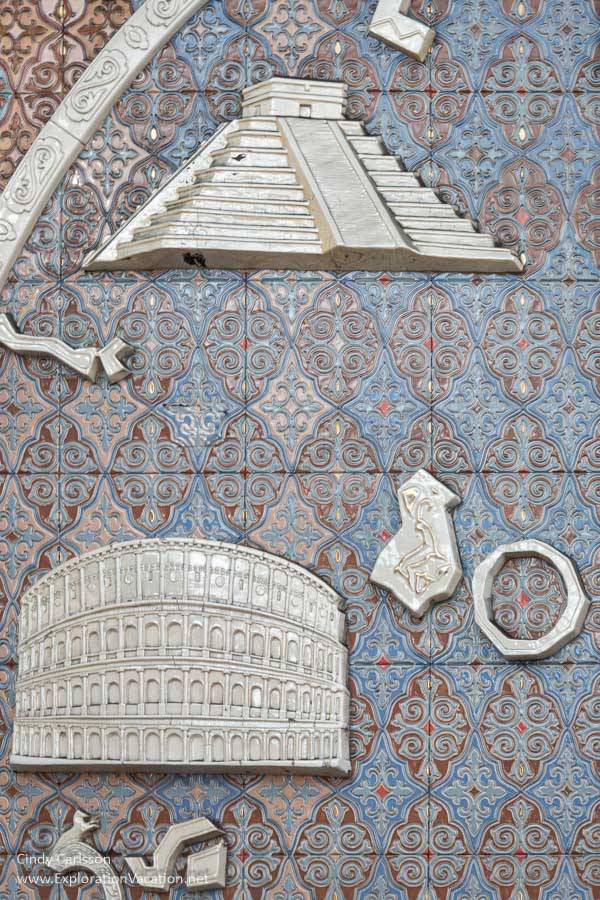
Oddly, this Silk Road mural includes both the Colosseum in Rome AND the Pyramid of Kukulkan (El Castillo) in Mexico, although Silk Road trade definitely did not extend to Mexico.
A similar rectangular mural at the other end of the station also depicts the Silk Road’s connections between Asia and the rest of the world, but this one more realistically shows connections only as far west as Europe and northern Africa.
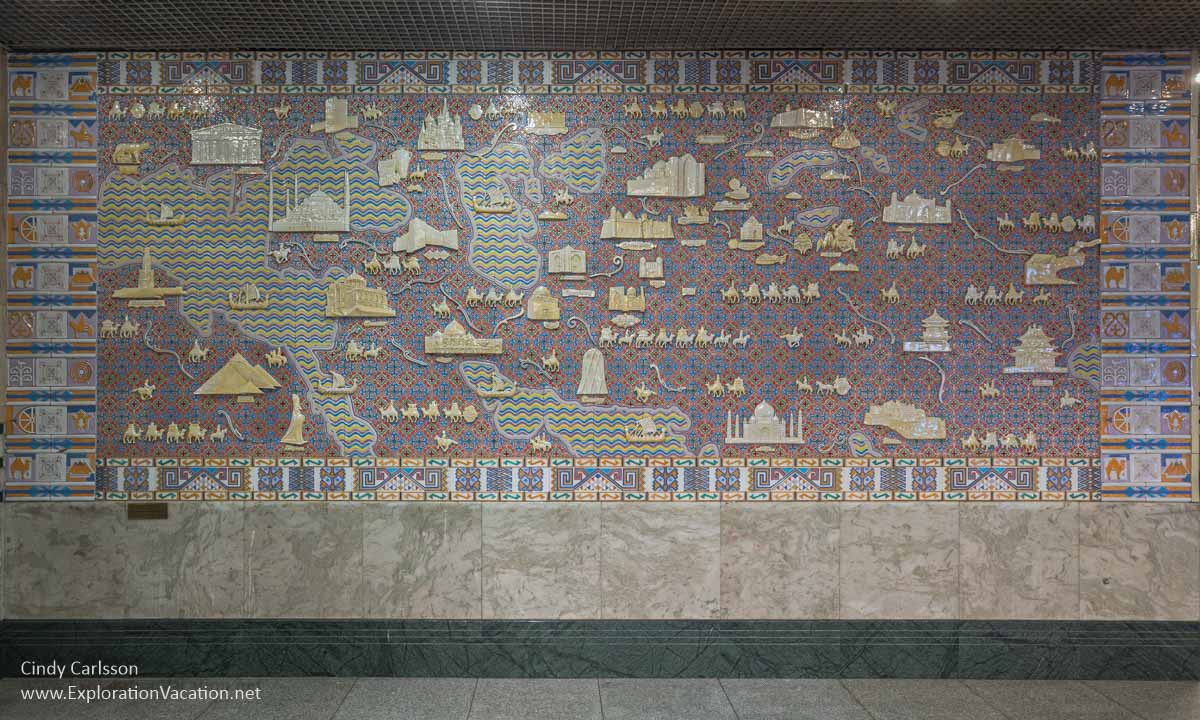
Another view of the Silk Road and its connections.
The fourth mural, of a camel caravan, is probably on the reverse side of this one. Wherever it is, it wasn’t obvious from the main hall or platform I was on.
I suspect the rectangular murals were later additions to station plans. Which isn’t particularly surprising, given the project was abandoned for years after construction began. A lot changed in Kazakhstan during that time, including this station (slow to load link).
This is another one of the original stations that opened in 2011. It’s also one of the deeper ones at 98 feet (30 m) below ground.
The Zhibek Zholy station serves several sites of interest to visitors, including Ascension Cathedral in 28 Panfilov Guardsmen Park and the pedestrianized area of Zhibek Zholy Street.
👉 Read less
Almaly (Almali) / Алмалы Station
Almaly translates to the “land of apples,” and the station recognizes the importance of apples in this region where they may have originated. Thus, it’s not surprising that the station’s two beautiful stained-glass panels feature apple trees.
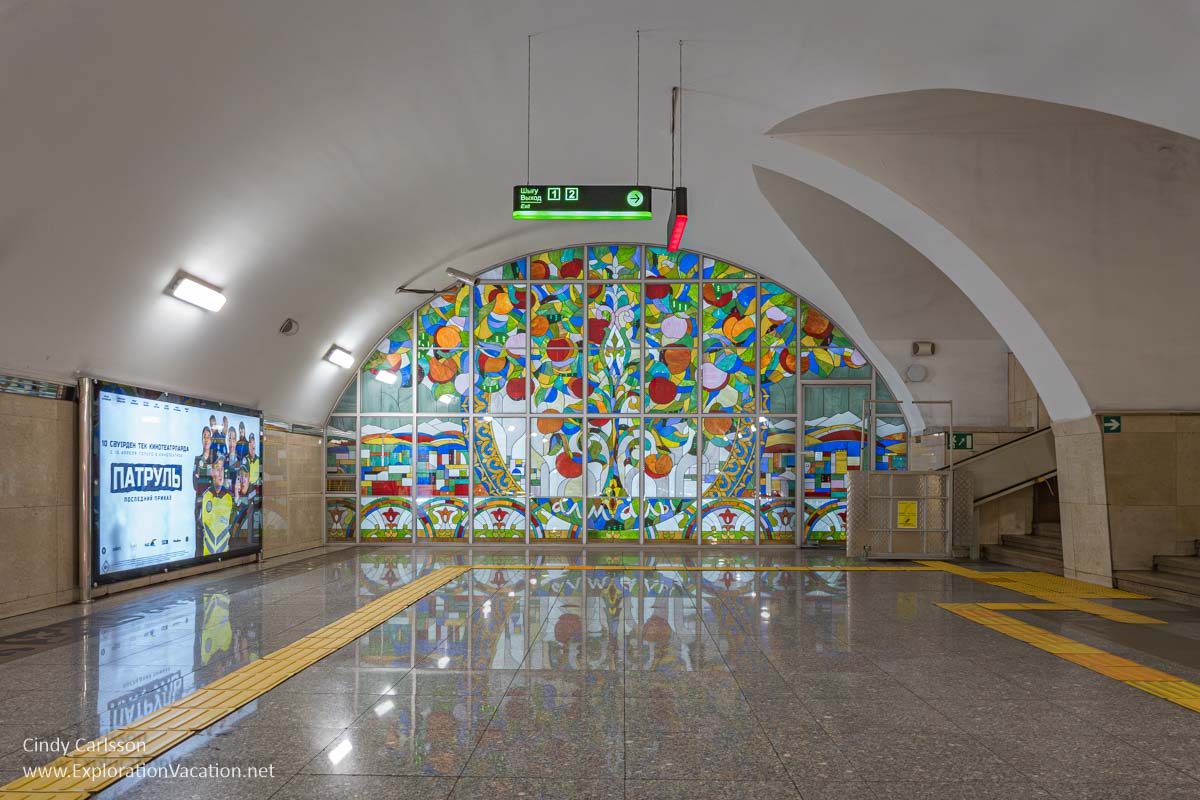
One of the glass panels depicting an apple tree.
👉 Read more about the Almaly Station
There’s another apple tree “widow” at the other end of the central hall.
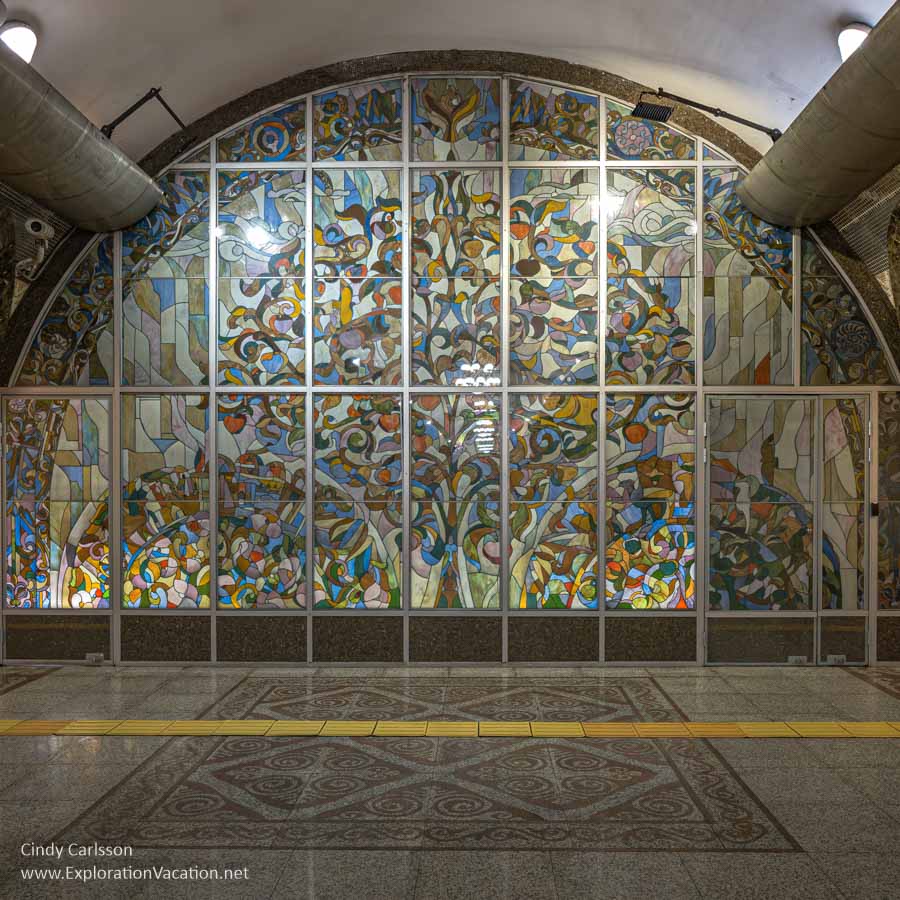
Another, more fanciful, apple tree glass mural.
I did find some information on the Almaly Station, but most of it appears to be wrong. (As with other stations on the initial line, some things seem to have changed over the 20 years between the station’s initial design and its completion.) The official information only discusses one panel and describes it thus:
The panel contains the idea of an ancient city and a blooming garden. The composition consists of three parts: The right part is a blooming garden with the outlines of the ancient city of Almaly. The left part is ripening fruits with a silhouette of a caravan. The central part is an apple tree with fruits, as a symbol of fertility, the tree of life and prosperity.” (Metropolitan Almaty City, translated by Google from Russian)
I’m not really seeing all of that in either window. Do you?
Someone suggested somewhere that one mural depicts the native sievers apple tree (from which modern apples developed) and the other depicts an aport apple tree (the first modern apple developed in the Almaty region). That seems to makes sense. I’d guess the first window depicts the cultivated aport trees that brought prosperity to the city (you can see them outlined behind the tree), while the native sievers tree is depicted in the other window as part of a lush wild scene.
Whatever the symbolism behind the glass panels is, they are lovely. And the rest of the station is also interesting, with wall and floor tiles that mimic traditional textile patterns.

Traditional textile patterns cover the Almaly station walls.
Structurally, the Almaly metro station is the same size, depth, and general layout as the Zhibek Zholy “Silk Road” station. Both opened in 2011. Early designs and construction photos (slow link) show how the station developed.
👉 Read less
Abai / Абай Station
Almaty’s Abai metro station is named for Abai Kunanbaiuly, a late 19th-century philosopher, poet, and Kazakh folk hero. The station’s main feature is a huge image of Abai surrounded by some of his best-known texts.
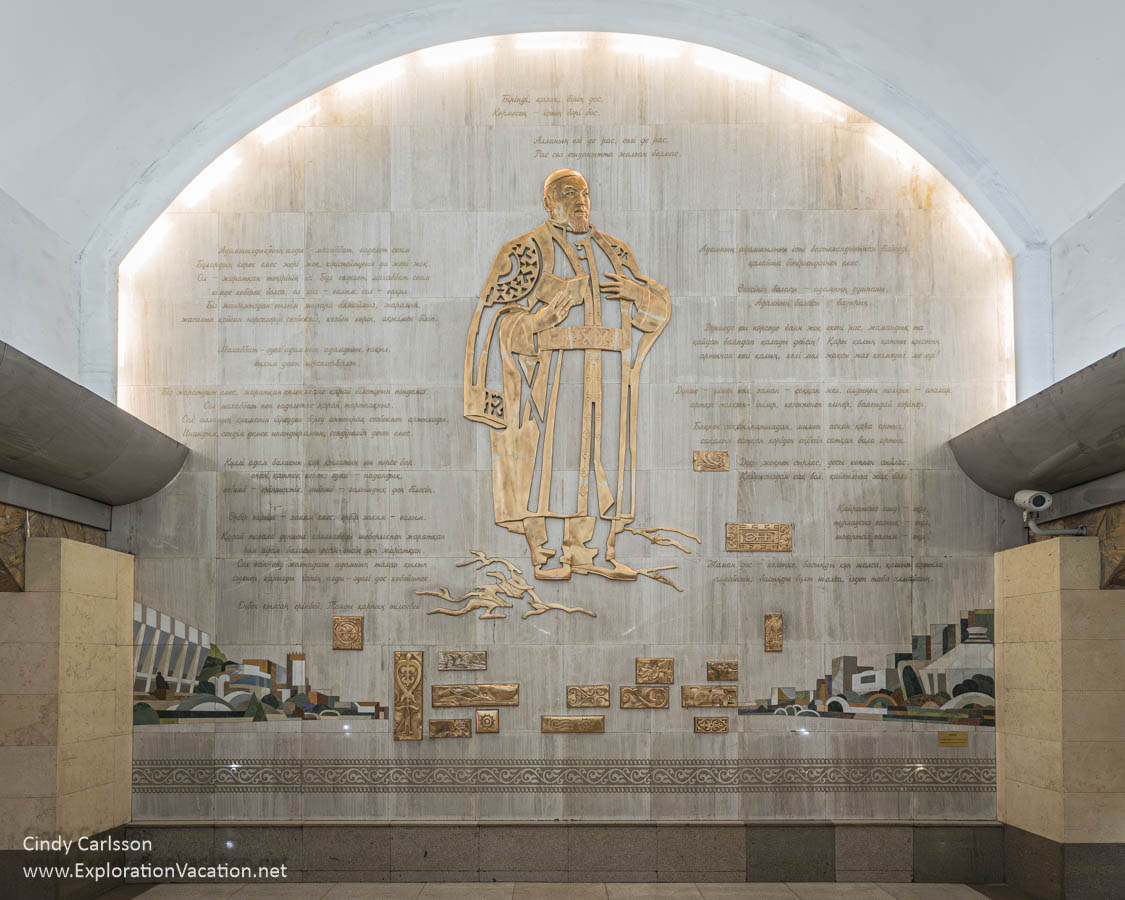
An outsized tribute to one of Kazakhstan’s outstanding cultural figures.
Aside from this impressive tribute, the rest of the station is pretty simple, with beige and brown granite and marble stonework without any fancy patterns.
The Abai station is another station that opened in 2011. It’s also a really deep station at 256 feet (78 m) below ground level. Early designs and construction photos (slow link) show how the station developed over time.
This is the station to use to get to the Abay Square area, including the Kok Tobe Hill cable car.
Baikonyr (Baikonur) / Байқоңыр Station
We’ve now reached a very different and quite dramatic metro station.
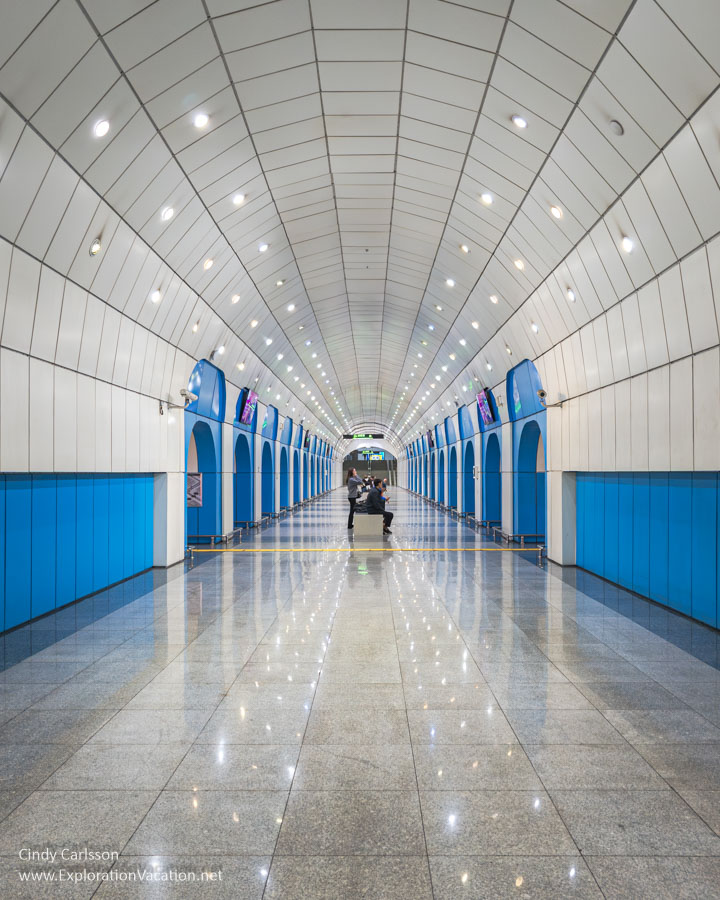
Step into the central hall at Baikonyr Station and you’ll feel as if you’ve been transported very far from the streets of Almaty.
This station is named for the Baikonur Cosmodrome, a Russian spaceport located in Kazakhstan. Baikonur has been the home base for the Russian space program since 1955. It’s where the space race between the USA and Soviet Union really began when Sputnik 1 was launched in 1957. Today the spaceport is leased by Russia and serves as the base for travel to the International Space Station. It’s also used to launch many other commercial, scientific, and military missions.
👉 Read more about the Baikonur Station
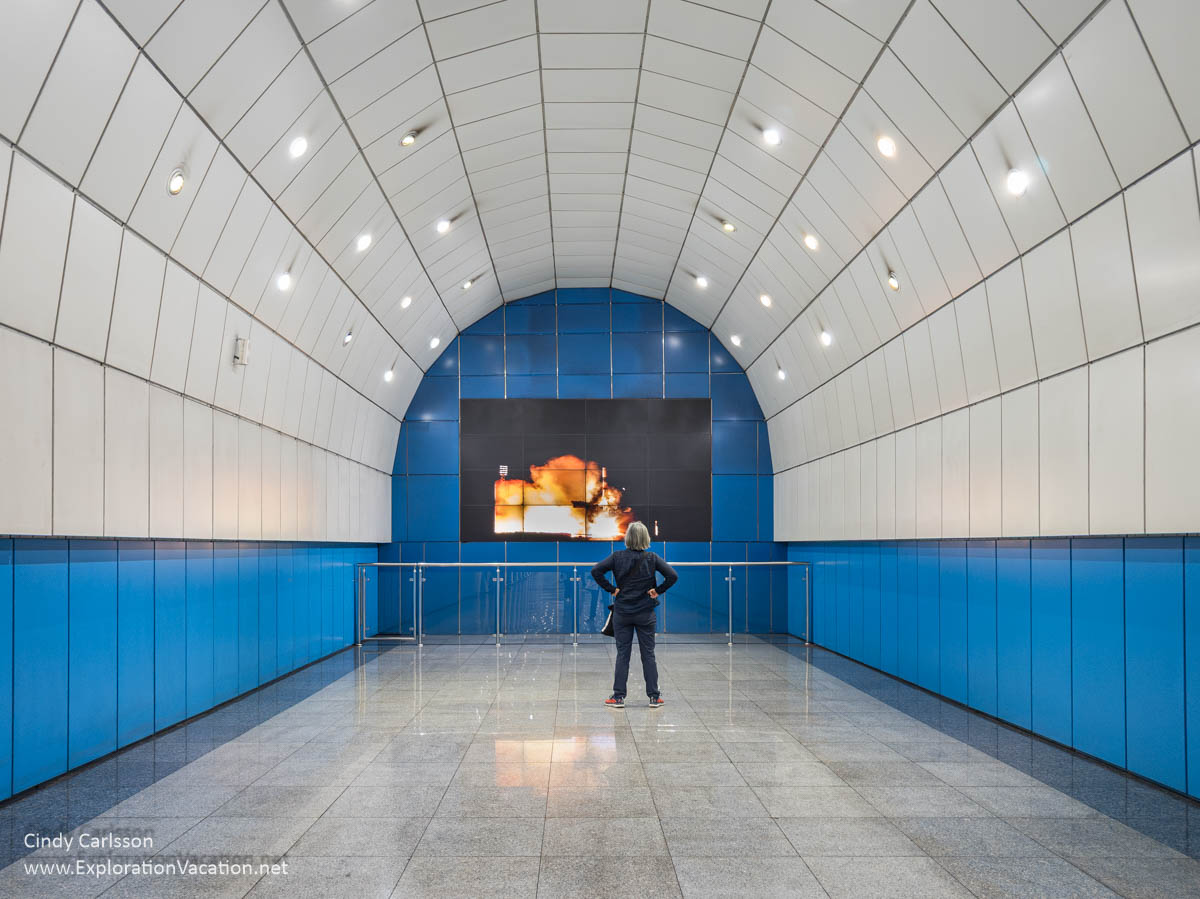
Watch videos of spacecraft lift-offs while waiting for your train at Baikonyr Station.
Info on the original station design describes it as “a modern interior in the “High-Tech” style, imitating the interior of a spaceship.” I’ve never been near a spaceship, let alone in one. But I’m thinking that’s maybe a bad translation. This is similar to, but way cooler than, the original designs. But I can’t imagine it’s anything like the inside of a spaceship. (Aren’t they really crowded inside?) But if I were outside the spacecraft at the launchpad. . . . Can’t you almost see an astronaut walking through here on their way to a spaceship? Either way, it’s pretty dramatic. And, as a bonus, the red taillights on departing trains apparently light up the rail platform a bit like the flames from a launch
Baikonyr is also one of the stations that opened in 2011.
👉 Read less
Auezov Theater / Мұхтар Әуезов атындағы театры Station
Not surprisingly, the Auezov Theater Station was named after the nearby Mukhtar Auezov Kazakh Drama Theater, which was itself named after the renowned Kazakh writer, dramatist, and Soviet academic. Early in life Auezov was influenced by the work of Abai (namesake of the Abai Station described above), who was a neighbor and friend of Auezov’s father and grandfather. Auezov also shared Abi’s interest in traditional Kazakh culture.
The Auezov Theater metro station brings a lot of this together in one place.
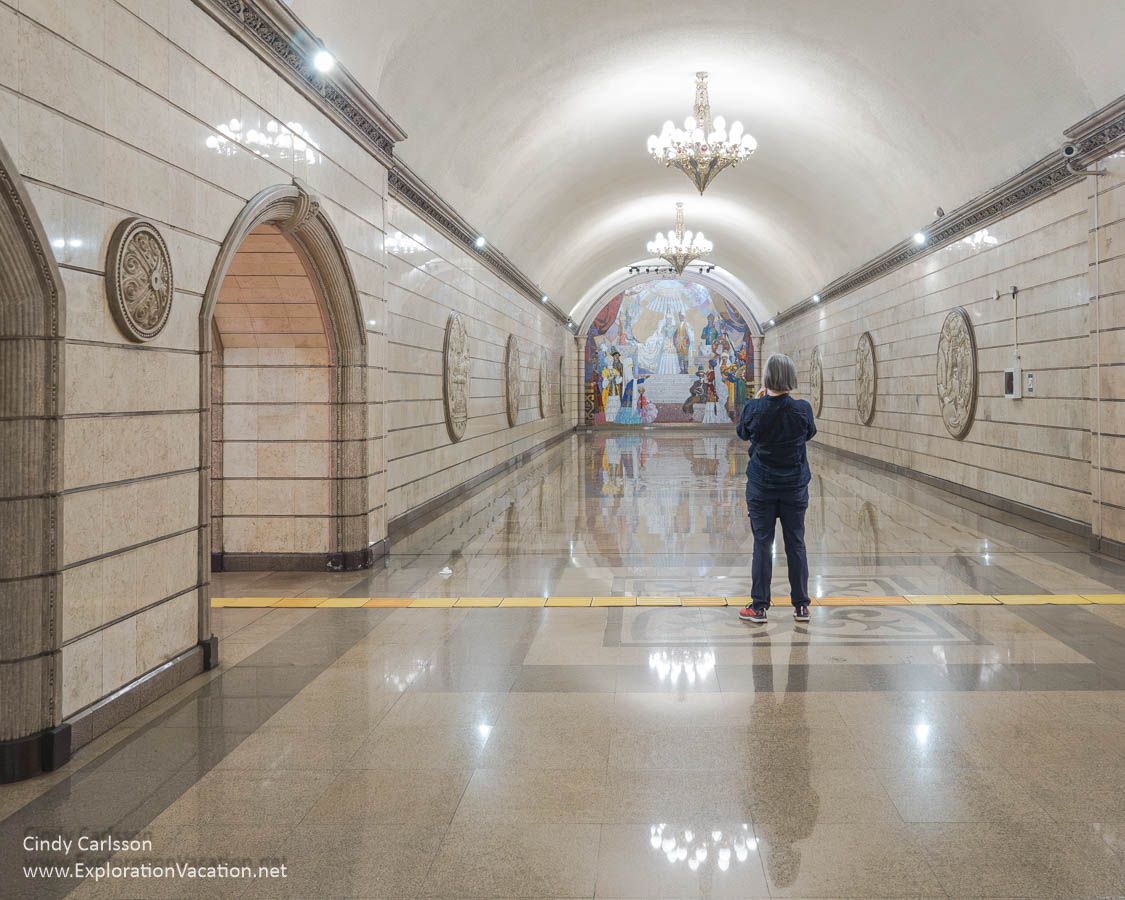
Traditional Kazakh stories are portrayed in the main corridor.
The colorful mural contrasts with the austere medallions that line the station walls. However, all of it relates to the stories of traditional Kazakh life that were at the heart of Auezov’s work.
👉 Read more about the Auezov Theater Station
Most information on the station describes the featured mosaic as a scene from Auezov’s Yenlik-Kebek (Enlik-Kebek), sometimes referred to as the Kazakh Romeo and Juliet. But I don’t see how what looks to be a grand wedding scene would fit into the tragic story of Yenlik-Kebek. I’m guessing the station plans changed and they used a scene from a different play. Maybe a happier one.
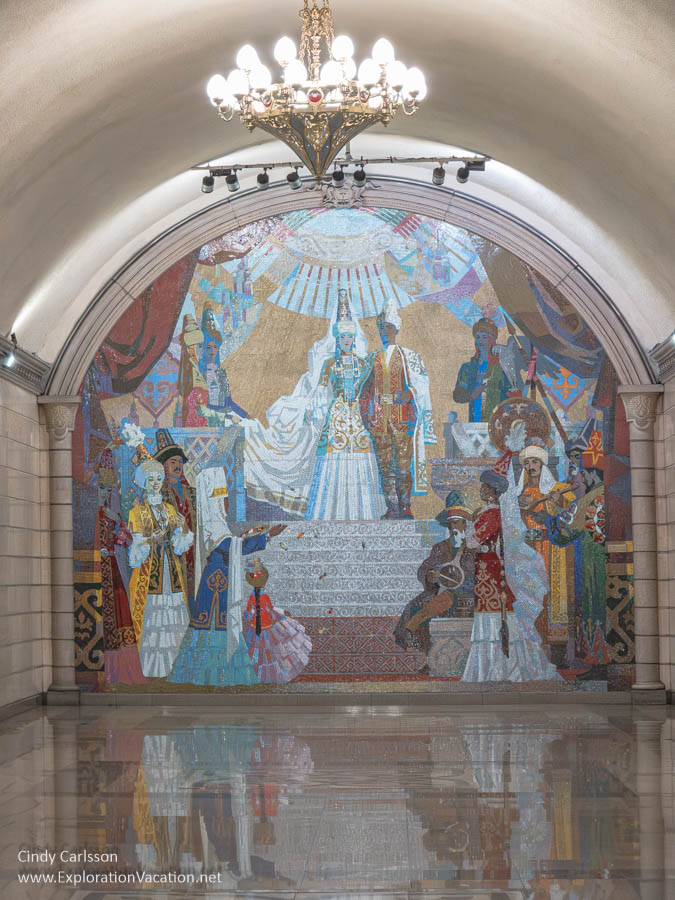
It has to be a scene written by Auezov, but which one?
The length of the main corridor is lined with 16 carved medallions. They all depict idealized scenes of traditional nomadic life. Auezov wrote a lot about traditional Kazakh culture, and the medallions created by E. Ospanov for the metro station are also based on scenes found in Auezov’s work.
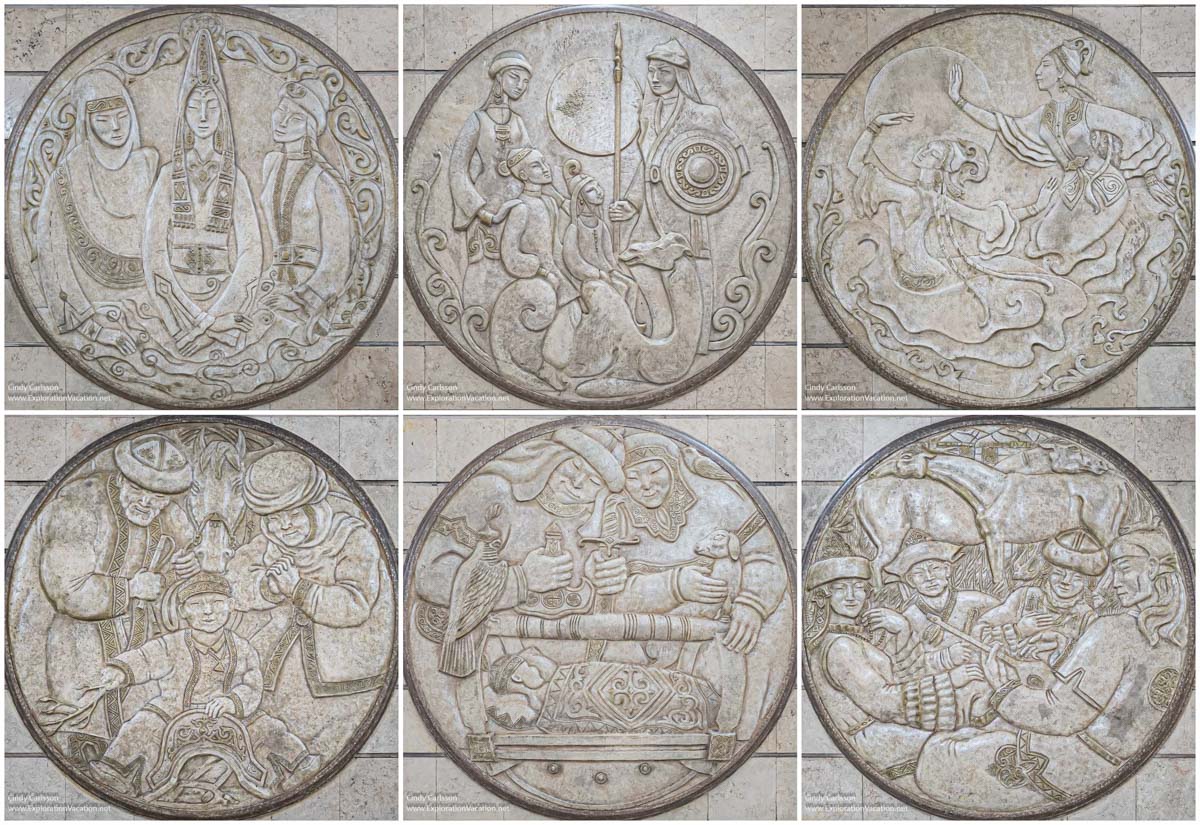
A sample of the station’s medallions celebrating traditional Kazakh life.
This is another one of the original stations that opened in 2011. It’s one of the deeper ones, at 98 feet (30 m) below ground. You can see some of the original designs and construction photos thanks to the slow loading Wayback Machine internet archive.
👉 Read less
Alatau / Алатау Station
Alatau is one of the simpler stations. It’s intended to evoke the Trans-Lli Alatau mountain range that rises above Almaty. This station is very subdued, with little decoration other than an intricate mosaic of the mountains located above the rails at each end of the platform. A few bronze geese add a bit of dimension to the mural.
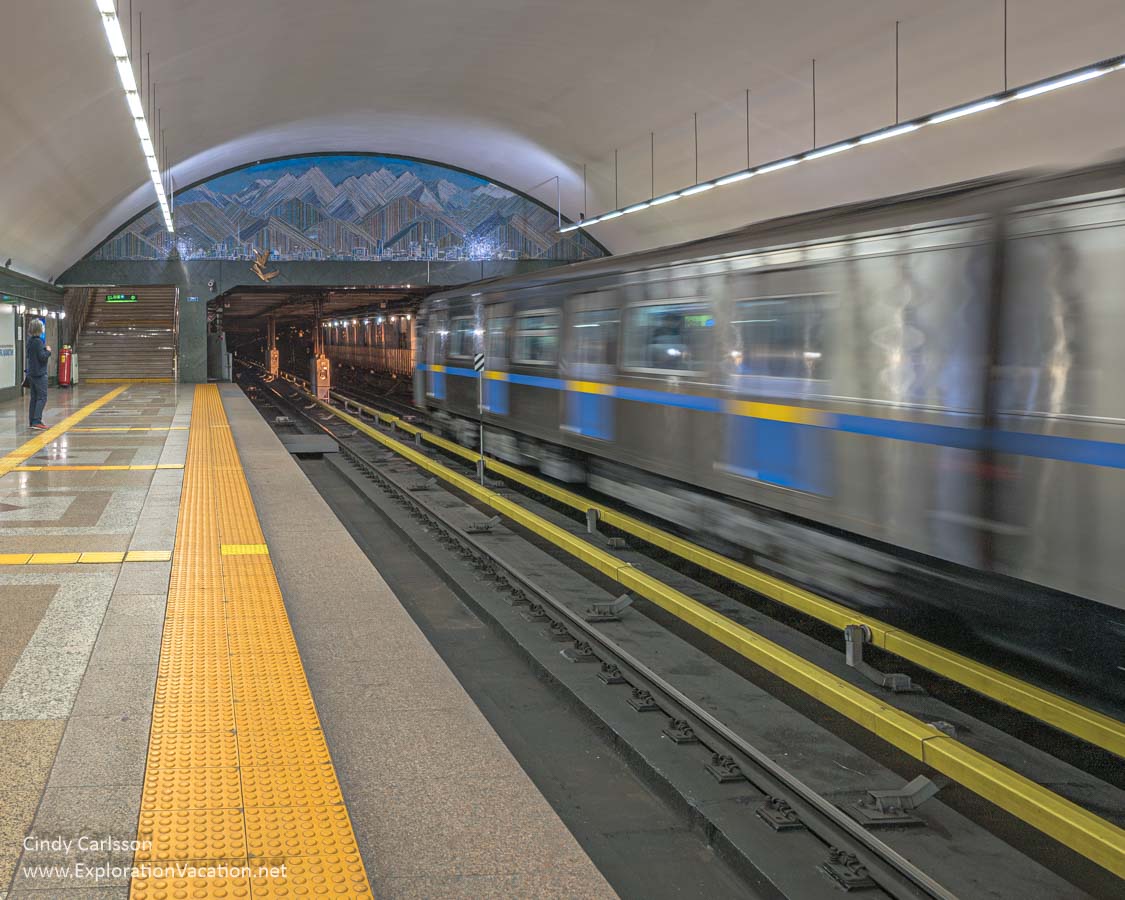
The Trans-Lli Alatau mountains rise above arriving and departing trains.
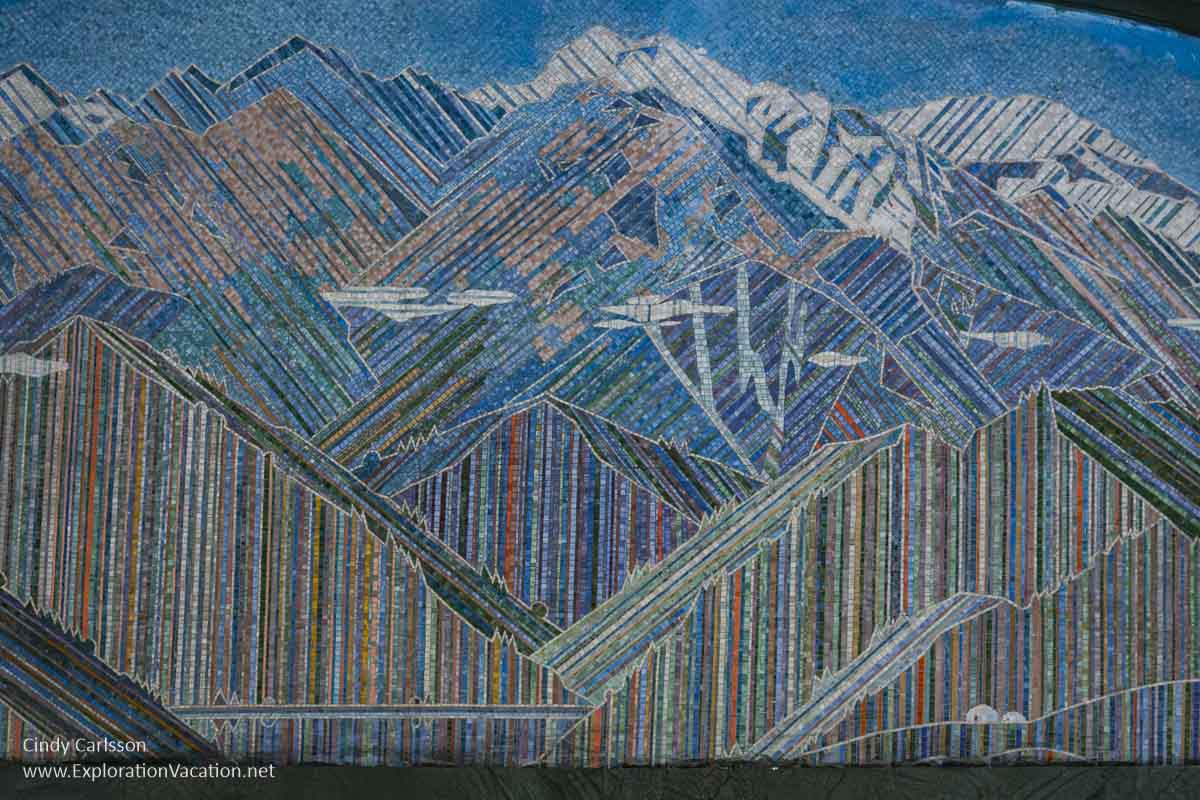
Although it’s difficult to see from the platform, zooming in proves these are very intricate mosaics.
Alatau is the last of the stations that opened in 2011. (The built station is far less grandiose than the original concept from the slow-to-load archives.)
Sairan / Сайран Station
This station gets its name from the nearby Sairan (Sayran) reservoir. However, the station itself doesn’t seem to have many direct references to the man-made lake it is named for. Instead, the walls have a repeating painted rainbow design with colorful versions of ancient petroglyphs like those at the Tamgaly (Tanbaly) World Heritage Site. (Apparently the bright colors and simple design are supposed to be “childlike,” an oblique reference to the children who use the lake’s beach.)
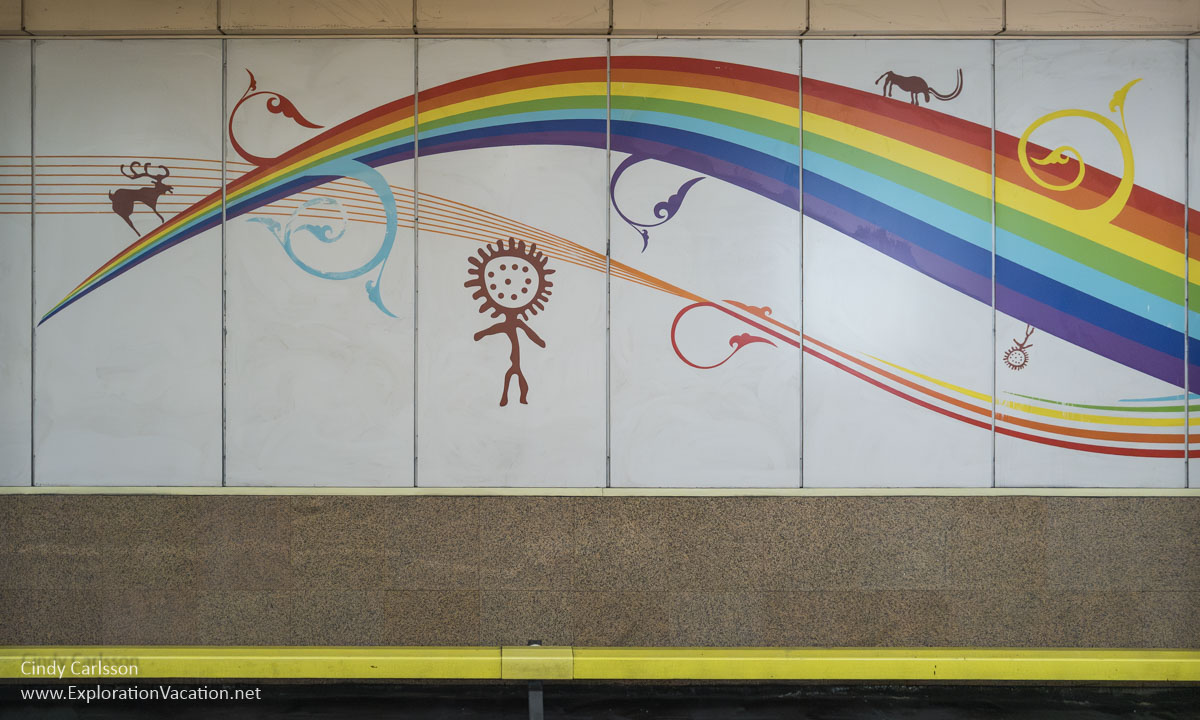
Painted walls in the Sairan station recreate ancient petroglyphs in bright colors.
Sairan is a shallow station that opened in 2015. From what I saw, it’s one of the least interesting stations on the current line.
Moscow (Moskva)/Мәскеу Station
The Moscow station’s two levels are unusually open, and most of the art (in the form of large-scale photos of Moscow) is on the upper level.
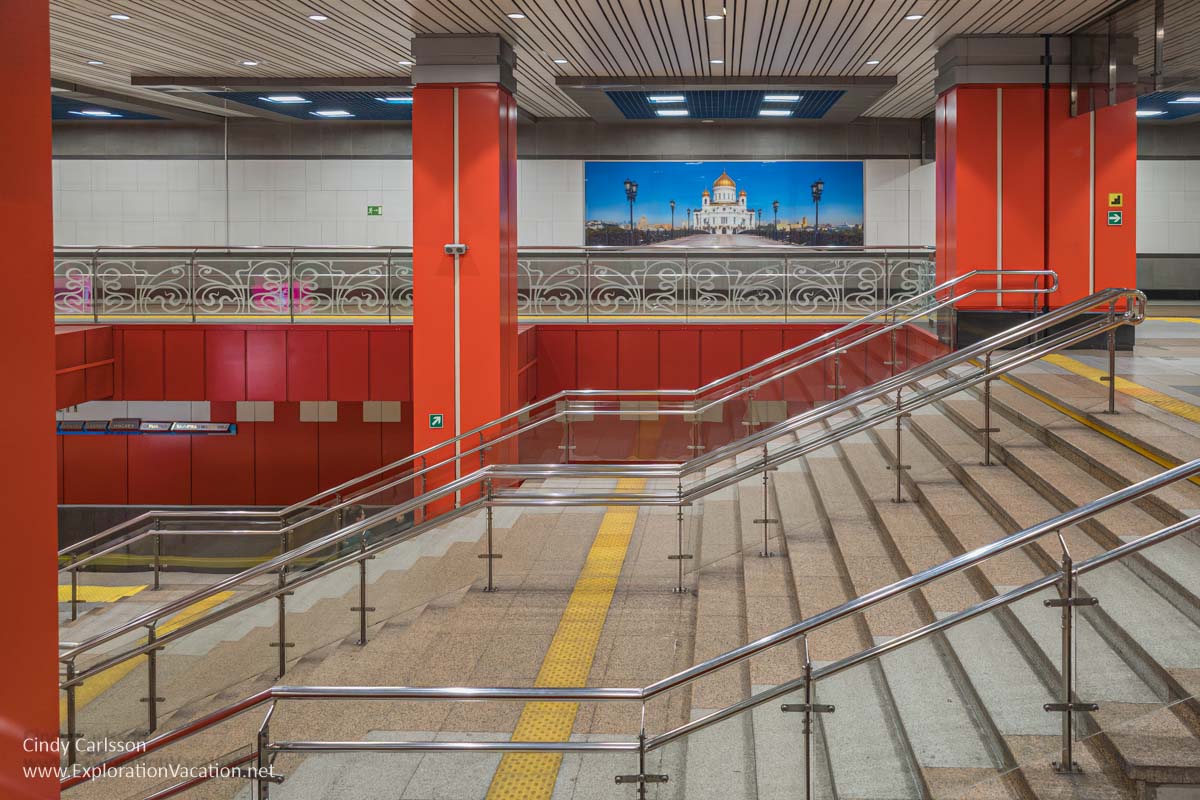
The Moscow station’s upper level displays large photographs of iconic sites in Moscow.
Down by the platform, the station’s tiled walls are intended to evoke the walls of the Kremlin.
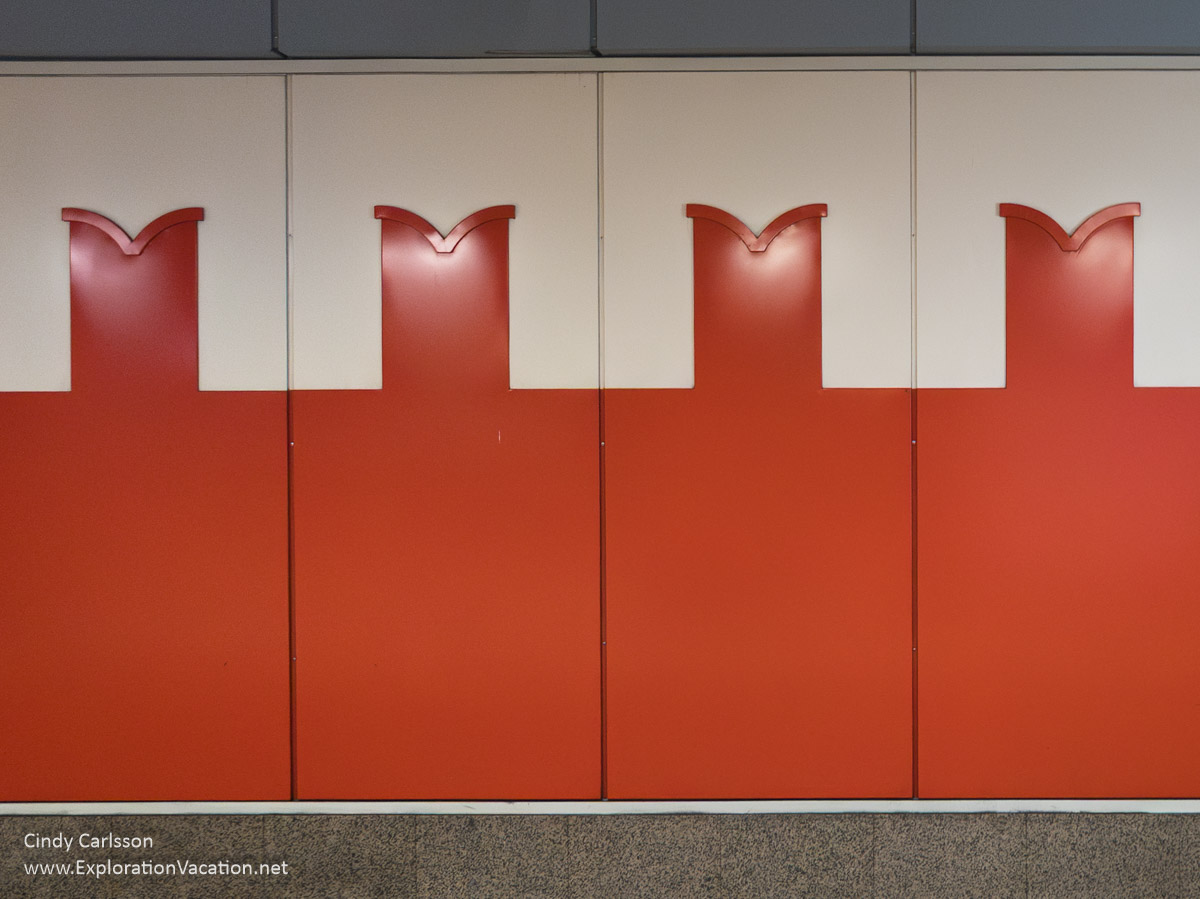
A simplified outline of the Kremlin wall runs along the station’s platforms.
I wondered why this theme was chosen so long after the end of the Soviet era. But, apparently, the station got its name (and design) as part of an agreement with Russia to name a station in Moscow for Almaty. (As both a sign of friendship between Russia and Kazakhstan and recognition of the role soldiers from Almaty played in defending Moscow in World War II.) In exchange, Almaty designed a station celebrating Moscow.
(The station was originally referred to as Molodezhnaya. The original design seems to have been modeled at least somewhat after a metro station in Moscow, and then modified when the name changed.)
This is the other station that opened in 2015. It served as the end of the Red Line until 2022.
Saryarka/Сарыарқа Station
This station is named for the Saryarka steppe, the vast landscape of dry plains and hills of northern and central Kazakhstan. (“Saryarka” is said to mean “a vast and large plain, a flat plateau, with countless hilly ridges, where the vegetation on the surface of the earth is yellowed from burning.”) But this area also has a rich cultural history. Astana, the Kazakh capital, is also located in this region. All of which is reflected in the station’s design.
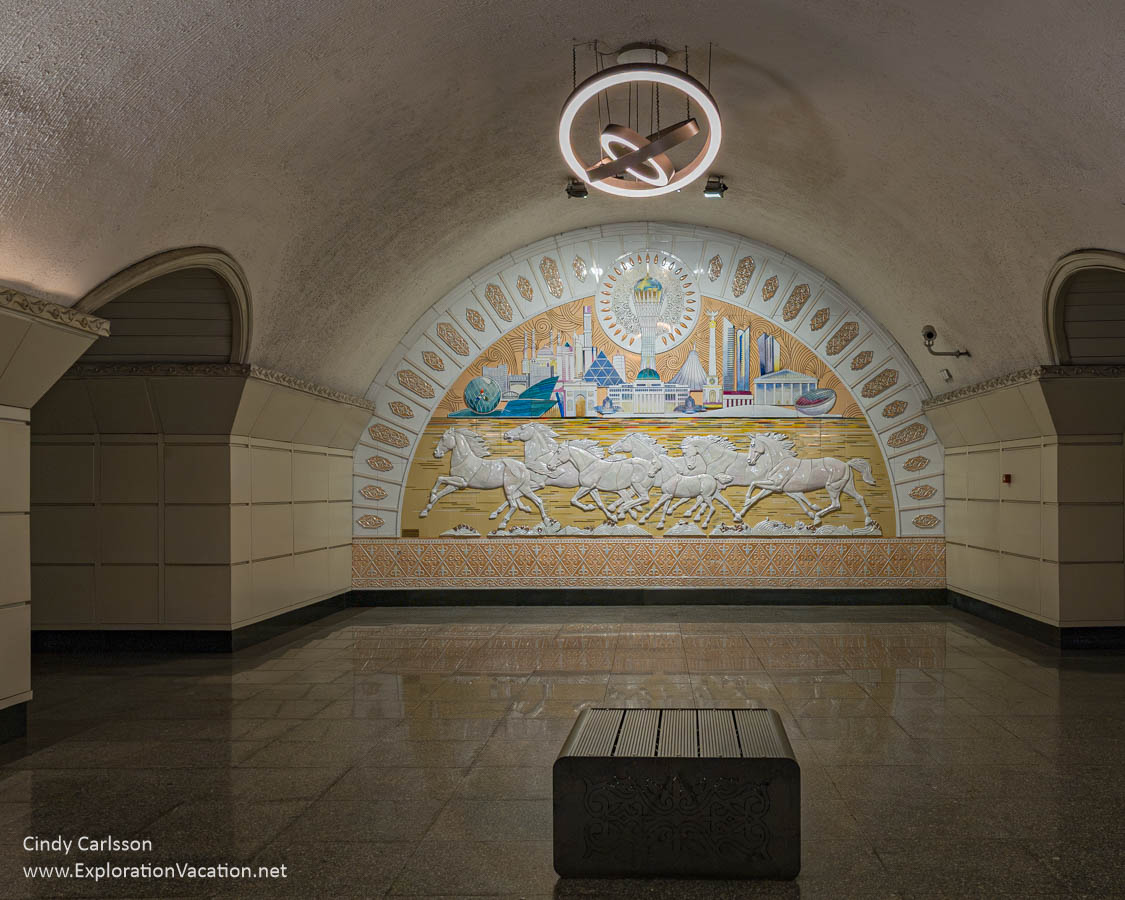
The Saryarka station is rich in symbolic imagery.
The main idea in creating the architectural and artistic design of the station’s interior was to reflect the beauty and uniqueness of the endless expanses of Saryarka. . . . On the end wall there is a panel depicting the sunrise over the steppes, in the foreground a herd of horses rushes purposefully against the backdrop of the young capital Nur-Sultan [now Astana], located in the heart of the endless steppes of Saryarka. The panels are a reminder of the rich cultural and historical heritage of the Kazakh people.” (Metropolitan Almaty City, translated by Google from Russian)
The walls in Saryarka station’s central hall also reflect this theme. They feature marble inserts with ceramic tiles and brass figures depicting the landscape and its creatures.
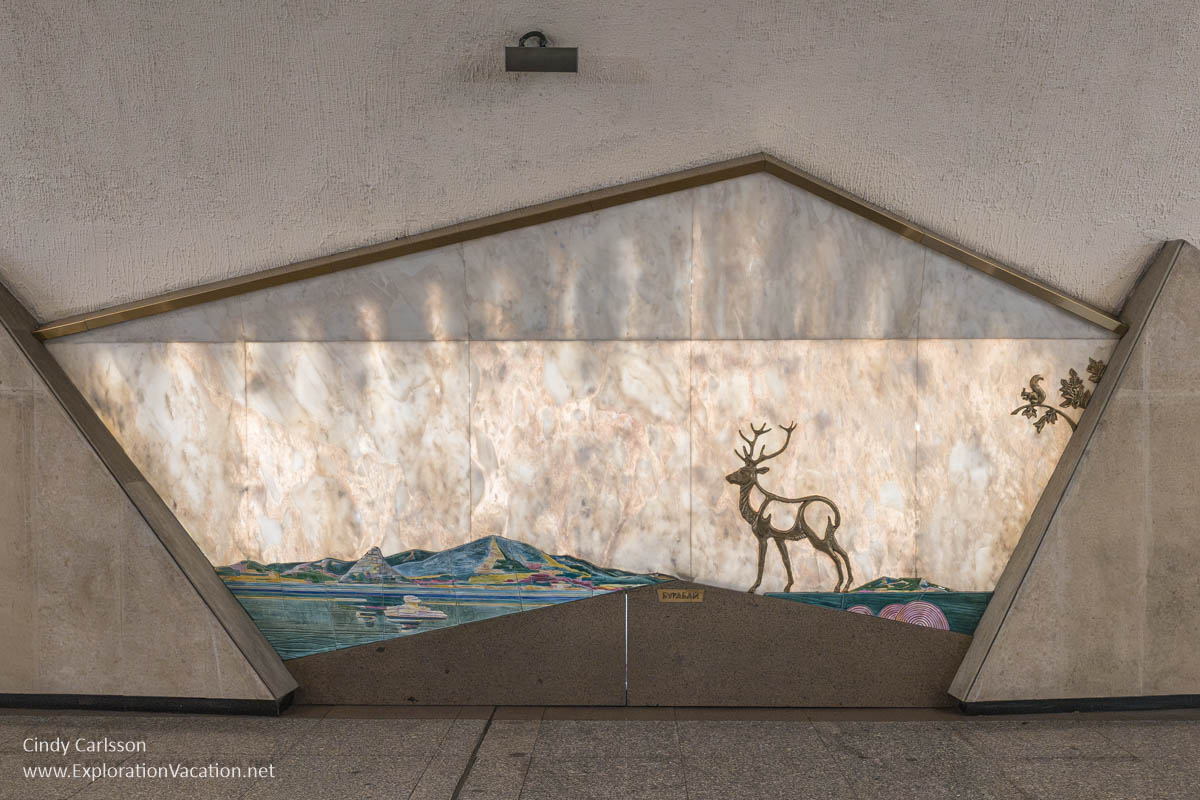
Depiction of elk (wapiti) inside the Saryarka metro station.
Construction on the Saryarka and “Dostyk” (now Bauyrzhan Momyshuly) stations began in 2015. However, apparently there wasn’t funding for it in the 2017-2021 budgets. (This seems connected to issues with the contractor.) This delayed completion of the Saryarka station until 2021 and its opening to the public until 2022.
Bauyrzhan Momyshuly / Бауыржан Момышұлы Station
Currently the last station on the underground metro line, the Bauyrzhan Momyshuly station is located in a large residential area. The station honors Bauyrzhan Momyshuly, a Kazakh-Soviet war hero and author. While the station recognizes an important figure in Kazakh history, the station itself isn’t very interesting visually. It’s mostly shades of grey with a portrait of Momyshuly on either side of the platform with sayings that, apparently, relate to peace.
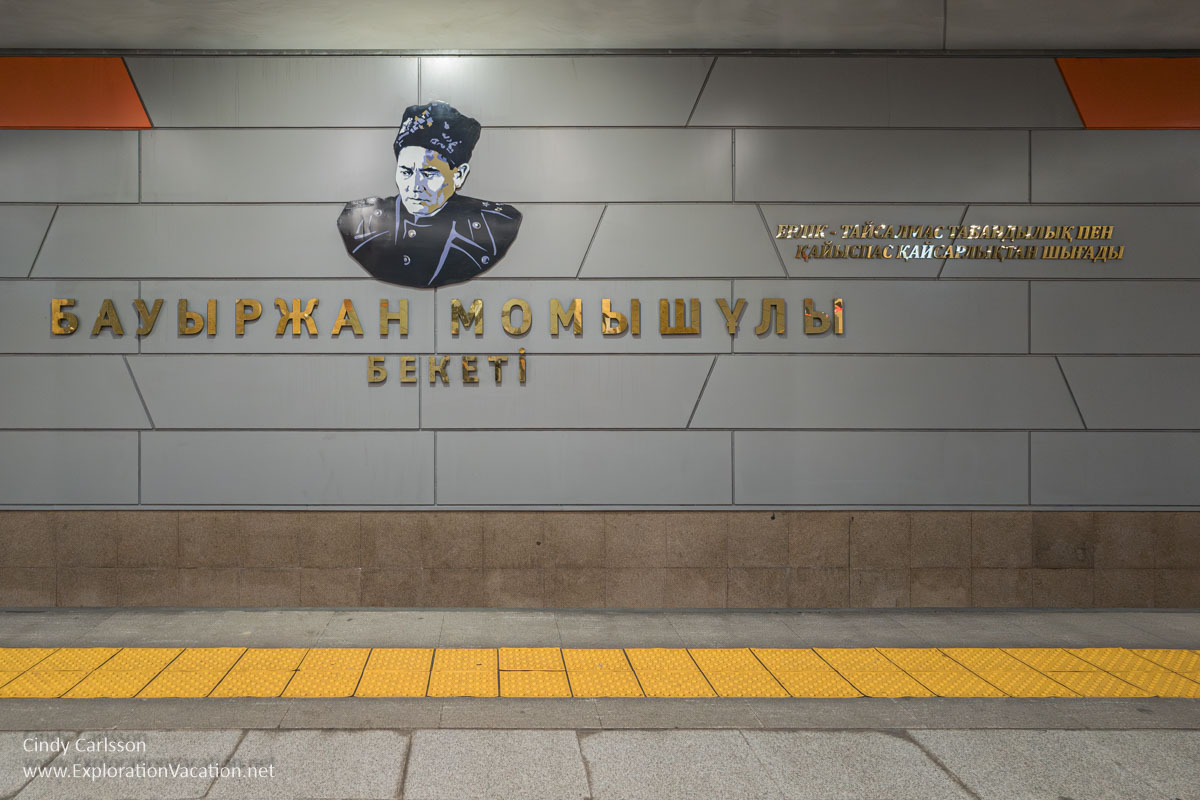
Kazakh-Soviet war hero and author Bauyrzhan Momyshuly is depicted at the station named for him.
This station opened in May 2022. As of spring 2025, it is the last station on the Red Line.
Future stations
Current plans call for two more Red Line stations farther west in residential areas, as well as a new line to connect the existing subway system to the airport.
The first of the new Red Line stations should be the Kalkaman Station. Construction began in 2020. However, assuming no new delays, plans call for a late 2026 opening.
Plans call for one final station on the Red Line that will run to the Barlyk bazaar. It doesn’t appear construction has started.
Planning is also underway to develop a new metro line connecting the subway to the airport from the Zhibek Zholy station. As envisioned, it would have eight stations along the route.
Almaty Metro history
Construction on Almaty’s metro system began in 1988. At that time, Kazakhstan was part of the Soviet Union, and Soviet funding was available to build the system.
However, the rather sudden dissolution of the Soviet Union late in 1991 brought an end to most large-scale economic activity in Kazakhstan and devastated city budgets. Nor was lost Soviet funding replaced by the Russian government in Moscow.
👉 Read more about the Almaty Metro's history
With a struggling economy and no external funding, work on the metro system stalled. It didn’t completely stop, but it was largely limited to maintaining what was already done and continuing excavation work. And, as if the lack of funds weren’t enough, with Russian technical experts largely out of the picture, the Kazakhs needed time to find new partners and develop their own expertise.
All that means construction moved very slowly when it moved at all. With “slowly” meaning the 1330-meter (more than ¾ of a mile) tunnel between the Auezov Theater (“Tulpar” project) and Alatau stations took 11 years to build.
The oil boom of the early 2000s made more funding available for everything, including the metro system. And, by then, the Kazakhs also had built the expertise needed to get the project moving again at a reasonable pace.
Construction resumed in earnest on the first section of the Red Line in 2005. Work continued (with a few breaks) until the entire route between Raiymbek Batyr and Alatau opened in 2011.
Construction began on the Sairan and Moscow stations in 2011, with those stations opening in 2015.
The next two stations, Saryarka and Bauyrzhan Momyshuly (originally called Dostyyk), didn’t open until 2022.
The Kalkamen is currently under construction. It’s scheduled for completion in 2026.
If you want to know more about the construction of the Almaty Metro, Wikipedia has some information, and the Almaty Metro has additional information about each station and a timeline of key dates (I had Google translate it from Russian). The WayBack Machine also preserves pages that have some information and numerous photos of station designs and construction through the Moscow station. Other than that, sources I’ve found usually just cover a station or two. If you can read Kazakh or Russian, you may be able to find more information.
👉 Read less
Info on how to use the Almaty Metro
Even if you haven’t used a subway anywhere else, you should give Almaty’s metro system a try while in town. It’s a good way to get to most tourist sites and it is cheap and easy to use. It’s also clean, safe, and filled with art!
The following information will help you out whether you are touring the Almaty metro stations or simply trying to get to a particular destination.
For the latest ticket prices, schedule, and other changes, check the Almaty Metro website. (Link to the Russian version.)
Metro station locations
The first thing you need to do is figure out which stations are closest to where you are and where you want to end up. So, of course, I created a map for you.
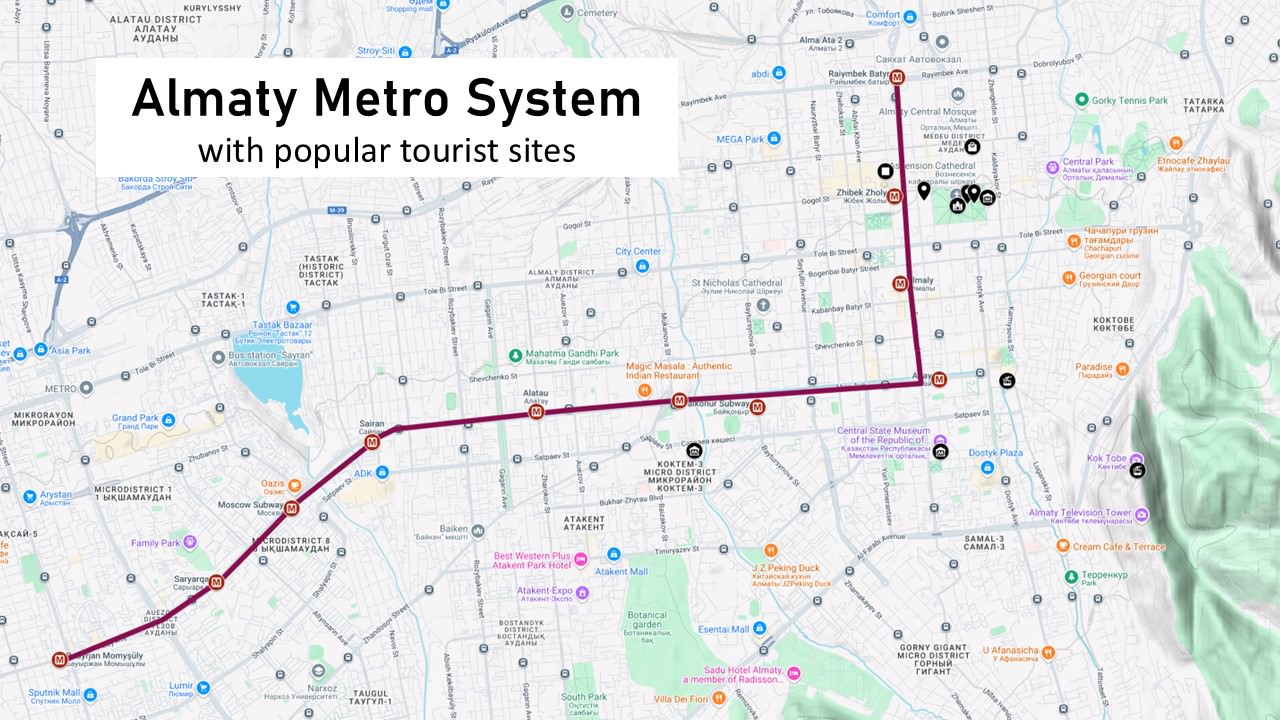
Open this map in Google to see where you are in relation to the metro system and city sights.
This shows where stations are in relation to some sites you might want to visit. If you open it in Google while in Almaty, you should see a blue dot showing your location. You can find a route to the nearest station or another destination from there.
Of course, in theory you can use Google or any mapping program with a transit option to show you how to anywhere via transit. IF your app works in Kazakhstan. I don’t know if Google shows transit options in Almaty, but I know it does NOT work in Tashkent, Uzbekistan. (It just said transit wasn’t available, which was absolutely not true.) Based on that, I wouldn’t count on using Google Map’s transit info in Almaty either!
At the station
Once you get to the metro station, you will go through a security scanner. Aside from flammables, I’m not sure what items are prohibited. However, if you are carrying a knife or another item that could be seen as a weapon, you might want to check before you get to the station to find out exactly what the rules are.
👉 Read more tips for riding the Almaty Metro
Stations are clean and well maintained. They also seem to be well monitored both via cameras and on-site staff. When I traveled on a Sunday morning we saw security or maintenance staff or both at almost every station.
Language
Language is complicated in Kazakhstan.
After way more than a century under both the Russian Empire and the Soviet Union, Russian is generally as widely spoken as Kazakh. That means signage is in both languages, usually in a Cyrillic script. However, written Kazakh is slowly shifting to the Latin (Roman) alphabet as the country moves away from Russian influences on the language. I still found a lot more Kazakh written in Cyrillic, but the metro system uses both forms of Kazakh along with Russian for key signage. (By the way, neither the Latin nor Cyrillic alphabet is traditional here. Kazakh was written in an Arab script up until the early 20th century. It switched to the Latin alphabet for a brief period before Russian became the language of government and official business in 1940.)
- All signage in the Almaty metro system is in both Kazakh and Russian in a Cyrillic script.
- SOME metro signage, such as the metro route map, includes Kazakh words written with the Latin alphabet. However, the Latin spelling is not always consistent. For example, you’ll find “j” and “zh” are interchangeable, as are “i” and “y.”
- Beyond station names, most information (including informational signage) is only in Cyrillic.
- Metro arrival and departure information is usually announced in Kazakh, Russian, and English.
Don’t expect most people to speak languages other than Kazakh and Russian.
Tickets
While you can buy passes that let you pay electronically, the easiest option for visitors is buying a subway token at the metro station. A token will set you back about $.23 USD. (Yes. 23 cents. Half that for children under 15 with proof of age.) And, as long as you don’t exit the system, you can get on and off trains and travel in both directions as long as you like without buying another ticket.
However, tokens are only good for that day. Don’t buy a bunch of them thinking you can use them over the next few days.
There are various transit cards and apps available to use as your ticket, but they are designed for residents who use the system regularly. They don’t appear to be particularly user-friendly for visitors (especially visitors who can’t read Kazakh or Russian) and wouldn’t save most short-term visitors money anyway.
Riding the train
Trains usually run at least every 12 minutes from about 6:30 am to midnight.
Electronic signage along the track tells you when the next train will arrive and where it is headed.
Few trains were very full on the Sunday morning when we visited, but some were. While usually not crowded compared to some other major subway systems, the Almaty Metro sometimes serves over 100,000 people on a day, so don’t assume it will be quiet all the time.
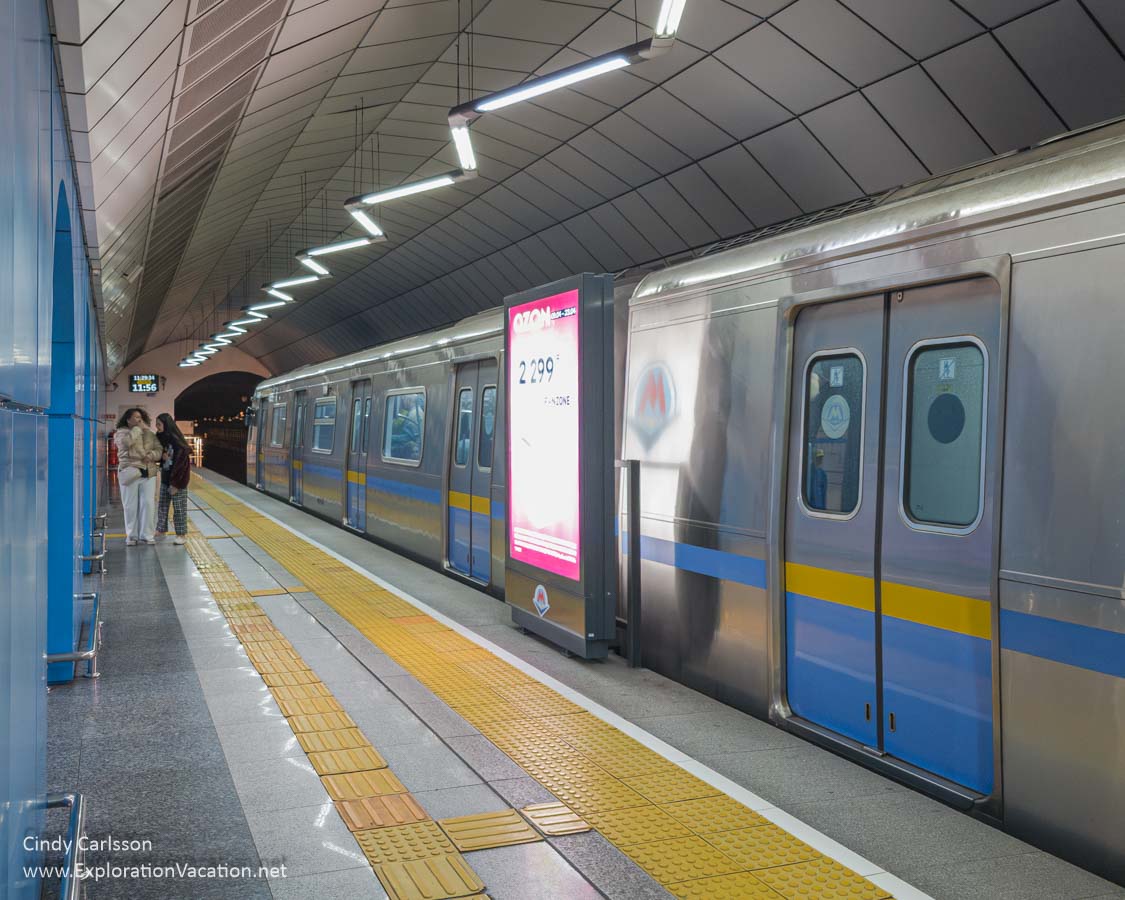
Most stations were pretty quiet on a Sunday morning.
Once on board, “older” passengers can expect that younger ones will offer them a seat. Respect for your elders is still a cultural norm here.
If you’ll be using the Almaty Metro for more than just a self-guided tour, see if the Almaty Metro App is available for up-to-date timetables, pricing, station information, and maps. (It was available on Google Play, but then disappeared. You can check and see if it is back again.)
👉 Read less
Visit these stations if you are short on time
It took us a couple of hours to get off and take a look at the below-ground portion of each station. Trains stop on each line at around 10-minute intervals. In most stations that was long enough to walk up and down the platform taking photos of the artwork and maybe even go up to the upper level. We stayed one train longer at a couple of stations where there was more to see and at one where the first train was particularly crowded.
However, if you just want to hit the highlights, these stations stand out:
- Zhibek Zholy (Jibek Joli) / Жібек Жолы, the mural-filled Silk Road station
- Almaly (Almali) / Алмалы with its stained-glass apple trees and patterned walls
- Baikonyr (Baikonur) / Байқоңыр, the space-age station like no other
- Auezov Theater / Мұхтар Әуезов атындағы театры for its mural and depictions of nomadic life
(If you want another view of all the stations as you decide which to visit, Shahina Travel has a nice page with lots of photos of all the stations.)
Book an Almaty Metro tour to learn more
It’s easy, safe, and cheap to tour the Almaty subway system on your own.
However, while it’s easy to tour these stations on your own (and we had fun just hopping off and on the train at each station), most stations don’t provide a lot of information about their history or artwork. (Or if they do, we usually couldn’t find it.) To understand what I saw, I needed to get on my computer and do some research after the fact.
Booking a good tour will give you that information and more while you are actually in the station.
Unfortunately, good Almaty Metro tours seem few and far between. Most Almaty city tours listed on sites like Get Your Guide and Viator don’t even use the subway to get around the city, let alone take the time to actually visit even a few key stations.
So, while there probably are other options, the rather nerdy Walking Almaty website and loads of positive TripAdvisor reviews indicate the Walking Almaty Metro Tour is the one to book. If you do, please let me know how it was!
Where to stay in Almaty
I visited Almaty on a tour, so I didn’t have a choice in my accommodations. However, were I to return to Almaty, I probably would stay at the Renion Park Hotel again. The Renion Park was comfortable, with an extensive and very good breakfast, a nice little bar, and very accommodating staff. It is in a very walkable neighborhood with coffee shops, bakeries, a Korean mini-market, and other shops of all kinds. Best of all, it is located between Zhibek Zholy Street (just down from the pedestrianized area) and Panfliov Park, making it easy to get to many tourist sights.
Read reviews and book the Renion Park Hotel at Booking.com or TripAdvisor. (Watch out if searching elsewhere. . . There are several different “Renion” hotels.
Looking for something else? You have plenty of options!
Other things to do in Almaty
You won’t find a long list of world-class tourist sites in Almaty, but it’s a pleasant city with some interesting things to do. It’s definitely worth a couple of days of your time while you are in the area. And it’s a good base for some spectacular scenery, hiking, and skiing just beyond the city.
Almaty is safe, and most sites of interest to tourists are relatively easy to get around. So, it’s pretty easy to tour on your own. But a good tour can be a great way to see and learn more about the city.
It’s usually best to book directly with a reputable tour provider. Not sure where to start? TripAdvisor probably has reviews for most tours available in Almaty and you can see exactly who the operator is and overall reviews of their tours. From there you can book through TripAdvisor or contact the tour company to book directly.
Of course, sites like Get Your Guide and Viator are also options.
Kok Tobe gondola
Want to see the whole city? The best way is from above! If the weather is clear, take the gondola cable car up Kok Tobe Hill for both mountain views and an overall view of Almaty.
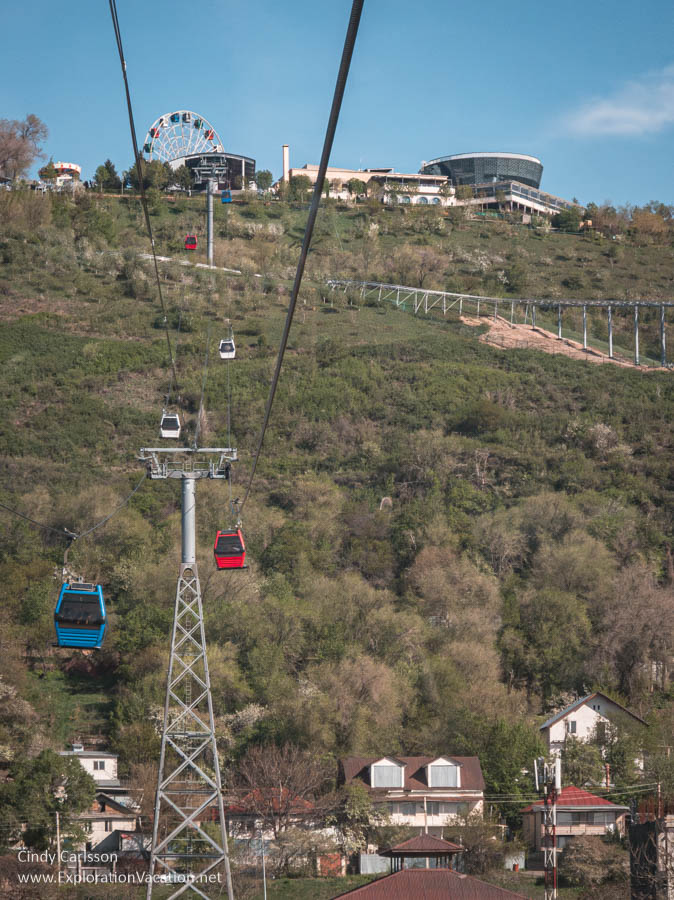
The cable car ride up is fun.
There’s an amusement park with many rides and attractions aimed at youth and families. It’s very active and colorful. While tourists come here, you’ll mostly find local families enjoying the games and carnival rides.
👉 Read more about things to do in Almaty
Of course, I was there for the mountain views. Unfortunately, when I visited, most of the scenic hiking trails through the woods were closed for repairs. The enormous restaurant at the far end of the park (which gives you the best views of the mountains) was also closed. (Apparently for a private event.) However, the mountain views were pretty good in other places too.
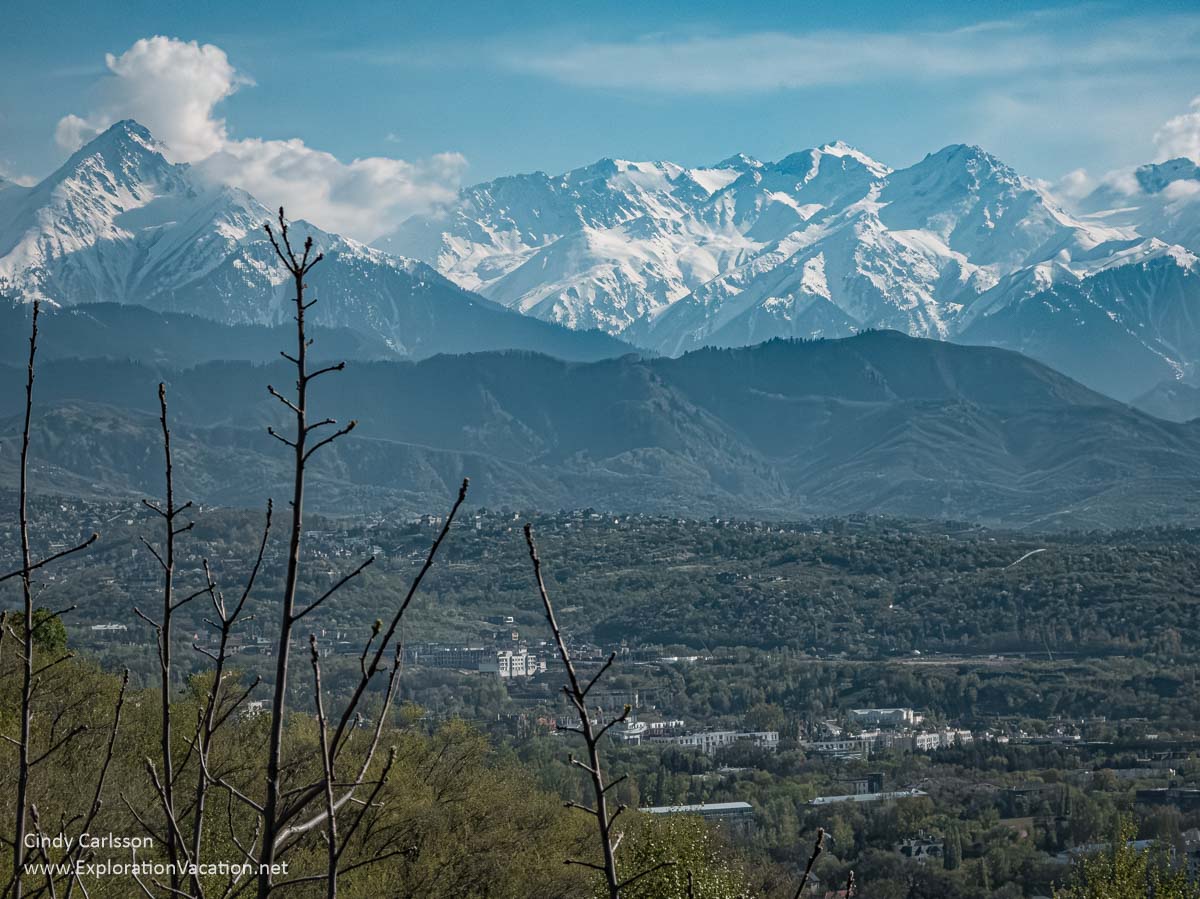
Because the area is wooded, you have to look for good mountain views.
You can get good city views almost anywhere along the hilltop.
At roughly $10 round-trip, this is one of the more expensive activities in the city. However, on a gorgeous day, it is totally worth it. But, unless you want to play in the amusement park, save this for a clear day. (A friend went up on a dark day when the air was so hazy with dust and smoke you could hardly see across the street, and then assured us there was absolutely nothing to see and, thus, no reason for us to go up when we returned to Almaty later a week later!)
She Travels Abroad has a detailed post on visiting Kok Tobe with a lot of information for families in particular.
Panfilov Park memorials
Panfilov Park is the leafy heart of the city. Besides being a peaceful wooded park, it is also home to Ascension (Zenkov) Cathedral, the Kazakh Museum of Folk Musical Instruments, the Memorial of Glory, and monuments to various Soviet heroes and others.
The largest and most dramatic memorial is the Memorial of Glory celebrating the (perhaps mostly apocryphal) story of the 28 Panfilov Guardsmen who died defending Moscow from the Nazis.
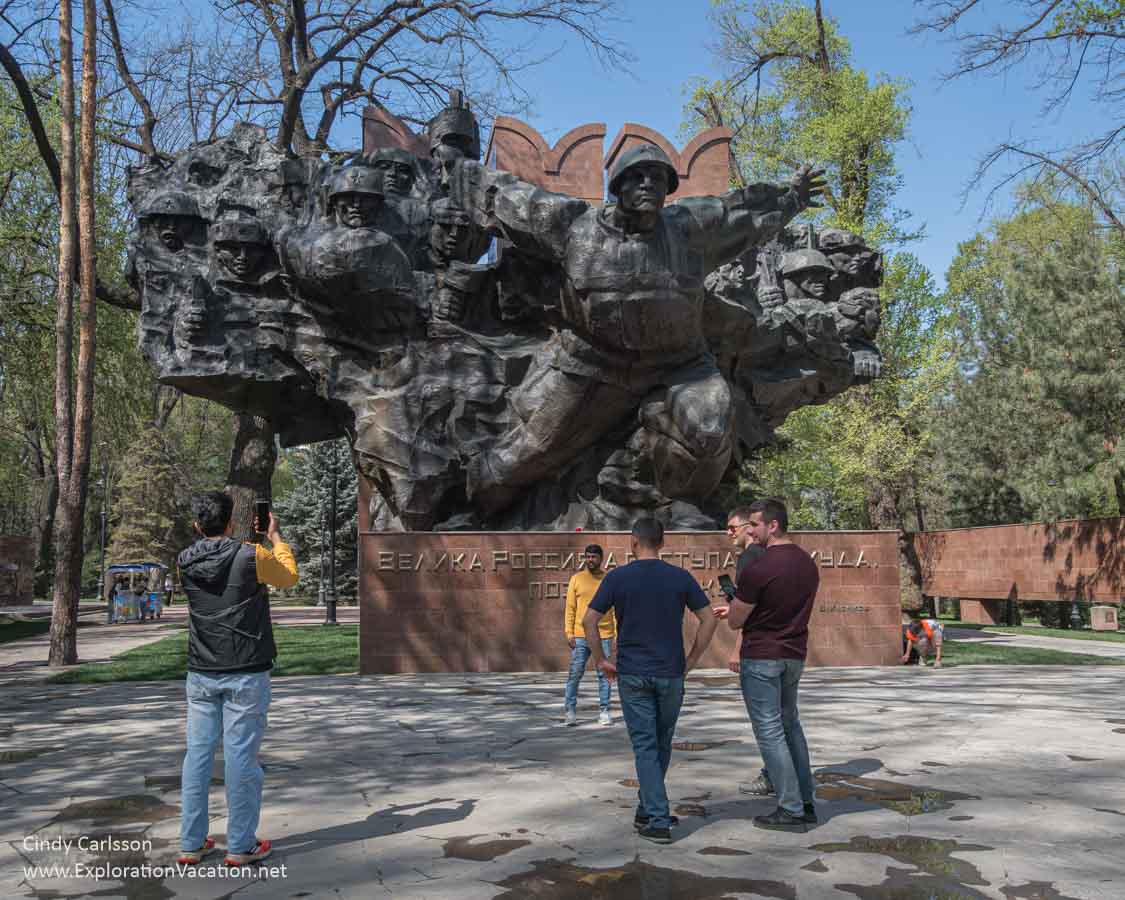
The main part of the memorial honors 28 Panfilov Guardsmen from Almaty for their actions to protect Moscow from the Nazis in World War II.
This small rifle division’s role in saving Moscow is one of the most celebrated military stories of the Soviet era in Kazakhstan. Even if the details of this particular incident aren’t completely accurate (for instance, not all 28 died), over a million Kazakh men were called on to serve, and between 125,000 and 300,000 died. (Apparently, the attempt to take Moscow was a prolonged slaughter on both sides.) They all deserve to be remembered and honored.
An eternal flame also burns at this memorial with a regular changing of the guard.
Acension (Zenkov) Cathedral
Ascension Cathedral (also known as Zenkov’s Cathedral in honor of its builder, Andrei Zenkov) is a Russian Orthodox church located inside Panfilov Park. The spectacularly colorful wooden church was completed in 1907.
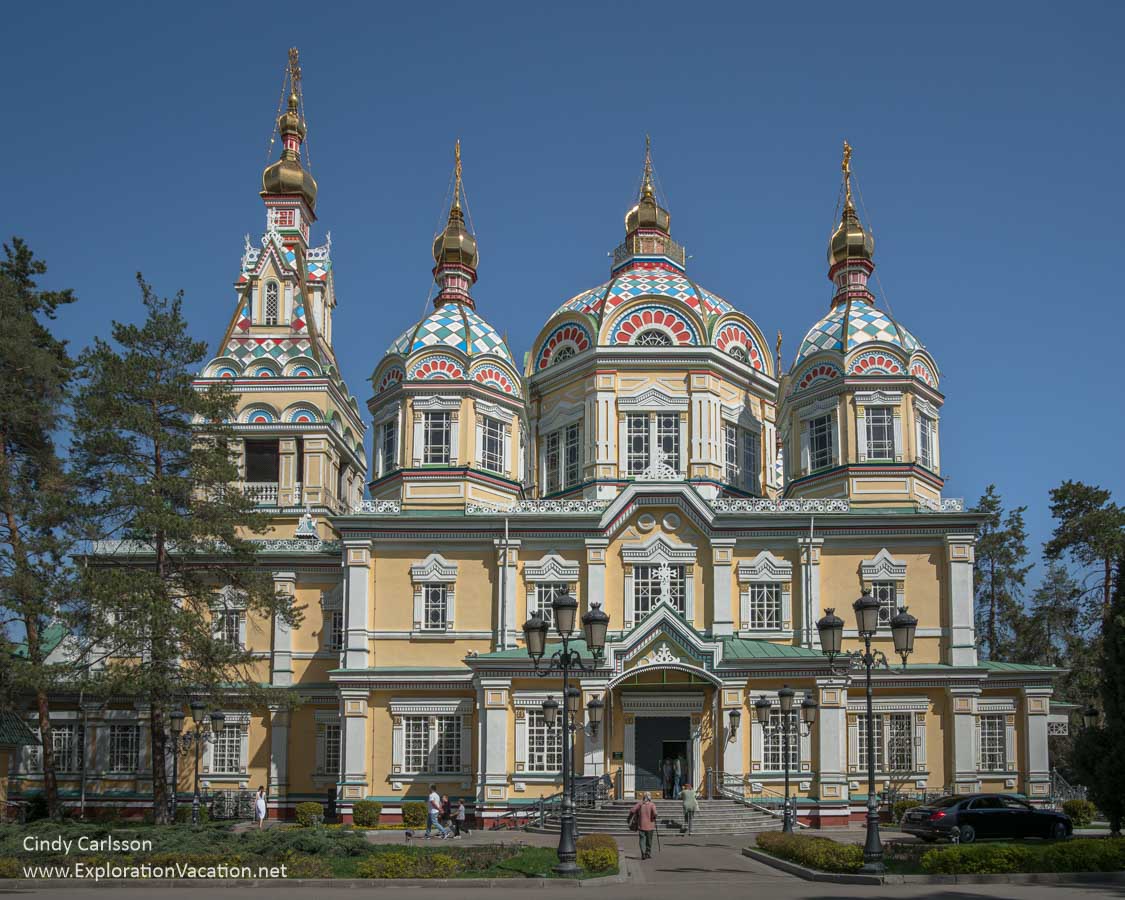
Ascension Cathedral survived both earthquakes and the Soviet crusade against religion.
Under the Soviets, the cathedral housed a museum. One of the few original Russian churches to survive the Soviet period, it was renovated in the 1970s and returned to the Russian Orthodox Church in the 1990s. The most recent renovation was completed in 2020.
The interior of the cathedral is richly decorated. Unfortunately, I was there during Holy Week, and photos are not allowed during worship services. . .
You can read more about the cathedral and see a few photos of the interior on Shaina Travel.
Museums
Almaty has several museums that sound as if they are good. I had big plans to get to most of them, but ran out of time.
Museum of Folk Musical Instruments
The one Almaty museum I did get to was the Kazakh Museum of Folk Musical Instruments, located in Panfilov Park.
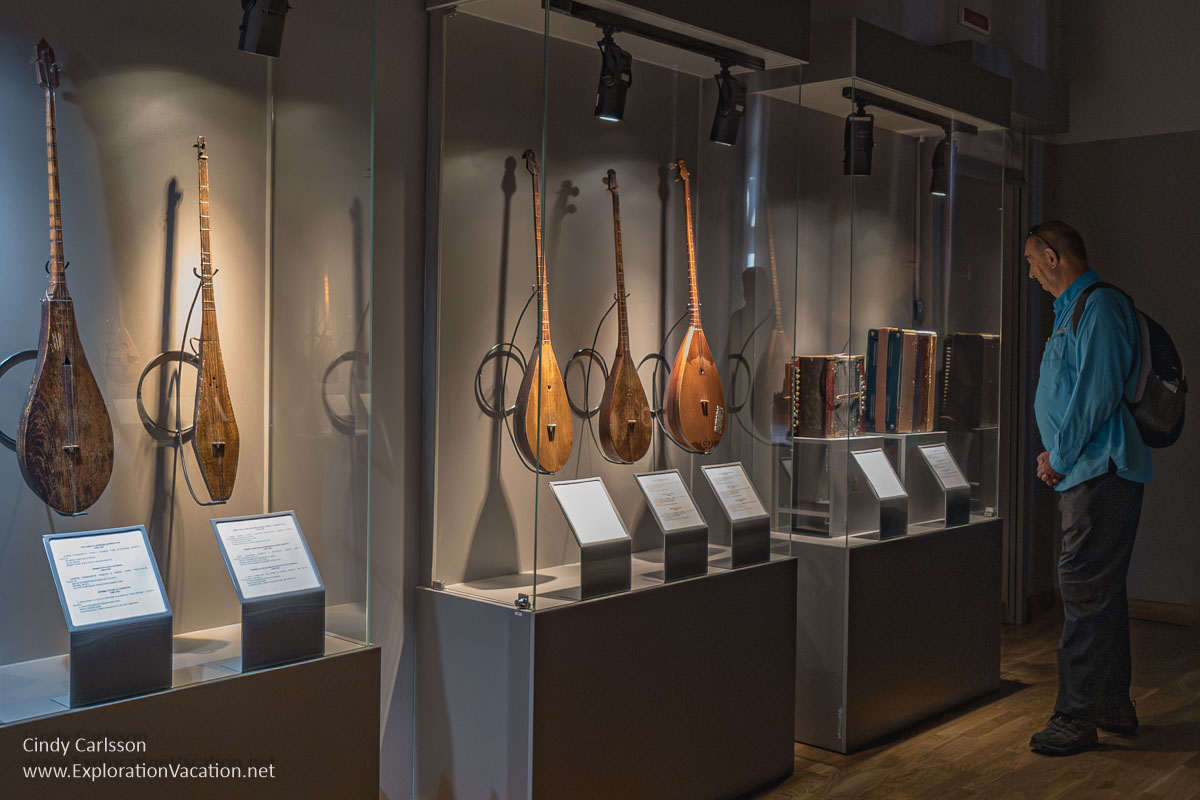
Traditional musical instruments once owned by noted Kazakh musicians.
Housed in a building designed by the builder of the Ascension Cathedral and built at the same time, this is another traditional wooden Russian building. It, too, has served various functions over time, including as a Soviet officers club and a puppet theater, before becoming the musical instrument museum in 1980.
The museum has more than 1,000 items. Galleries focus on the history of Turkic music, musical instruments (both historic and contemporary) of Kazakhstan and other Turkic people, as well as pieces and recordings by contemporary masters, and instruments from around the world. It’s a fascinating little museum.
You can read a little more about the museum (and see its cool building) on Shahina Travel.
Art museums
The Kazakhstan Museum of Arts (officially the Abilkhan Kasteev State Art Museum) is the largest art museum in Kazakhstan, with a collection said to include over 23,000 works. The broad range of the collection appealed to me, but especially the promise of seeing both historic and contemporary Kazakh art, craft, and decorative arts. Not that the Russian, Soviet, Western European, and East Asian collections didn’t look interesting as well.
As of 2026, a new art museum, the Almaty Museum of Arts, is now open. The heart of this museum seems to be contemporary Kazakh and other Central Asian art. It looks fabulous
Central State Museum
The Central State Museum was once housed in Ascension Cathedral. Today the museum’s collection includes more than 200,000 artifacts housed in a modern building specifically designed for the museum. Although the museum does have a large art collection, it appears to be more of a natural and cultural history museum.
You can find a lot more information on the Central State Museum on Shahina Travel.
Green Bazaar
Also referred to as the Green Market, Zelony Bazar, or Kok Bazar, this is a huge indoor market. The main floor (the only section I visited) has huge areas given over to specific foods: Fresh fruit, dried fruit, and nuts of all types (the pecans are incredible); herbs, spices, and tea; candy and sweets; baked goods; cheese and other milk products; meats of all kinds, including dried meats and sausages; both fresh and smoked fish; and more!
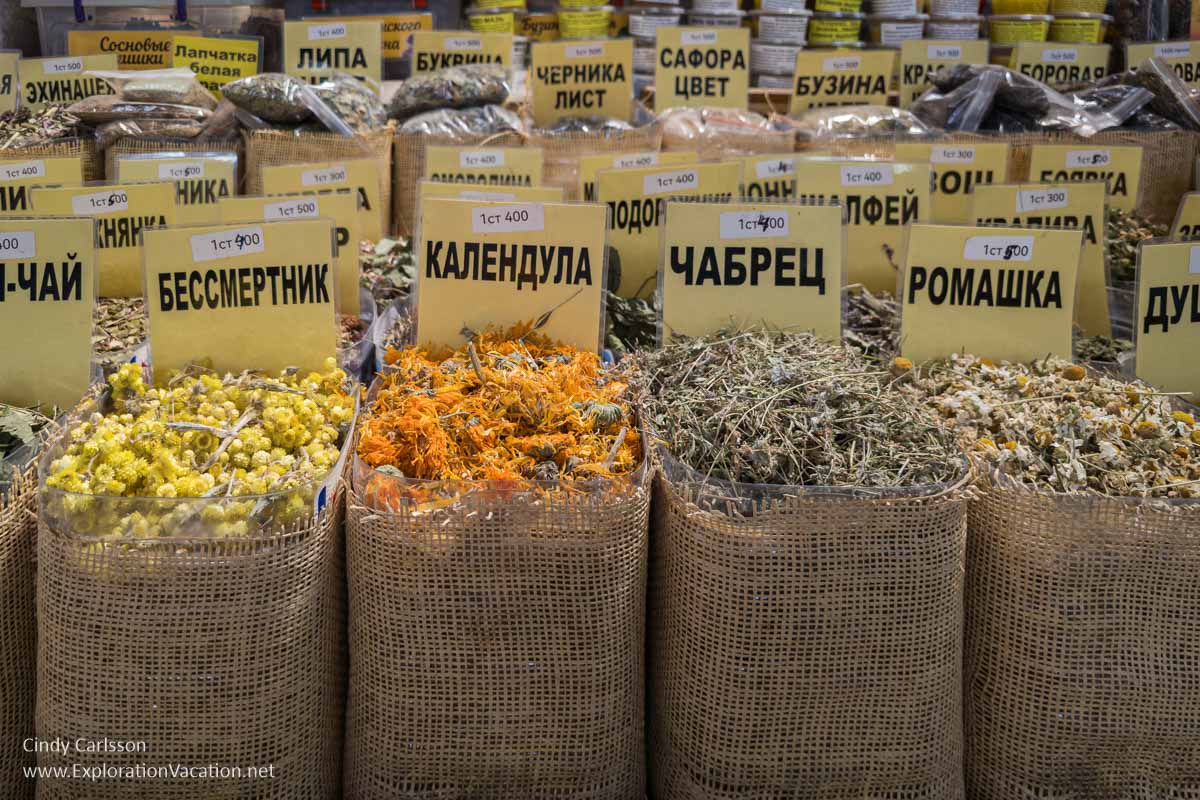
You can buy many different herbal teas at the market or find everything you need to mix your own!
There’s a huge variety of edibles for sale (including salads and other ready-made take-out items) and the market is very clean. Upstairs you’ll find clothes, shoes, household goods, furniture, and more.
Bargaining is expected throughout the market.
You can learn more about this market’s history (although they call it Zeleny Bazaar) on She Travels Abroad and Shahina Travel.
Zhibek Zholy Street
Pedestrianized Zhibek Zholy Street (and particularly the Arbat area) is filled with places to eat and shop for art and other fun things. The area is cheerfully lit at night and is the go-to place for locals and visitors alike in the evenings. That’s particularly true as the weekend rolls around, when the restaurants and shops are a backdrop for impromptu stalls selling food or art, buskers and bands playing music of all sorts, and street performers of all types. There were literally people dancing in the street the night I walked through on my way back from dinner.
Take a day trip to the Tanbaly (Tamgaly) Petroglyphs World Heritage Site
Less than 3 hours from Almaty, the Petroglyphs of the Archaeological Landscape of Tanbaly (Tamgaly) UNESCO World Heritage Site preserves about 5,000 drawings carved into rocky canyon walls and associated altars, burial sites, and settlements. Images have been carved in the rock here over several thousand years and include some of the finest rock art in Central Asia.
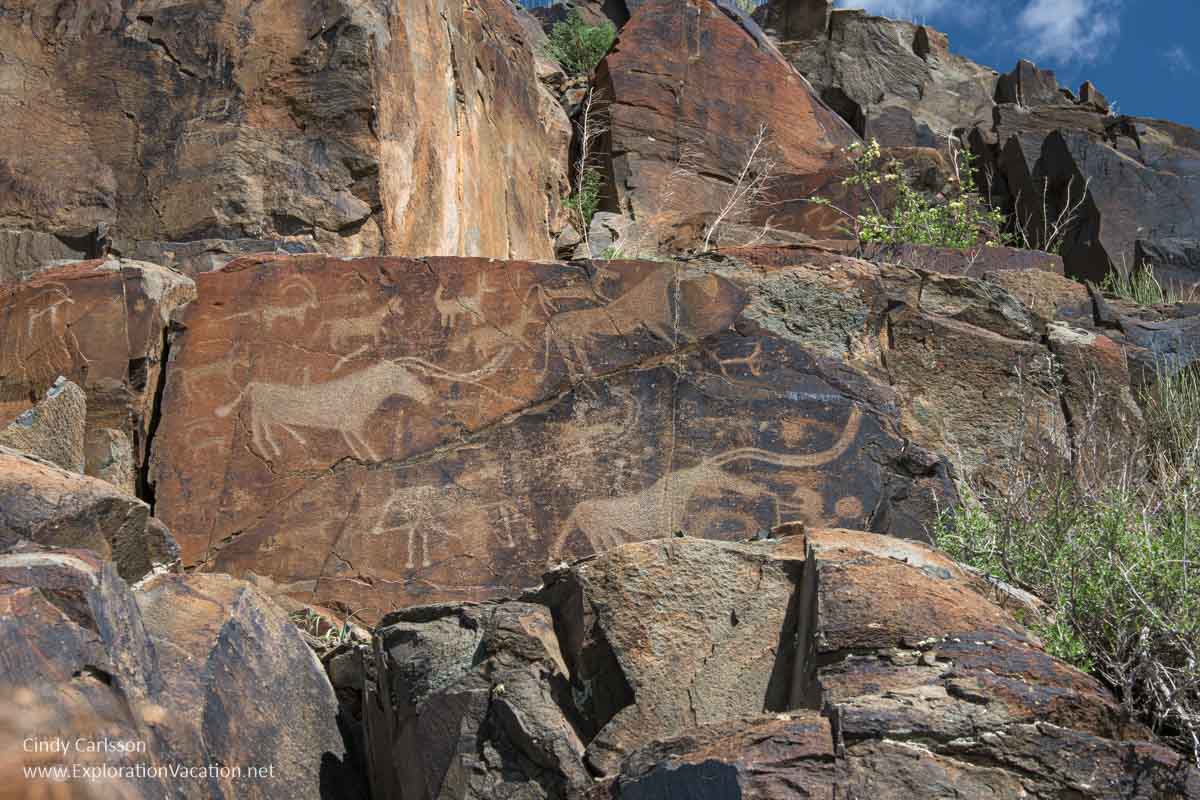
People have been carving drawings into the rock at Tanbaly since the Bronze Age.
Read more about visiting these rock carvings at WorldHeritageSites.net.
👉 Read less
You’ve probably noticed I have links to Almaty information on the Shahina Travel website. I have no connection to this company and no idea if they are a reliable tour company. What I do know is that they have one of the few websites with comprehensive information on Almaty.