Last updated on June 10th, 2026
Looking for a road trip where you can take in stunning mountain scenery, beaches, or one of the world’s most active volcanoes without driving more than an hour or two each day? The Indian Ocean island of Réunion has all this and more. And, as a department of France, you are in the European Union. That means spending Euros and standard European road signs. But on an otherworldly tropical island off the coast of Africa.
As the entire island is slightly smaller than the US state of Rhode Island, you can drive all the way around the coast in a day. But there’s a lot more to see inland, where the verdant mountains and desolate volcanic plains of the island’s UNESCO World Heritage Site can only be reached via roads that may have hundreds of switchbacks. If there is a road at all. . .
Curious?
Find out how I spent my week road tripping on Réunion and get tips for planning your own trip to this magical island.
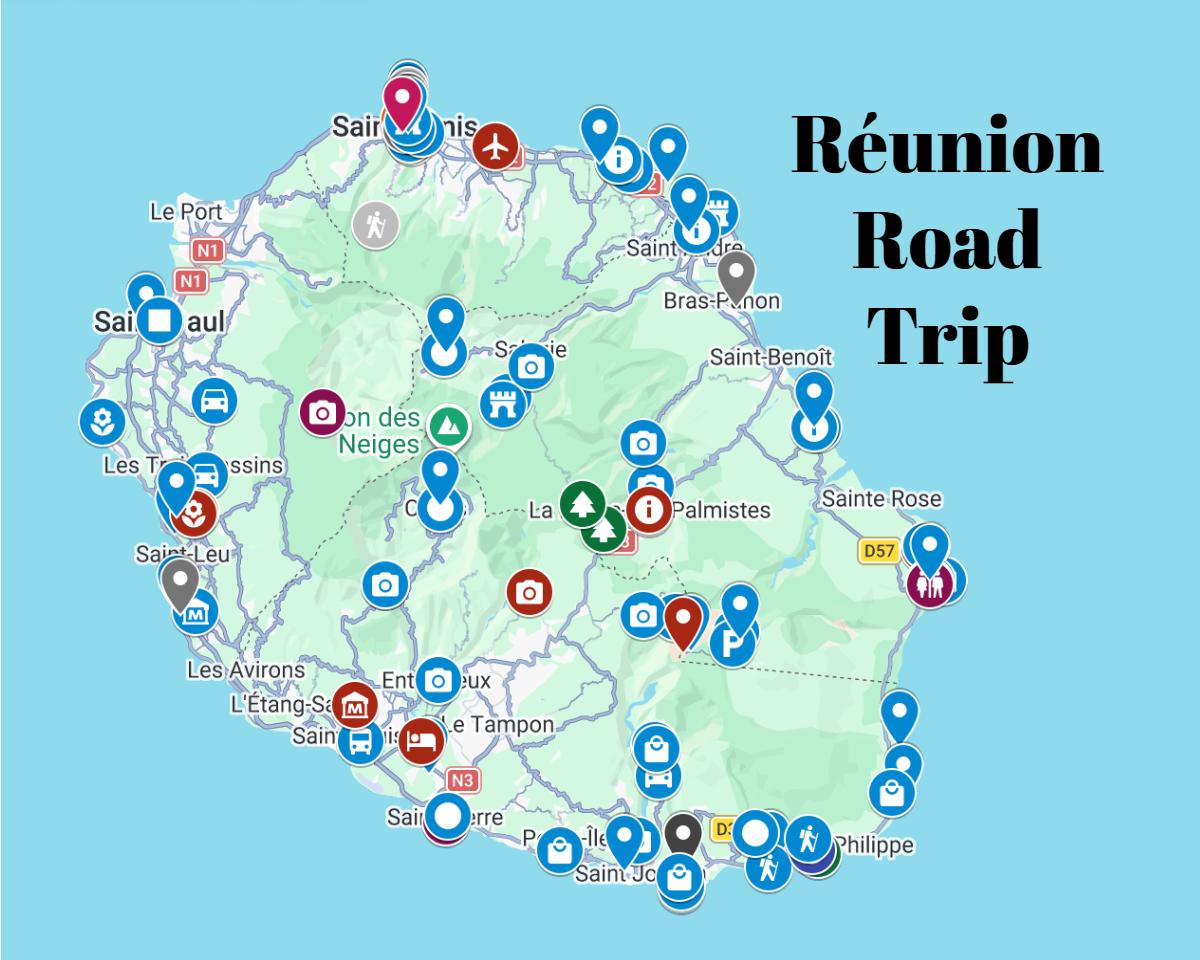
Map of Reunion with things of interest to me. (Click to get an interactive Google map..)
I included the fact that we relied on a vehicle for our adventures right in the title because you can explore the island without renting a car. And many island visitors spend the majority of their time here exploring on foot, either hiking and climbing in the mountains or staking out a spot on a beach. That includes my almost-neighbor, who wrote about his very active and adventurous trip and discussed why you should visit Reunion on his website.
While Réunion is very far from Europe, let alone the Americas, it’s a beautiful place with a rich culture that is very much worth the long trip.
I use links to improve your experience using this website. Some may be affiliate links that pay me a small commission if you use them to book a room, rent a car, or purchase goods or services. You don’t pay extra, but it helps keep this website running. To learn more, see my policies and disclosures.
My week on l’île de La Réunion
Since we were traveling on Réunion during cyclone season (January), when the weather is unpredictable, I didn’t plan a set itinerary. Instead, I made a list and the above map of things we would like to do if we had the time and cooperating weather. Likewise, our lodging was reserved very much at the last minute, as we decided a few days in advance where we wanted to be next and for how long. In general, this worked pretty well. The only downside was not feeling confident enough of the weather and where we’d be located on any given day to book land or air tours in advance. If you are traveling at other times of the year, you’ll usually want to book lodging and tours in advance.
Day 1: Arrival in Réunion
Getting to Réunion from New York City involved a 6½-hour overnight Delta flight to Paris, a most-of-the-day layover in Paris (Yotel let us get at least a little real sleep), a 10½-hour flight on Air France to the Island of Mauritius, a four-hour layover on Mauritius, and then (finally) a 45-minute flight on Austral Air to Réunion. You can fly to Réunion direct from Paris on a couple of different airlines, but not Delta/Air France. We also needed to end our trip on Mauritius, and there didn’t seem to be a round-trip option out of Paris that would let us fly into Réunion and out of Mauritius.
We had a little time to look around the Mauritius airport. Architecturally, it was pretty interesting in a space age meets the tropical jungle way. So, I spent some of my layover just wandering around checking it out.
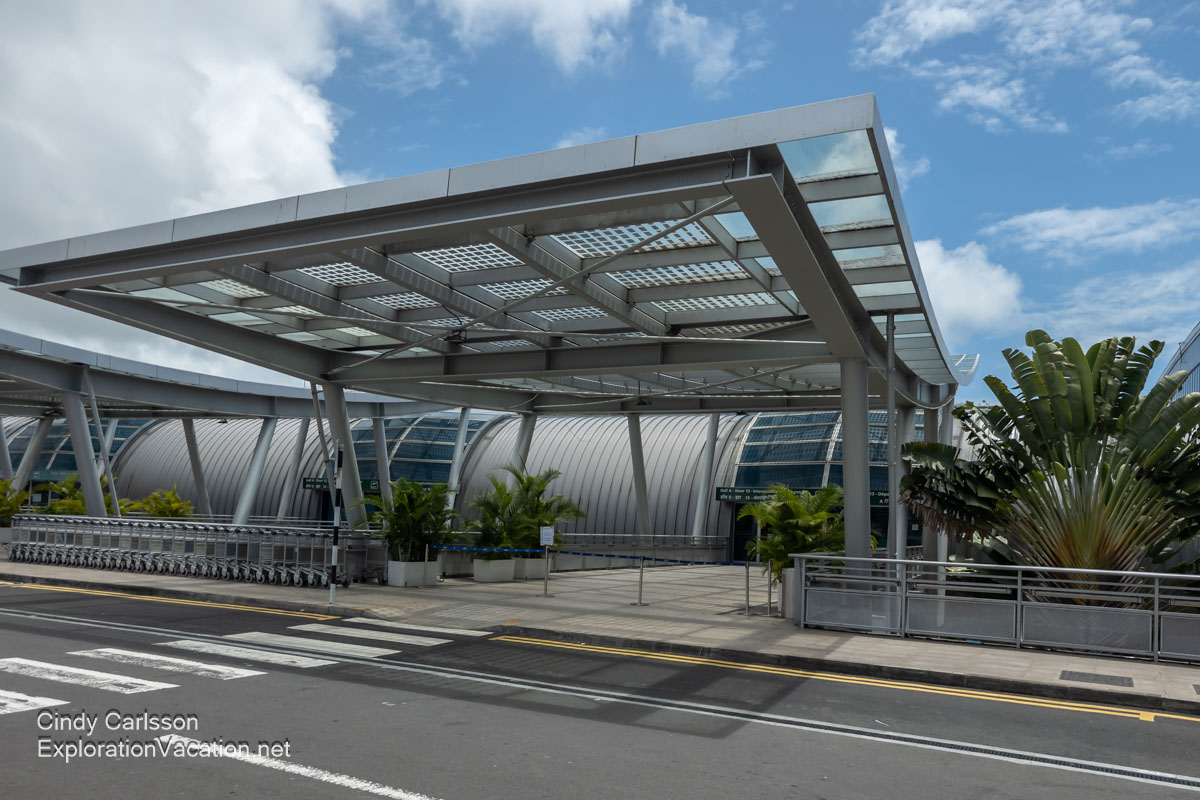
The Mauritius airport has some interesting design features, some of which I suspect helped make it a more sustainable facility.
Back in the air, I was really looking forward to seeing Réunion from above because I knew it was mountainous. However, we were also traveling during the rainy season. So I wasn’t surprised that the island was largely swathed in clouds when we flew in!
As in Mauritius, the Réunion airport is pretty cool. I didn’t take many photos because, well, it was late afternoon, and we needed to get our luggage, get our rental car, and get up to our house in the mountains. Preferably before either darkness or rain arrived.
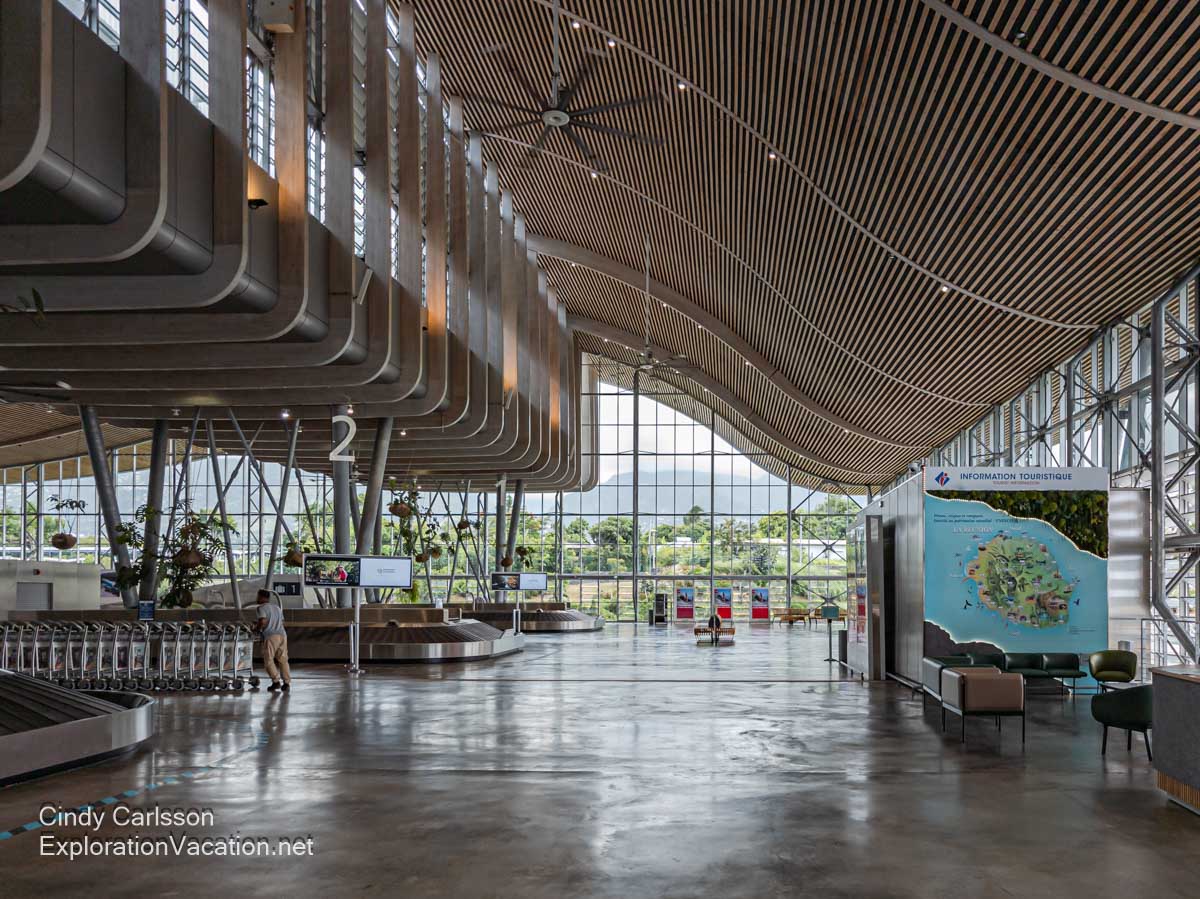
We had a full flight coming into Réunion, but it didn’t take long for everyone to get their baggage and clear out!
Days 1 & 2: Cirque de Salazie
We chose to spend our first night in the Cirque de Salazie, one of three cirques (massive natural amphitheater-shaped depressions surrounded by towering walls) on the island. All three (Salazie, Cilaos, and Mafate) are included in the island’s Pitons, Cirques, and Ramparts of Reunion Island UNESCO World Heritage Site. It was one of the top places I wanted to see, and it was a relatively easy hour or so from the airport, so that made it an obvious choice for our first night.
Did I mention this is the rainy season?
The rain started almost the moment we started up into the mountains, raining hard enough to create waterfalls everywhere. But that heavy rain didn’t last very long (and French roads are good), so it wasn’t too bad of a drive up. . . And we weren’t going up too high.
Finding our lodging was another matter. However, after a too-long drive up a mountain track through banana fields, a nice man directed us back down the mountain a bit and over to his “neighbor’s” house, where our lodging was located.
The house was pretty basic, and the sun was getting low enough it was hard to see the view. (A mountainside full of waterfalls.) We really just wanted to get to sort out our luggage and get some sleep, so we had a couple of granola bars for dinner and called it a day.
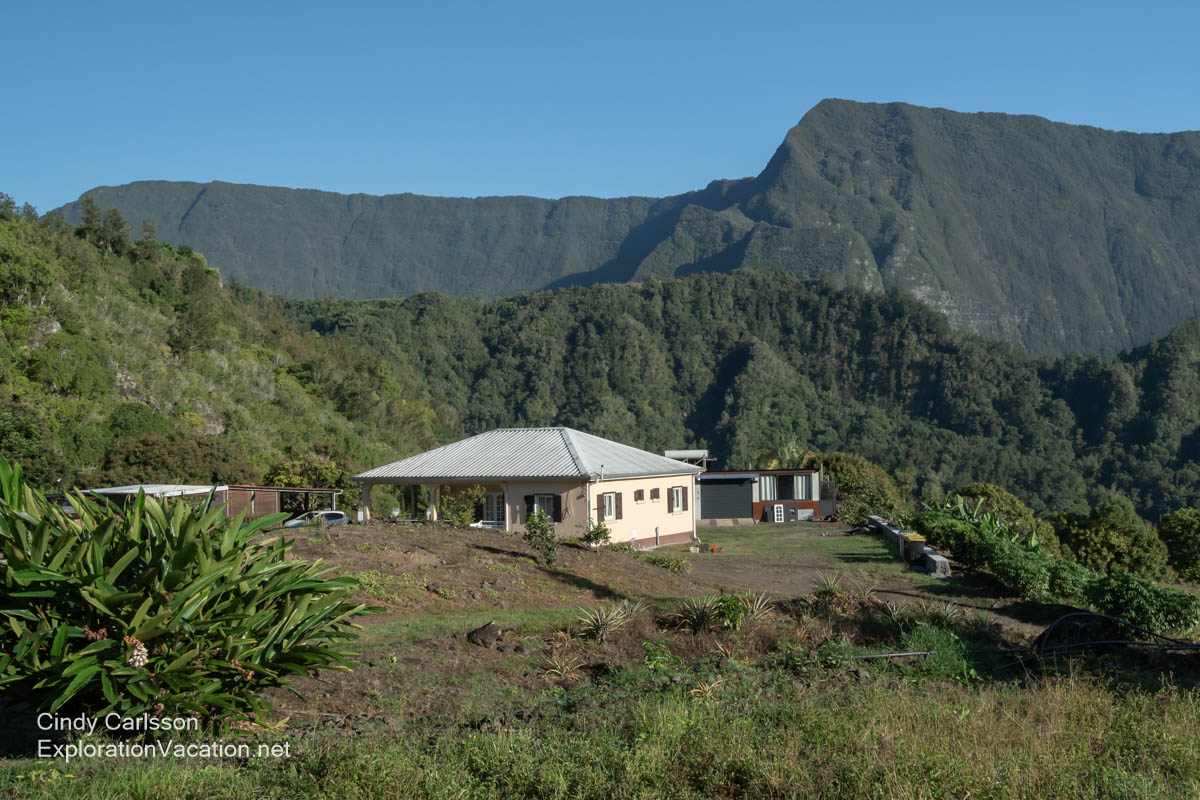
Our house for the night, photographed the next morning.
We followed our host’s suggestion to take the bedroom that had the best morning view.
She wasn’t kidding. The morning light on the surrounding mountains was gorgeous. So, it was nice to have a chance to enjoy it before we were ready to head out and explore the area.
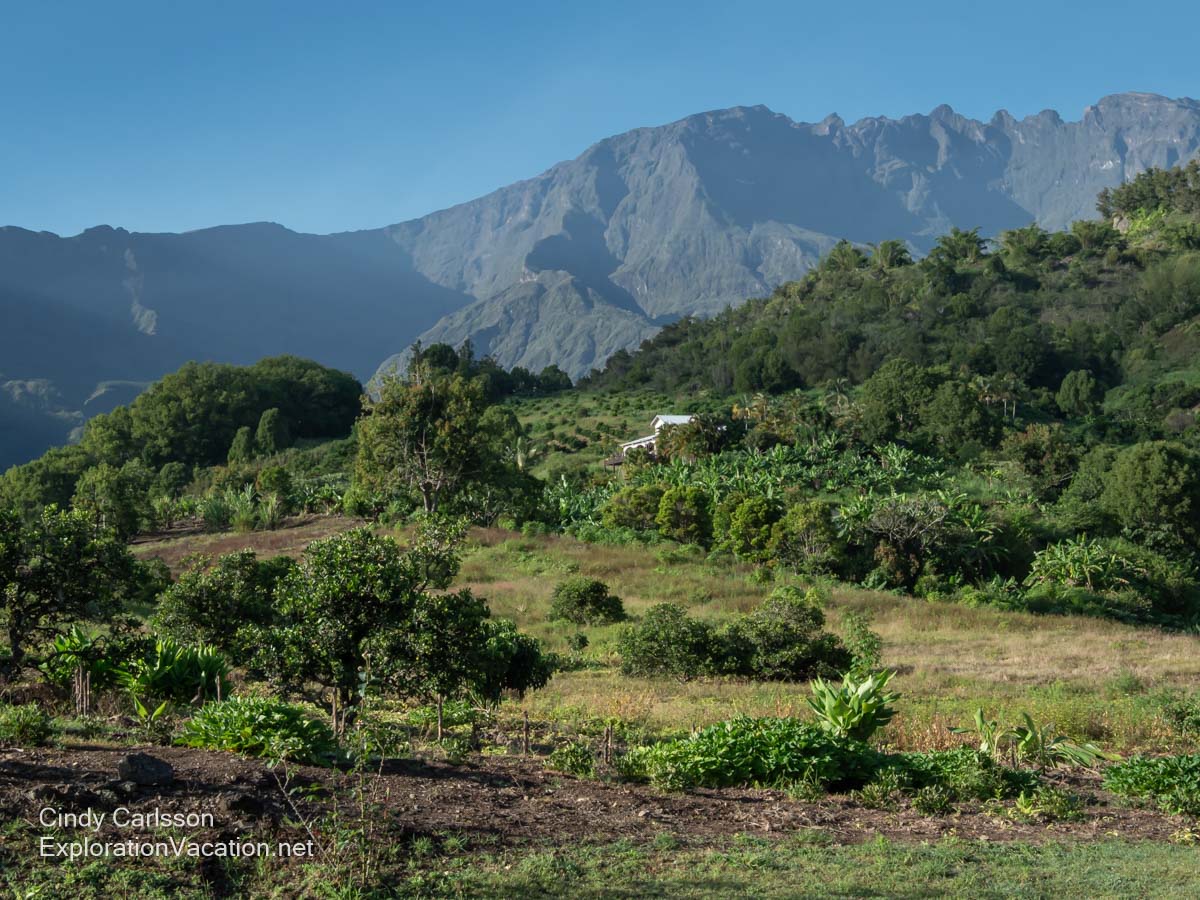
When we were ready to venture out, this was part of the view from our house. (The waterfalls were in shadows while the mountains behind us were in the sun, so this is the LEAST dramatic bit of scenery immediately around us.)
The ultimate goal for the morning was the town of Hell-Bourg (in another part of the cirque), but we made a couple of side trips in the area where we were first.
👉 See more of our tour of Cirque de Salazie . . .
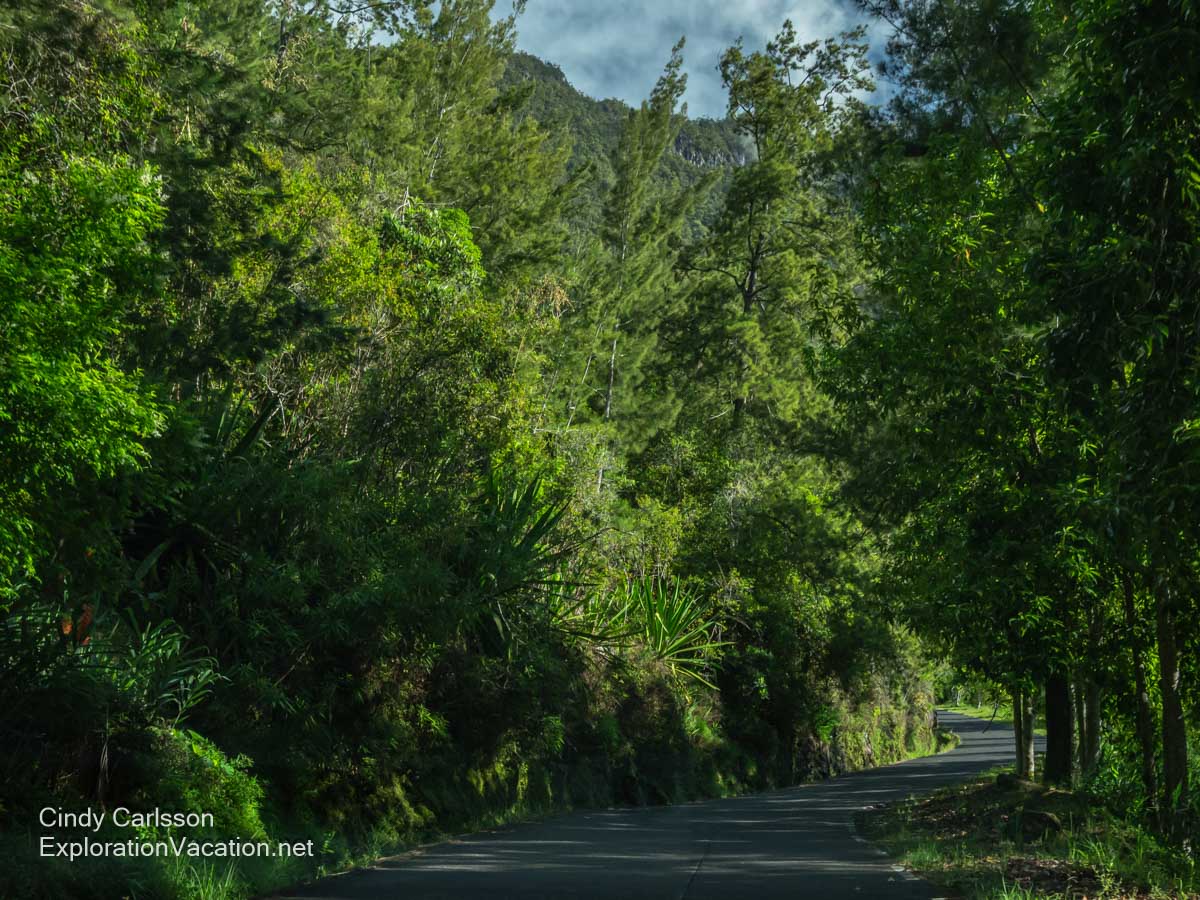
While there is a lot of amazing mountain scenery, dense vegetation hides a lot of it as you drive along.
The challenge here was a narrow road with deep drainage ditches two inches from the white stripe at the edge of the road combined with almost no places to pull off and enjoy the view. But we did find a couple of places to stop, so you can see how beautiful it is!
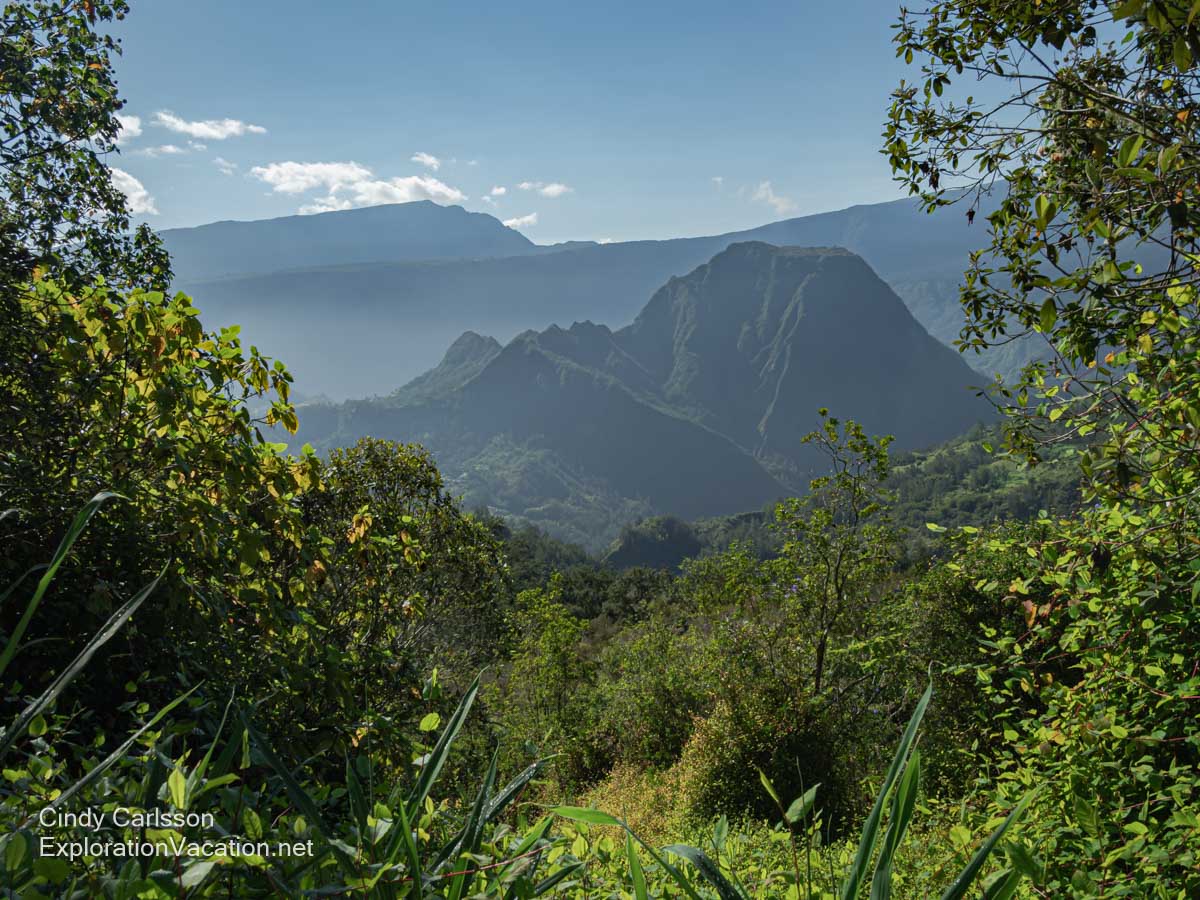
View from a pull-off at a trailhead.
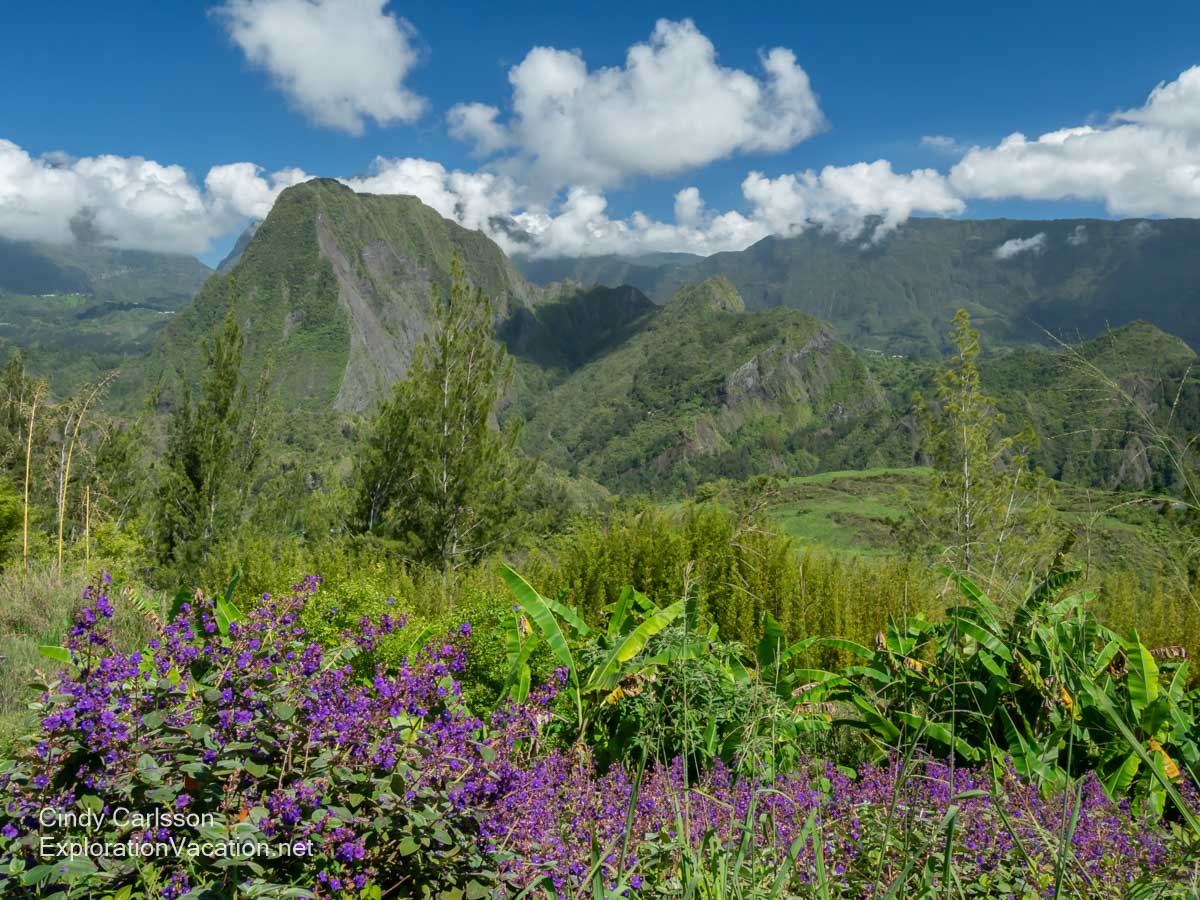
Mountains and flowers along the way in the Salazie Cirque.
By late morning we were in Hell-Bourg. A town described as one of the most charming Creole towns on the island. So, we got a bite to eat and did a little exploring on foot. (But just a little, because it was already really hot and humid!)
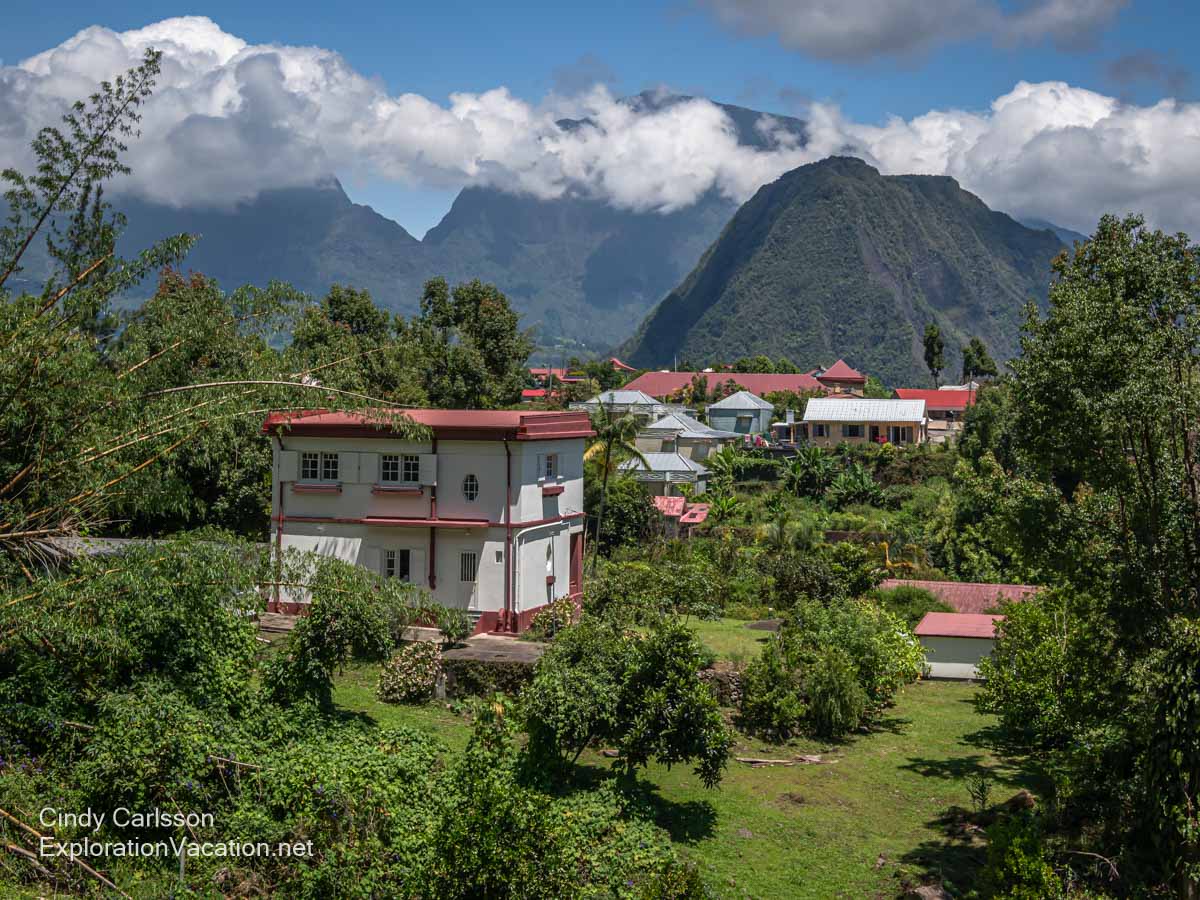
Hell-Bourg from the mountainside slightly above town.
Hell-Bourg lived up to the tourism hype! It’s a charming little town in a beautiful location.
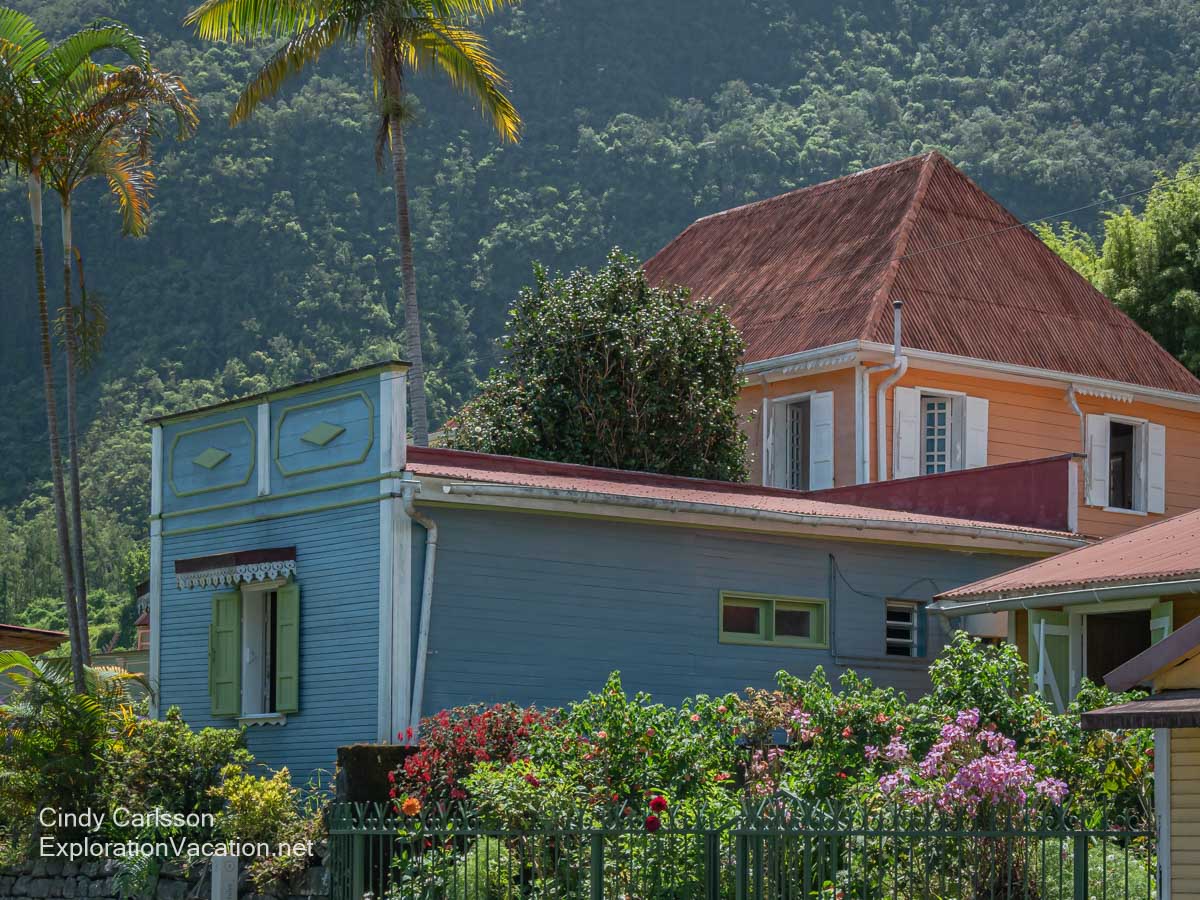
Colorful Creole buildings (and gardens) in Hell-Bourg.
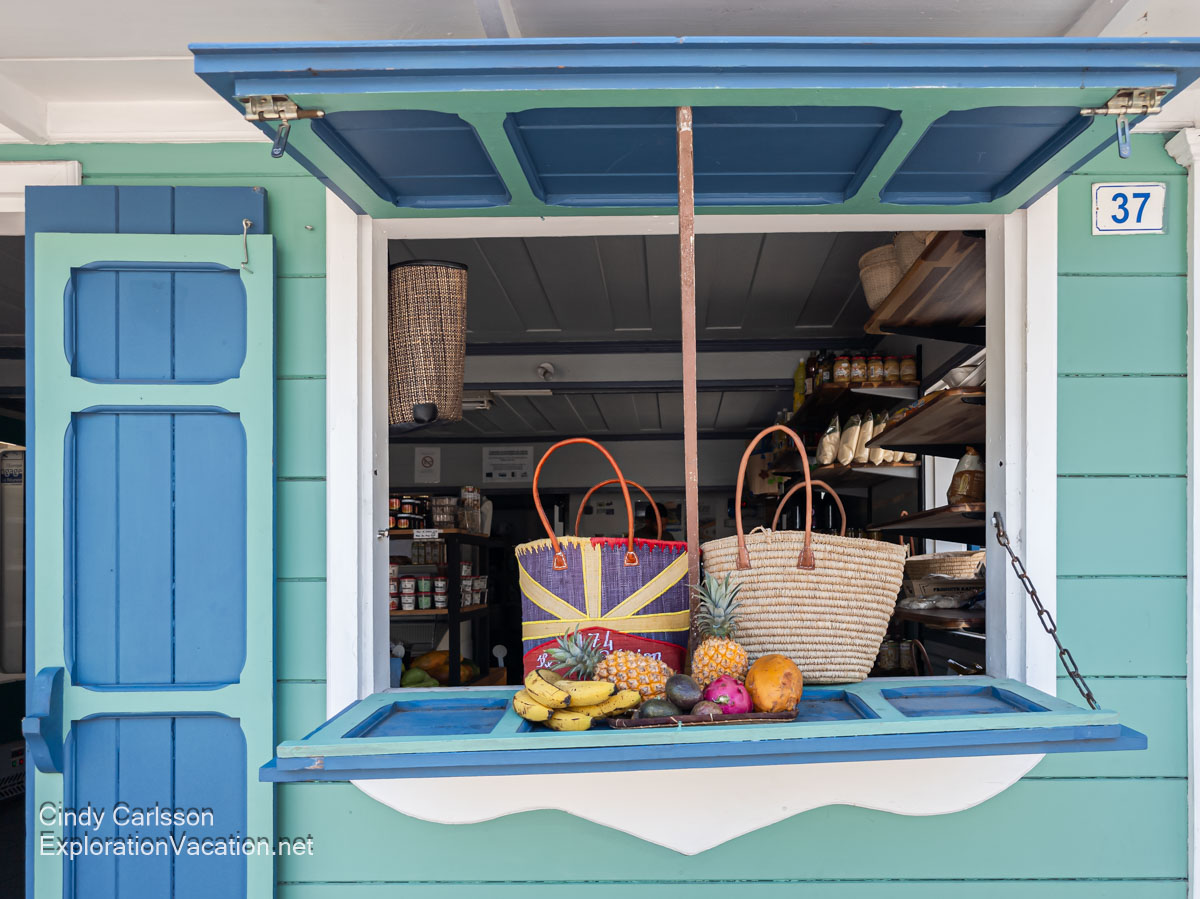
A window display at the Hell-Bourg grocery store.
We made one more stop as we headed down and out of the cirque. That was to see Bridal Veil Waterfall, the lower section of the multiple waterfalls we could see from our house last night.
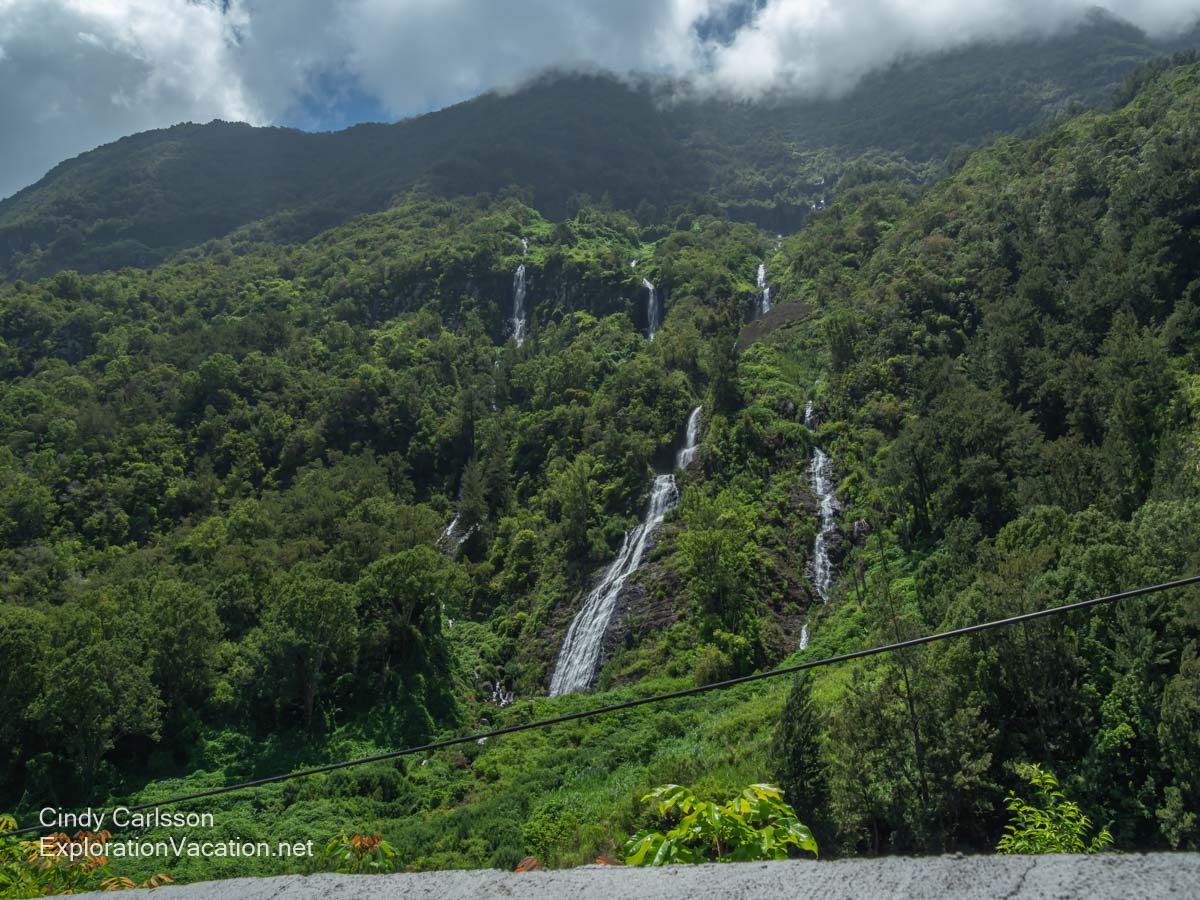
Bridal Veil Falls is supposed to be an area highlight, but maybe you have to hike to get a decent view.
Oh, well. It’s still a nice waterfall, even if the view is marred by high walls and power lines!
👉 Read less
Day 2 continued: Crossing the island
Our lodging for the next few days was located on the other side of the island.
We had two ways to get there: Drive around the island along the coast or cross through the center along a mountainous ridge.
We chose the central ridge, largely because it appeared it would be clear enough to get good views over the island toward the sea AND so I could stop at the Réunion National Park visitor center to better plan my time in the island’s National Park/UNESCO World Heritage Site.
The scenery was nice (at least where it wasn’t too hazy), but not as spectacular as earlier in the morning.
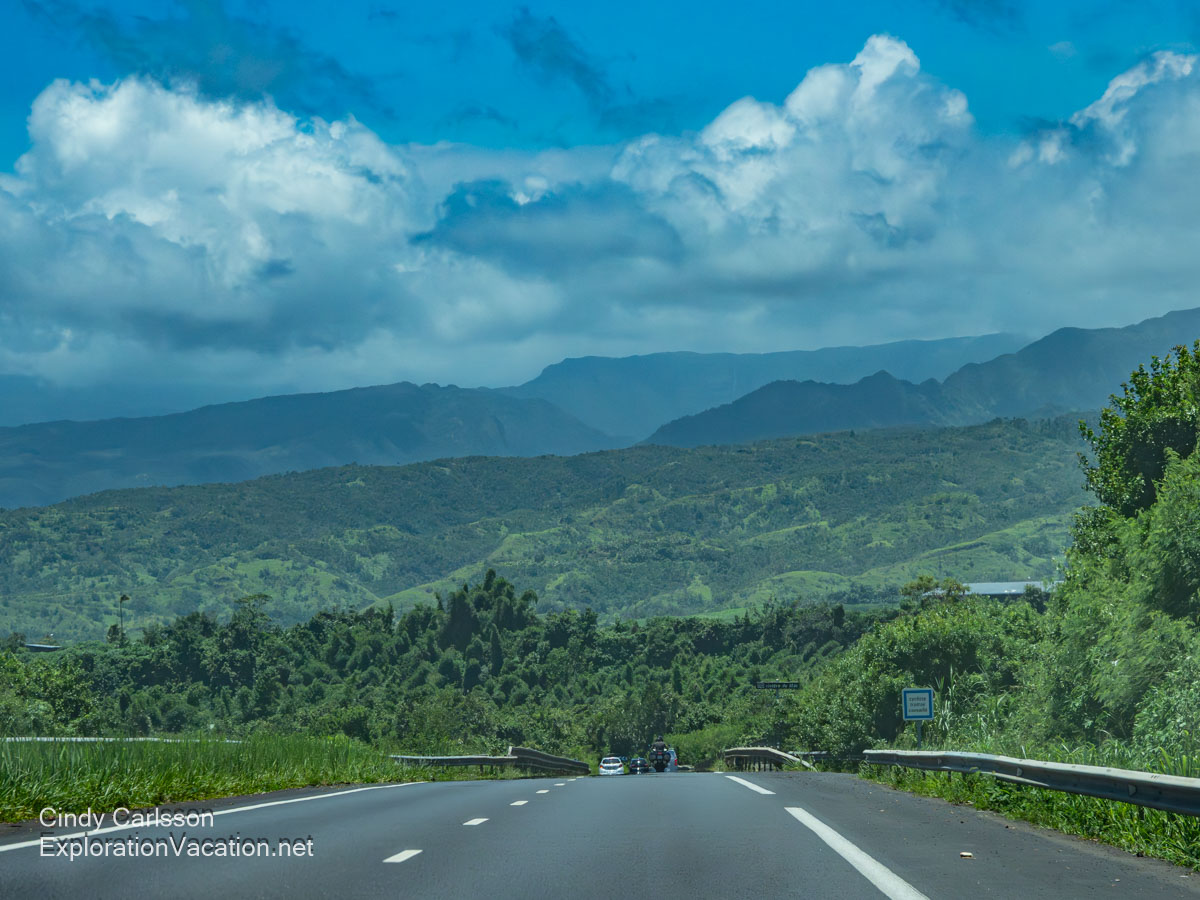
Heading across the island.
The major town along this route is La Plaine-des-Palmistes, which looks like a pretty nice place to explore. (It has some great buildings, both Creole and modern.) But we wanted to get to the park visitor center to learn more about the national park and the best options for seeing the most we could in the rather limited time we had. (And without major hiking.)
As it turns out, the building that houses the park headquarters, visitor information, and a permanent exhibition about the park (along with various other agencies and offices) is a stunning example of sustainable architecture.
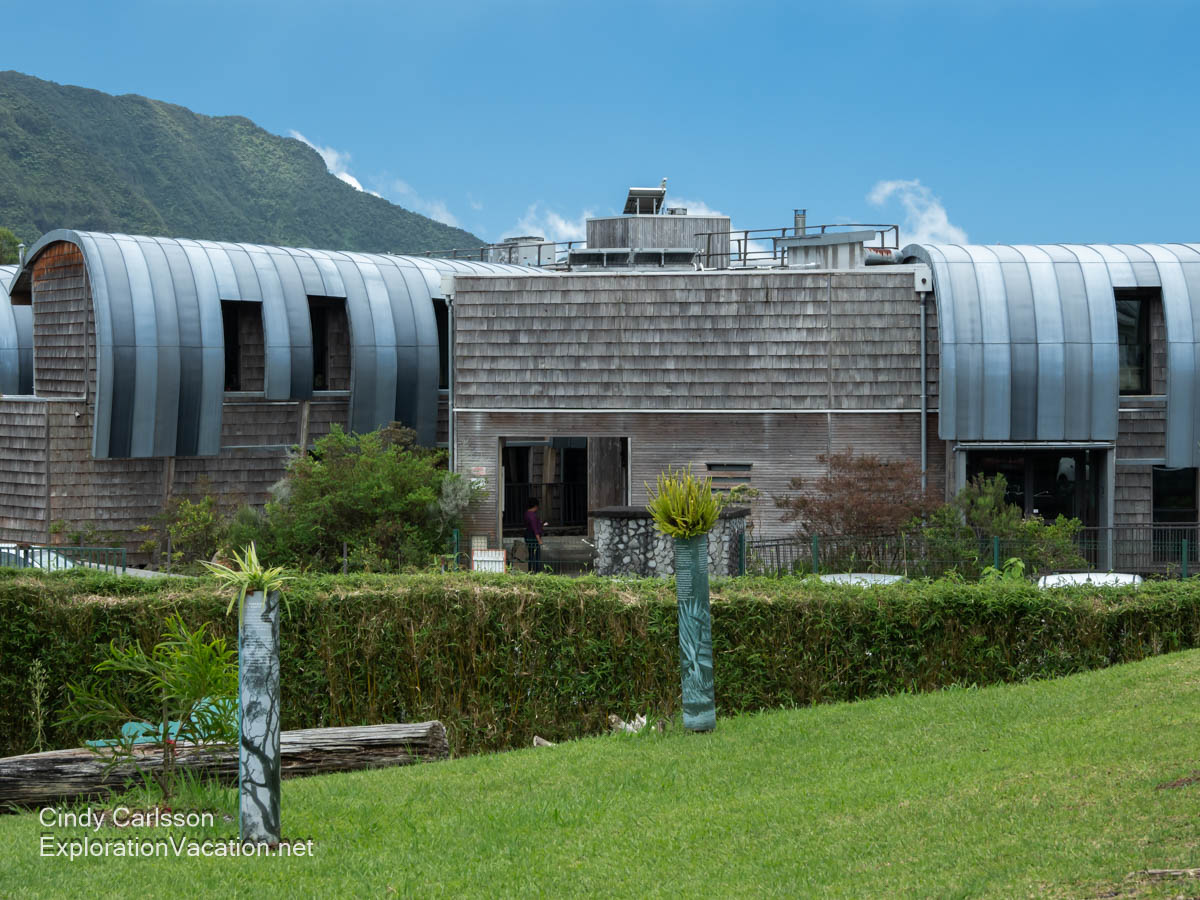
Just part of the elaborate building where the park headquarters and other agencies are housed.
Of course, we arrived right after noon on a Monday. And this is France. That means we weren’t surprised when the building was closed. But the sign said it opened again at 1:30, so we decided to see what else was around.
“What else” was a large park-like site with a number of historic buildings now used for artists’ workshops, galleries, restaurants, and a museum or two. One restaurant was open, but it didn’t look that appetizing, so we just wandered around trying to figure out what this historic site actually was. (It’s a historic estate, but the outdoor museum part seems to focus on some kind of camp or settlement for poor white people who were welcomed here by freed slaves. Or something like that. Google Translate can only handle so much.)
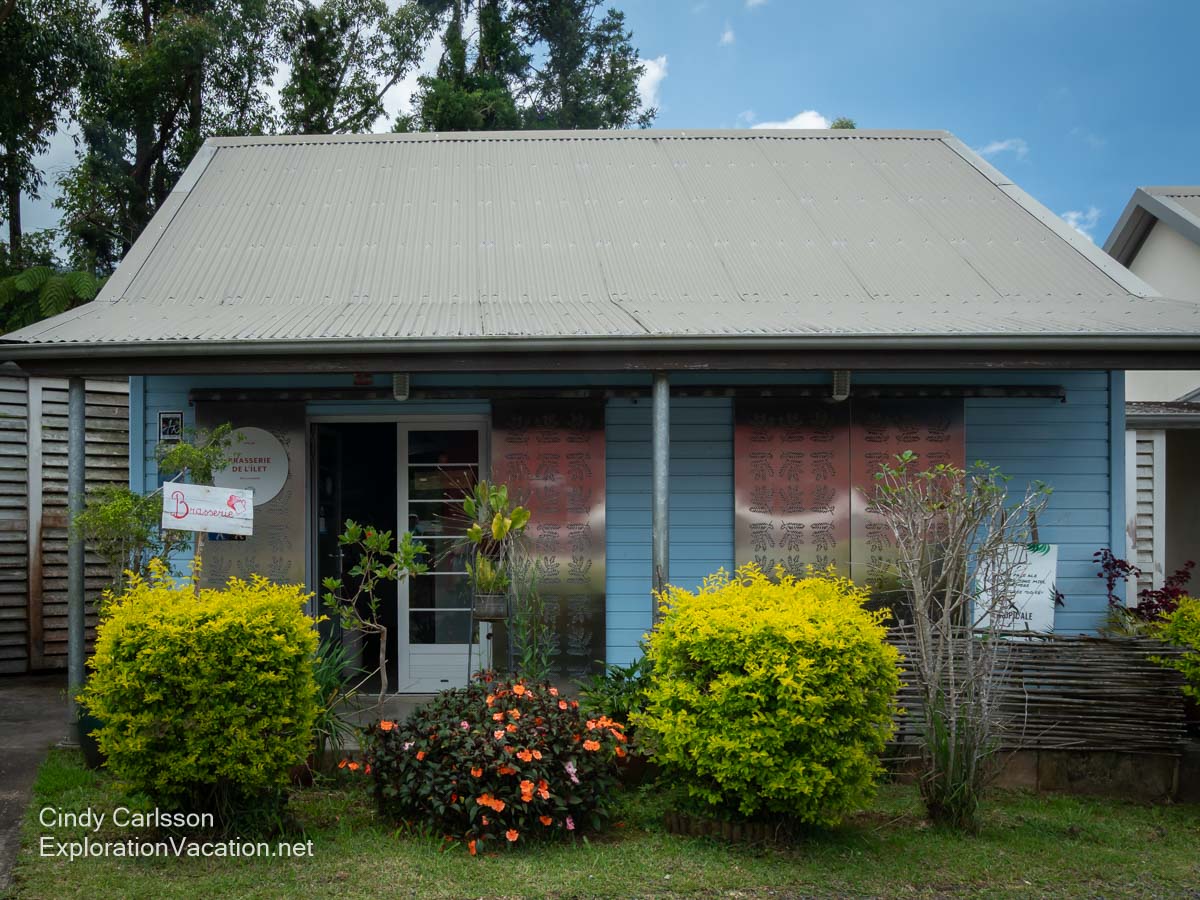
One of the historic buildings on the site. Sadly, despite appearances, it was not actually open for business.
At 1:30 we headed back across the parking lot to the park visitor center. And waited. And waited. And waited a bit more before finally taking a closer look at the sign on the door. The visitor center is closed on Sundays and Mondays. But really, why would anyone (other than us) want to visit a national park on a Monday anyway?
So, it was back on the road again.
(I never did get back to the visitor center. Or anything else in town, for that matter.)
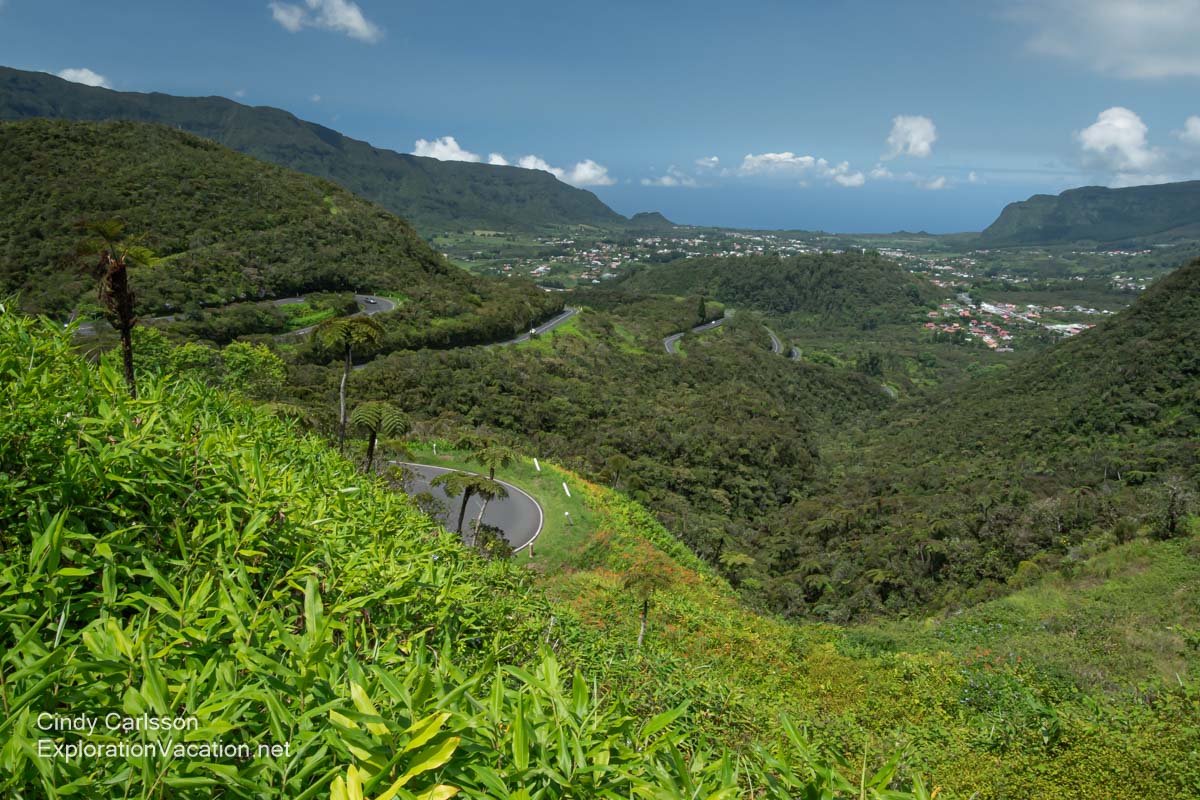
Plenty of switchbacks, but the scenery got more dramatic as we traveled west toward the other coast.
Day 2 continued: Settling into Saint Pierre
Saint Pierre is supposed to be a fun town, but not as much of a party town as others further up the coast. I choose it mostly because it is a good jumping-off point for travel in multiple directions. And I chose a cottage that was sort of on a route out of town, in hopes of avoiding the city’s notorious congestion. (That was a fantasy. Traffic is terrible everywhere in and around the city.)
Maybe Saint Pierre is a fun place to stay, but I didn’t see much to like on either our initial drive through or later journeys in or through town. Maybe the beach area (which we never got to) is pleasant, but it was horrible to drive through the city. (Plenty of ugly buildings and unpleasant spaces if you wanted to try to walk anywhere.) But, like I said, we didn’t get to the touristy part of town. (That required going through a LOT more of town than seemed worth it. Even for a reputably wonderful Indian restaurant we wanted to try.)
But our cottage made the hassle of getting to it well worthwhile!
It was new, well-designed, and comfortable, with private parking, cold Dodo beers waiting for us in the refrigerator, and an English-speaking owner who had actually been to Minnesota and was thrilled to have his first guests from the USA. And we had a private garden with a pool.
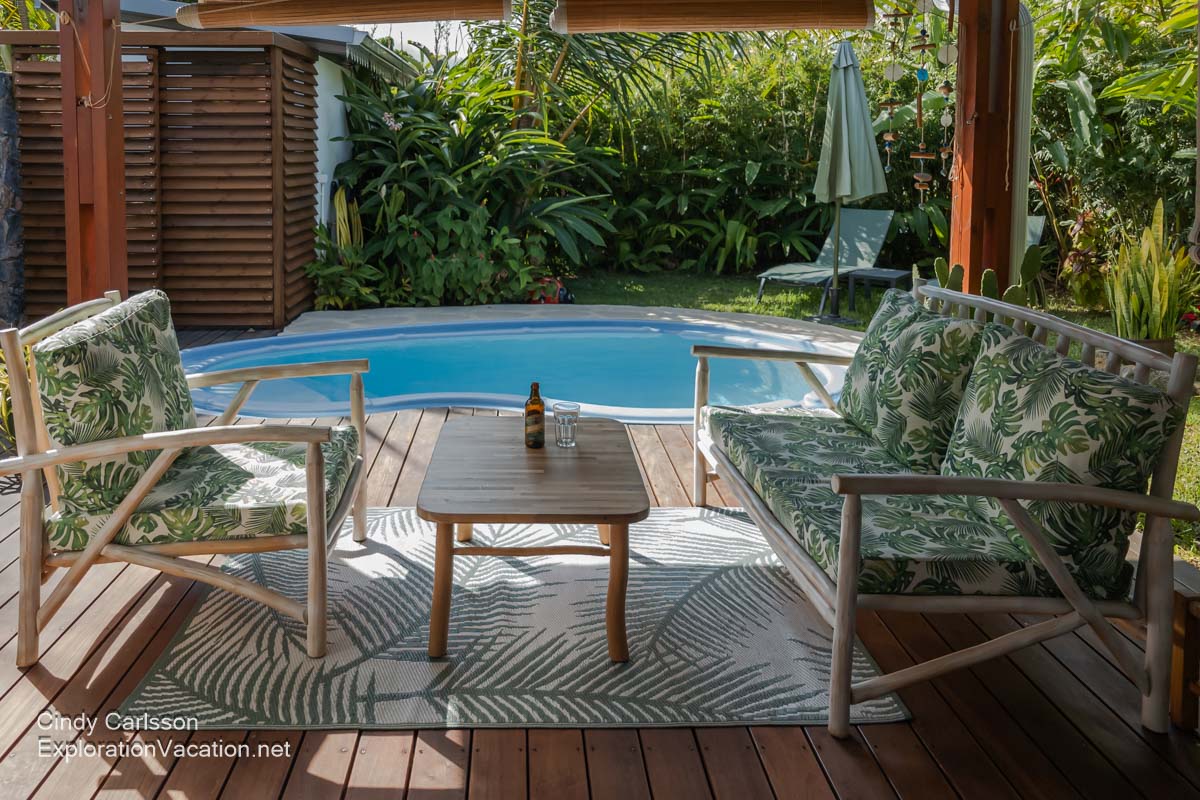
What could be better at the end of the day than a private pool in a tropical garden? A cold Dodo beer!
It was fabulous and very reasonably priced. If you are headed to Mauritius, this is a great base, and I highly recommend it. I found it on Booking.com, where you can also get cash back through Rakuten. They also have a second unit next door, Bungalow Vetyver, that has a view of the sea. That can also be booked through Booking.com.
Day 3: Visiting the botanic garden
Our plans for the morning included a visit to one of the relatively nearby botanical gardens. Of course, it was located up a frightfully narrow road with a seemingly unending series of switchbacks. Much of it was through sugarcane fields, but there were also plenty of villages to work our way through without meeting anyone head-on.
But at last we arrived.
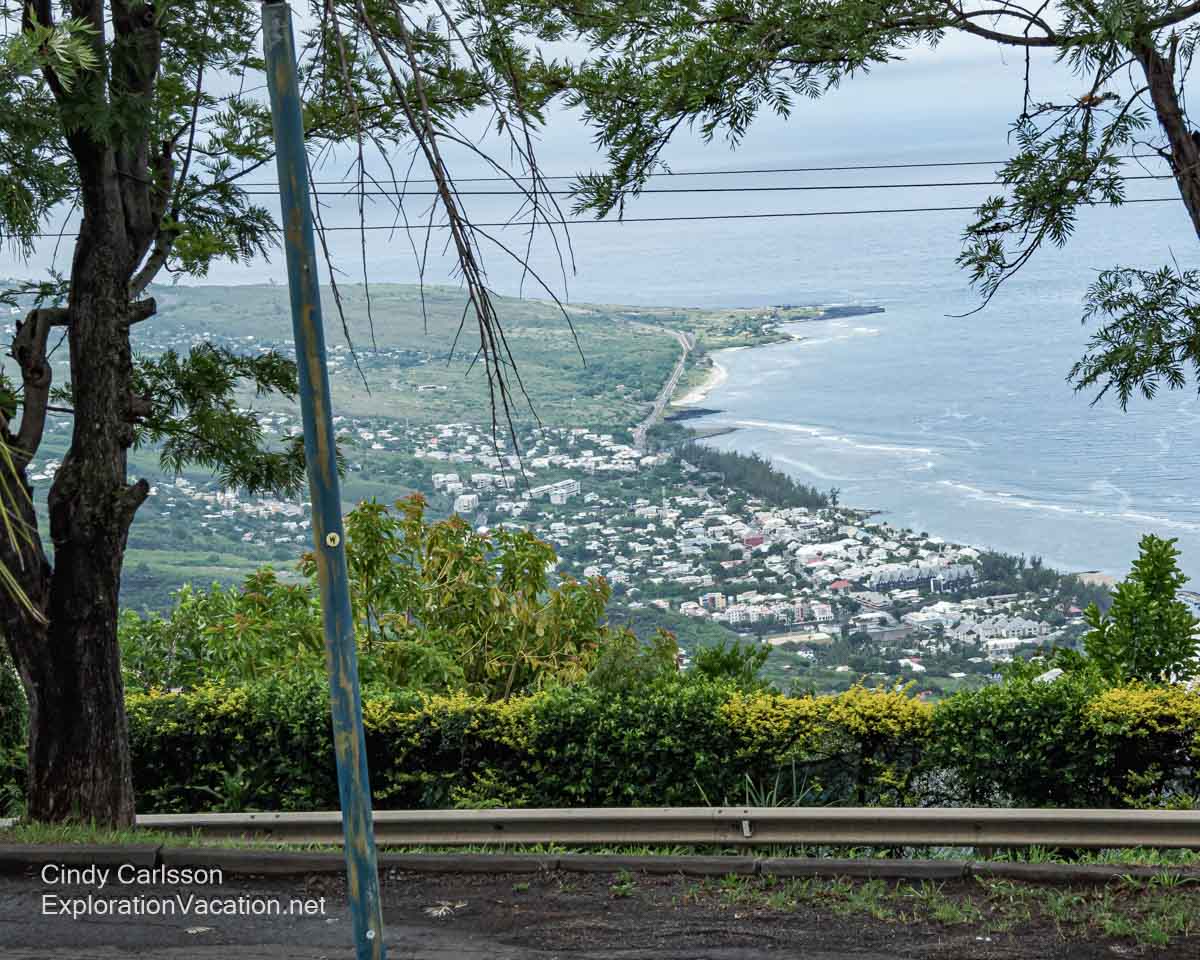
A view of Reunion’s west coast from the parking lot at the botanical garden.
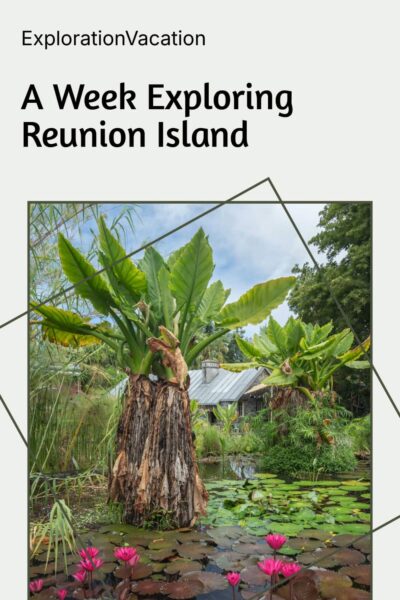
The Mascarin National Botanical Conservatory is located on the grounds of a 19th-century Creole farm. While it flows around various historic buildings, the garden itself is a relatively recent creation.
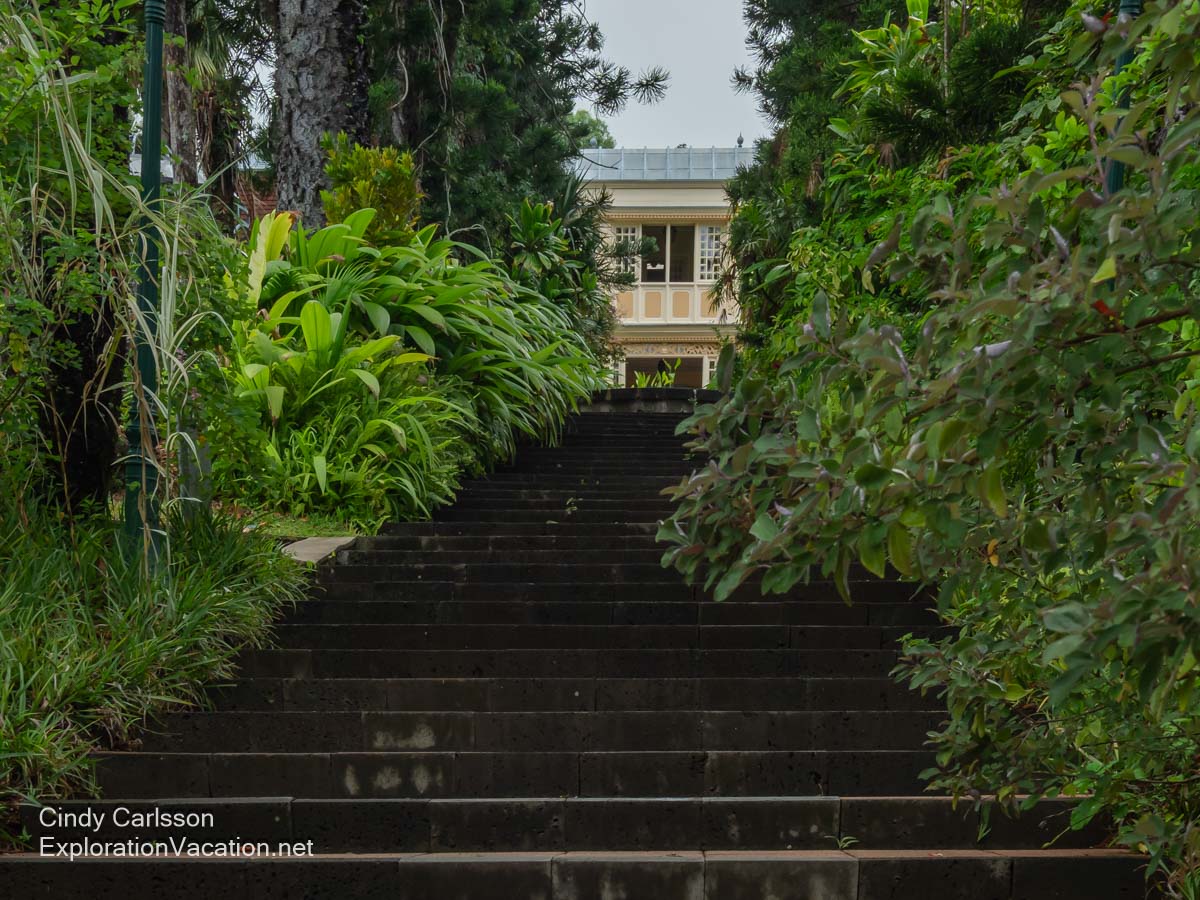
A large traditional Creole awaits in the gardens above.
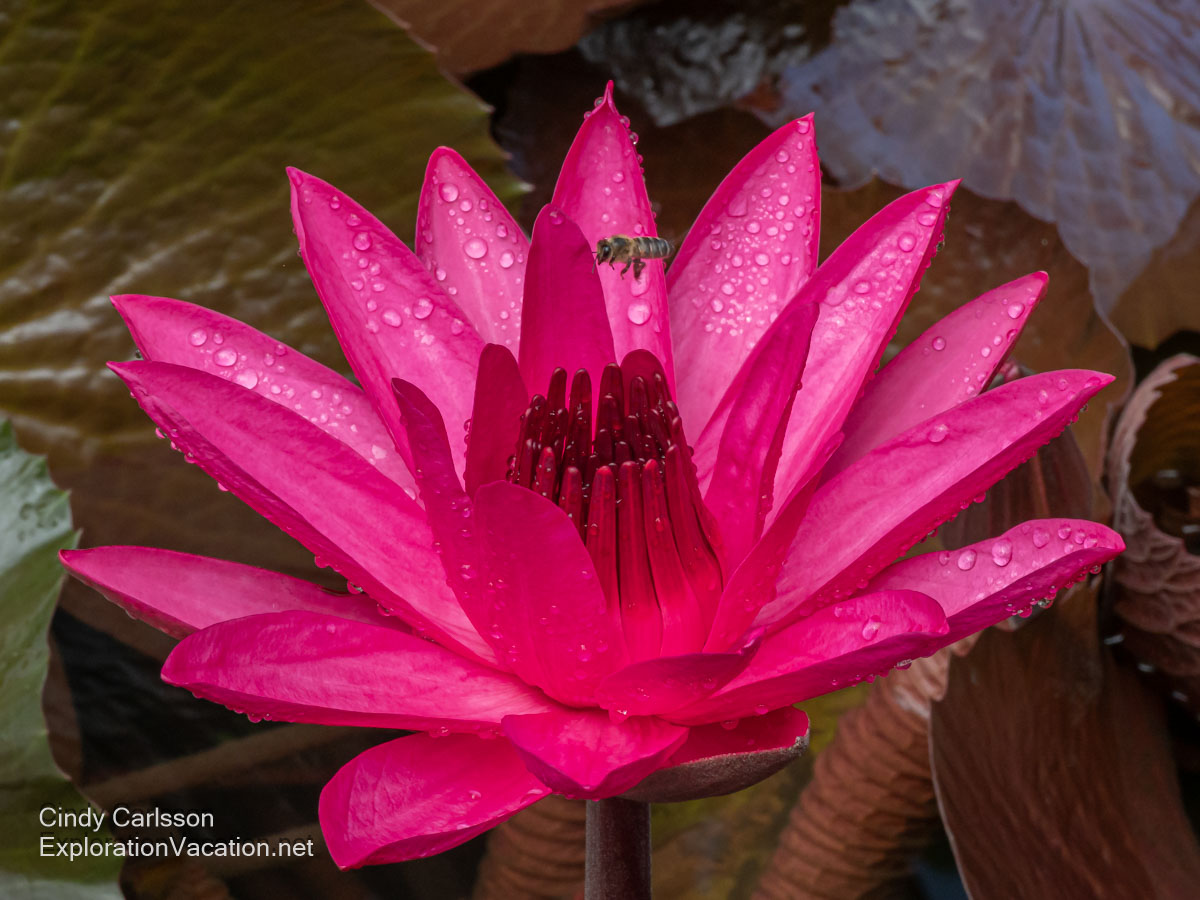
It has the formal flowering plantings (and water lilies) around the house that one expects at a botanical garden.
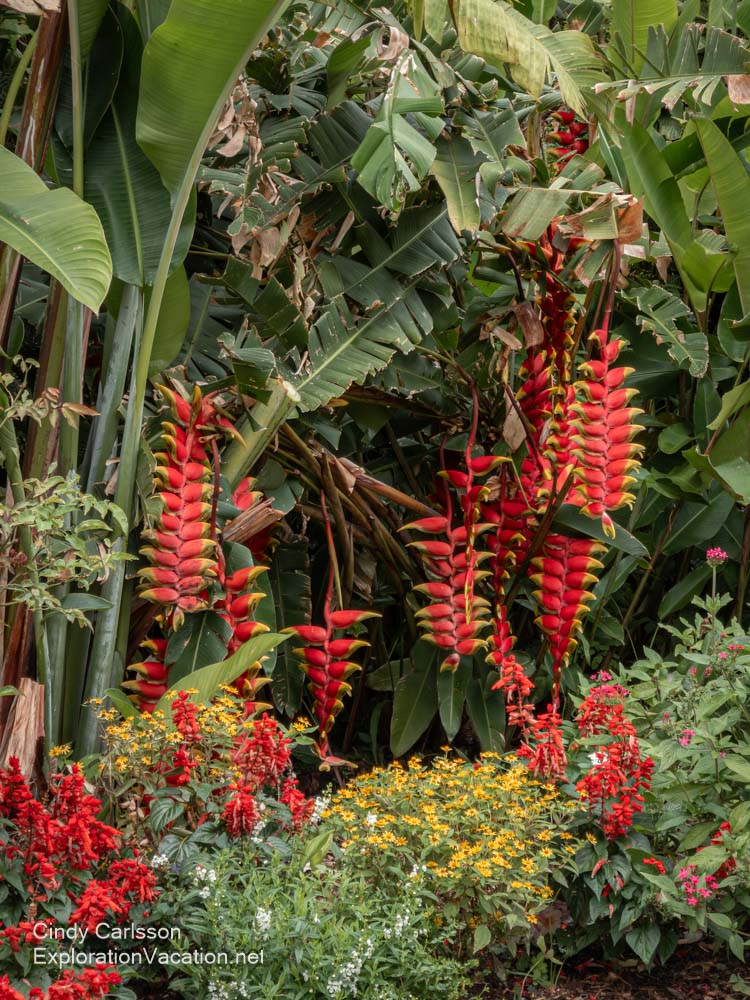
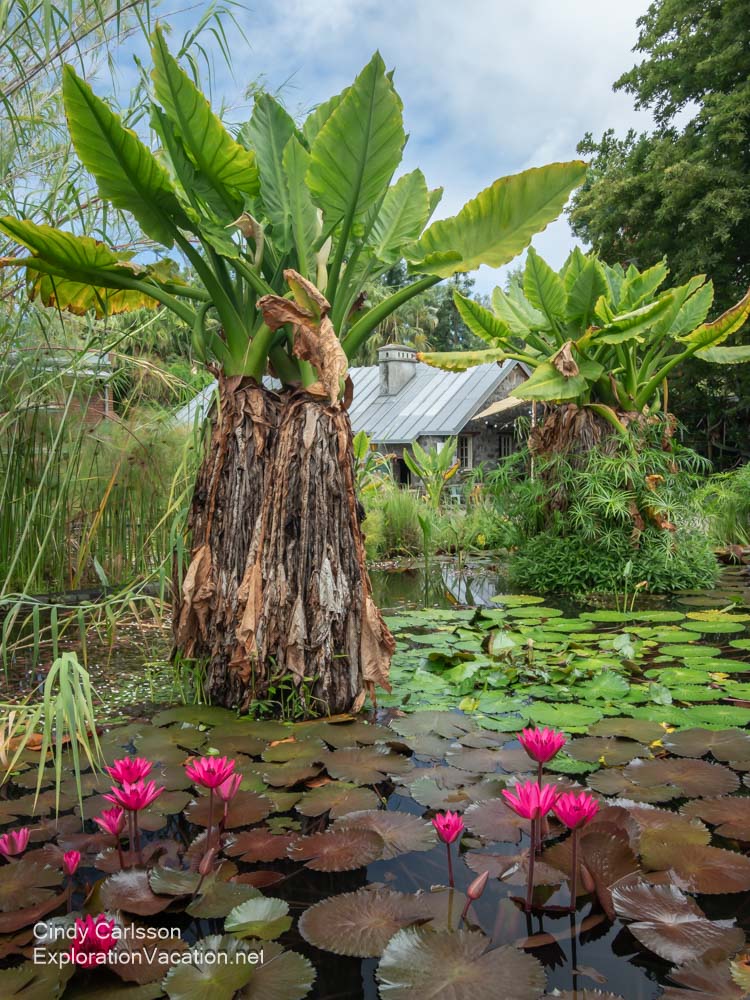
There’s also a rose garden, but not much in the way of roses at this time of year. And there is an almost underground fern and orchid house (not the season for many orchids either) that several unattended young boys found wildly amusing (it echoed), as well as some fabulous old lava stone barns with educational displays.
However, most of the space is given over to plantings representing different ecosystems, native plants, and plants used by the island’s early settlers.
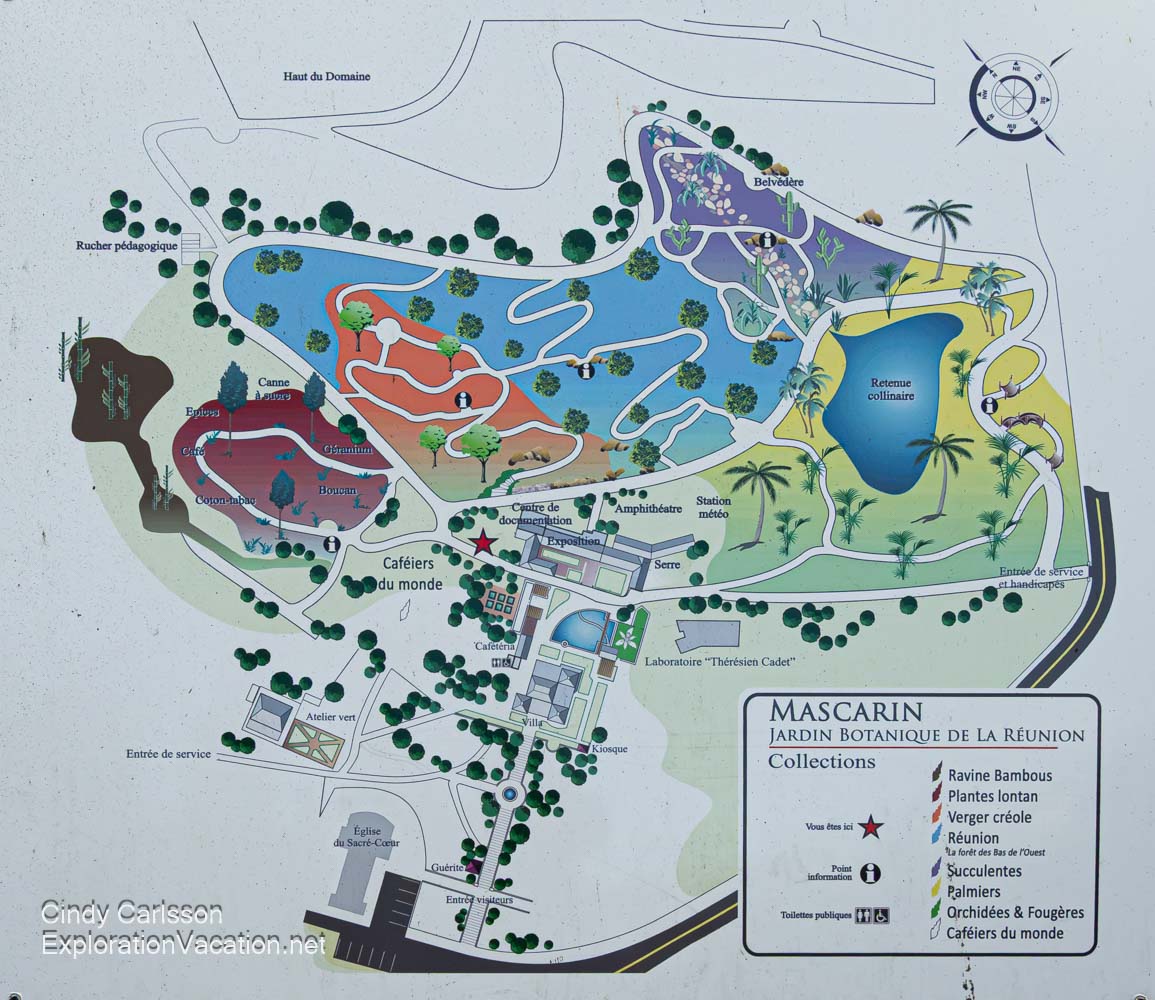
This is a research garden as much as a display garden, so it includes orchards and traditional crops, as well as more exotic vegetation from around the island and beyond.
Of course, I’m into cacti, so I decided the dry gardens were a priority. And it was a good choice!
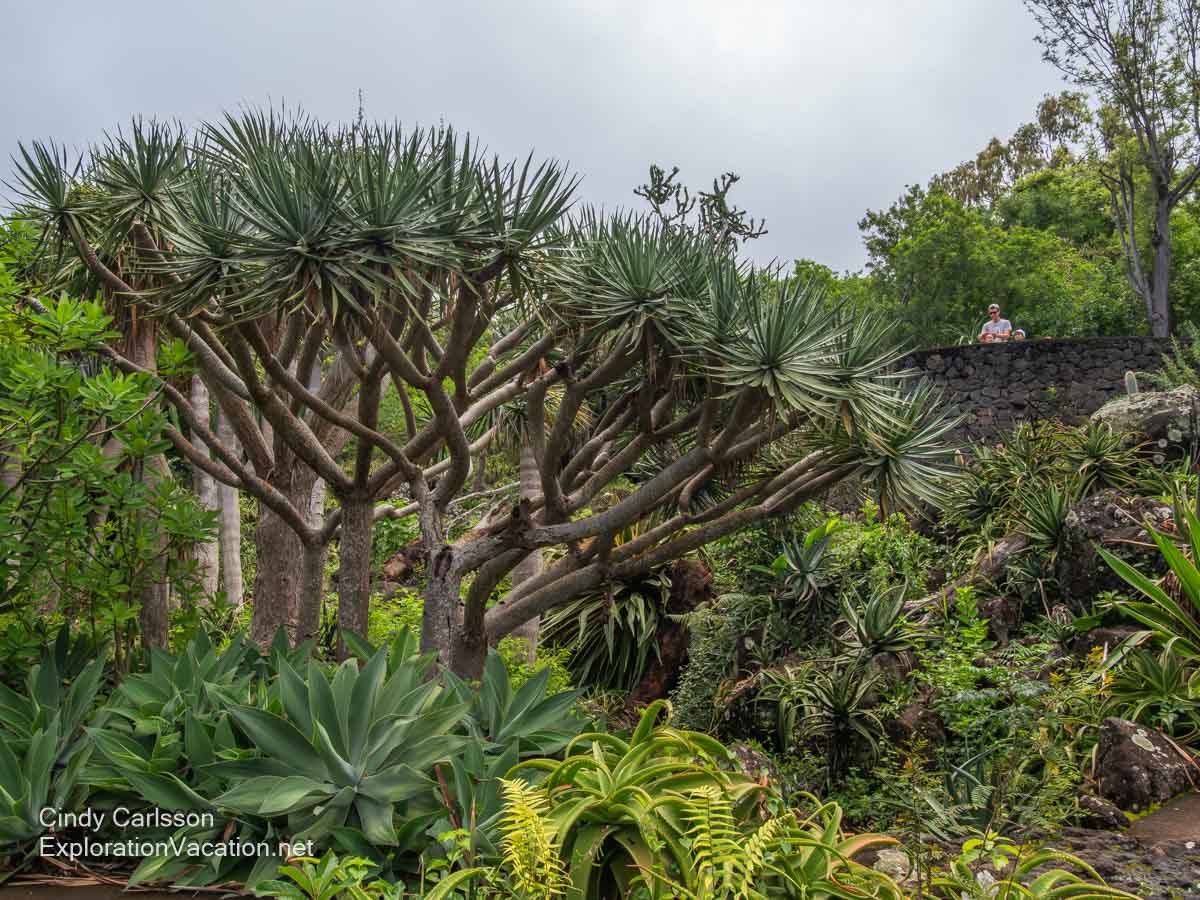
Walk through a veritable cactus jungle and/or view it from above. (I did both.)
Day 3 continued: Through the mountains to a big hole full of fog
Unfortunately, it took a while to figure out how weather forecasts work on Réunion. Our original plan was to go straight up to a lookout (the Piton Maïdo) where you can look into the Cirque of Mafate, which is the only cirque still accessible only by foot or helicopter. But we did the botanic garden first because it sounded like we would have nice sunlight in the mountains later in the morning. . . which I should have realized wasn’t what really mattered.
Of course, the drive up did start under lovely blue skies.
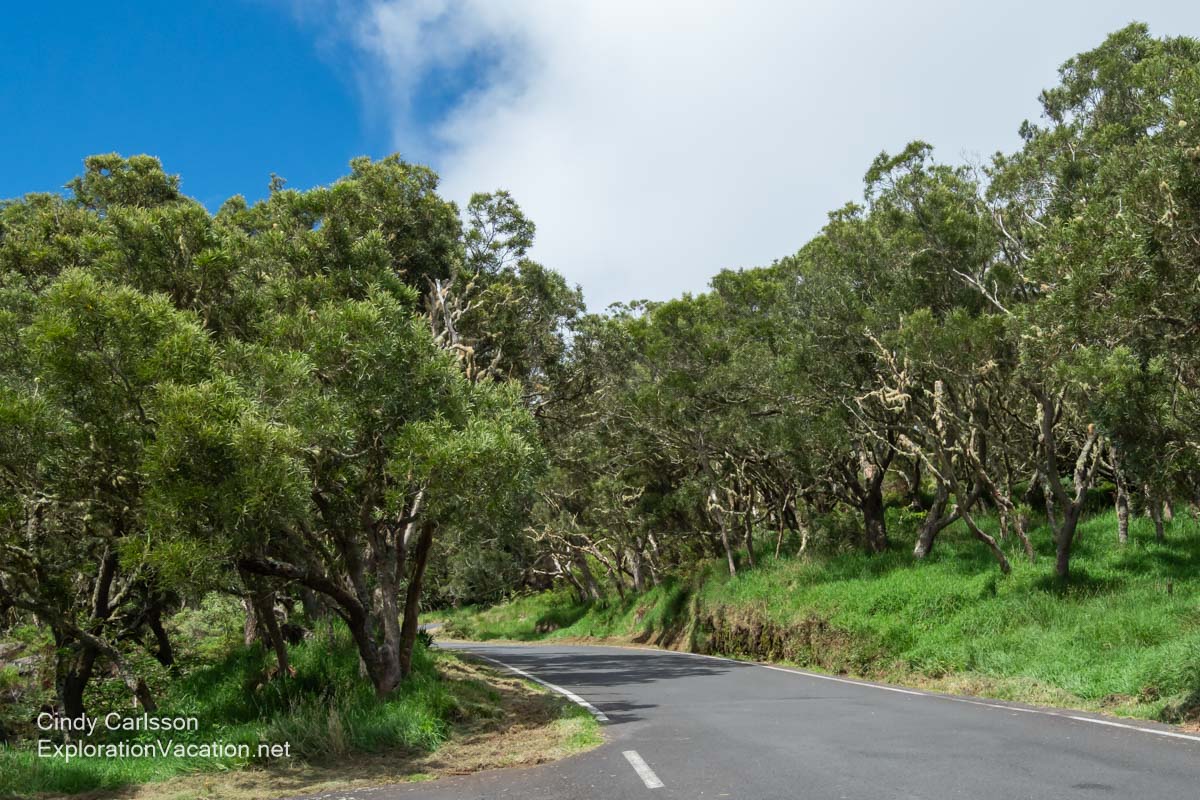
Trees along the route to the overlook.
As was true of the drive up the botanical garden, it was mostly one switchback after another, but once you got into Réunion Island National Park (a UNESCO World Heritage Site), the road was sometimes a little wider with a little more infrastructure. And fewer blind curves.
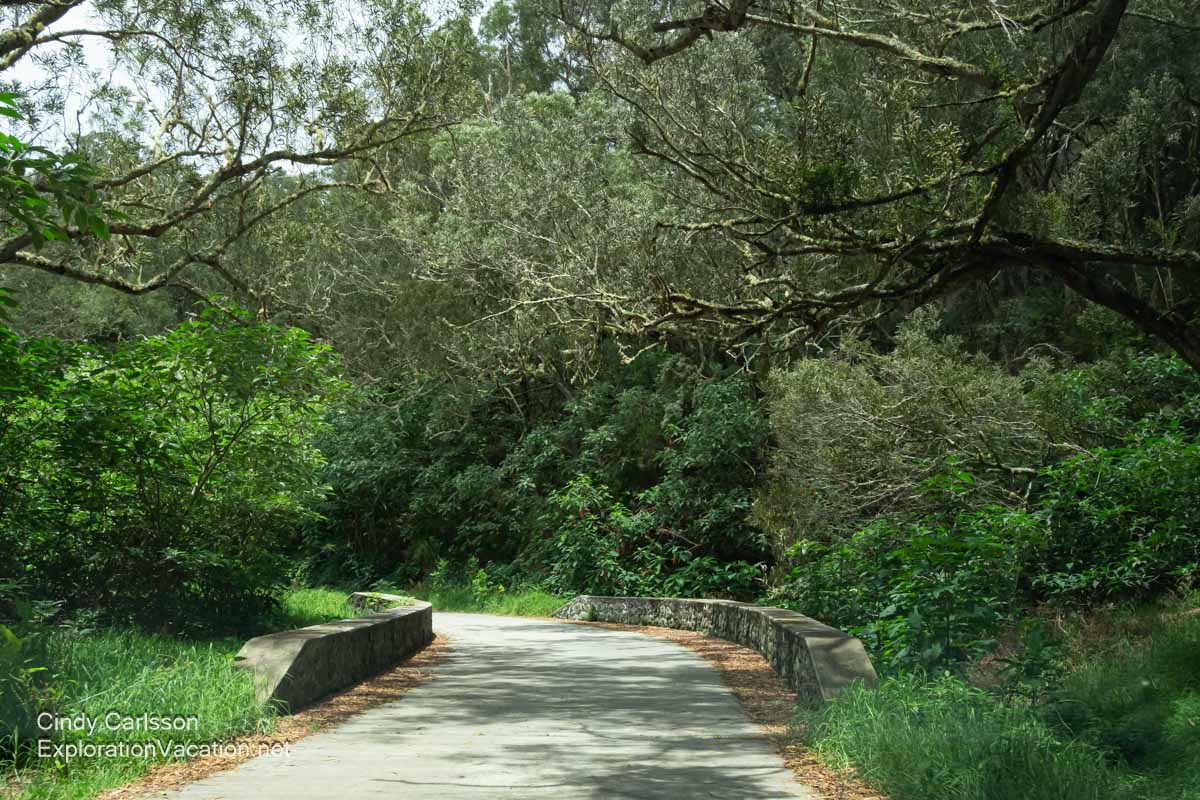
The driving was a little easier once we actually got to the national park.
The vegetation kept changing as we drove, and I really wanted to stop and check it out. But now that I realized my mistake in not going here first thing in the morning, I was rushing to get to the overlook before the view was obscured by low-hanging clouds and fog. So, we only made a couple of super quick stops.
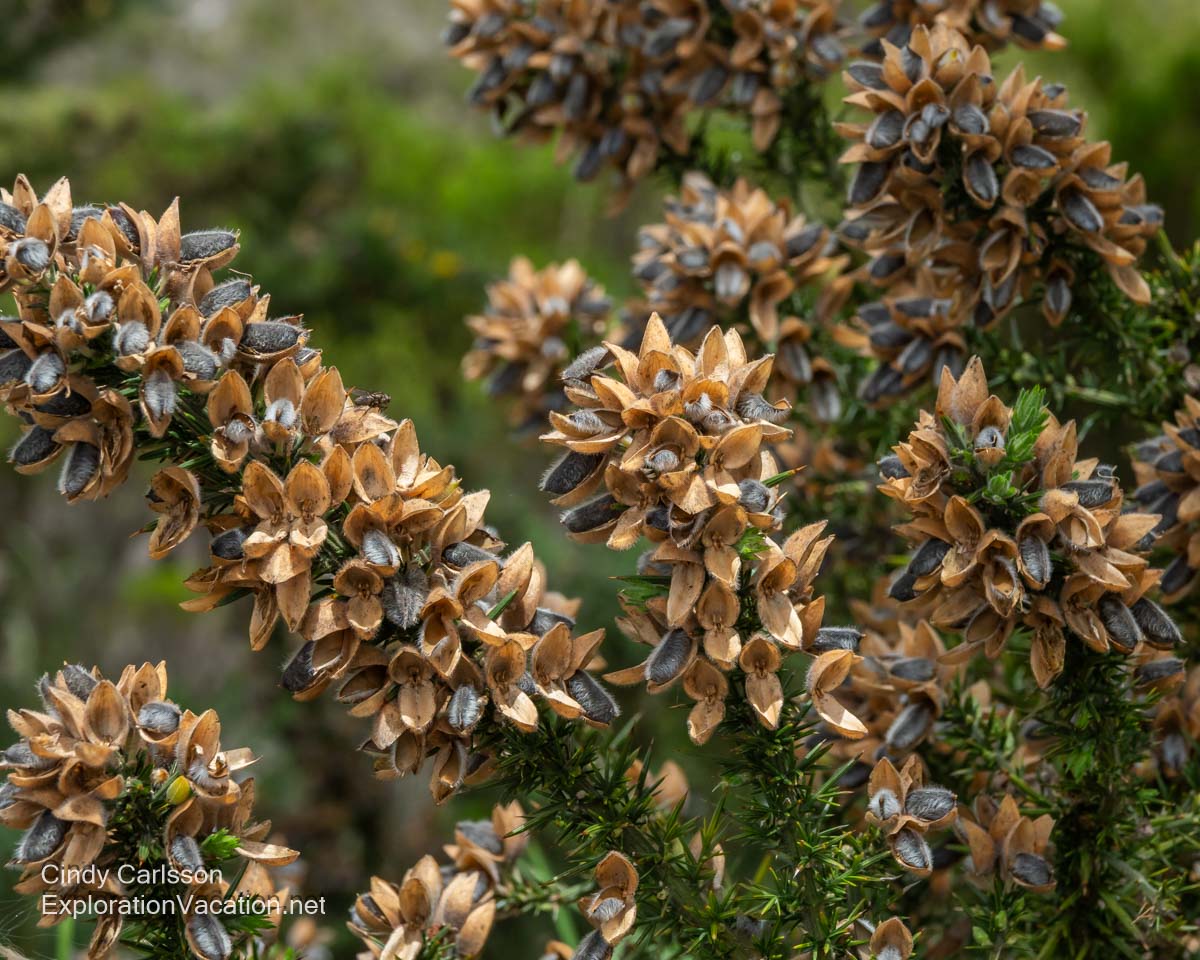
Not sure what this is (maybe a heather of some kind?), but it was interesting.
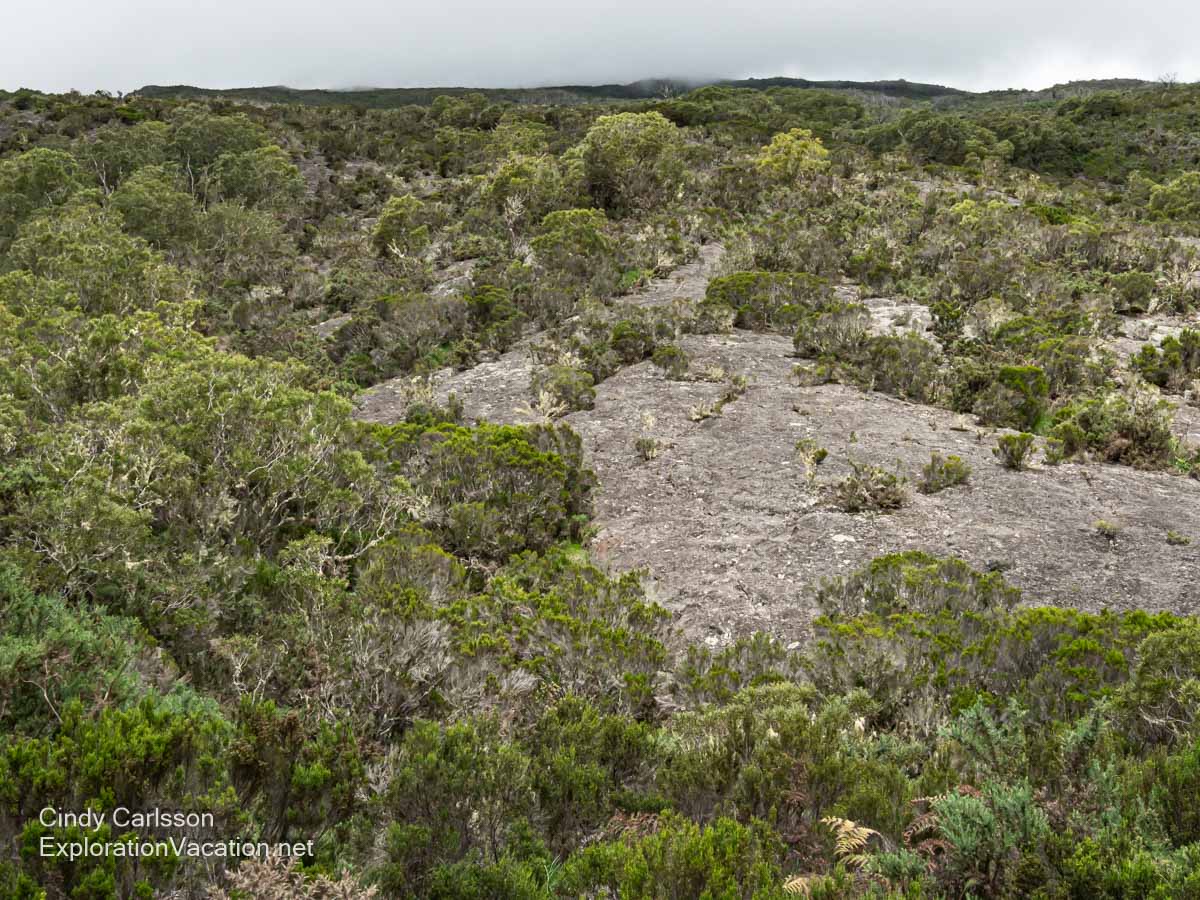
Very near the overlook, but look at those clouds!
By the time we pulled into the parking lot at the lookout, I knew there would be no view. But we headed up the footpath with everyone else anyway.
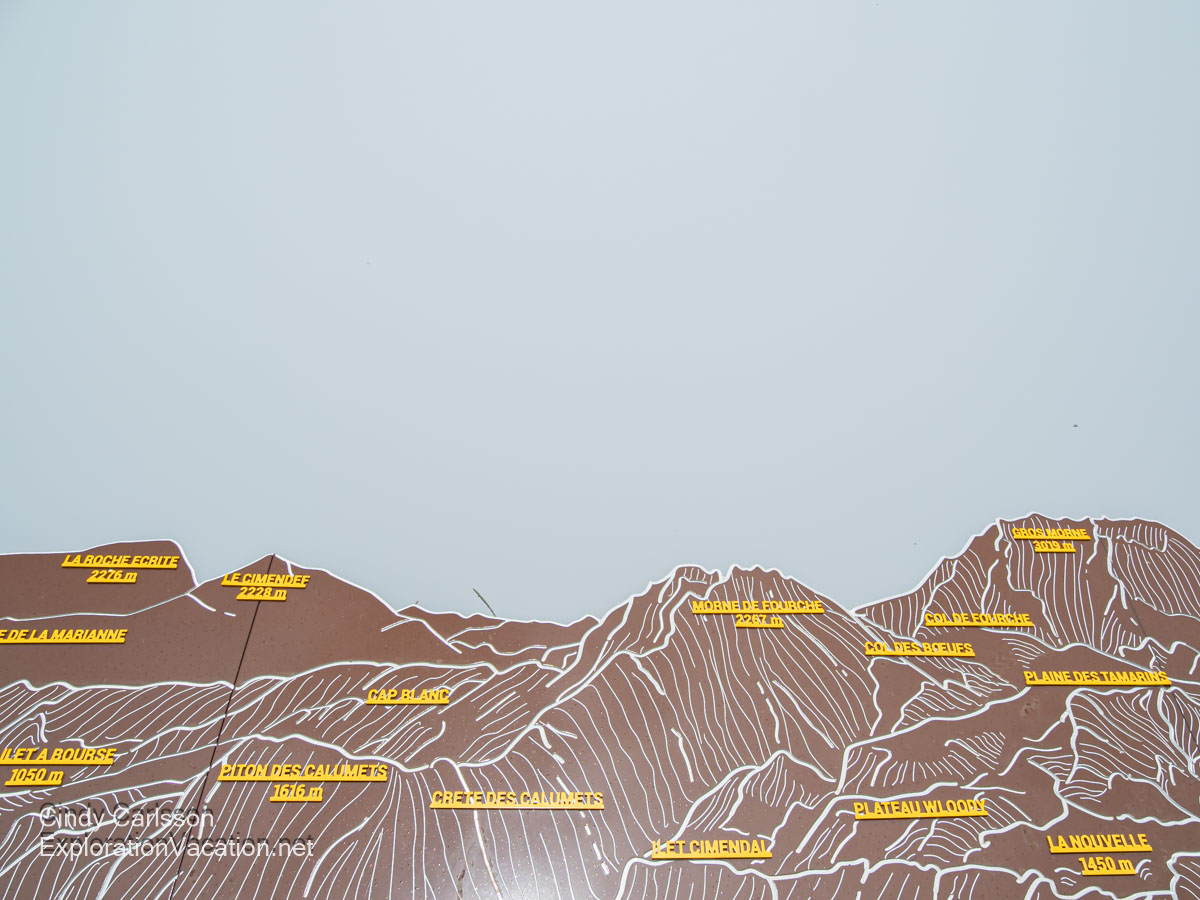
You couldn’t see ANYTHING beyond the sign.
Apparently, there are mountains out there. But there was no seeing them now, so, we headed back down the road.
However, this time we ended up on a different road. It had fewer switchbacks and was more direct. . . but it didn’t have many places to pull off and take a close look at all the weird vegetation and stark dead trees. (The dead trees are from a fire up here a number of years ago.)
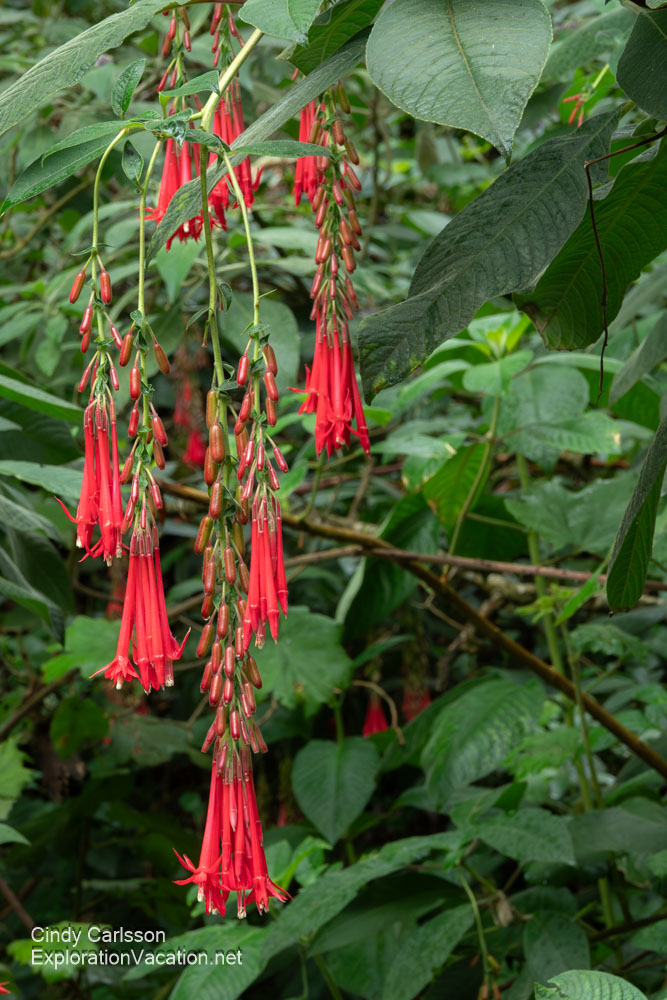
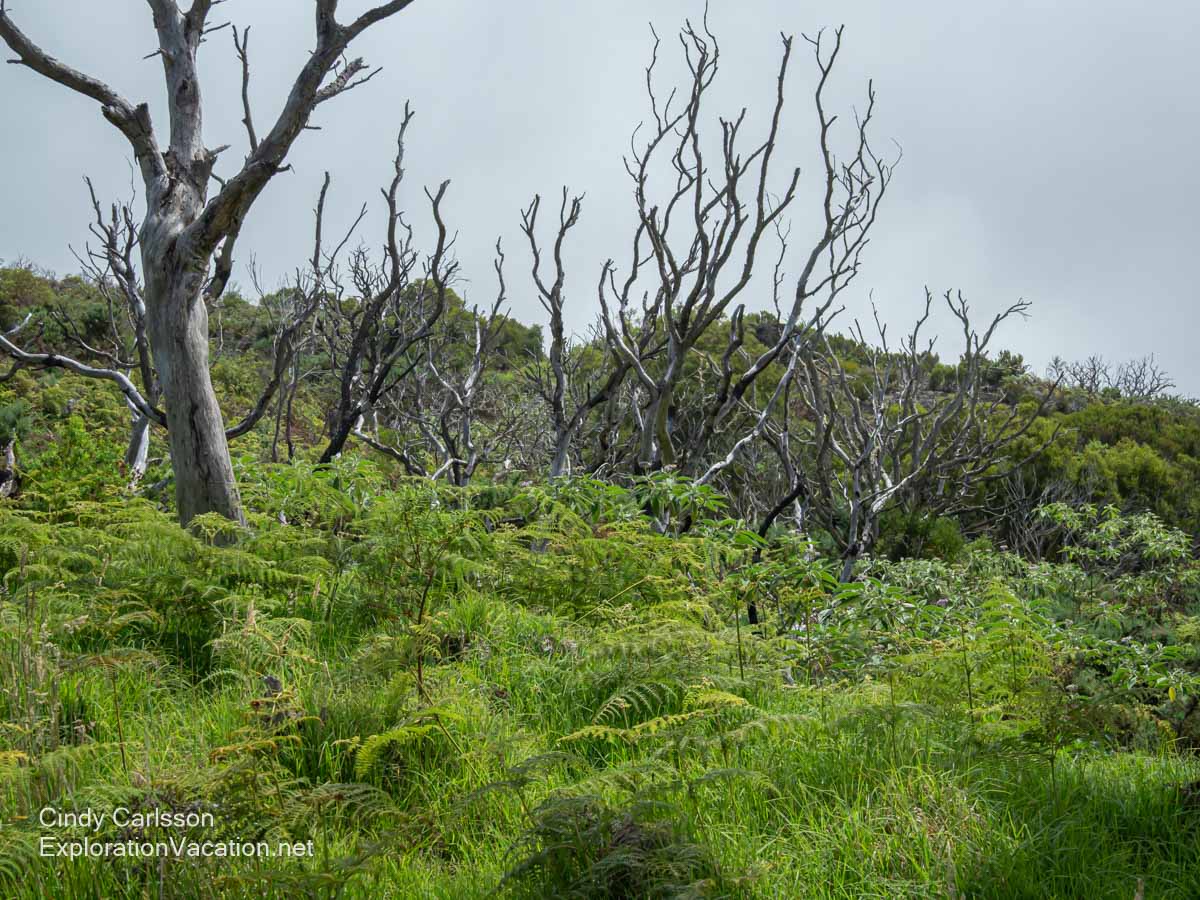
The vegetation varied dramatically along the route.
And there was more than just the native (or maybe invasive) vegetation to admire. There appears to be a biome on the island that is perfect for blue hydrangeas.
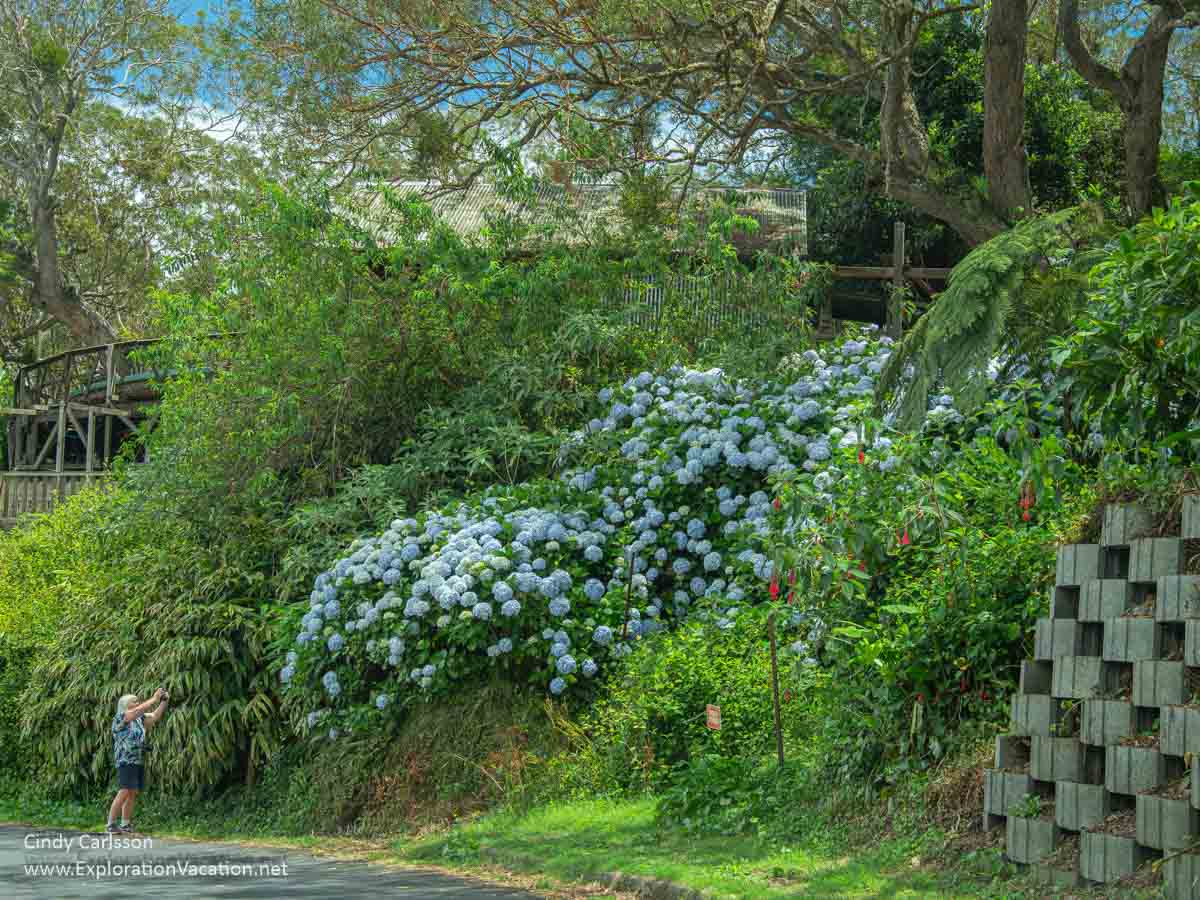
Blue hydrangeas along the road.
I’d noticed plenty of hydrangeas as we crossed the island along the central ridgeline the other day, and there were some along this route as well. They reminded me of the Azores.
It was overcast and cloudy most of the way down, but the sun was bright and hot by the time we got back to the coast. Which was perfect for a dip in our pool and another cold Dodo beer.
Day 4: Driving a bit of the Volcano Route
Today’s itinerary features getting as close to the volcano overlook as we can with our rented sedan.
Réunion is probably best known for the Piton de la Fournaise, a shield volcano on the island’s east side. It’s an active volcano, one of the most active in the world. (A list that includes Kilauea in Hawaii, as well as Etna and Stromboli in Italy.)
I say we are going to get as close to the volcano overlook as we can because it is unclear how close you can get without a high clearance vehicle and/or a very tough hike.
As I’ve finally figured out both how to interpret the local weather forecast and how long it takes to actually get out of our neighborhood (let alone up into the mountains), we start our journey early in the morning – after the sun is up, but not long after.
The Route of the Volcano is basically a scenic drive that ends at an overlook where you can see into the caldera where Fournaise is located. But there are plenty of other stops along the way.
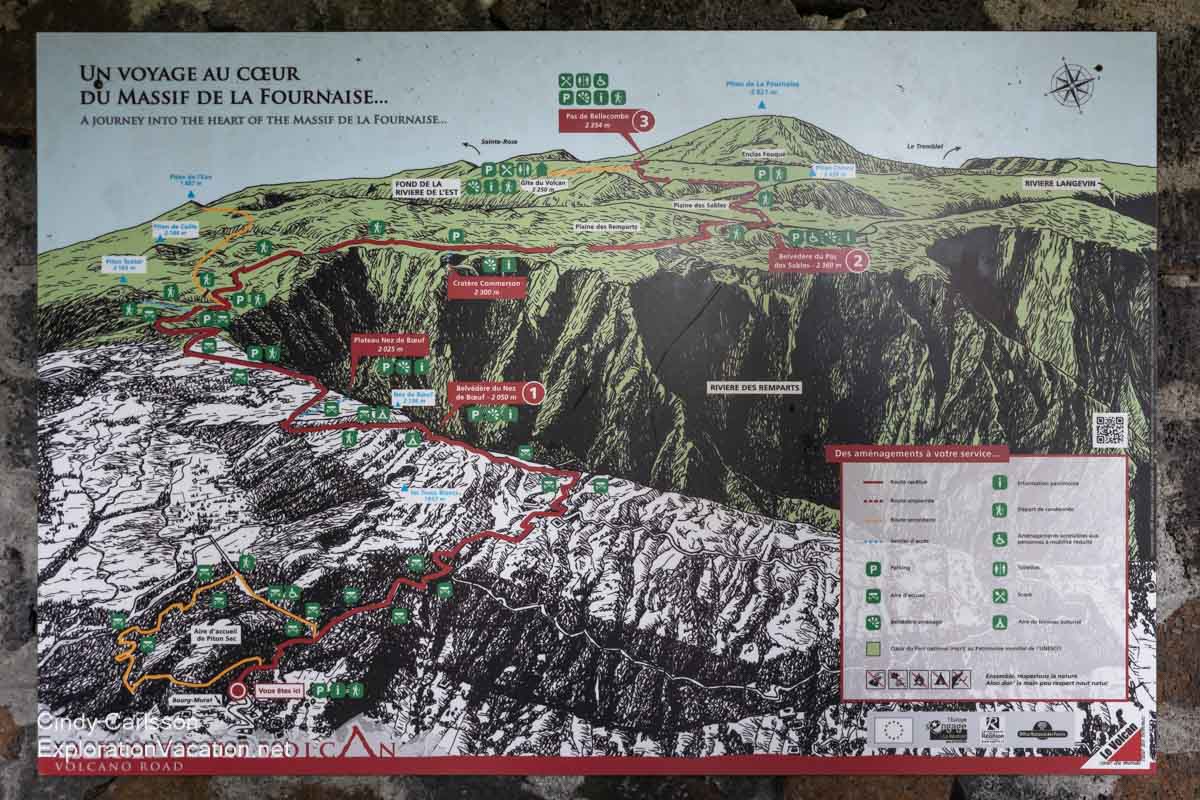
There are places to stop along the route, but our goal is #3 or a little beyond – if we can get there.
The route starts out very green, with rolling pastures, old orchards, and grazing cows.
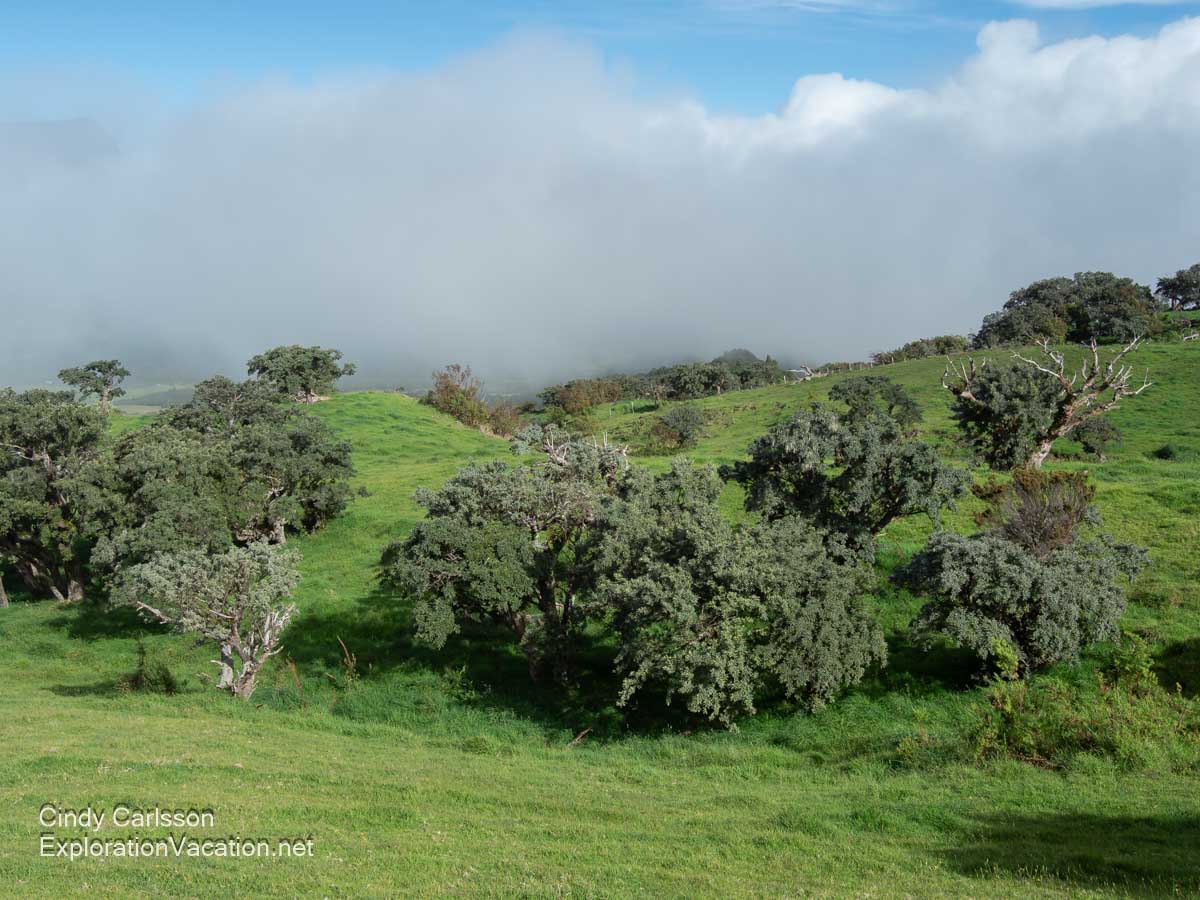
No cows in this photo, but there were some nearby. (Someone else had stopped to photograph them so I didn’t have to.)
Although it is warm and sunny where we are driving, the low clouds and fog filling the lowlands have Lane worried that we are in for a repeat of yesterday’s fog-shrouded experience.
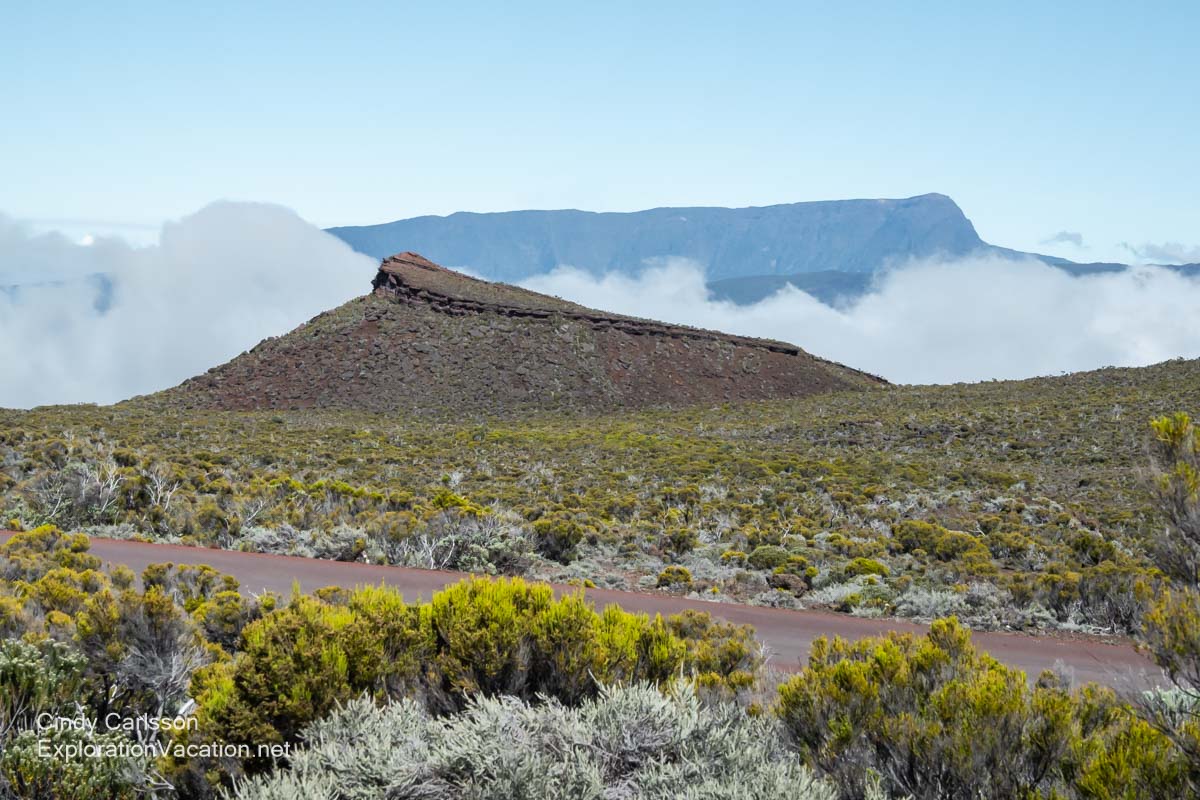
The constantly changing clouds and fog provided all sorts of interesting views.
But the fog does make for some interesting scenes.
The end of the road (for us)
We reached the Plaine des Sables overlook under hot sunshine. And it’s quite a view.
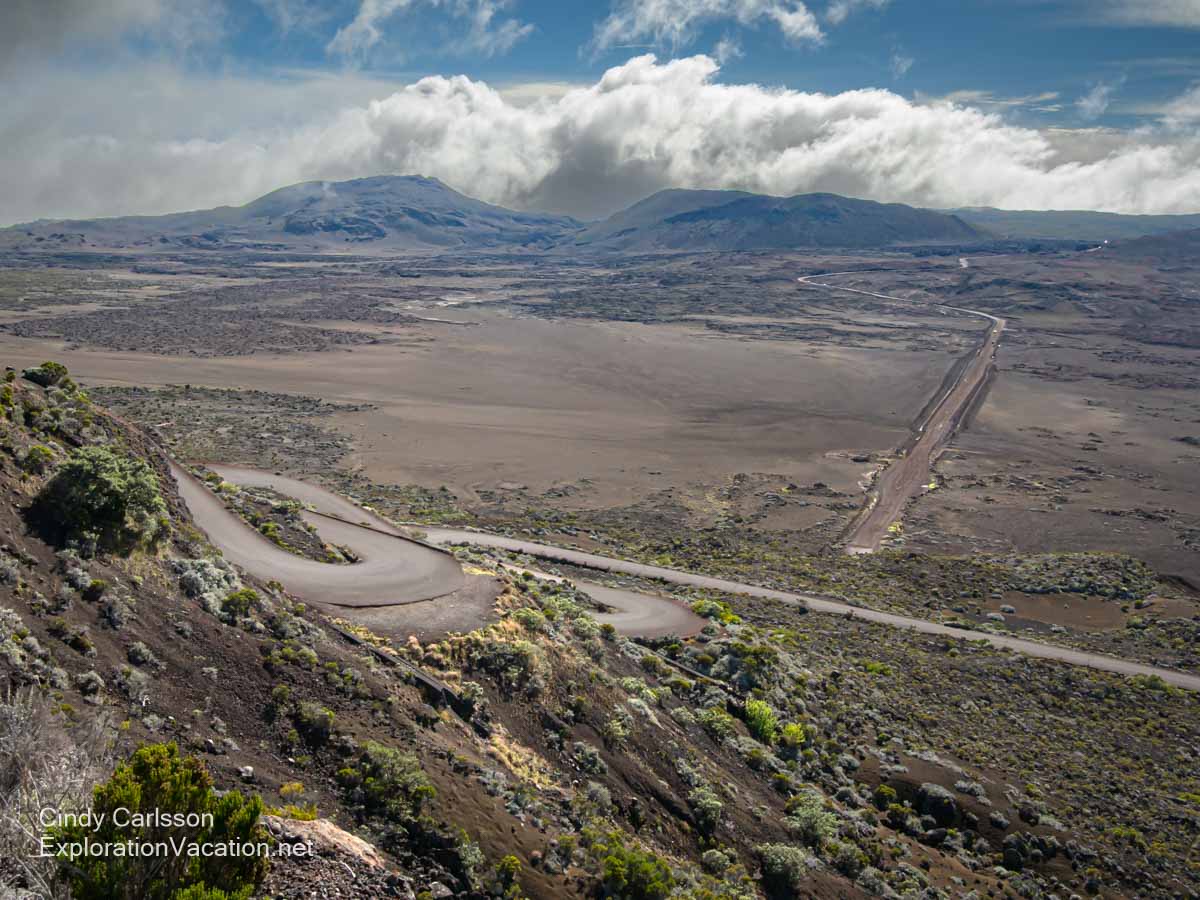
The stop-you-in-your-tracks view from the overlook of the ash-covered plain, the road down to it, and the volcanic peaks in the distance.
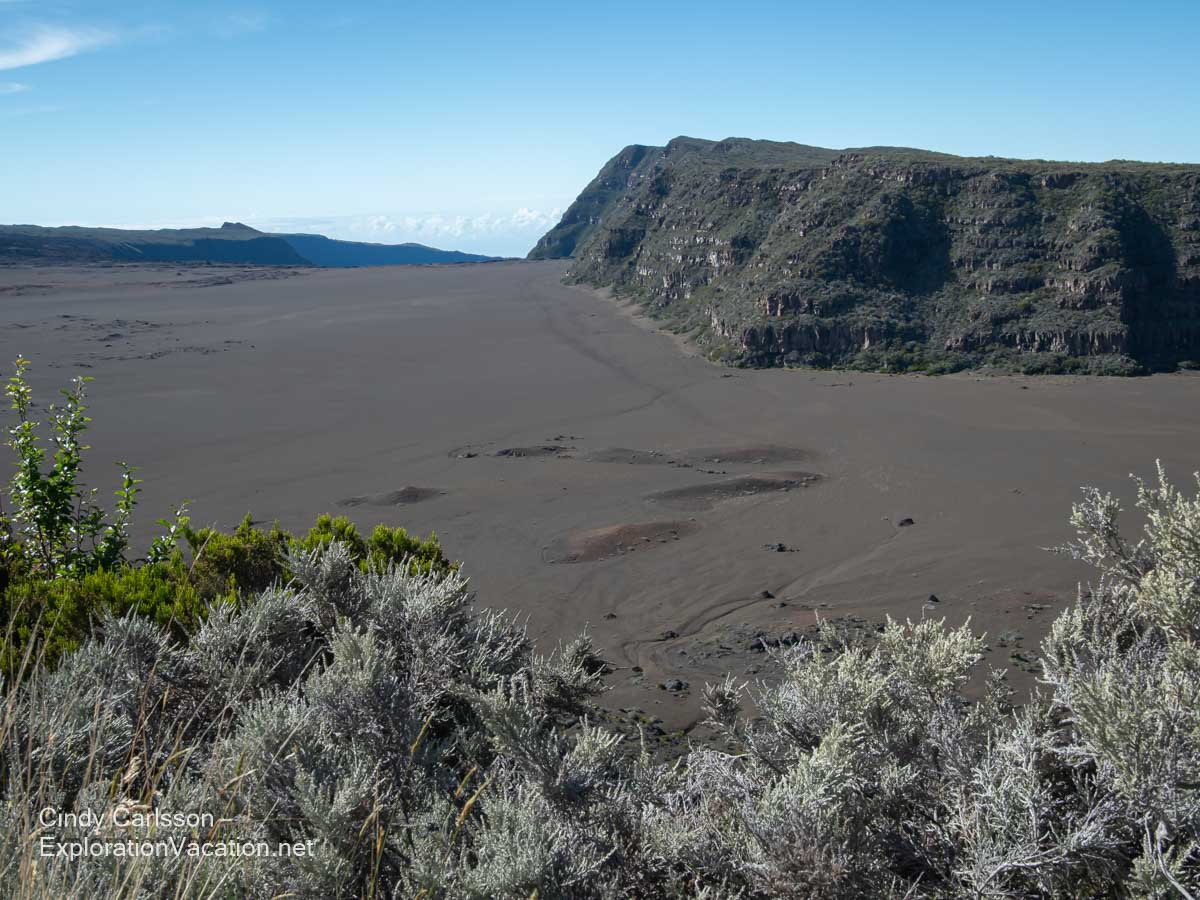
The plain looks absolutely barren from up here.
Time to head down those switchbacks!
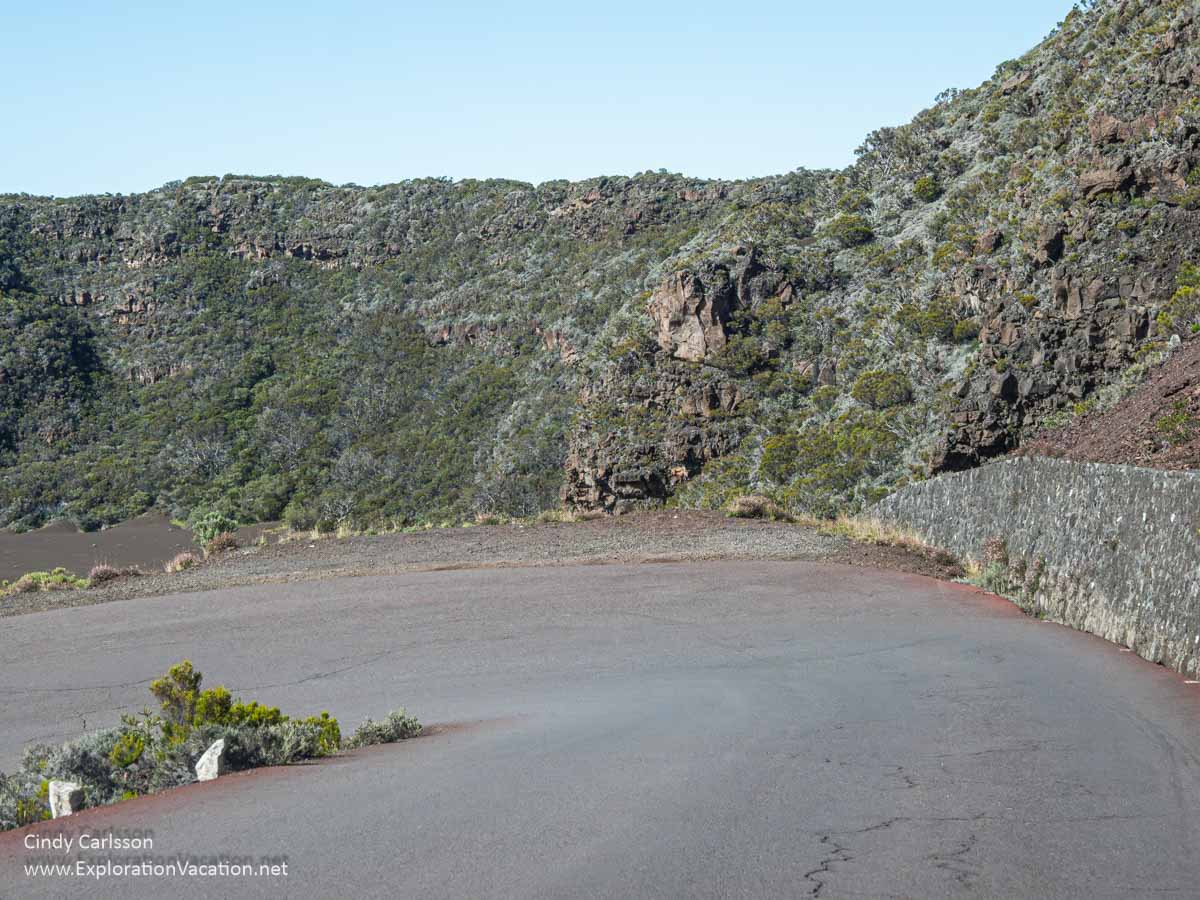
At least the road was in good shape.
Unfortunately, when the switchbacks ended, that nicely paved road devolved into a deeply eroded dirt washboard.
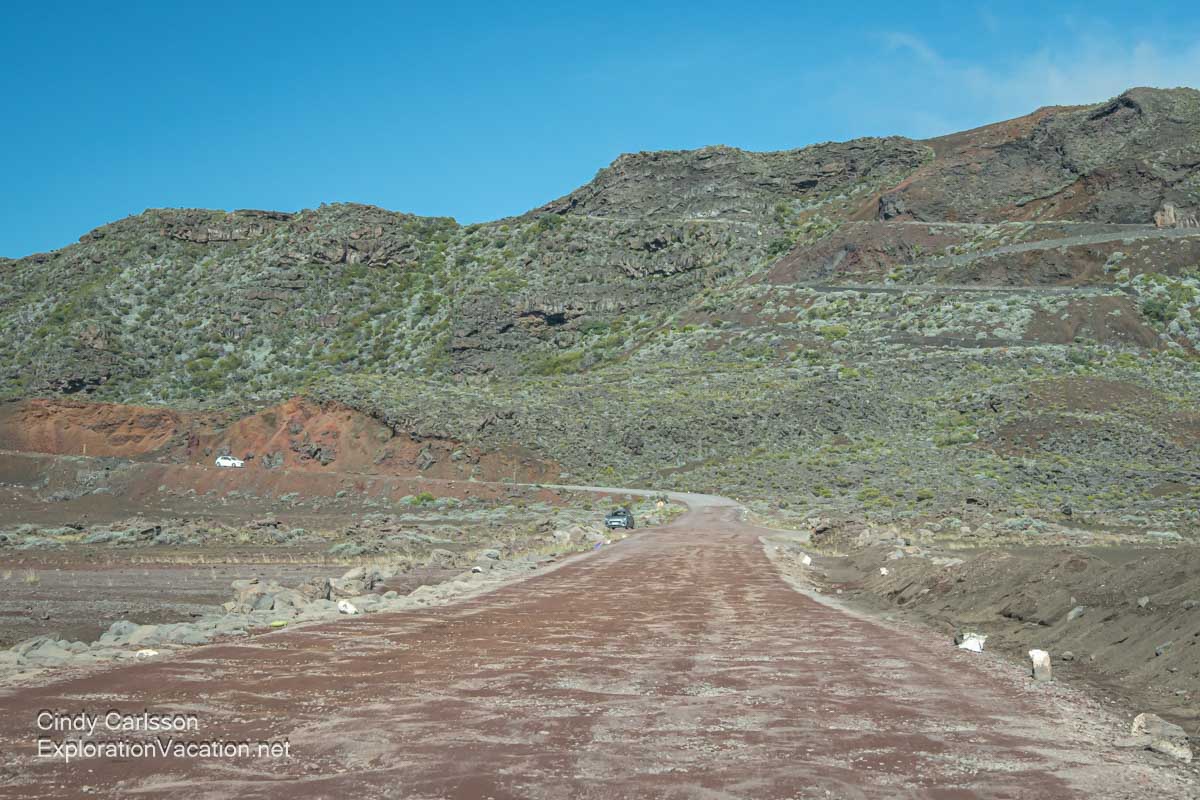
It’s actually a lot worse than it looks.
We pulled over and discussed our options. It wasn’t like it was an impossible drive in a small car — just really slow and miserably rough. What would the road be like further along? Better? Worse? And would we be able to see anything by the time we got up to the lookout, or would the clouds and fog roll in first?
Meanwhile, a surprisingly steady trickle of cars of all sizes (some smaller and lower than ours), passed us on their way up to the volcano overlook.
After driving a bit farther up the road as a test, I decided no. This was one of the things I really, really wanted to do while on Reunion. One that I would have booked a tour or an overflight for — if the weather forecast for the week hadn’t been so cloudy and foggy. But, even if it weren’t a violation of our rental agreement to continue on (hadn’t checked that), it was unlikely the road would get any better once we climbed to the next level. And then there were those clouds moving in . . .
So we decided not to continue.
What I didn’t realize until writing this a month after the fact: Piton de la Fournaise started erupting two days before our visit. While the eruption ended late the day before our arrival here, at night you could still see the volcano glow. And, during the day, the hope of seeing the volcano erupt again was drawing a LOT of people.
But I did look around a little and take a few pictures.
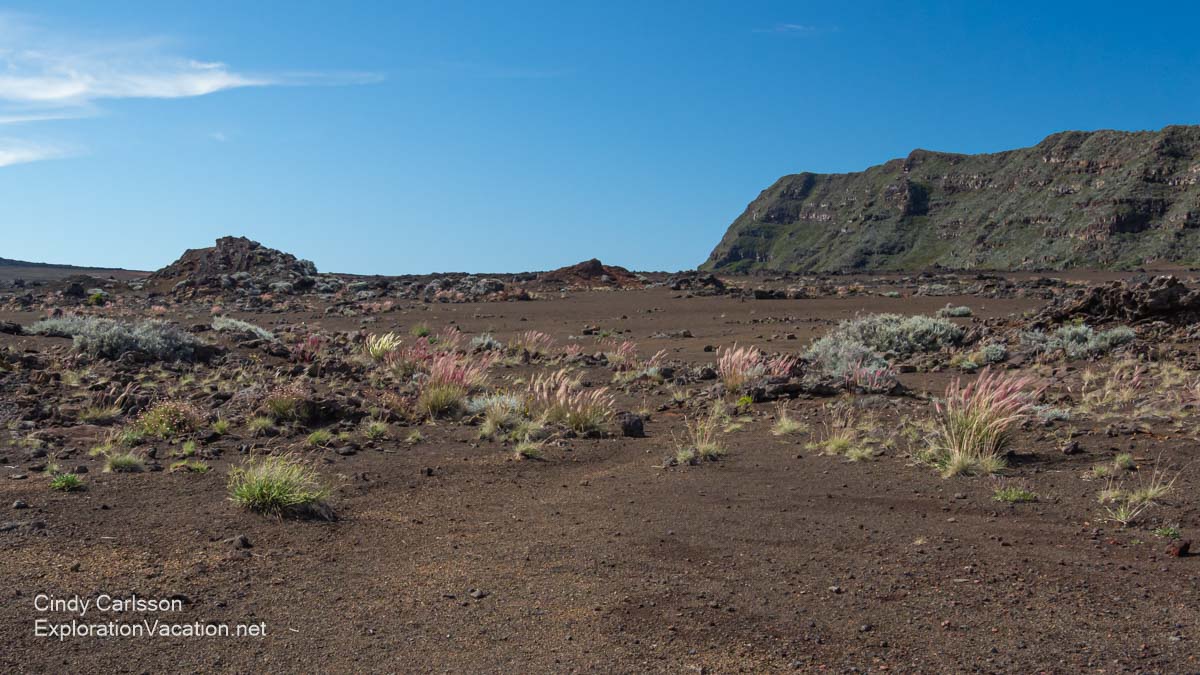
Even in this harsh landscape, there are some pretty grasses and plants in bloom.
What had looked like a vast dead landscape turned out to have a fair number of grasses and flowering plants. Many of which were tucked next to rocks that provided some shelter from (what I soon discovered) was a howling wind.
Back down the Volcano route (with time to explore)
Now that I know I’m not going to get to the volcano overlook, I have plenty of time to explore elsewhere along the route. Or, at least time to stop and take a bunch of photos!
Of course, we still had some fog.
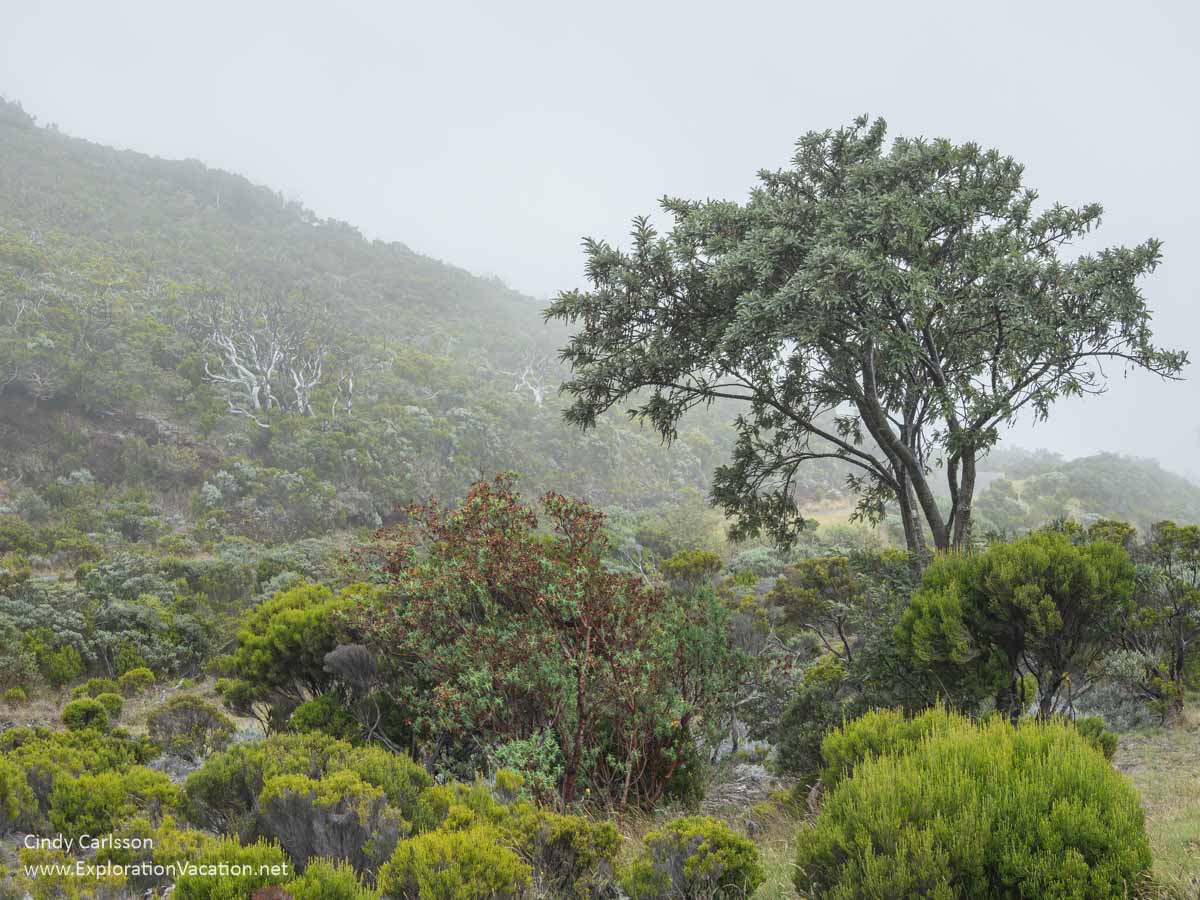
Fog lets you choose what you want to focus on.
But now I had plenty of time to look for good scenes to photograph and wait for the fog to create interesting compositions.
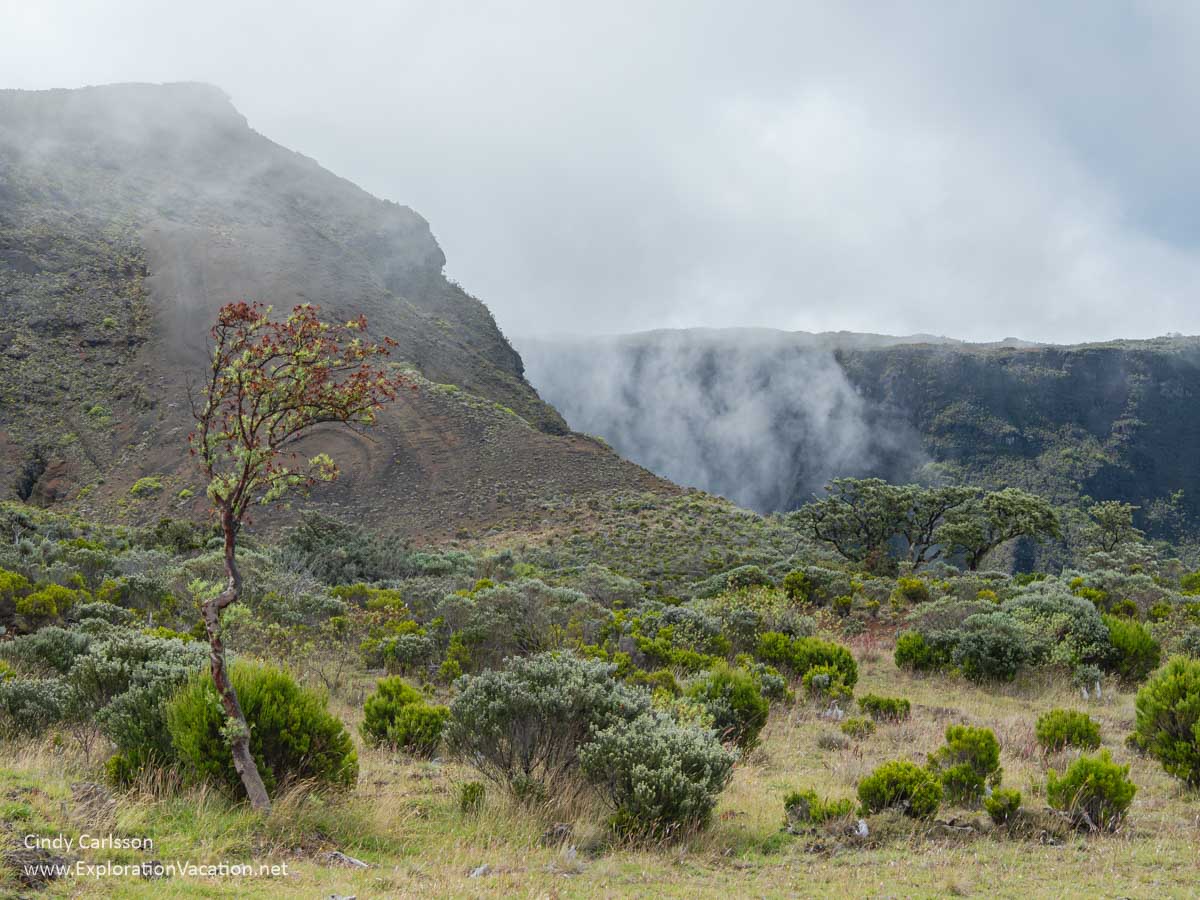
I waited a long time for just the right amount of fog to appear!
But eventually we were back in areas with much more sunshine, so we could really see the geology of this place.
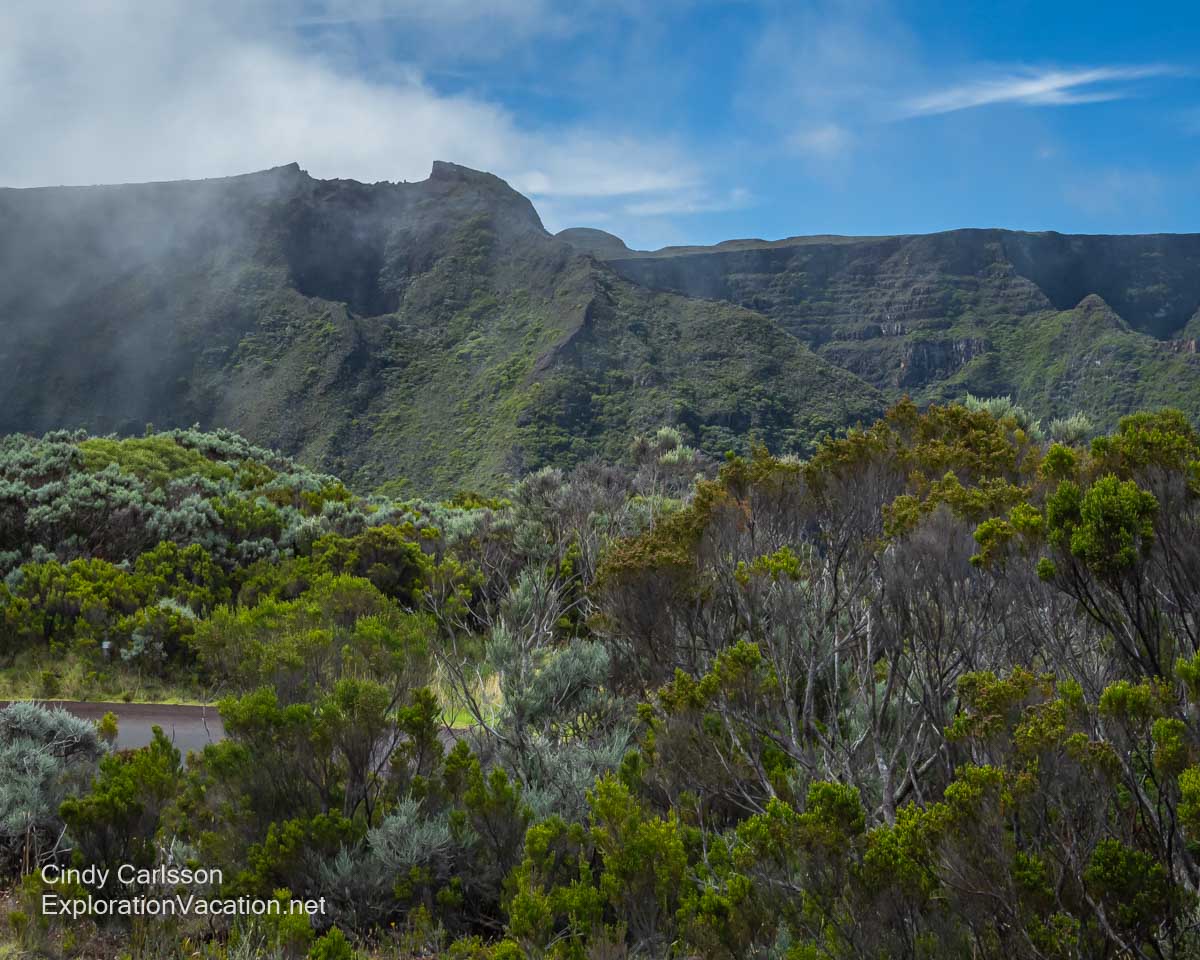
What a spectacular landscape!
We could even see the coast.
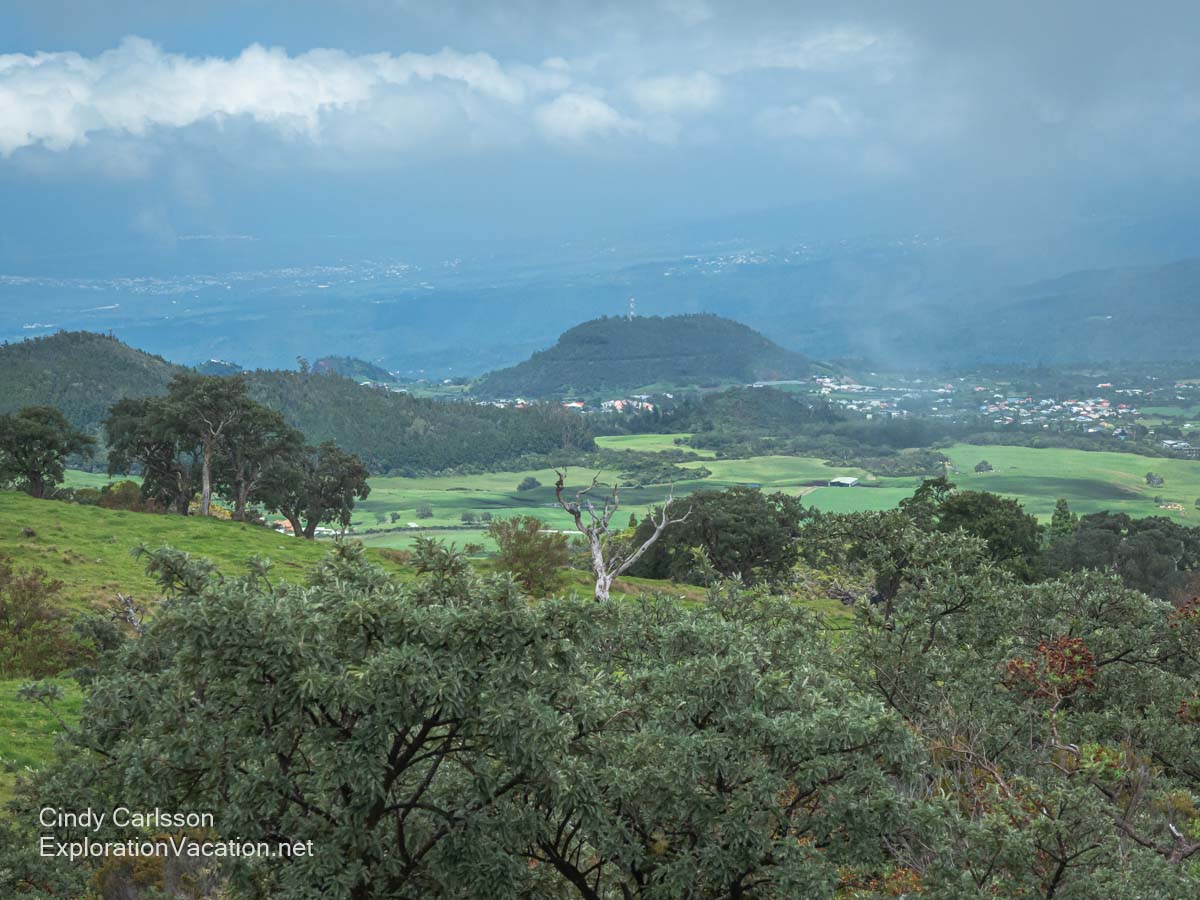
I can see the sea!
But the Volcano Route had one more surprise for us. And it was a great one.
The Valley of the Remparts
An overlook for the Valley of the Remparts River was supposed to be a stop on the way out to the volcano. However, I missed the pull-off. And I figured the view would be obscured by clouds and fog anyway. So, we just kept going and figured we could stop on the way back down.
Which turned out to be a fantastic decision.
Not that I could tell from the parking area. There is absolutely no view from where you park. It actually looked so uninspiring that Lane decided to wait in the car while I headed down an unassuming path through the trees.
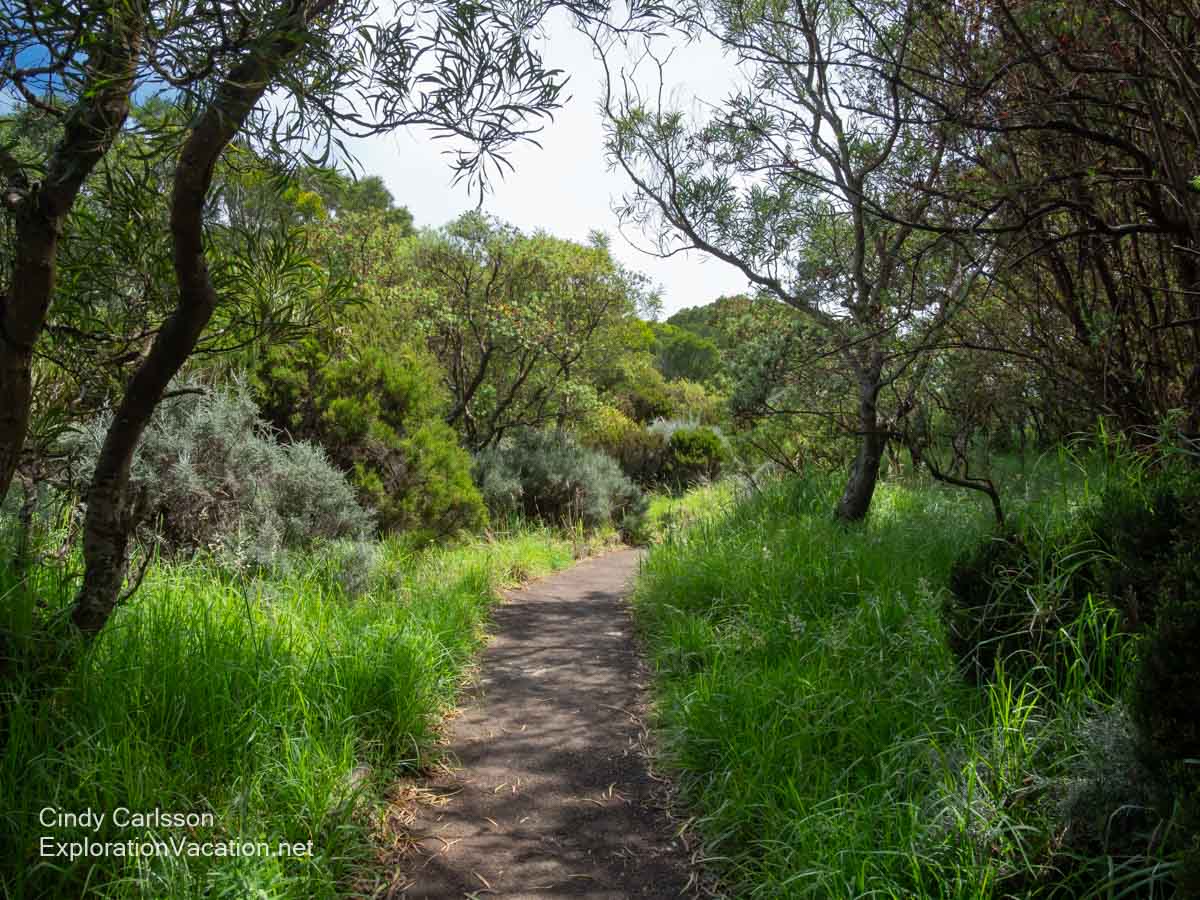
I admit, I doubted this was going to be much more than a pleasant little walk.
I didn’t really realize where I was headed until I got to the actual overlook. (This is the Nez de Bœuf Lookout.) And then I was looking at an astonishingly beautiful scene.
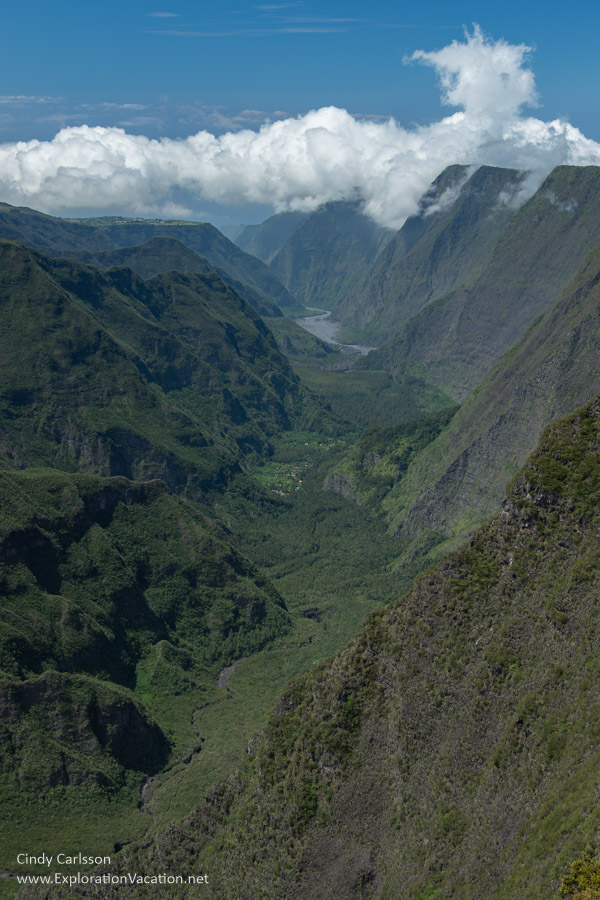
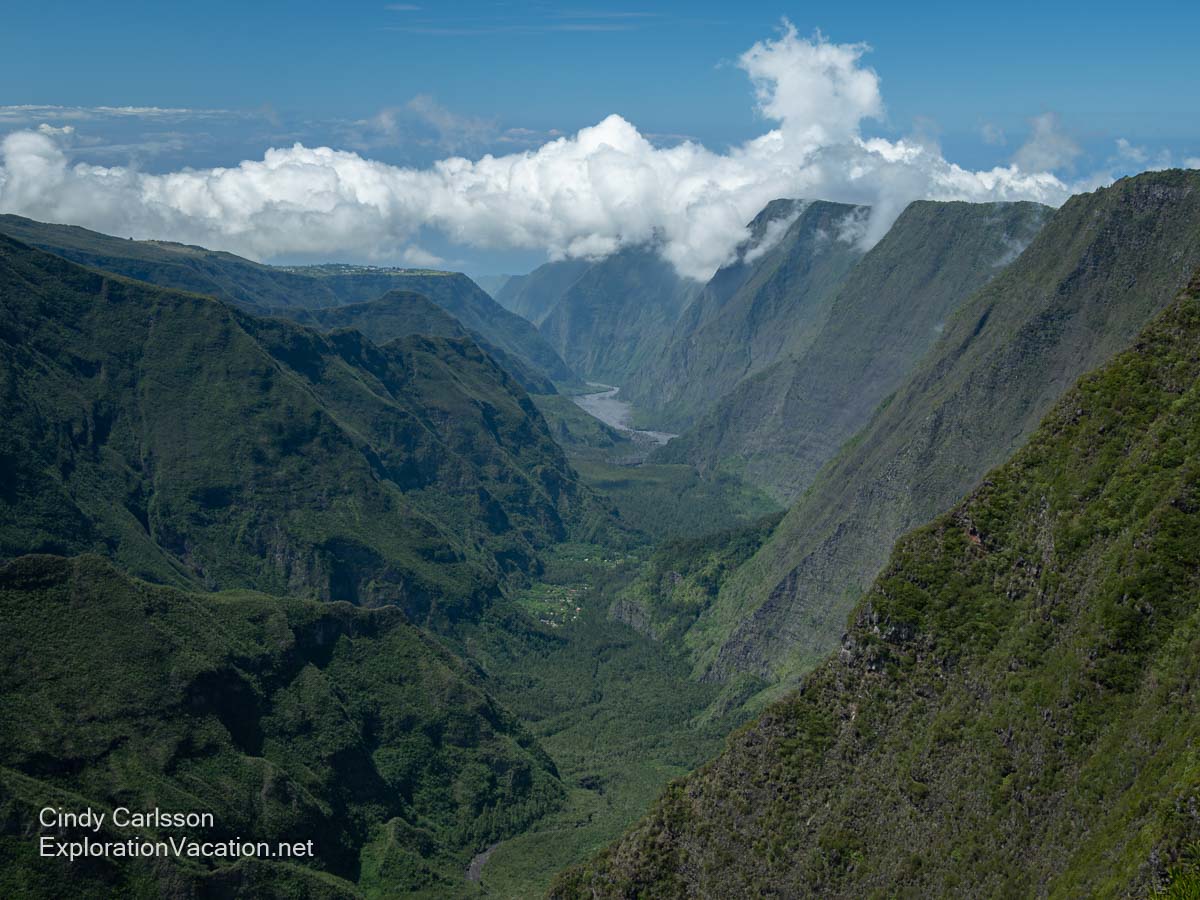
Spectacular scenery — even for Réunion, which has a lot of impressive scenery.
And yes, Lane did get out of the car to go see the view once I reported back!
Day 4 continued: Along the southern coast
The rest of the day was our first opportunity to explore Réunion’s southern coast.
But first we had to get there, which involved retracing some of our route across the center of the island.
I was looking forward to that, since the first day we crossed it was dark and rainy. That limited our ability to enjoy long views to the sea. Limited spots to pull off the road limited my ability to stop and take a look at the fern tree forests and other interesting vegetation.
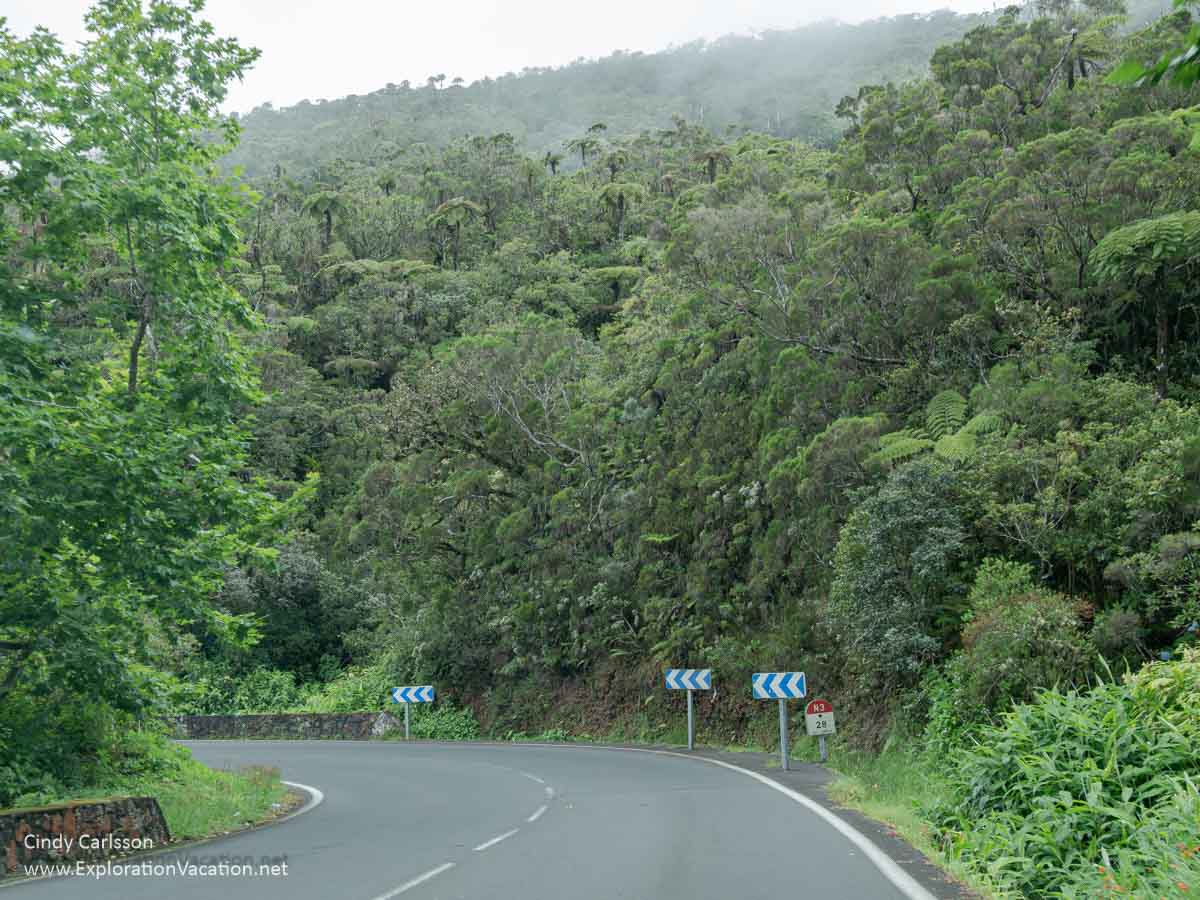
You can see part of the fern tree forest on the hillside.
But, as you can see, it was another dark and rainy day! That gave us even fewer views over the island than we had the first time. And it wouldn’t have been very fun wandering through the fern forest even if I had been able to locate the trail I’d planned to stop at!
(I think most days are wet in this part of the island at this time of year. If it weren’t, there wouldn’t be fern trees.)
So we basically just cruised on down to the coast.
Our Lady of the Lavas
One of the places I really wanted to see along the southeast coast was Notre-Dame des Laves (Our Lady of the Lavas), famous for a 1977 lava flow that miraculously went around the church.
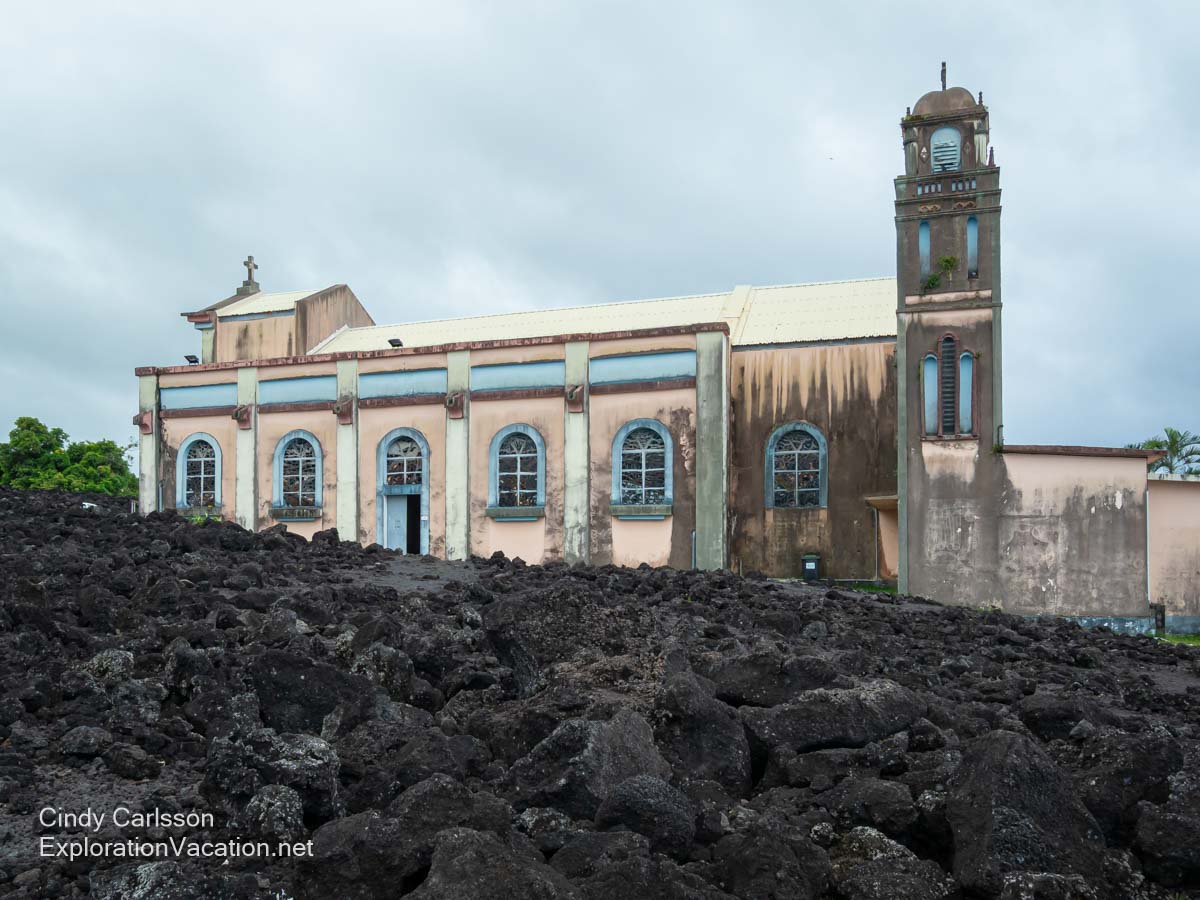
We got a break from the rain at the aptly named Our Lady of the Lavas church.
Most stories say the lava went around the church, which it did. But it also went inside the front door and over a portion of the floor. The hardened lava was removed from the interior. It was also cut away from the exterior wall in the front of the church. (The church seems to have been right at the edge of the lava flow.) It is pretty amazing that the church remained standing, but the hot lava seems to have done quite a job on the interior, which is quite plain (with what appears to be a sprayed ceiling) today.
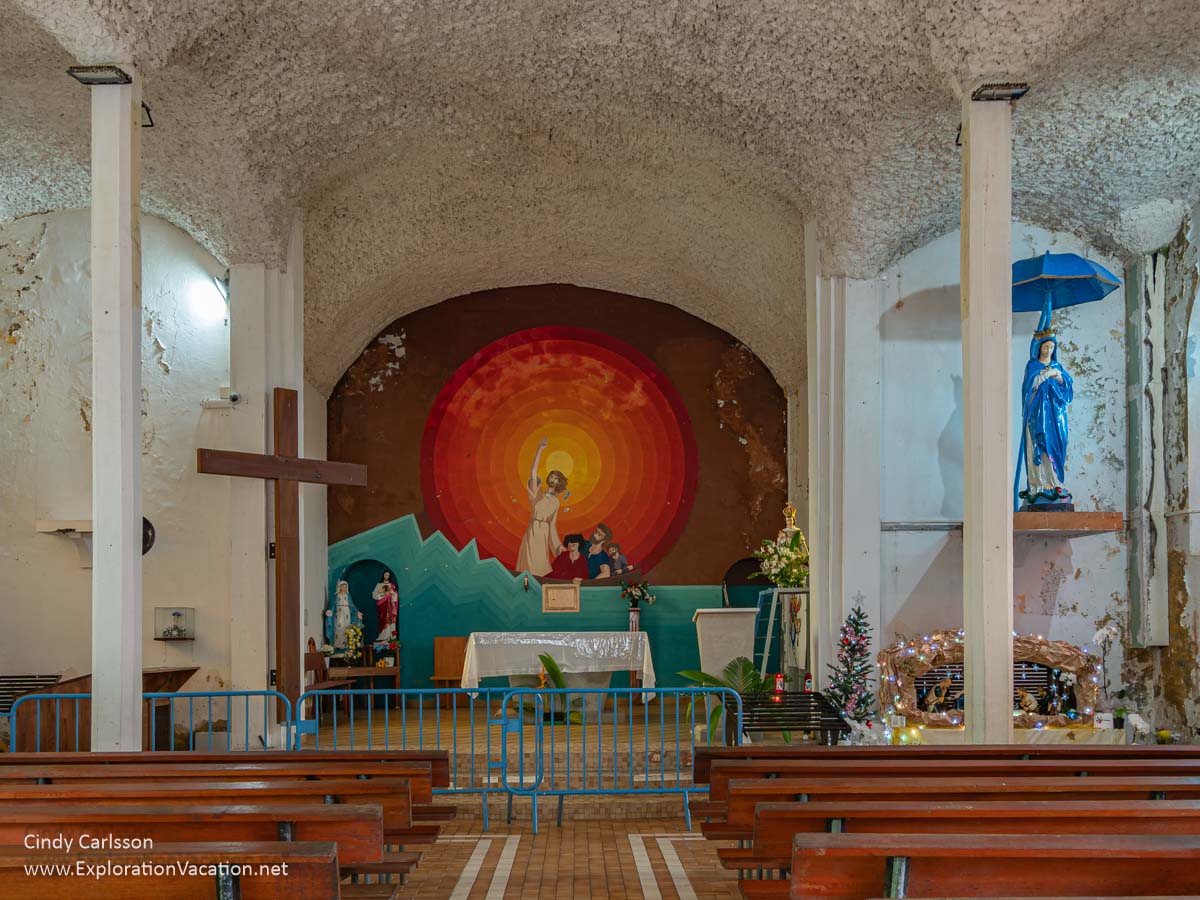
The interior of Our Lady of the Lavas.
Ooopsie
I had a number of areas I wanted to explore, both along the shore and inland. And lunch seemed like a good idea too by this point. Unfortunately, it started raining hard again as we left the church.
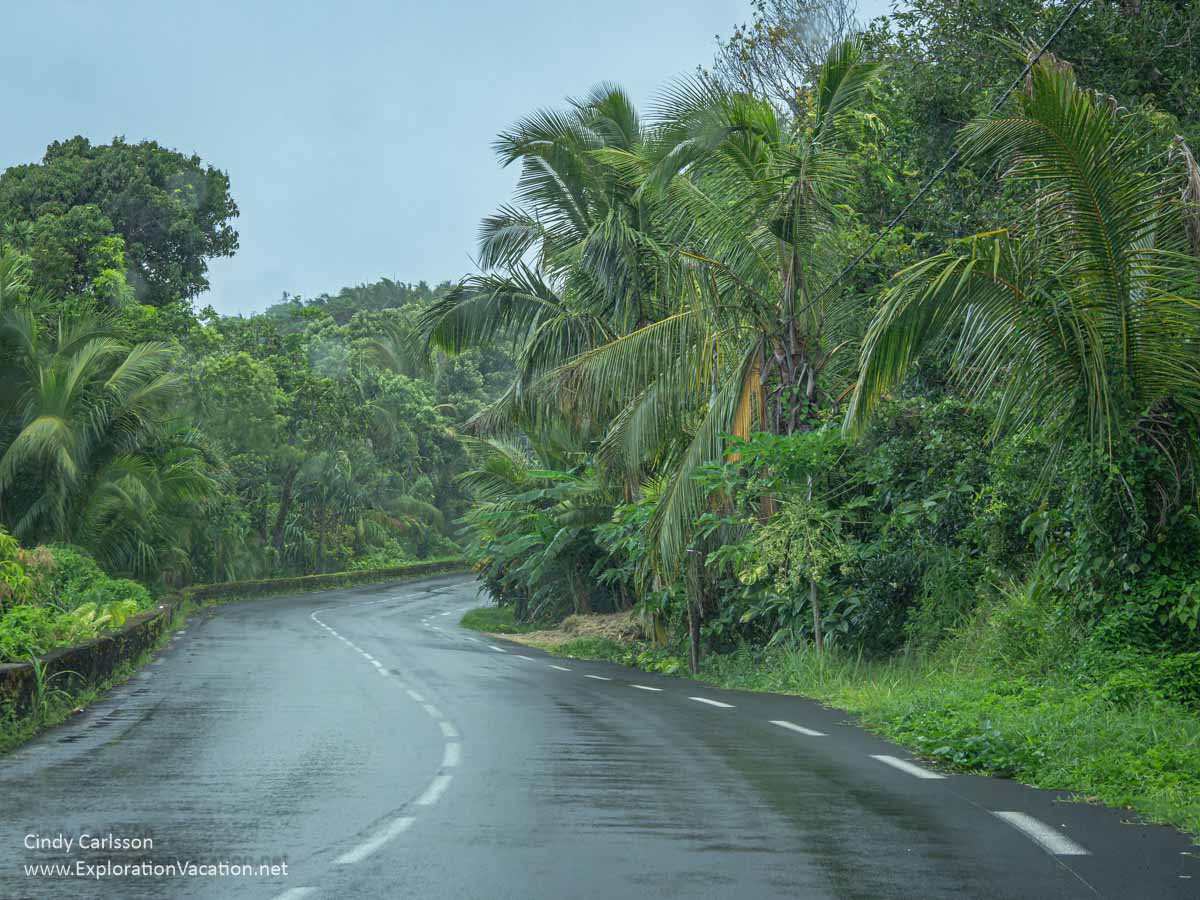
It’s warm enough, but awfully wet to be out and about.
The first place we picked for lunch was closed for a special event, so we kept driving. We skipped the forest walk I had planned to do (I was trying to see all the different types of forest) and drove long enough (far enough) that we were out of the rain by the time we got to one of the other places I thought we could try for lunch.
👉 Read more about our little slip . . .
That place looked packed, with cars parked everywhere. I told Lane we should just skip it. But he’d spotted a parking spot and quickly turned to pull into it. . . quickly enough that I had no idea what he was doing even as I heard the wheel in front of me drop into a very well-hidden drainage ditch with a nasty scraping sound.
I knew immediately what had happened.
We’d been here before.
Well, not here, as in at this place. But in this situation. Luckily it wasn’t nearly as scary this time, as it was daylight and we were not at the edge of a precipice!
See, Réunion, like the island of Mahé in the Seychelles, lines roadways with deep concrete gutters to manage the heavy rains. And when I say “lines roadways,” I mean exactly that. These are usually located right at the edge of the pavement on roads with no fog lines. They leave no room for error when you meet an oncoming car or unexpectedly come upon a very sharp curve. Not wanting to repeat our encounter with one in the Seychelles, I’d been nervously (and needlessly) pointing them out for days as we drove around Réunion.
In the Seychelles, these were always really obvious. You could see them a long way away. And pretty much every road was lined with them on both sides, so you knew they were always going to be there.
Réunion’s system is similar, but they don’t use them everywhere. And, where they do use them, they tend to be smaller and less visible, their placement often seems rather random, and (despite all the road crews we saw removing vegetation from them) many had very large plants of various types growing in them. (From a plant’s perspective, these probably seem like ideal planter boxes.) But all this made it much more difficult to even see these things along the road.
This particular one was in a really weird spot (along a very short wall between two driveways at the edge of a gravel parking area) where it was essentially useless. And even more fully overgrown than usual. It just looked like vegetation happily growing in the dirt along a wall.
Fortunately, we were able to solve the problem the same way we did in the Seychelles: A few local men came over, picked up the car, and lifted the wheel back onto solid ground. (I suspect falling into these drainage gutters is not a particularly unusual occurrence on Réunion.) Also, as in the Seychelles, the car was still very much drivable. Unfortunately, unlike in the Seychelles, where there was no damage to the car, here we’d fallen into the very end of the drain, so the front corner of the bumper and wheel well were damaged.
We’ll have the rental car company and my travel insurance to deal with later. But, at this point I mostly just wanted to get off the road and chill out at our cottage. And I’m sure Lane is even more eager to get off the road and relax. So, a few more “things to do today if it isn’t pouring rain” drop off today’s list.
👉 Read less
Along the sea
As we move farther west, we leave the rain behind. And Lane still wants lunch, and there are interesting sights along the way. So, we make a few short stops.
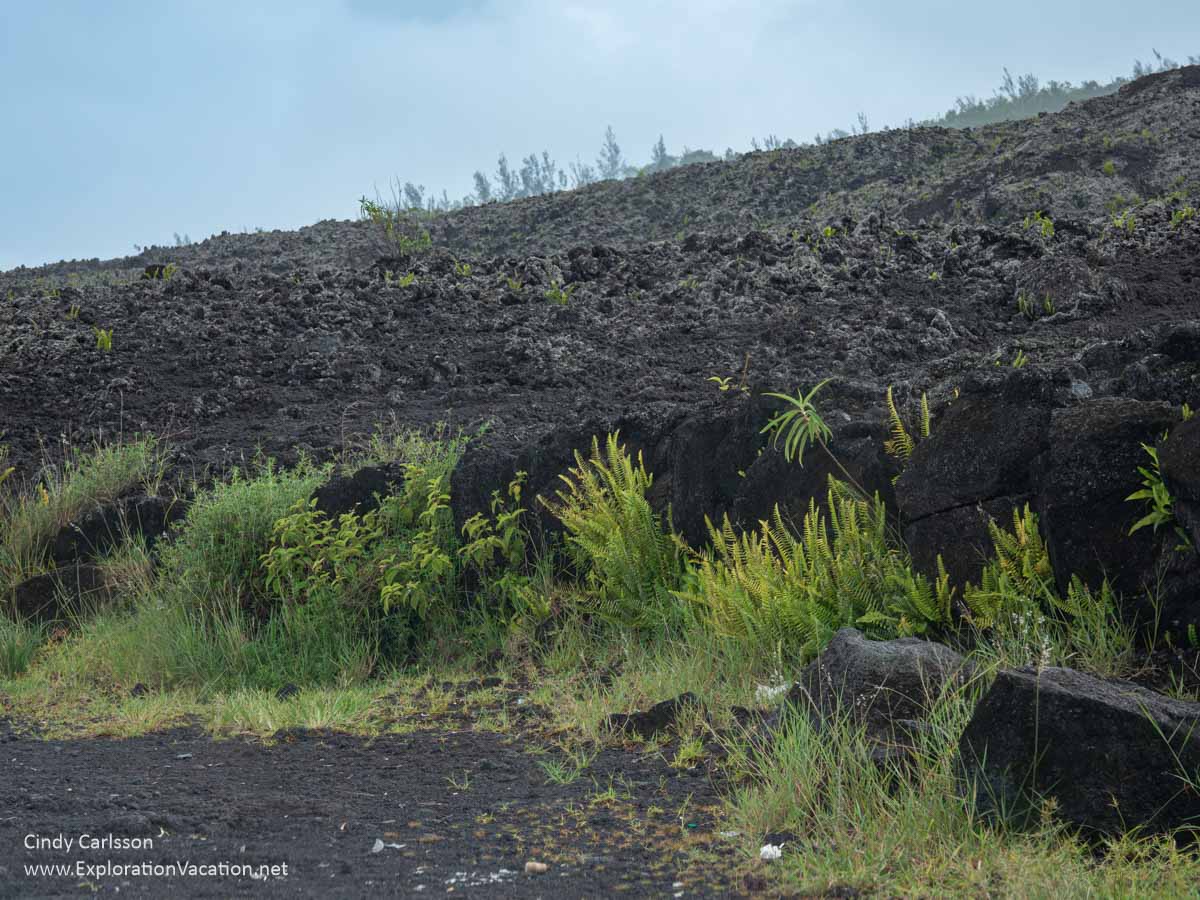
Building and maintaining roads looks like a challenge on Réunion.
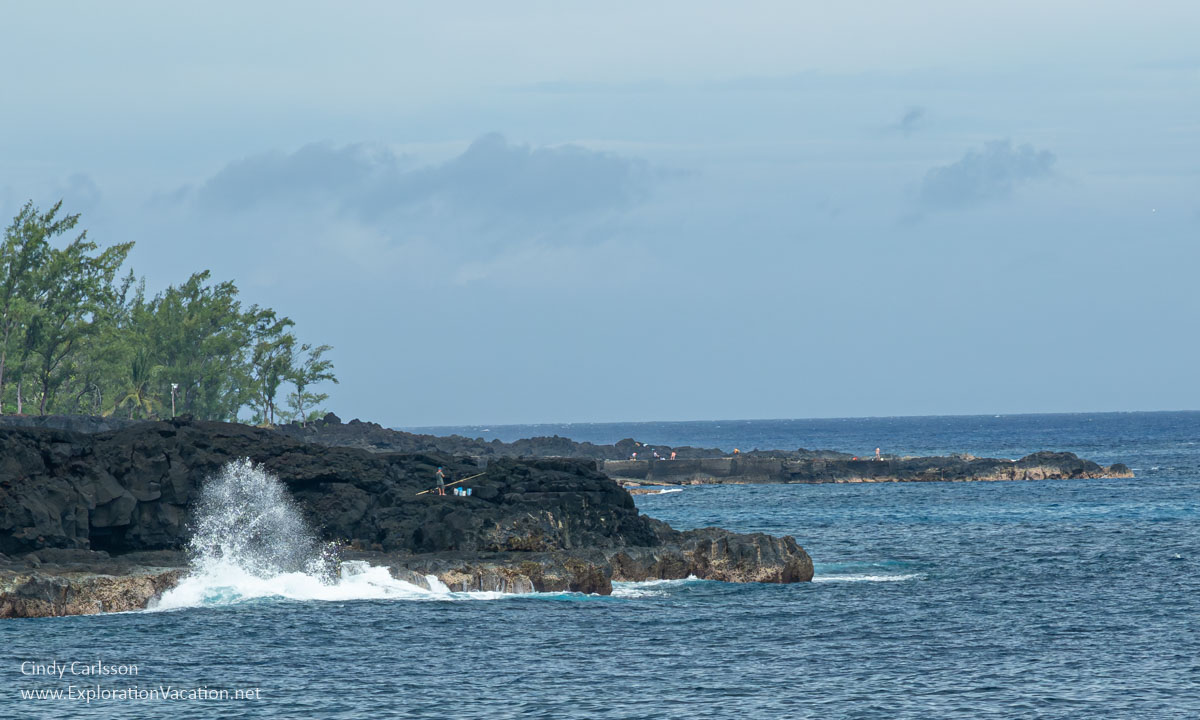
The volcano regularly expands Réunion’s land area, which is very visible from the coastal road.
We tried to find a trail along the beach that was supposed to be a good place to look for tropic birds, but couldn’t find it. However, there were other distractions.
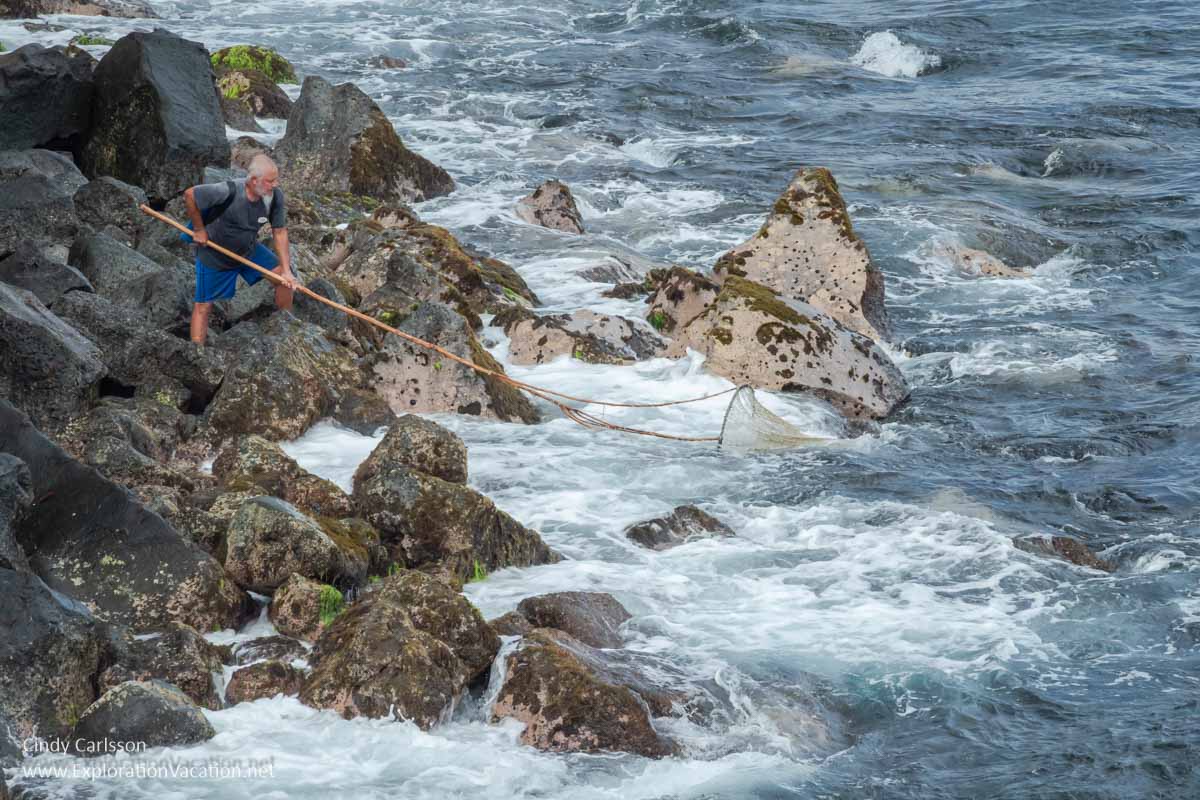
I watched this man for a long time, hoping to see what he was trying to catch. However, his net always came up empty. Maybe he had better luck farther along the shore.
As I think I’ve mentioned before, navigation on Réunion was often challenging, so I don’t have a lot of my usual photos out the car window. But there were some cool things in the towns and villages we passed along the way.
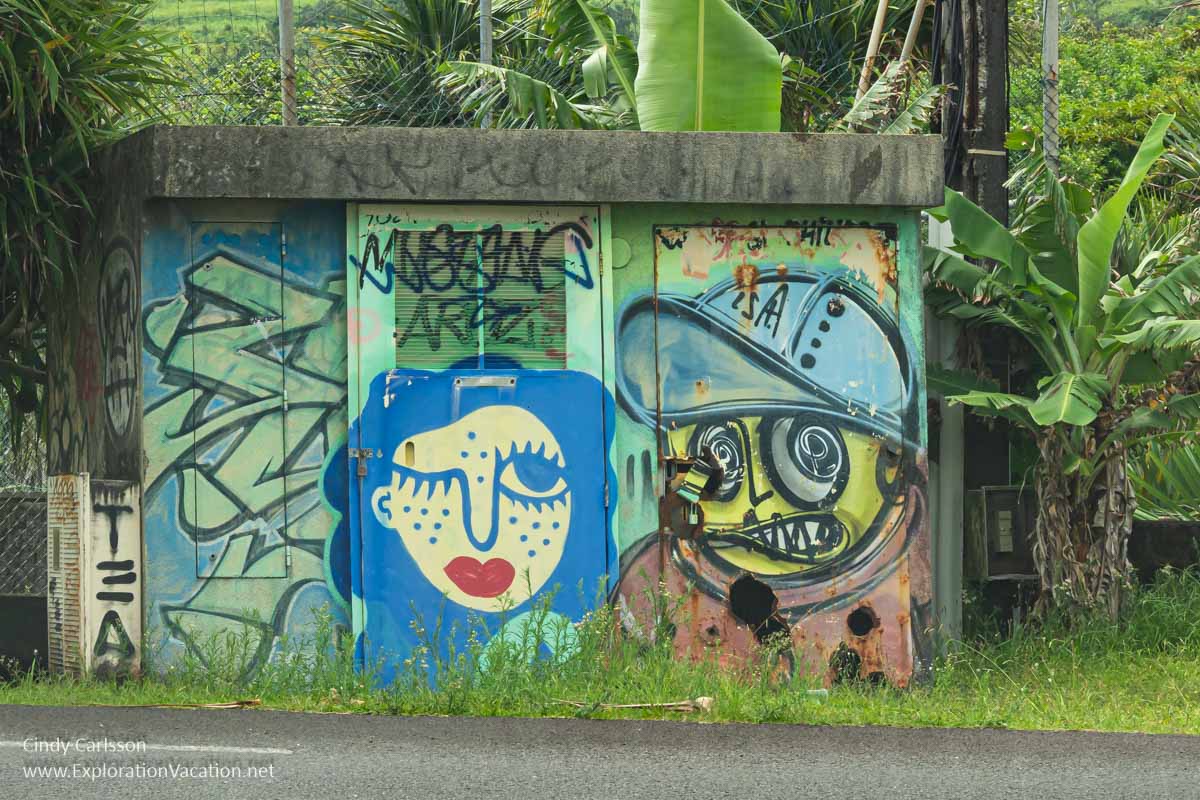
Street art on Réunion tends to be bold and colorful.
And then it was back in the traffic of Saint Pierre on to our lovely little cottage.
Day 5: The Decorative Arts Museum
Today was supposed to be really rainy all across the island (typical monsoon weather), so it seemed like a good day to do a museum. And the most promising museum on our side of the island (where the rain wasn’t supposed to be as intense) was the Museum of Decorative Arts of the Indian Ocean.
On arriving, we discovered they only do one exhibit at a time, and the current one focused on the Asian ceramics trade. And there really isn’t much left of the historic coffee estate it’s located in. But we were there, it wasn’t expensive to visit, and we are a bit interested in Asian trade ceramics. So we decided to check it out.
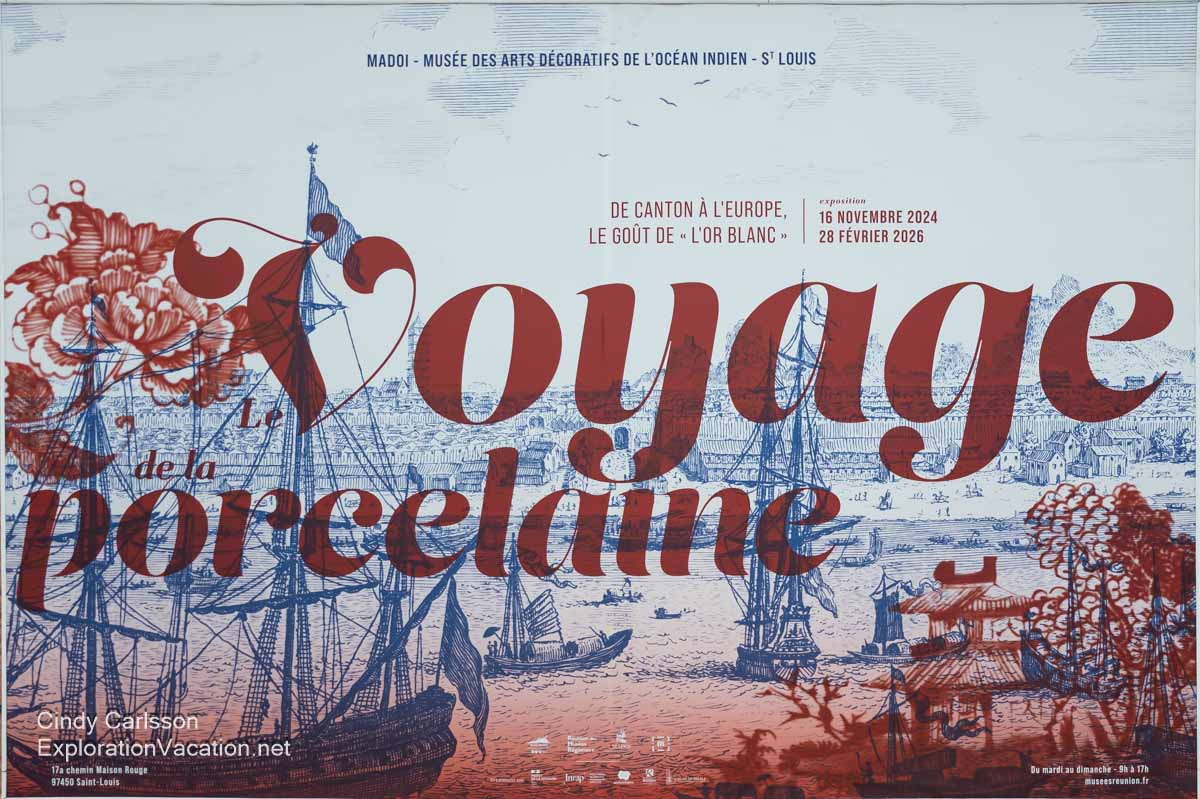
This was an interesting and beautifully presented exhibit, even if it wasn’t the exhibit I was expecting.
There were some interesting pieces, some downright odd pieces (a Martin Luther tea set, among others), and some truly beautiful ones.
👉 Learn more about Museum of Decorative Arts of the Indian Ocean . . .
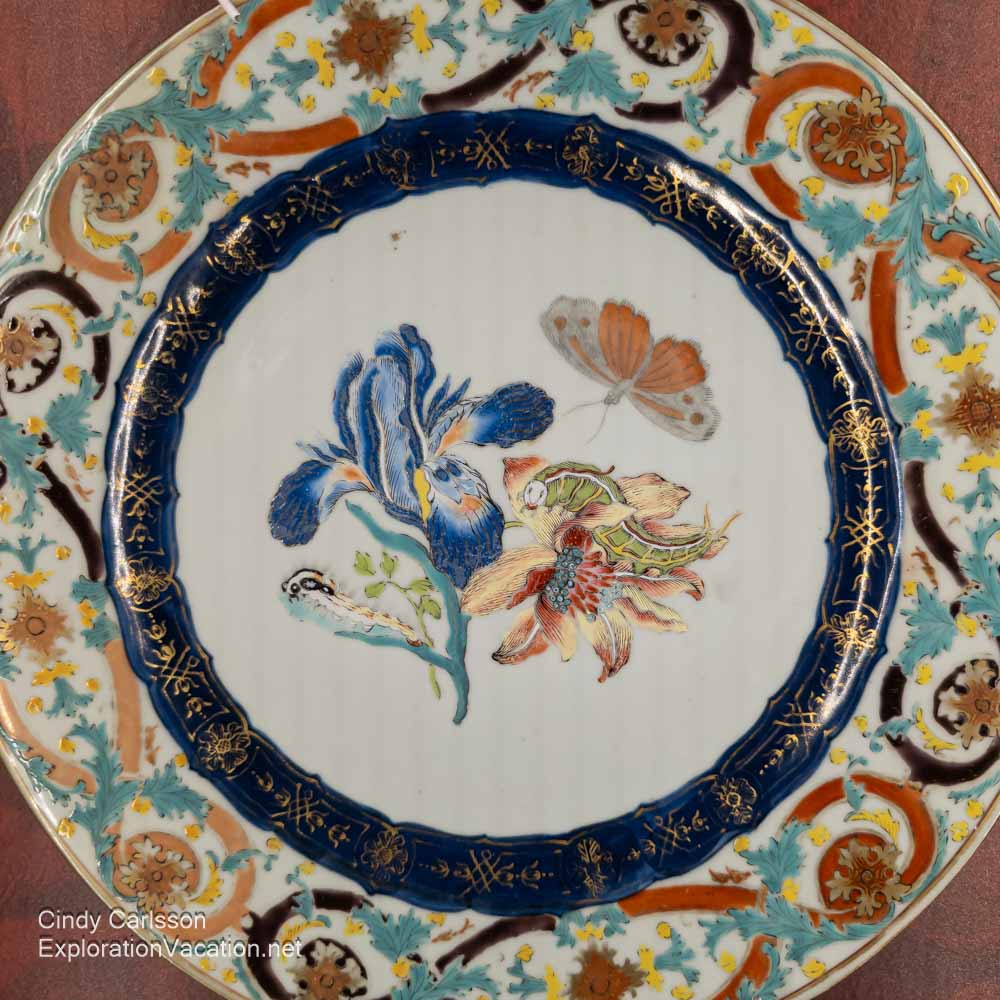
The decoration on some of these was gorgeous. (And some were hideous.)
The museum also offers a self-guided tour of the historic estate. That turned out to be both less interesting and a bit wetter than anticipated. While the original plantation house is still standing, it appears from older photos that it is in terrible condition. It’s undergoing restoration, but it sounded like the end of that project was a very long way off.
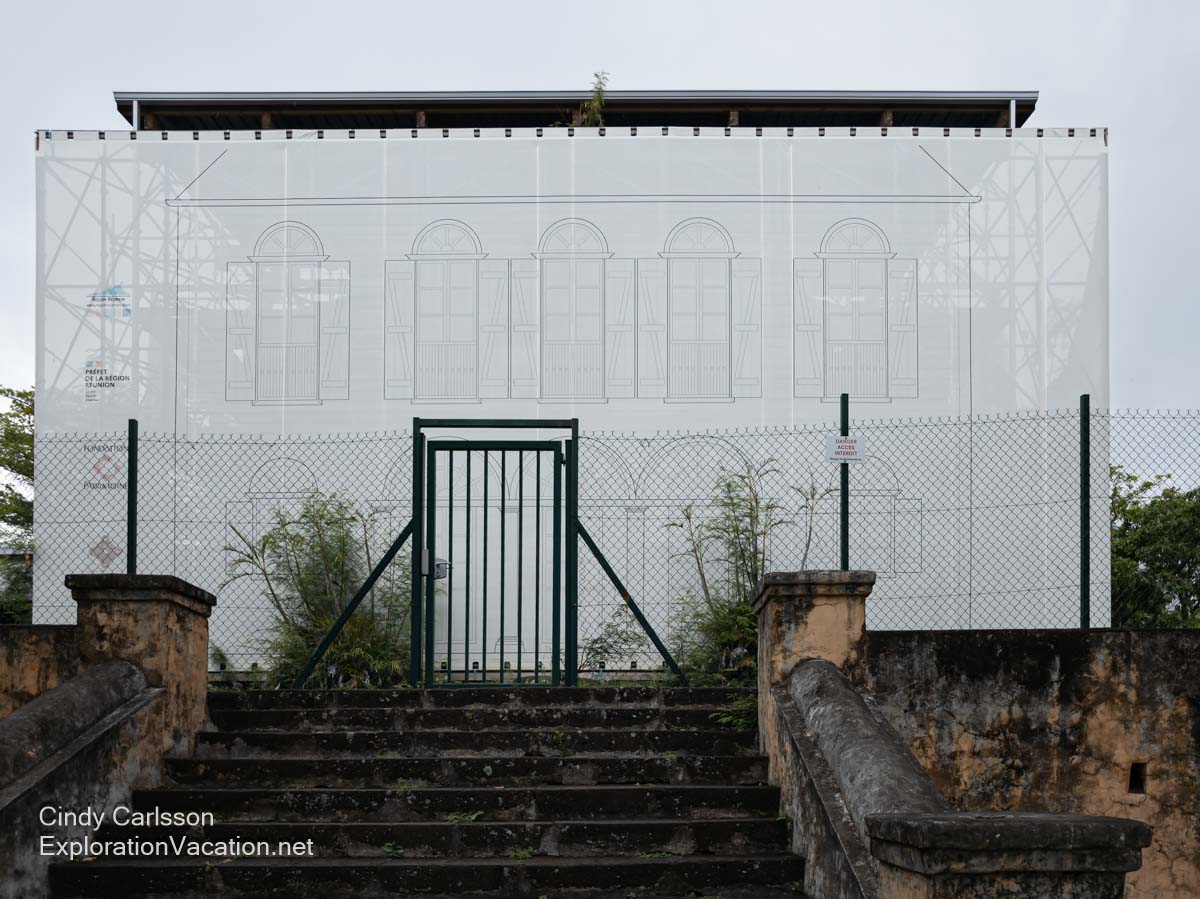
I’m not sure how active the plantation house renovation is. It looked like a very challenging project.
Except for the stables area, the plantation house, and a large building used for coffee production, other buildings on the historic estate are ruins.
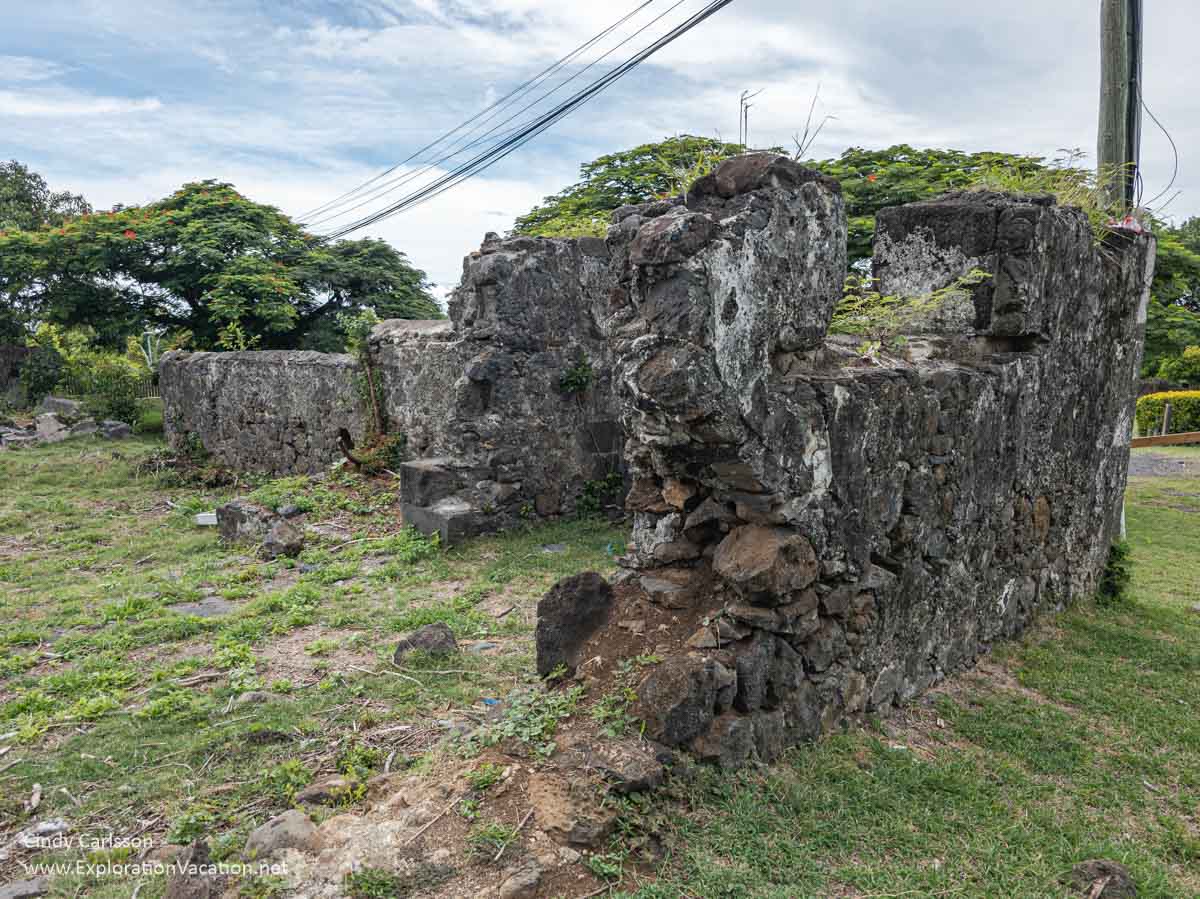
Good signage explained what the ruins had once been and what role they played in the operation of the plantation. But they weren’t much to look at. And it was starting to rain again.
There aren’t really many museums on Réunion, and they are pretty scattered about. That means this is the only one we got to. And, while it would have been nice to see more of their collection, which includes a lot of really amazing furniture and textiles. It sounds like they will have much more once they finish restoring the plantation house. But that could be a while.
👉 Read less
The best restaurant
The downside of our lovely cottage was the lack of dining options within walking distance. (There didn’t seem to even be a bakery very near.) And most restaurants were in very busy urban areas that we didn’t feel like dealing with after a day of driving around.
That means we hadn’t taken advantage of the fact that Réunion has wonderful French Creole food.
Today we decided we deserved a really nice lunch after the museum. So I searched out a spot along our route home.
Restaurant Le Close Des Lys in Saint Louis is one of those chef-driven places where every dish is a work of art. And every single thing was absolutely delicious. For my main, I had a langoustine (like a small lobster, but sweeter) that was split in half with a white sauce on one half and a chimichurri on the other, and risotto and roasted vegetables on the side. It was an incredible-looking plate (I took pictures, but something didn’t work) and absolutely delicious.
This was not an inexpensive restaurant, but it was worth every cent. I highly recommend it.
Day 6: Back to the Maïdo Overlook
Our final full day on Réunion dawned bright and sunny.
We finished packing, ate a quick breakfast, did a last-minute cleanup, met with our host to check out, and were on the road before 7:30. (Sunrise was around 5:30, so it wasn’t hard to get up early enough to get on the road at a decent time.)
Today’s weather was supposed to be beautiful all across the island, so we were going to to make another attempt at actually seeing something at the Maïdo Overlook. And getting there before 9 am would give us a good chance of actually seeing something before the (inevitable) fog settled in.
This time we took the direct route. (Or, as direct as anything is on Réunion, which may be fairly direct, but certainly not straight!) And no lollygagging along the way.
We got there in time.
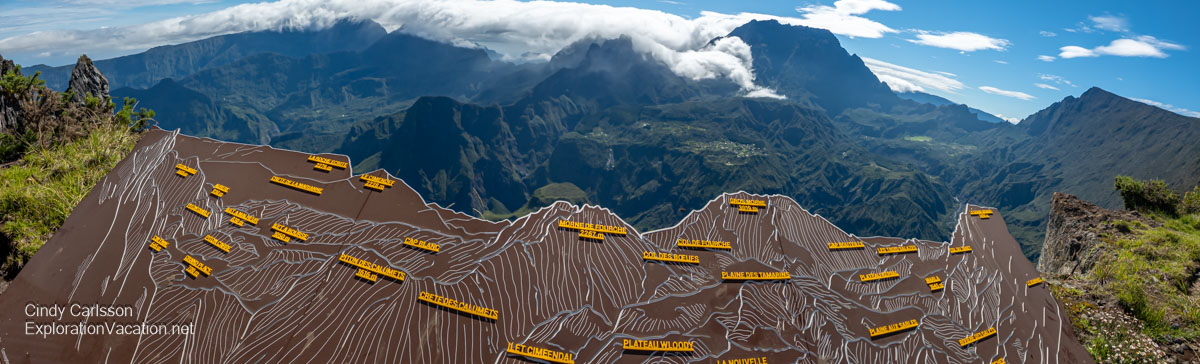
There they are!!
The viewpoint runs all along a ridge and offers breathtaking views of the Cirque de Mafate’s mountains. That includes at least 10 peaks over 6,500 feet (2,000 m).
There were other people gathered by the sign showing the peaks when we arrived, so we headed up a short rise to the right that gave us a nice view of some of the small settlements that make up the village of Grand Place.
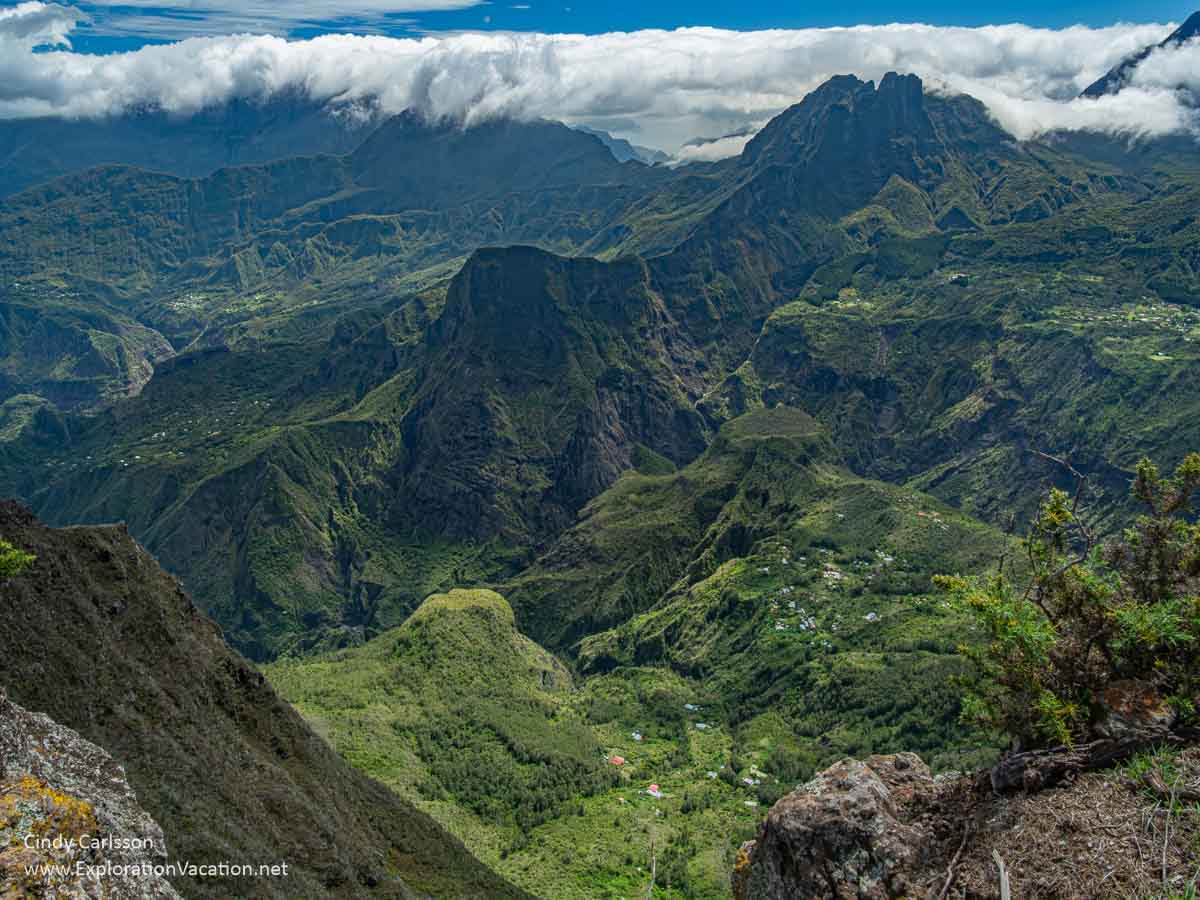
The view into the cirque (a collapsed caldera) is stunning.
Everything we are viewing from here is part of the caldera of the long-dormant Piton des Neiges volcano.
I’d brought a long lens to get a better view of some of the îlets (tiny villages) in the cirque. But the lens was somehow both too long and too short to get what I wanted. And the sun was utterly wrong for photography. Still, it gave me a little bit better look at some of it. (What would it be like to stay in one of those villages?)
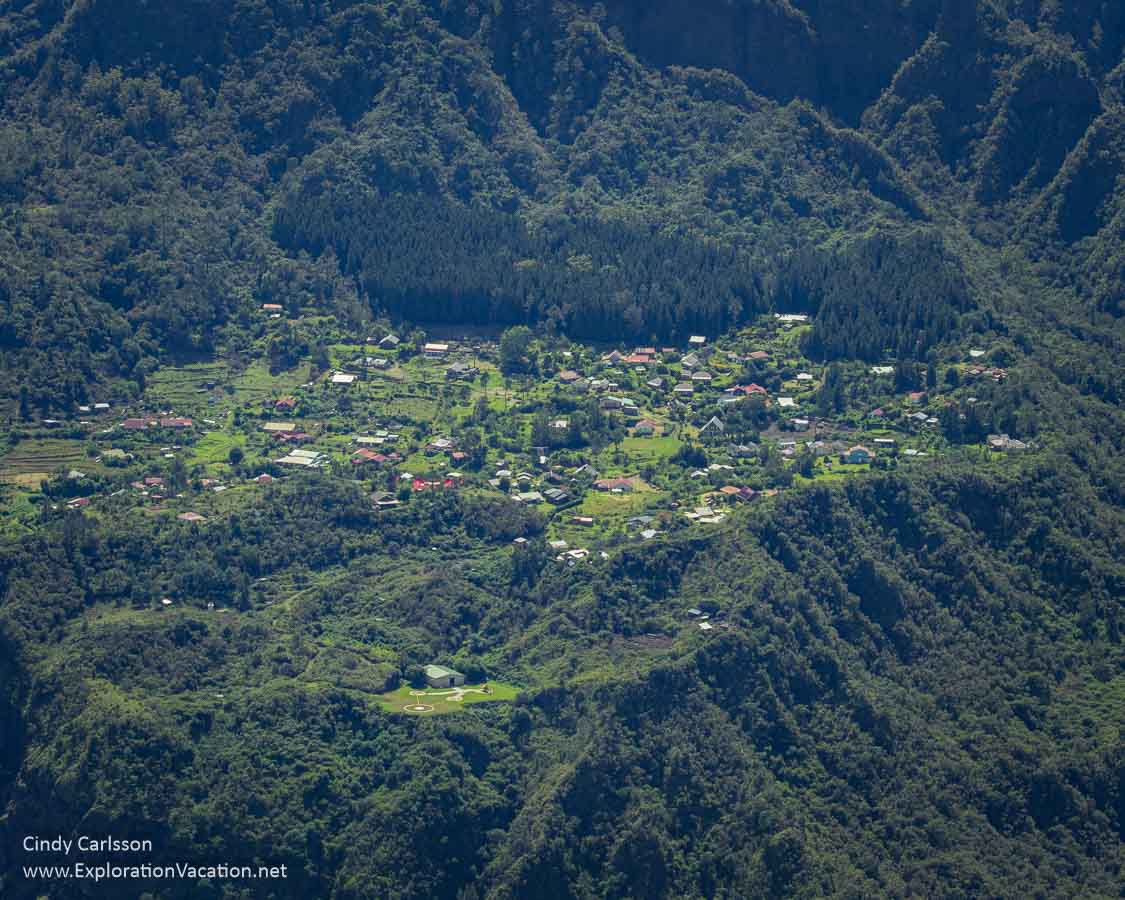
This is Cayenne, a district in the village of Grand Place.
While the scenery was pretty impressive, what’s more impressive is that people actually live in this cirque. Unlike the island’s other large cirques, there are no roads into these tiny settlements. (The original settlers were escaped slaves. They were later joined by poor white laborers.) Even today, everyone and everything comes into Cirque de Mafate’s villages by foot or helicopter!
👉 See more from the Maïdo Overlook . . .
And it isn’t easy to get in on foot. Reaching any of the îlets requires a long, strenuous hike with no services along the way. Of course, had the weather been more reliable, I could have gotten a better look by booking a helicopter flyover. . .
Of course, since I wasn’t doing a flyover, I really wanted to see the view from the rest of the path along the overlook.
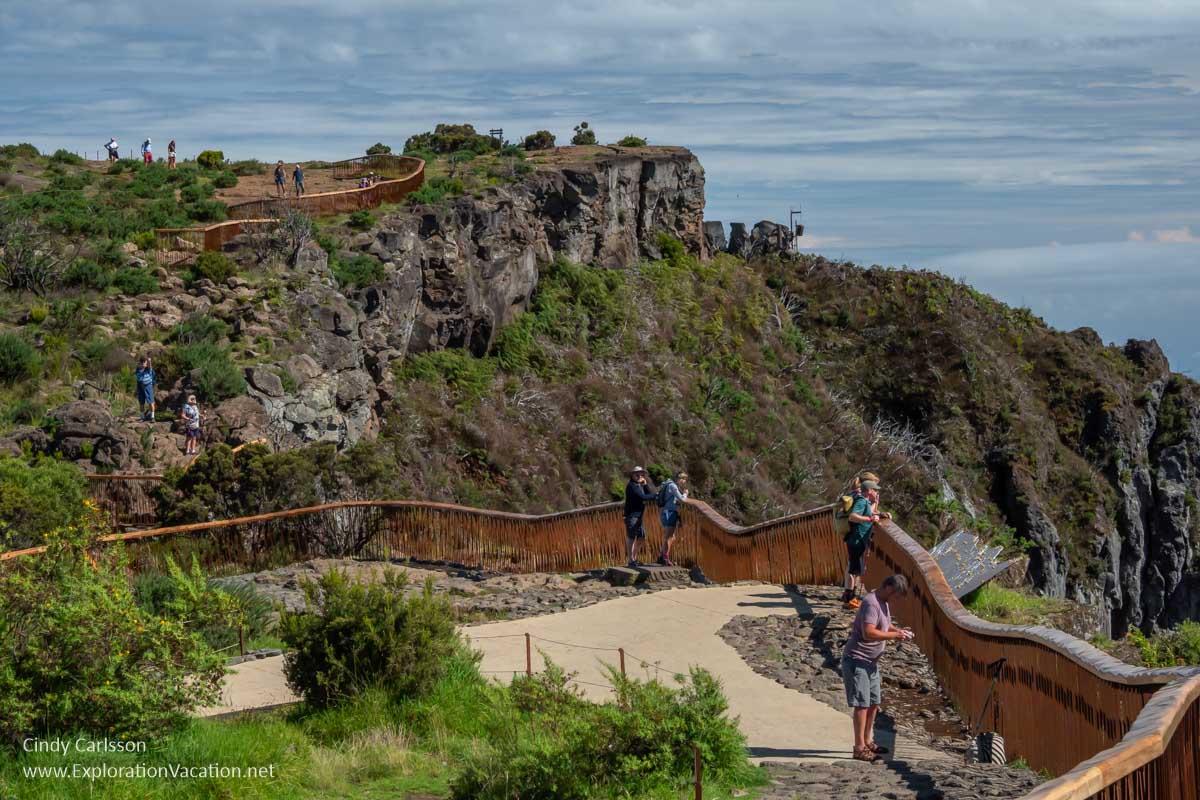
The overlook runs along the edge of a ridge. The photos above were taken from one end of the trail.
Lane (who wasn’t wearing hiking boots) decided to hang out and enjoy the scenery from down by the sign. Meanwhile, I headed up to the other direction to get a view of the mountains and sea from the top of the ridge. (Stopping to take more photos along the way.)
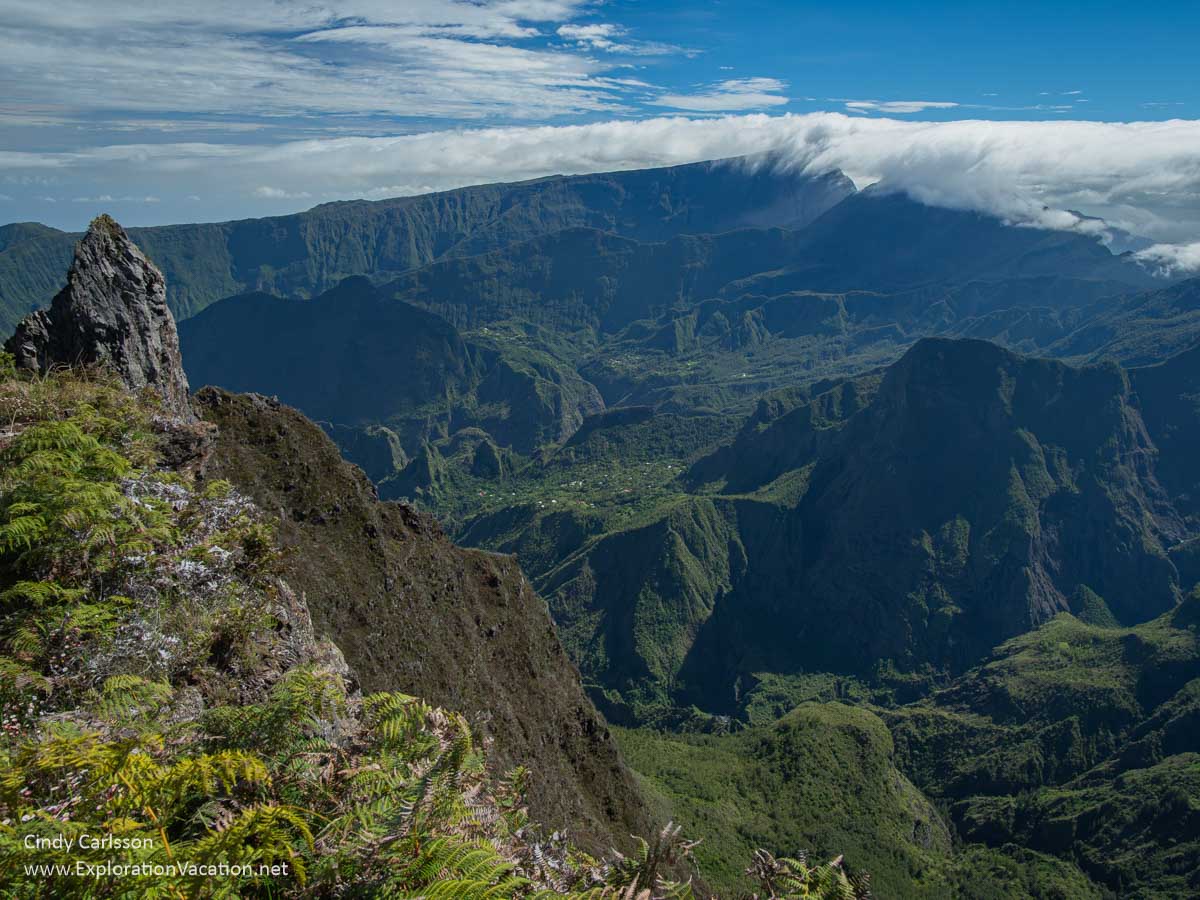
It’s so beautiful!
Unfortunately, a couple of sections of this trail are pretty rough.
I didn’t mind hiking over the rock face and a few boulders when the concrete path ended, but there was one spot where you had to step a long way down onto a small, flat boulder. If I’d had my hiking poles or someone nearby to give me a hand, I would have kept going. But I didn’t have either and didn’t see anyone headed my way.
Deciding I didn’t want to risk a fall this early in my trip (we’d still be traveling for over two weeks), I backtracked to see if I could find another path up that would be more manageable, but everything else seemed to disintegrate into a scramble up and over loose rock.
I do think the light on the mountains as they ran toward the sea would have been spectacular, had I found a route up to the end of the lookout. But we also needed to get across the island to Saint Denis. And there were things I hoped to do there too.
So, we got back in the car and headed down to the coast, stopping along the way to check out the landscape, vegetation, views of the sea, and some guys working on their slackline skills.
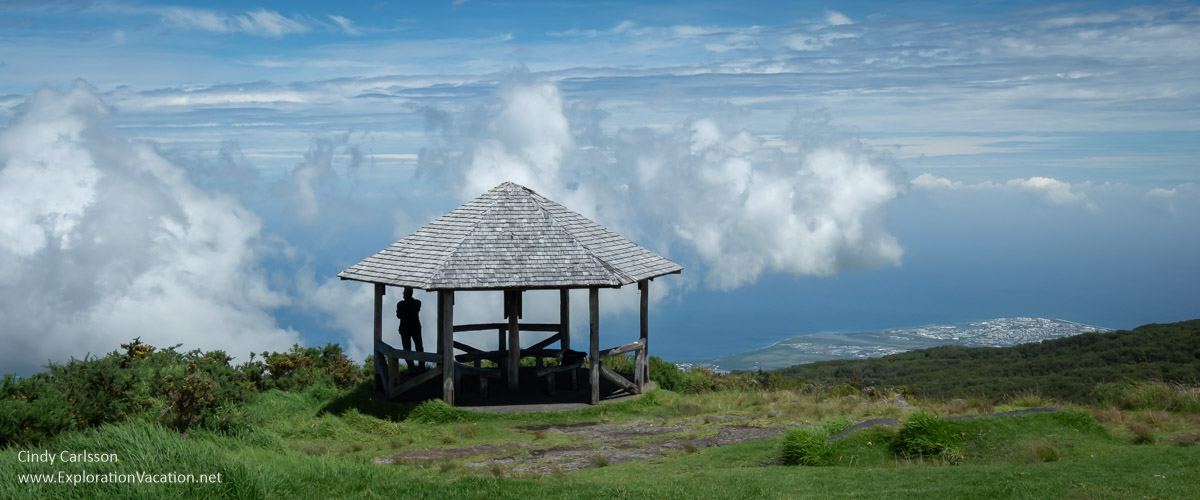
You can actually see the coastline today!
All of this is part of Réunion National Park, which is a UNESCO World Heritage Site. But for the people who live here and regular visitors, it’s just another beautiful place to picnic and hang out on a sunny day.
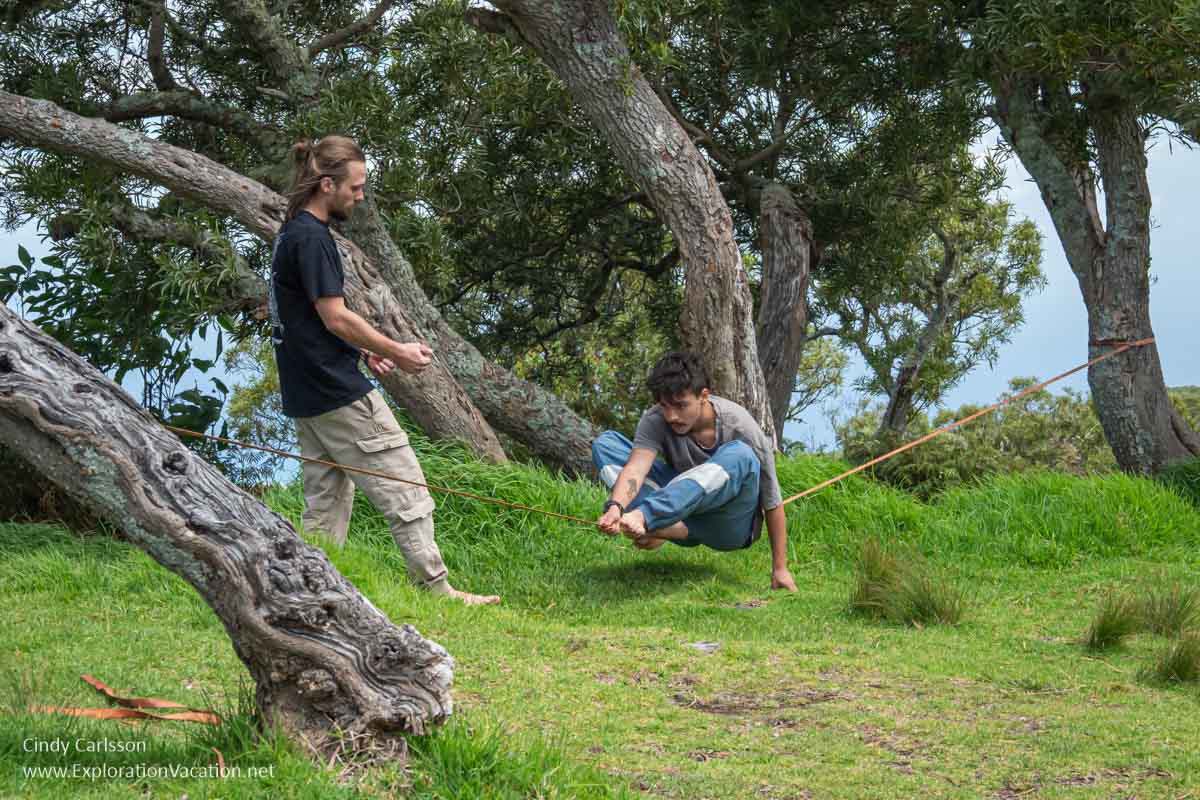
Slackline lessons with a view during a picnic.
👉 Read less
Day 6 continued: Driving the EU’s (and maybe the world’s) most expensive highway
It doesn’t take long to get to a major highway once we leave the national park en route to Saint Denis.
And, while there are some nice hillsides and sea views, the route along the main road is mostly developed. Or, more accurately, developed along the coast at the base of some very large hills.
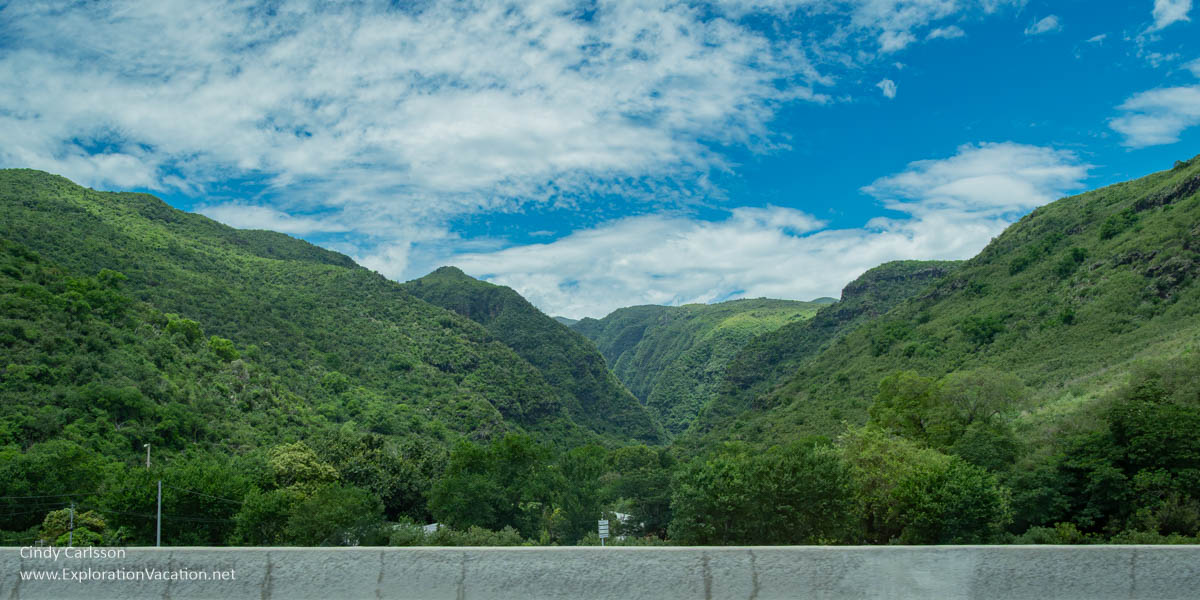
The retaining wall blocks most of the view, but there are a few buildings along the base of these hills (mountains?).
But I was eagerly awaiting the later section of our drive. The section that would take us along the Nouvelle Route du Littoral RN1 (the New Coastal Road) as we traveled between La Possession and Saint Denis.
👉 Learn more about the EU's most expensive highway . . .
Still incomplete, this 7.8-mile (12.5 km) highway runs above the sea on dikes and viaducts. It’s a spectacular bit of engineering. One that could end up costing an equally spectacular 2.6 billion euros (almost 3 billion USD) or more. That’s about 200 million euros per kilometer, making it the most expensive road in the European Union and perhaps the most expensive in the world.
(Note for transportation geeks: It’s $3 billion dollars on a highway that currently serves 80,000 vehicles per day.)
You are wondering why France is building what may be the world’s most expensive road on a tiny island in the Indian Ocean?
This is why:
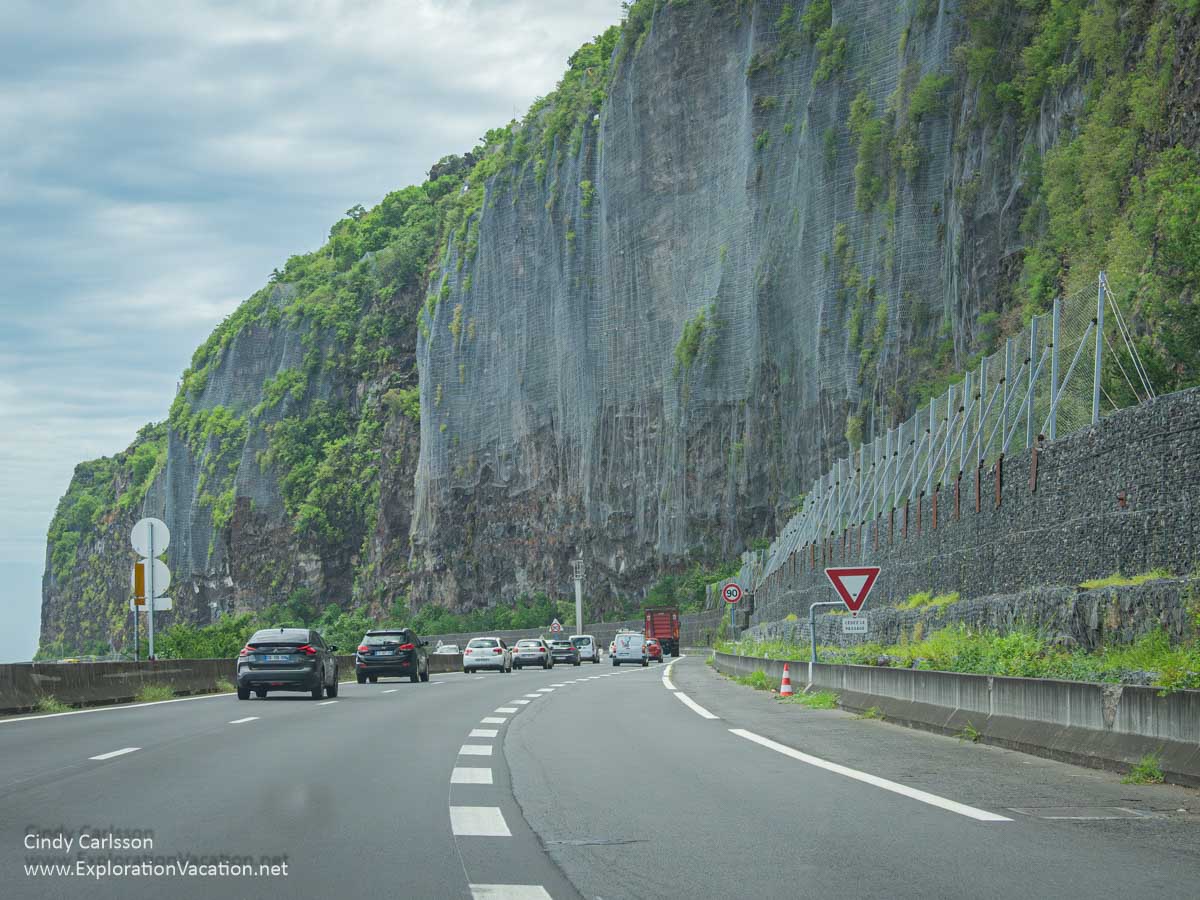
A section of the Coastal Road (RN1) that hasn’t yet been rebuilt.
Squeezed between the sea and the mountains, the original road faced destruction from both sides. Giant swells wash over it when cyclones arrive and falling rock (both very small and very, very large) clobbers it whenever part of the mountainside collapses. Meaning one of Réunion’s most important transportation routes has long had serious safety issues.
And, with rock too fractured to tunnel through, building a new road over the sea seemed like the best option.
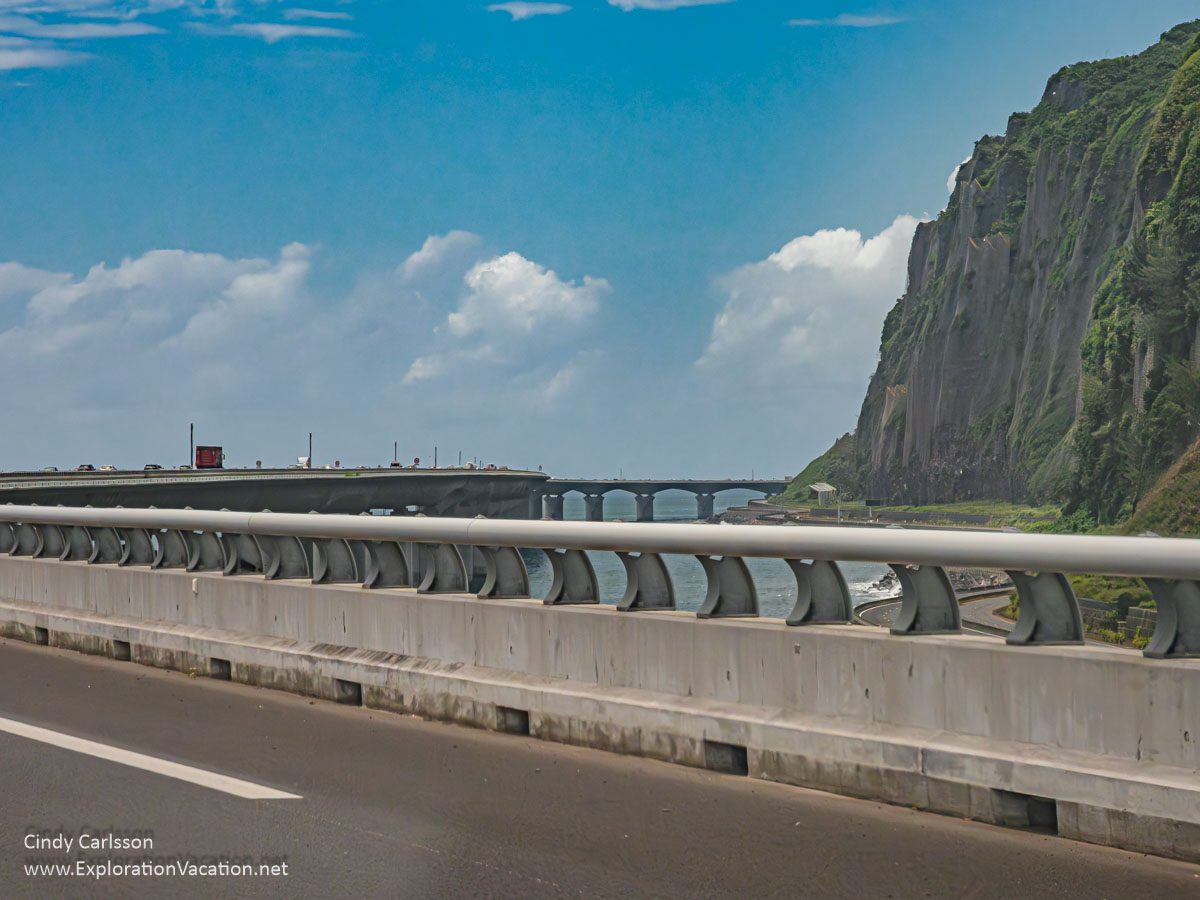
What the new road looks like when you are traveling on it. (I needed to be in a higher vehicle to get a better view!)
But building that new road has been a challenge. Currently only part is complete, with no clear timeline for when the rest will be done – or even what the remaining section will actually look like when complete.
👉 Read less
Day 6 continued: Settling into Saint Denis
I had expected to get into Saint Denis in time to explore the city a little and maybe even visit an art museum.
However, we had to return our damaged rental car to the airport, which is on the other side of Saint Denis, and then get a taxi back to town. Despite the damage, Sixt was fast and efficient. (Highly recommended based on our experience.) However, there were no taxis at the airport. None.
There was one other couple that also seemed to be waiting for a taxi, but after waiting a while, I made Lane (who understands basic French) go into the information desk and ask how we could get a taxi. (If Réunion has a taxi app, I never found it. And, if they have Uber, they were off for the day.) I made him do this more than once. The answer eventually changed from “a taxi will come” to “I will call a taxi” to “I called a taxi” to “the taxi will be here shortly” — which was finally true. We waited well over an hour.
(I have no idea what happened to the other couple. Maybe they were waiting for a friend. They didn’t seem concerned when we took the first taxi to arrive.)
Of course, this put us in rush hour. But, eventually, we arrived at our hotel.
Not a hotel in the heart of the historic area (where I couldn’t find anything that didn’t seem either scary or outrageously expensive), but one along the sea at the far edge of the business district near a more industrial part of the city.
We checked into the Hotel Dina Morgabine to find a large, comfortable room. Except the control lever on the air conditioner was missing, so there was no way to turn it on or adjust it. And it was a little warm.
After wasting another hour dealing with several staff members, it finally became clear that they had disabled it and needed to have someone put it back together to turn it on. Apparently this was the usual practice. (I think it was supposed to be reassembled before we checked in.) Why it took so long to figure that out and deal with it remains a mystery. But they upgraded us to a room with a sea view as a “sorry for the confusion” gift.
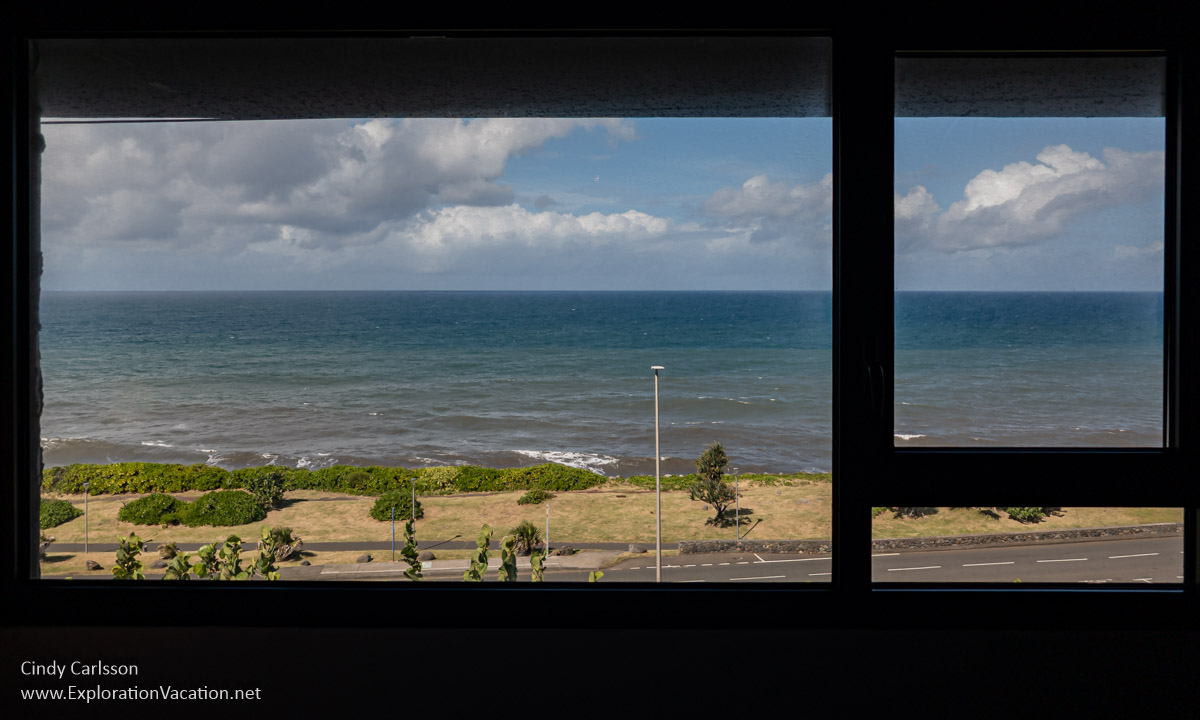
I’m always happy to have a sea view. Especially when I don’t have to pay extra for it.
So we didn’t get to visit a museum or do any sightseeing, but we did wander through an interesting neighborhood on our way to a good restaurant for dinner.
Despite the weird air conditioner issue, I’d recommend the Hotel Dina Morgabine in Saint Denis (they have two hotels on the island). It’s a modern hotel with large, comfortable rooms and quirky tropical decor. And, while it isn’t located right near the prettiest historical areas in the city, it’s an easy walk to get to them and most other things you might want to see. It’s also about a block from dozens of restaurants of all types and all price points. It’s clear you could spend all your time in Saint Denis exploring the world’s food without walking more than a few blocks.
Day 7: Exploring a bit of Saint Denis
With an early afternoon flight, we had a little time to explore the city a bit.
Saint Denis is often compared to New Orleans. A vibe I didn’t really feel. But it did feel very French Caribbean, which I’m also fond of.
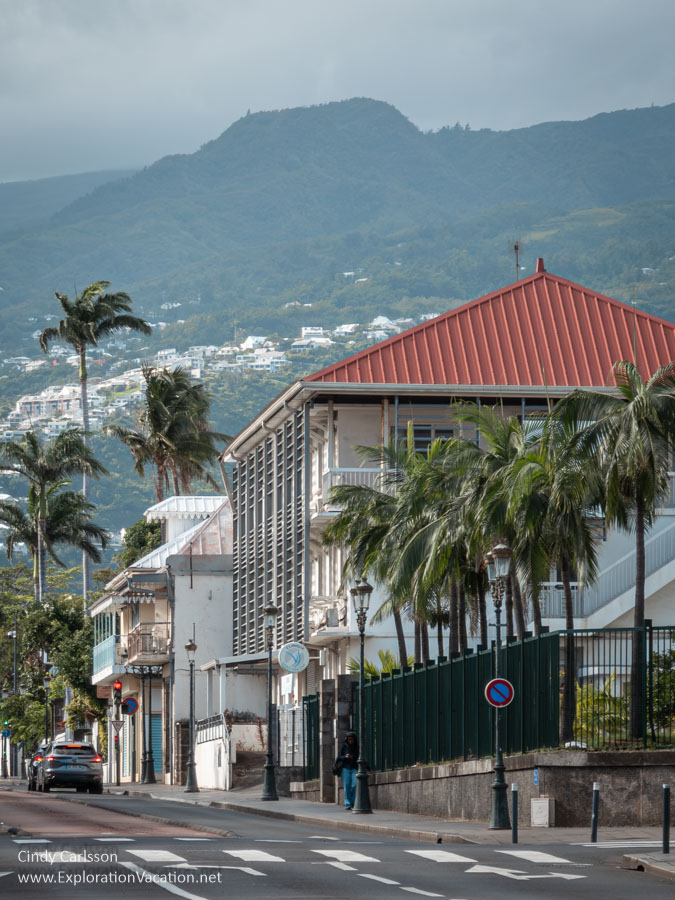
This street scene in Saint Denis could be from one of many French-influenced tropical cities. Just not New Orleans.
We wandered through part of the historic district, past the cathedral, the city hall (undergoing renovation), and a few of the city’s remaining Creole mansions. Of course, we also stopped in the fabulous Bois la Tasse for a breakfast snack.
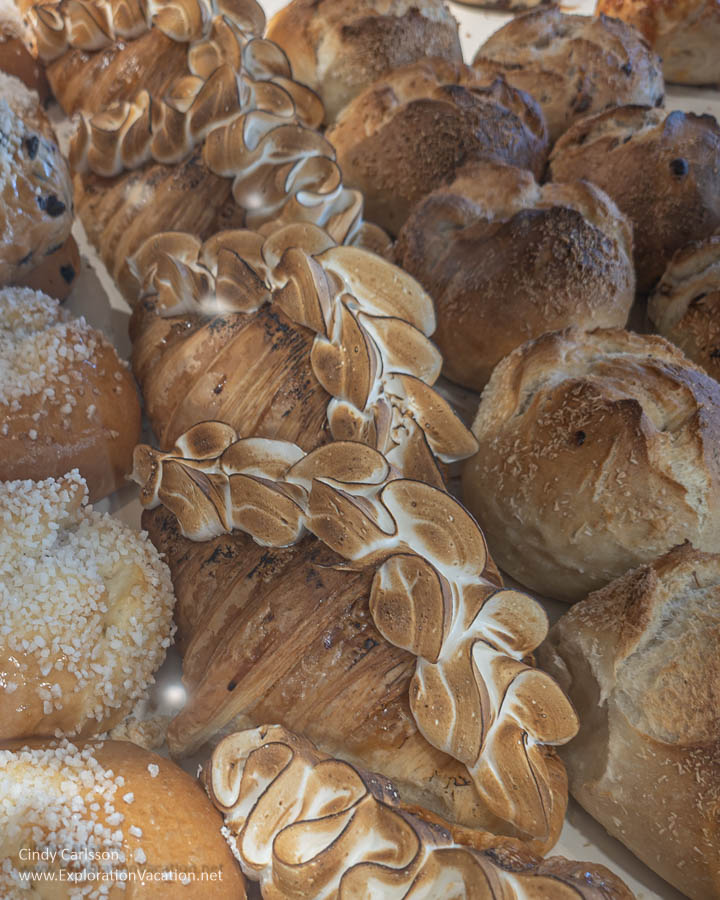
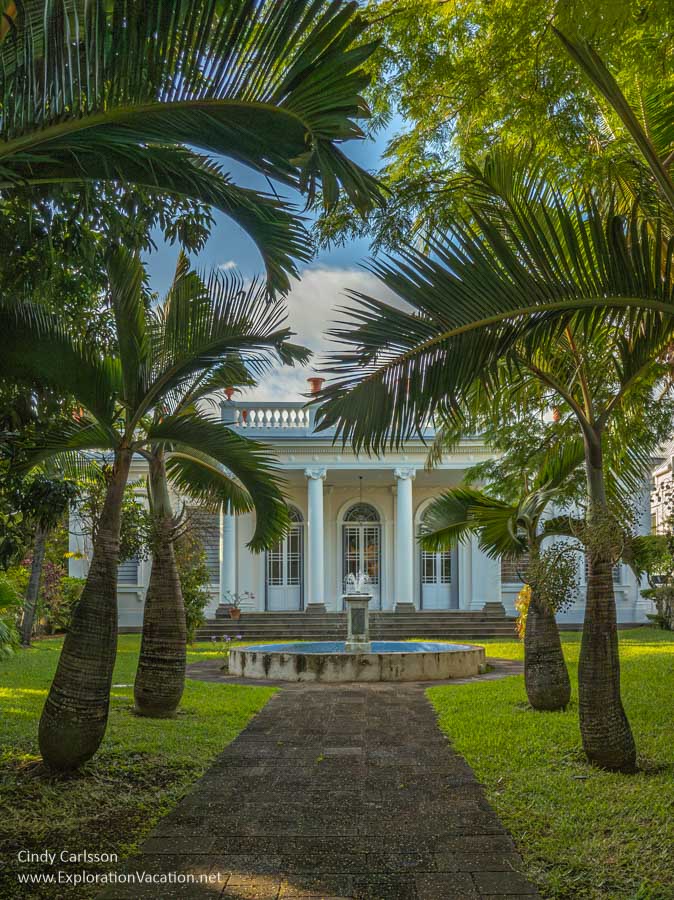
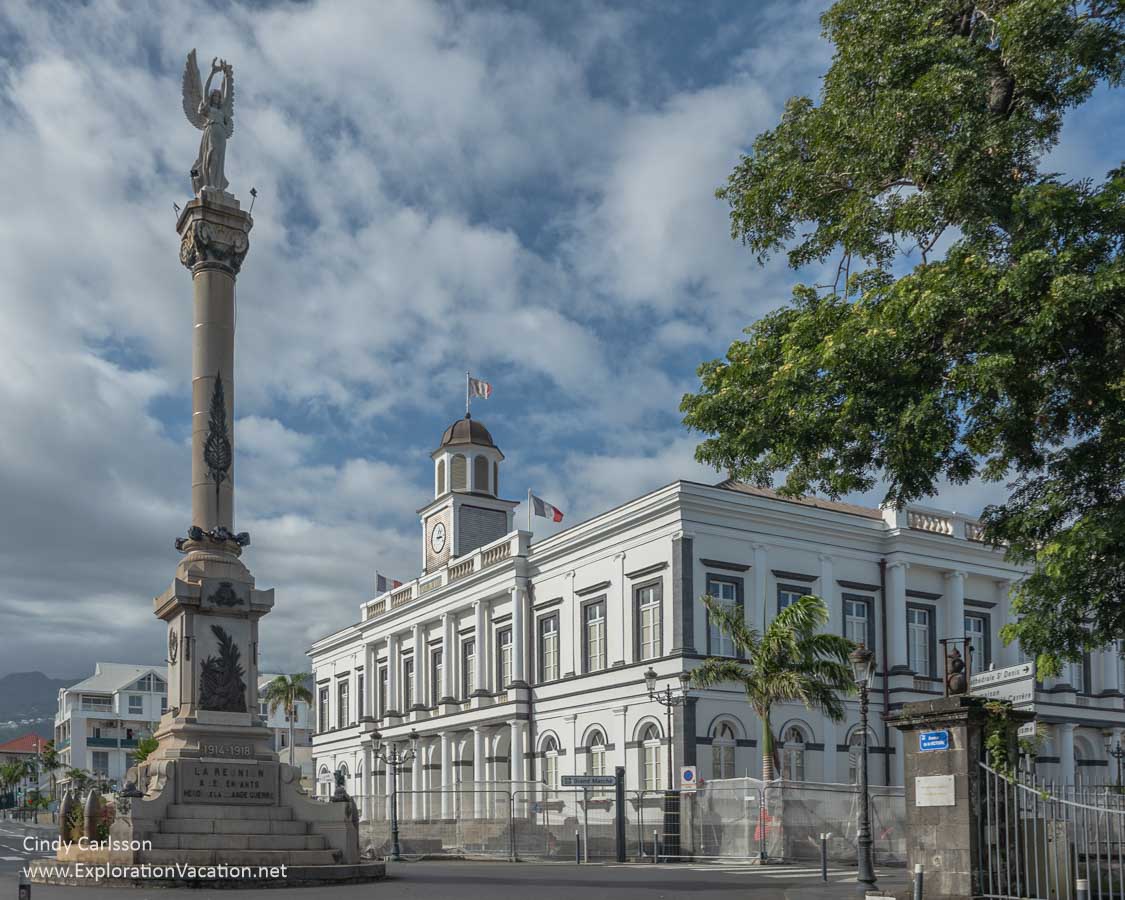
A few images from our wandering through town.
Plan your trip to Réunion
Your time on Réunion will benefit from some advanced planning.
I wish I had done a little more planning and taken a chance on the weather to book a couple of tours. While Réunion has been on my radar for decades, I’d never looked into actually traveling there. So, I really didn’t know much about it.
It was just an exotic tropical island destination, and I have a soft spot for those despite hating heat and humidity!
This trip only happened because I’d promised cousins from Finland that I would meet them in Mauritius. Since I don’t know if my Madagascar trip that COVID killed will ever get rescheduled, Mauritius seemed to be as close to Réunion as I might ever get. That made it a pretty obvious add-on to the Mauritius trip.
But now that I’ve been there, I’m telling everyone that they should visit!
Why go to Réunion?
Réunion has a wide variety of stunning scenery. It’s an adventure traveler’s dream. But there are also plenty of stunningly beautiful places that you don’t need to hike miles or climb peaks or ford rivers to enjoy. And it’s all quite close together. (The entire island is about 45 miles long; just don’t expect to find a straight road that will take you across it!) That means you can spend the morning in the mountains and then relax on a beach in the afternoon. That variation means it’s also a great destination for birdwatching.
Réunion is also safe, you can get a wide variety of great food, and roads are mostly what you would find in the rest of France. (Except for those drainage gutters!) But you will have an easier time if you can learn at least a few basic words in French, as few people speak much English. (Road signs are usually in both.) Otherwise the only real challenge is getting there since it isn’t close to very many major population centers.
You already know I have a thing for tropical islands. So, if I had to choose between French Polynesia or Réunion, I’d go with French Polynesia. But I’d recommend Réunion over Fiji, the Cook Islands, or even neighboring Mauritius, unless you are really focused on cultural activities or snorkeling/diving/surfing. (Réunion has all those water activities, but you have more options and fewer sharks in other places.)
Culture-wise, Réunion is French Creole. It’s a blend of French culture and the cultures of the people of India and Africa who were brought to the island as slaves or indentured workers. It feels French with an interesting accent. It’s NOT like Pacific Islands, where indigenous culture is often still vibrant and readily available to visitors. (There is no indigenous culture on Réunion, since the island was uninhabited before the arrival of Europeans.)
There are cultural festivals, events, and activities on Réunion, but you’ll generally need to seek them out.
When should you visit Réunion?
We visited in late January. That is NOT the ideal time or the time I would have chosen. But we linked this trip to one to neighboring Mauritius, and the dates for the Mauritius trip were set by Europeans who wanted to escape winter on a tropical island. And we had better weather than I expected.
When planning your trip, keep in mind that Réunion is located in the southern hemisphere, which means their seasons are the opposite of those in North America and Europe.
And, like anywhere, there are seasonal advantages and disadvantages for visitors at any time of year.
👉 Learn more about visiting at various times of year . . .
Late spring or early fall are great times to visit
The weather is comfortable and dry in spring and fall, but it’s shoulder season. That makes it a great time for hiking and other outdoor activities, but without crowds or high prices.
Of these, it appears that May and June seem to offer the best mix of dry weather and a still lush landscape.
The southern winter brings pleasant weather and tourists
Réunion’s peak tourist season is July and August. The weather is dry and comfortable, and whales can be viewed off the coast. However, this is also the most crowded and expensive time to visit.
And, while no one seems to mention it, the number of burned-over areas in some parts of the national park, was well as signs warning of fire danger and pointing to escape routes, seem to indicate that winter’s dry weather can also bring wildfires.
Early spring and late fall are wet
The months of April and November into December are in the rainy season, but cyclones are unlikely.
If you want to experience a lush landscape with waterfalls rushing down every mountainside without much risk of a tropical storm, April should be a good bet. But be aware that some hiking trails may close if they are too wet.
Avoid Réunion during the southern summer and French school holidays
Northerners seeking an escape from cold winter weather may think that the tropical summer in Réunion sounds like a great change of pace. And Réunion is hot and humid at this time of year. But it is also very wet. That’s particularly true from January through March, when cyclones can bring howling wind and torrential rain. Flooded trails are likely. But if you want to see raging waterfalls everywhere, this is the season for it. (Weather-wise, we were lucky. We had some rainy days, but no big storms.)
As we discovered, the west coast is relatively sunny and dry all year. If you are traveling this time of year, the west side of the island will be your best base.
And keep in mind that Christmas and Easter are busy and more expensive, as French families travel here during their children’s school breaks.
👉 Read less
Getting to Réunion
Réunion is located in the southern Indian Ocean. It is east of Madagascar, which is located east of Mozambique and northeast of South Africa. It is a long flight from Europe and even farther from North America.
👉 Learn more about getting to Réunion from Europe and North America . . .
Traveling to Réunion from Europe
While Réunion is a long way from anywhere in Europe, it’s relatively easy to get there.
As of 2026, four airlines offer direct flights from Paris via Orly or Charles de Gaulle, including Air France (Orly and CDG), French Bee (Orly), Corsair (Orly), and Air Austral (CDG). Corsair seems to also have direct flights from Marseilles and other French cities. (These may be seasonal.)
Flight time from Paris to Réunion is between 10 and 12 hours, depending on the airline and direction of travel.
Most, but not all, flights from Paris land at Roland Garros Airport (RUN) in Saint Denis.
Réunion Island is part of France and the European Union. However, it is NOT part of the Schengen Agreement. Schengen visa holders need a specific visa extension to enter Réunion.
Traveling to Réunion from North America
Getting to Réunion from anywhere in the USA is both more complicated and more exhausting.
Because I wanted to book everything on one airline partnership AND wanted to avoid changing airports in Paris AND wanted to fly back from Mauritius, we flew Delta from NYC to Paris and Air France from Paris to Mauritius. From Mauritius, we flew Air Austral to Réunion on a separate ticket. I did consider spending a few days in Paris, but all the options that let me do that were more expensive.
If you only want one international connection
Travel from the USA or Canada to Réunion with the fewest connections will generally be routed through Paris. The only other option seems to be traveling through Johannesburg, South Africa, and connecting to Reunion from there.
Add a connection in Mauritius
You have more flight options if you are willing to add a connection in Mauritius.
Even if you don’t plan to spend time in Mauritius, you might want to do pretty much what I did: Fly from the USA (or Canada) through Europe (or Dubai) to Mauritius and on to Réunion from there.
You end up with an extra stop along the way, but a plane change in Mauritius gives you the option of flying Air France, Emirates, Turkish, or British Airways and/or their partners. And it gives you a few transfer options besides Paris. It also gives you more options if you want to use or earn points or miles on a specific airline or simply want the cheapest price or easiest connection.
- You will need to complete the Mauritius All-In-One Travel Form if you are not booked all the way through to Réunion on a single reservation.
- A visa is NOT required even if you are spending time on Mauritius en route to or from Réunion.
Give yourself a break along the way
No matter how you do it, getting to Réunion from North America is a long haul.
Some airlines, including Turkish and Emirates, make it cheap and easy to schedule a layover for a day or two, giving you a chance to sleep in a real bed and do a little touring mid-trip. (I did this in Doha when I flew Qatar Airways the other year. And it was great!)
At the least, if you have a long enough layover to actually get some sleep, it’s worth booking a room at an airport hotel for at least a few hours. We used the Yotel located right in the terminal at CDG for an afternoon on our way to Réunion, and it made a big difference. On the return trip we actually had an overnight layover, which let us get a nice room (with a view of airport operations) at the Sheraton right at CDG.
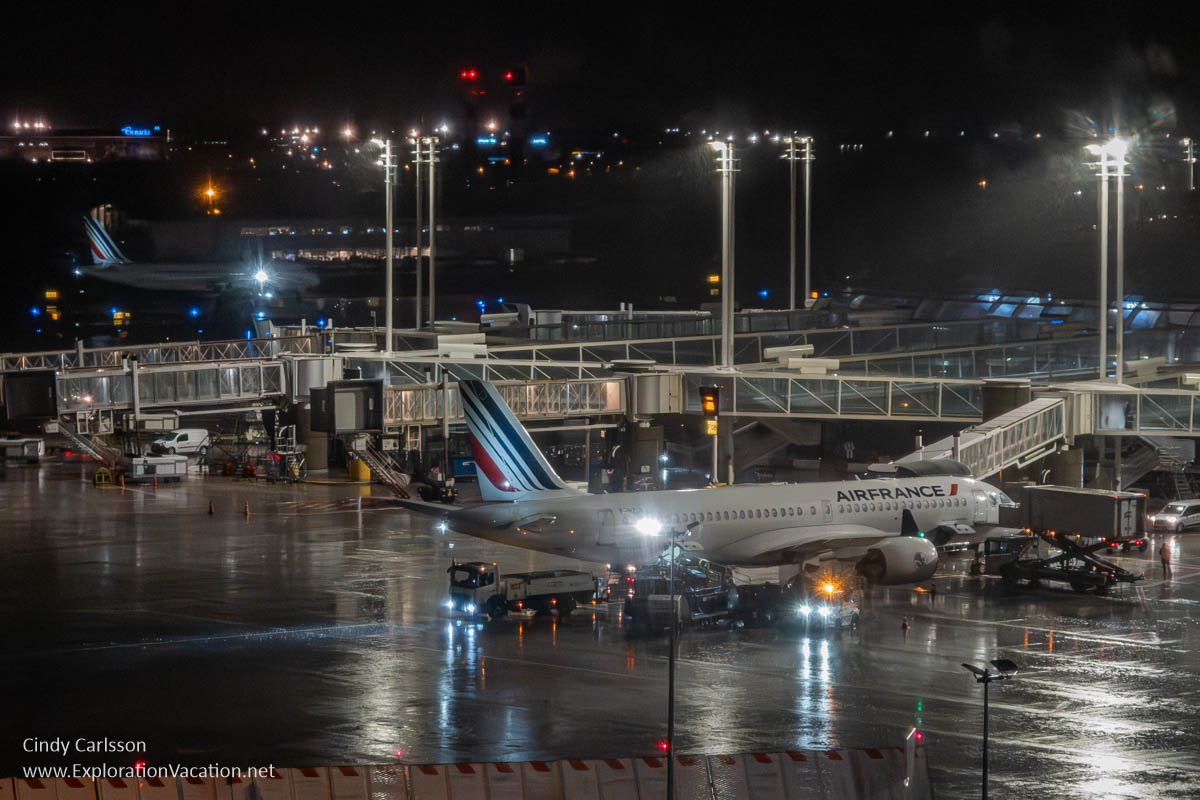
A bit of the view from my hotel room at Charles de Gaulle.
👉 Read less
Where to stay on Réunion
There are a couple of ways to visit Réunion:
On a short trip, it’s easiest to stay in one place and make day trips to other parts of the island.
If you are traveling for a week and want to see as much of the island as possible, I would stay on each side of the island. Spend a couple of nights in Saint Denis or farther down along the east coast, and then spend the bulk of your time somewhere around Saint Pierre.
On a trip of 10 days or more, add a couple of nights in either Cirque de Cilaos and/or add a night or two in Saint Denis or La Plaine des Palmistes (two cities with more cultural options as well as access to scenery and adventure).
The west coast has the driest weather, good beaches, and the best access to many of Réunion’s outstanding sights and activities. That makes it a particularly good base, with the area around Saint Pierre offering the best access to the most things. Most beach resorts are north of Saint Pierre.
While there are places to stay in the south/southeast end of the island, options are pretty limited. And, once you get east of Saint Joseph, there’s no easy access to other parts of the island.
Lodging on Réunion includes hotels, resorts, mountain huts, home stays, private cottages and apartments, and campgrounds. But you won’t find every option everywhere.
Saint Denis
Stay in Saint Denis if you want a more urban, cultural experience with a couple of day-trip options into the mountains.
As I noted above, I really liked the Hotel Dina Morgabine, and the location ended up being much better than I expected for exploring the city. While it’s at one edge of the historic downtown area, that area is all very walkable from the hotel. The only places I wanted to get to that would have been a pretty long hike were the museums and art galleries near and at the botanical garden.
Saint Denis has a range of options available, although really walkable options do seem a bit limited. This isn’t a big tourist destination except as a stopover for a night before/after departing/arriving at the nearby airport. Thus, most lodging seems to be located between the city center and the airport.
Put in your travel dates for current prices.
Saint Pierre
Saint Pierre is a major commercial and tourist center with plenty of shops (including a discount grocery), beach resorts, and relatively easy access to much of the interior. This is a big city that has grown too large for its road network. And travel is further complicated by the limited number of places where you can cross the rivers that run through and along the edge of the city.
Just because it’s so slow to drive through the city, I would avoid the coastal resorts in the city’s core unless you want to spend a lot of time at the beach or out and about eating, dining, and shopping. The farther you are from the center, the easier it will be to get out of town and explore the rest of the island. However, your dining options are a lot more limited. So many amazing-looking restaurants were right downtown near the waterfront!.
I absolutely loved our cottage, but even in this more outlying neighborhood, getting out of the urban area was a lot slower than I expected. But you have loads of options in and around the city. That’s especially true if you are looking for a cottage or apartment, as you will find many units designed for longer-term stays by French visitors coming for a few weeks or a month.
Put in your travel dates for current prices.
Beach resorts beyond Saint Pierre
Réunion has a few gorgeous white sand beaches as well as good snorkeling in spots from Saint Pierre and northward. However, because Réunion is a shark hotspot, swimming and snorkeling are only options in protected lagoons and designated areas that have shark nets. That limits the places where you can actually get in the water, but these are some of the best spots on the island anyway.
Saint Pierre (above) is often recommended for families for its lagoon and easy access to dining along the waterfront. But there are other, probably better (that’s subjective) beach resort areas farther up the coast.
La Saline les Bains/L’Hermitage les Bains
La Saline les Bains/L’Hermitage les Bains is a quieter area, with luxury lodgings, shallow water along white sand beaches, and snorkeling along the reef.
Saint Gilles les Bains
If you want more activities of all sorts and a lively nightlife, Saint Gilles les Bains is the place to be. There’s a beach where you can swim, but you’ll find a whole range of activities in the water, on the beach, in town, or beyond. And you’ll have plenty of restaurants and bars to choose from when the day’s adventure is over.
Put in your travel dates for current prices.
Inland
No matter how much you love being at the beach, you need to get to the island’s rugged interior — much of which is both a national park and a UNESCO World Heritage Site. While you can easily get to some remarkable places on a day trip or tour, spending at least a night or two inland gives you time to explore at a more leisurely pace. And here your road trip options are limited to two of the island’s three cirques (eroded calderas) and the city of La Plaine-des-Palmistes.
If you are a serious hiker, hiking huts are available on some trails, and there is some lodging available once you hike or helicopter into the Cirque de Mafate. But others can better advise you on those options.
La Plaine-des-Palmistes
I didn’t get to spend much time here, but I really liked what I saw. This is a not-too-large city with decent access to portions of the island that offer a lot of variety. There are some nice hikes and waterfalls right outside town. And the crafts village/museum and national park headquarters are right in town. You probably don’t want to spend your whole vacation here, but it’s good for at least a couple of days.
Put in your travel dates for current prices.
Cirque de Salazie
Because it is a relatively quick and easy drive from the main airport in Saint Denis, we spent our first night on Réunion in one of the villages here. I was torn between getting something with a great view or staying in the village of Hell-Bourg. I ended up going for the view, which was lovely. But I would have been happier staying in funky little Hell-Bourg, recognized as one of the most beautiful villages in France, where I could have wandered the flower-filled town and had a nice meal after our long day getting to the island. And there’s plenty of scenery and hiking right around town.
Put in your travel dates for current prices.
Cirque de Cilaos
The road to Cirque de Cilaos is infamous for its 400 switchbacks. So, while the drive takes less than 2 hours from the coast, it’s not a drive for everyone.
I REALLY wanted to get here, but I didn’t want to just drive out there for just a day. And this was one spot where I seriously considered hiring a driver so both my husband and I could enjoy the scenery. But with several days of rain, we decided this was going to take more time than we could give it.
So, I haven’t been here. But it’s described as being in a high mountain area with spectacular scenery, many conifers (Réunion has some really cool conifers), great Creole buildings, and flower gardens everywhere. It sounds fabulous.
Put in your travel dates for current prices.
Language
When you visit Réunion you are traveling in France. And, since most visitors to Réunion are French, English isn’t widely spoken. However, usually we could get by through a mix of broken English and my spouse’s many decades-past high school French. But I wouldn’t count on this everywhere. And printed information was rarely available in English.
That means you’ll find traveling on Réunion a lot easier if you can learn at least a few basic phrases in French. But don’t let that keep you from visiting! You can get by, especially in more touristy areas, without speaking French. And many tours and activities have English-speaking options.
Besides, your phone probably has Google Translate or another translation app that can get you through basic conversations. I used Google Lens to quickly translate menus, informational signs, and the information for my cottages; but there are many other apps for that too.
Planning resources
The airline Frenchbee has a really basic but easy-to-follow guide to the island. It’s a good place to start if you are searching online for information on traveling on Réunion Island.
The official website for travel in La Reunion is beautiful. But it’s not particularly user-friendly. Look at it for inspiration, but then look for guidebooks or websites that will help you actually put a trip together. And then go back to La Reunion’s site when you are ready to start booking tours and activities.
Find a short piece on why you should visit Réunion, along with his Réunion trip report, to get an idea of what a more active trip might be like. Or check out his talk on the Amateur Traveler podcast.
I couldn’t find any good guidebooks that only covered Réunion. Everything also includes Mauritius and, usually, the Seychelles. Unless you are also visiting one or more of those countries (and I highly recommend visiting the Seychelles), see if your local library has a book you can use to plan your trip instead of paying for a lot of stuff you don’t need.