Last updated on June 11th, 2026
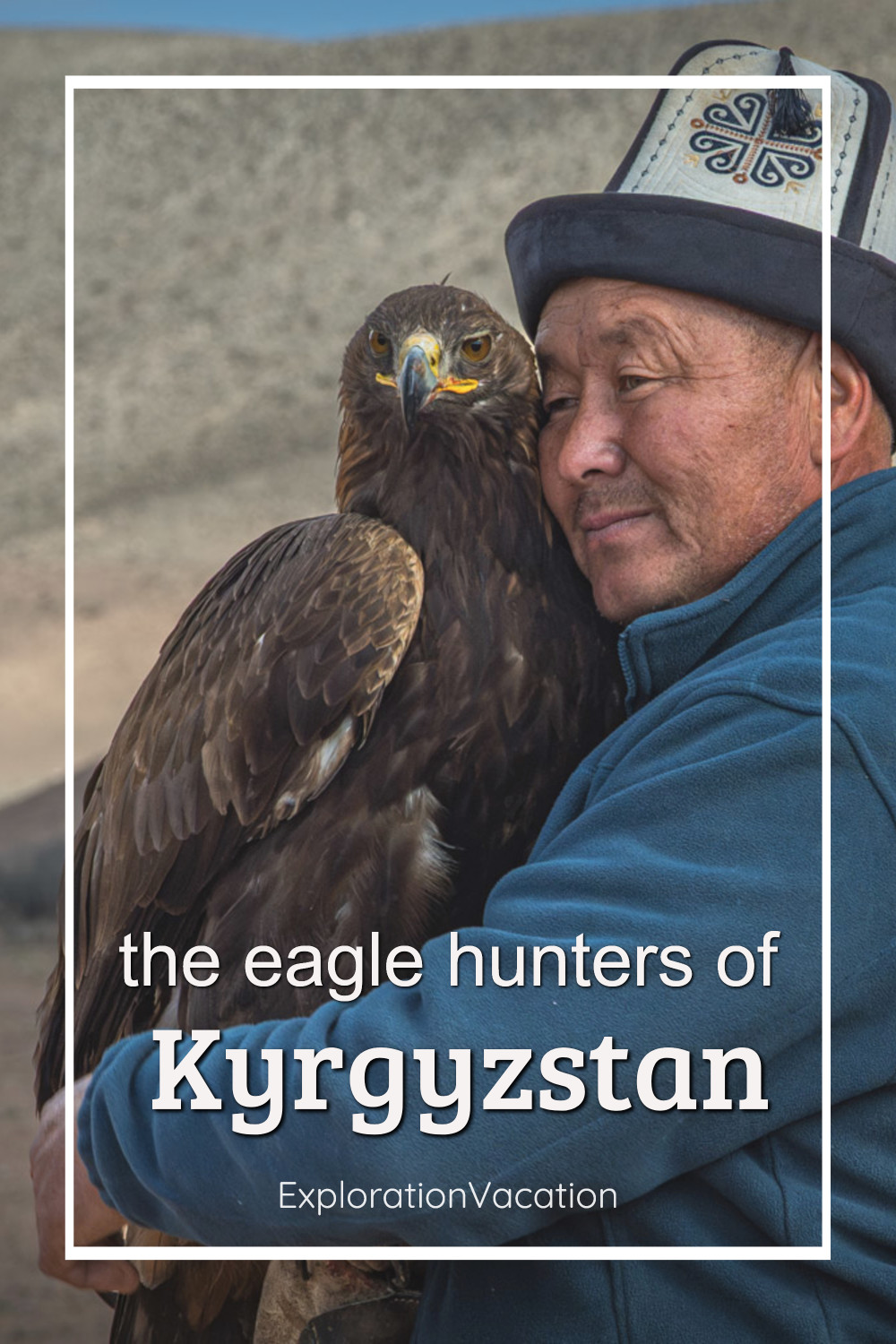
Want to learn more about one of Central Asia’s ancient hunting traditions? Plan ahead and add a demonstration (or training session) with an eagle hunter to your travel plans for Kyrgyzstan.
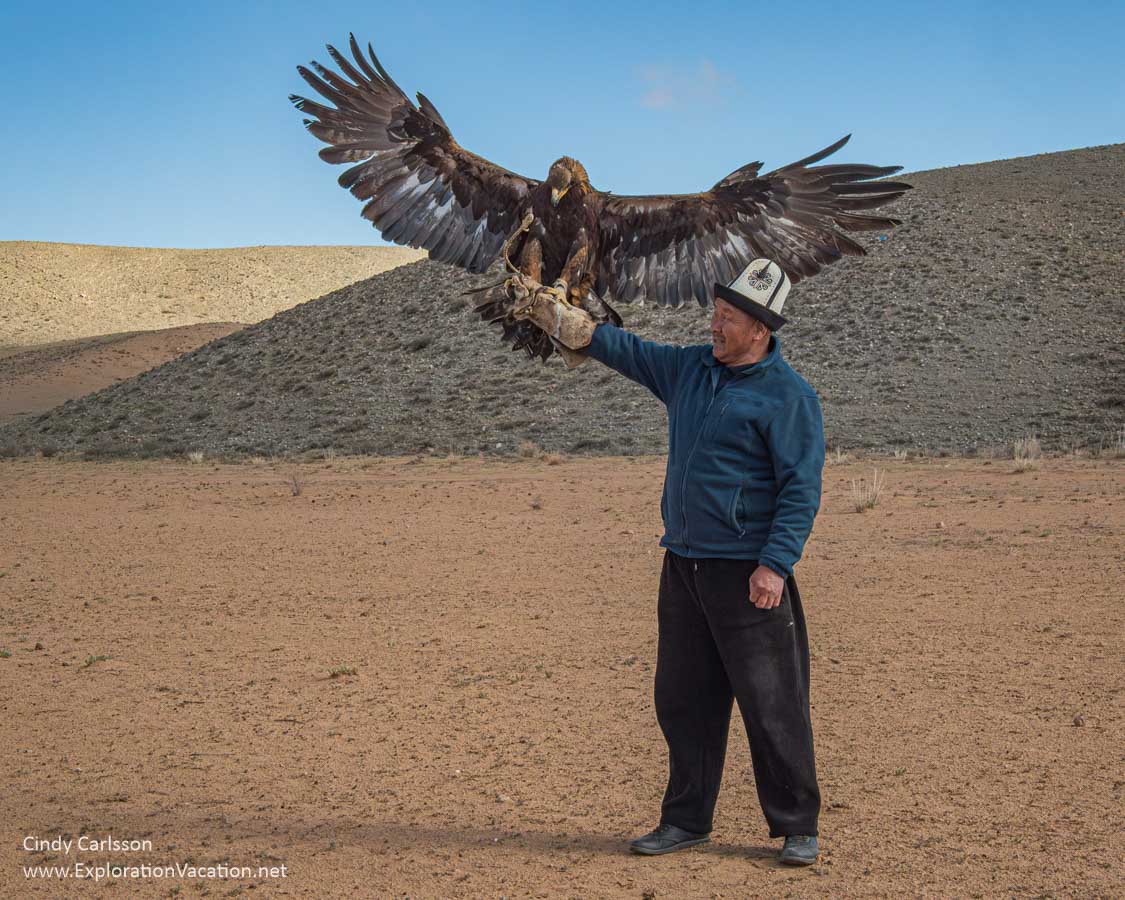
Golden eagles are the birds of choice for falconry in Kyrgyzstan.
Hunting with golden eagles is a type of falconry with a very long history on the Eurasian steppes of Kyrgyzstan, Kazakhstan, Mongolia, and parts of China.(“Falconry, a Living Human Heritage” is on the UNESCO list of the Intangible Cultural Heritage of Humanity.) But it’s a tradition at risk of disappearing from many areas where it was once practiced, including Kyrgyzstan.
I really wanted to see a falconry demonstration while in Central Asia. Unfortunately, my tour didn’t include that. So, it was pure luck that my group happened to drive by while a local hunter was standing by his car at the side of the road . . . with his eagle. (He was waiting for a family member who needed to get something from him.)
Of course we stopped.
We were lucky. He was on his way to a training session with his eagle and invited us to tag along and learn a little about this ancient practice.
I use links to improve your experience using this website. Some may be affiliate links that pay me a small commission if you use them to book a room, rent a car, or purchase goods or services. You don’t pay extra, but it helps keep this website running. To learn more, see my policies and disclosures.
Golden eagles as hunting partners
You’re probably familiar with falconry, which has a particularly long and deep history in the Middle East, but is also practiced in many places in the northern hemisphere. One of those other places is Kyrgyzstan, although falconers in Kyrgyzstan prefer to hunt with golden eagles.
Falconers who hunt with eagles – berkutchi or bürkütchü in Kyrgyz – have a long history in this region. As a mostly nomadic people, the practice continued for centuries, passed down from generation to generation within a family. That pretty much ended during the Soviet period, when nomads were moved into settlements and hunting was no longer critical for survival. That’s because eagle hunting isn’t a sport one takes up as a casual pastime. This is a long-term lifestyle that requires a great deal of time and patience every day. It’s a major commitment.
Turning an wild eagle chick into a partner
Golden eagles are taken from the nest as fledglings. Females are preferred for hunting, as they are bigger and tend to be more aggressive. They are also usually larger than male chicks, which makes it easier to know which one to take from a nest. (Serious hunters scope out a promising nest, watch it pretty obsessively, and then select their chick when it is about three months old – old enough to fly, but young enough to bond with its human captor.)
The young bird is then fitted with a leather hood (to reduce distractions) and slowly introduced to its new environment and substitute parent.
Training an eagle begins with its handler (berkutchi) not only hand-feeding the bird, but also singing and talking to it for hours each day. One person, and only that person, interacts with the eagle while it is young. That creates a strong bond between man and bird. It also insures that, as an adult, that bird will only respond to its human partner.
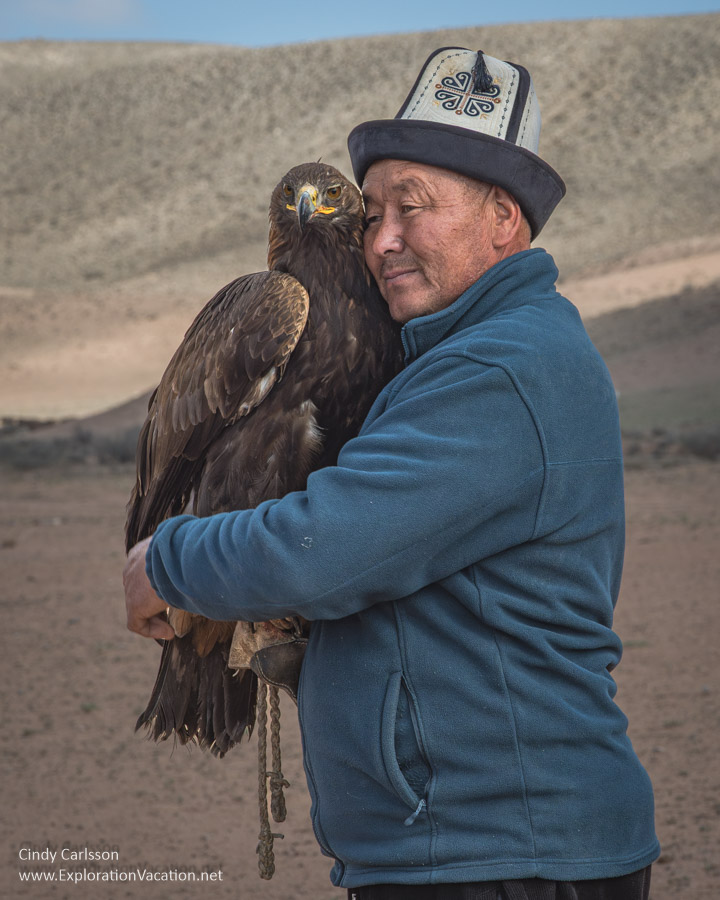
Eagle hunters develop a close relationship with their birds.
It takes at least three years of training together before an eagle is ready to begin hunting in the wild. That training includes teaching the bird to come to rest on the berkutchi’s arm and remain there even while in motion; make a clean kill that quickly kills its prey without damaging the pelt or injuring itself; and then to guard its kill – without eating it – until the berkutchi arrives.
Training sessions like I saw serve a couple of purposes for mature birds. While it reinforces the bird’s training and hunting skills, ongoing training is needed to keep the bird healthy and in good physical condition. It’s the golden eagle equivalent of a regular workout at the gym!
The training session
Because this was an actual training session, we drove out into an open area that seems best described as a bleak desert. . . but with great mountain views.
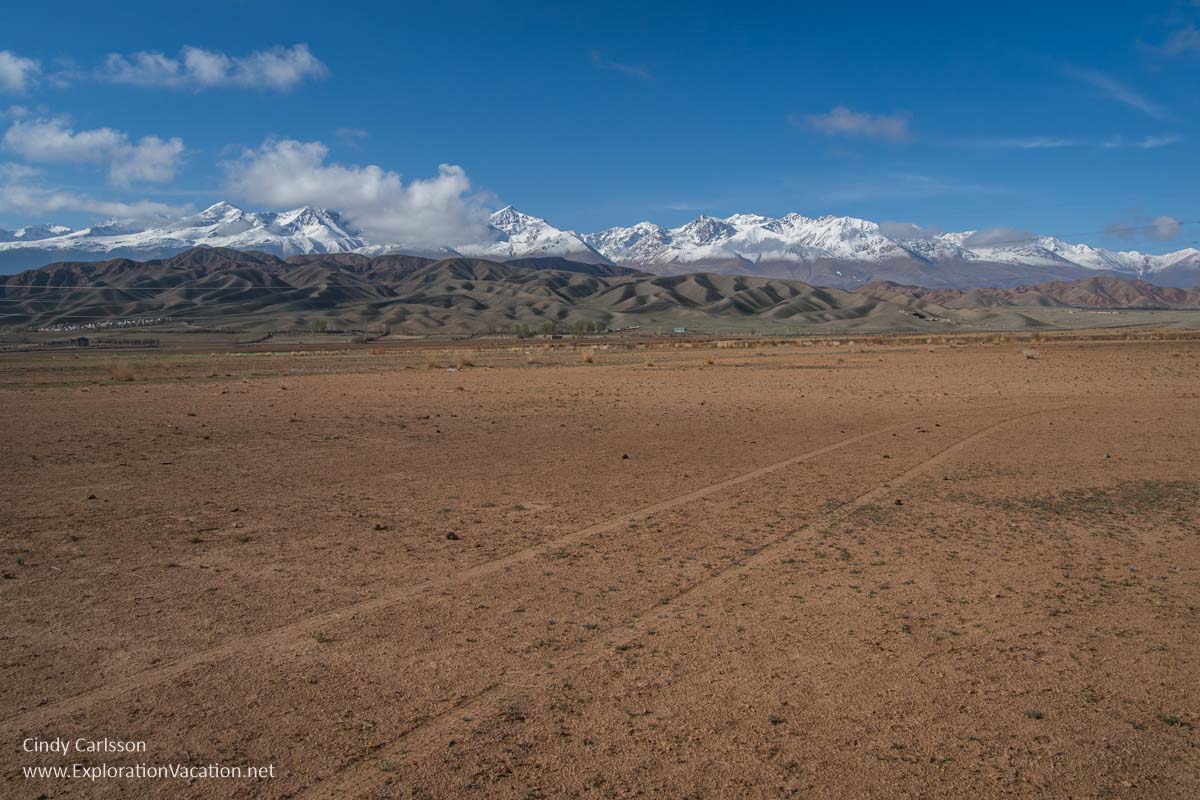
A parched location, but with rugged snow-capped mountains in the distance.
Today’s training was happening with the help of the berkutchi’s nephew, who wants to hunt with his own eagle someday.
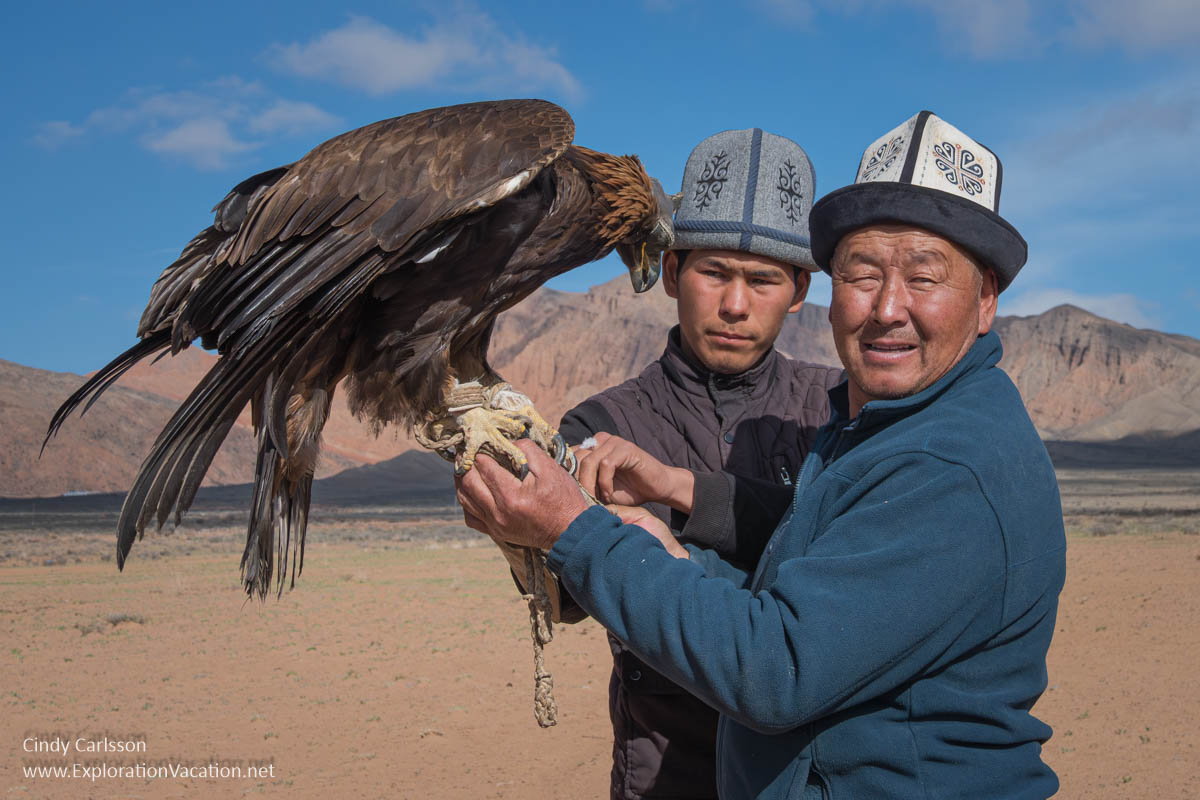
Passing a hunting tradition on to the next generation.
Even when eagle hunting was common, it wasn’t something every family did. But in those that did hunt this way, the practice was passed down from one generation to the next.
👉 Learn more about hunting with eagles . . .
Hunting was necessary for survival when families were nomadic. Today, few families maintain this tradition, as it’s more sport than means of survival. But the men we met are from a long line of eagle hunters – and this berkutchi seemed very pleased that his nephew would follow in his footsteps. At least in this family, hunting with eagles would continue for another generation.
This eagle is over 15 years old and is so comfortable with her human hunting partner that he can handle her without a falconry glove. (At least for demonstration purposes.)
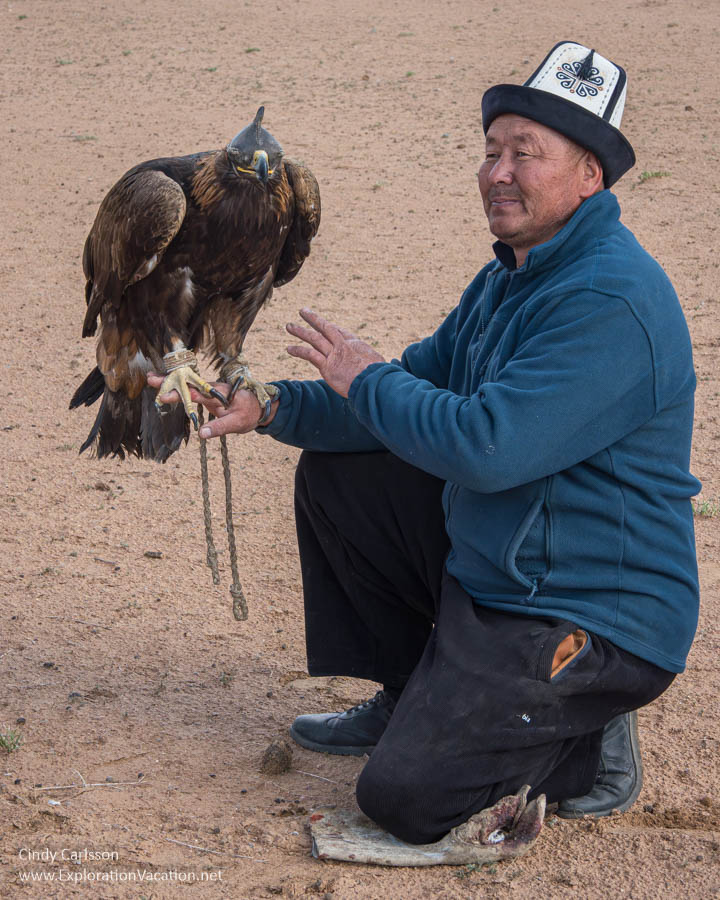
If they are just having a quiet chat, she is gentle enough to handle without a glove.
When not hunting, she usually wears a hood. There’s a reason for the term “eagle eye,” and the hood keeps her from being distracted. (An eagle can see a rabbit up to 3 miles or 5 kms away.) But she knows the voice of her berkutchi, so even if they are some distance apart, she can find him while hooded. And she’ll quickly return to him when called, hood or no hood.
Like most hunting eagles, she’ll remain in captivity until she’s 20. At that point, she’ll be given less food to reduce her weight. That seems to trigger an instinct to return to the wild. (Hunting eagles are fed enough to keep them a little heavier than they would be in the wild.) When she’s released, she’ll be more than ready to go and there will be no returning to her human partner. Instead she’ll hunt for herself, find a mate, and breed in the wild like any other eagle for up to 20 years or more. And maybe one of her chicks will one day end up in the hands of another dedicated berkutchi.
On the other hand, the thought of releasing his treasured bird in the future clearly made her human partner sad. This is a bird he will have spent hours with every day for two decades. A bird he hand feeds, pets, and kisses just as you might with a beloved family dog. She is definitely part of his family.
But he is also already training the young bird that will take her place in a few years.
👉 Read less
Up-close with a golden eagle
Scheduled hunting demonstrations usually include an opportunity to hold an eagle. And we had that opportunity as well.
Central Asian golden eagles are heavier than golden eagles in other parts of the world. A captive bird may weigh more than 20 pounds (9 kilos). That means the instinct is to just hold that weight nice and still. But, if you do that, the eagle will also sit perfectly still.
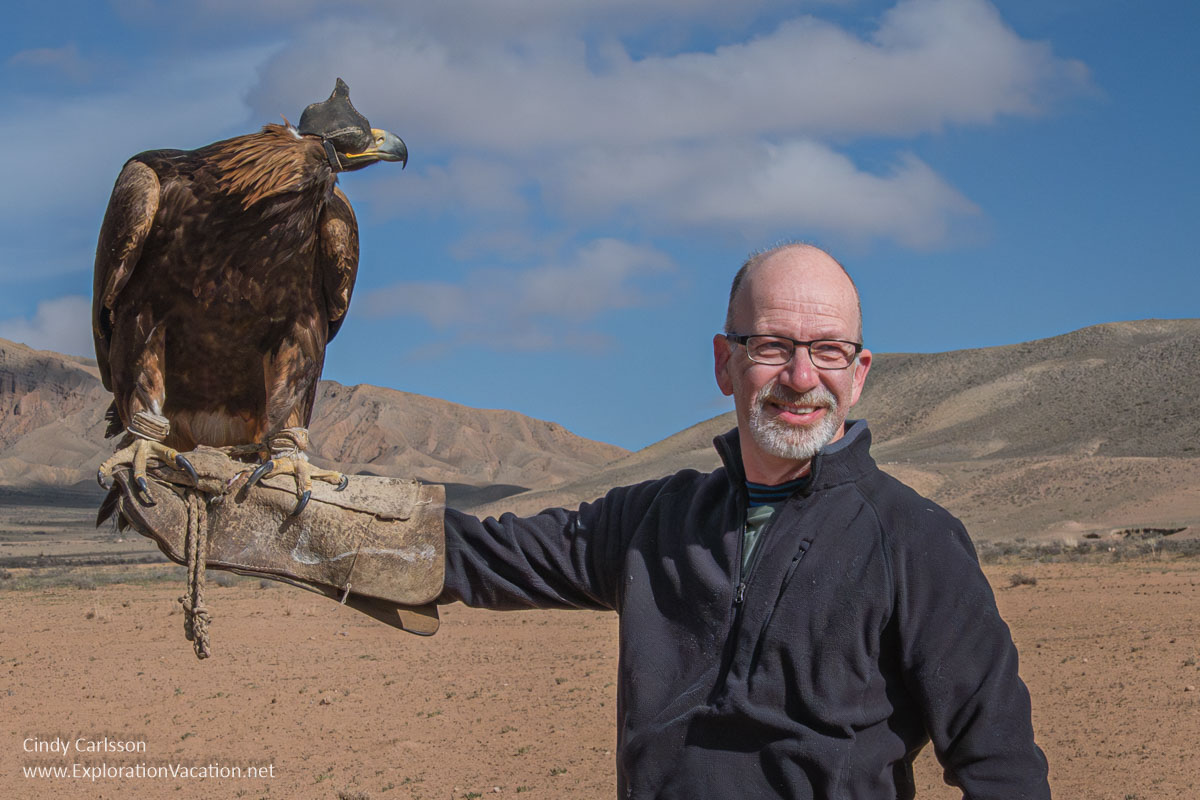
The eagle seems to be wondering why she’s just sitting there!
That’s a little boring.
So, most of the time, you’re told to move your arm some so the eagle spreads its wings to stay balanced.
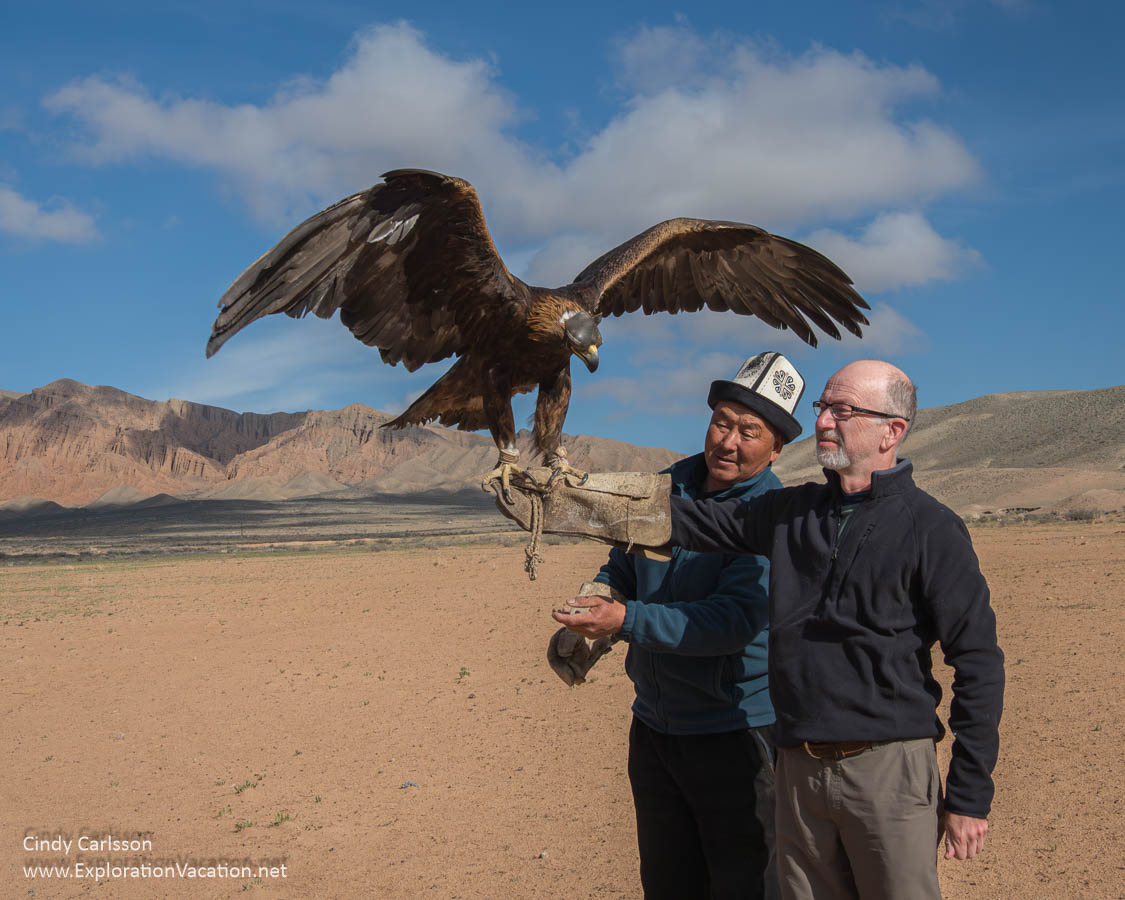
Moving your arm requires the eagle to spread her wings to stay balanced.
👉 Learn more about holding a golden eagle . . .
Not only do you need to move your arm, but you also need to raise your arm so the eagle has plenty of room to spread her wings over your head as if she were going to fly off.
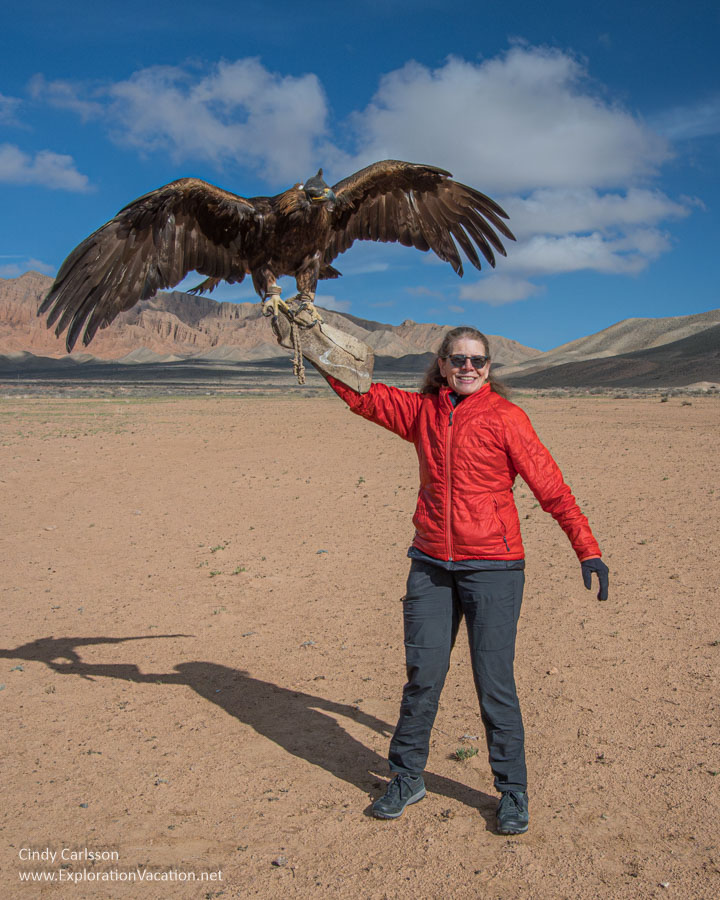
Ta da! A perfect pose!
This may look easy, but clearly it is not.
Everyone in our group who tried it (I decided I’d be better at taking pictures) got the eagle over their head with outstretched wings. But I could tell that getting the eagle up and then settled back down again was a bit of challenge for most.
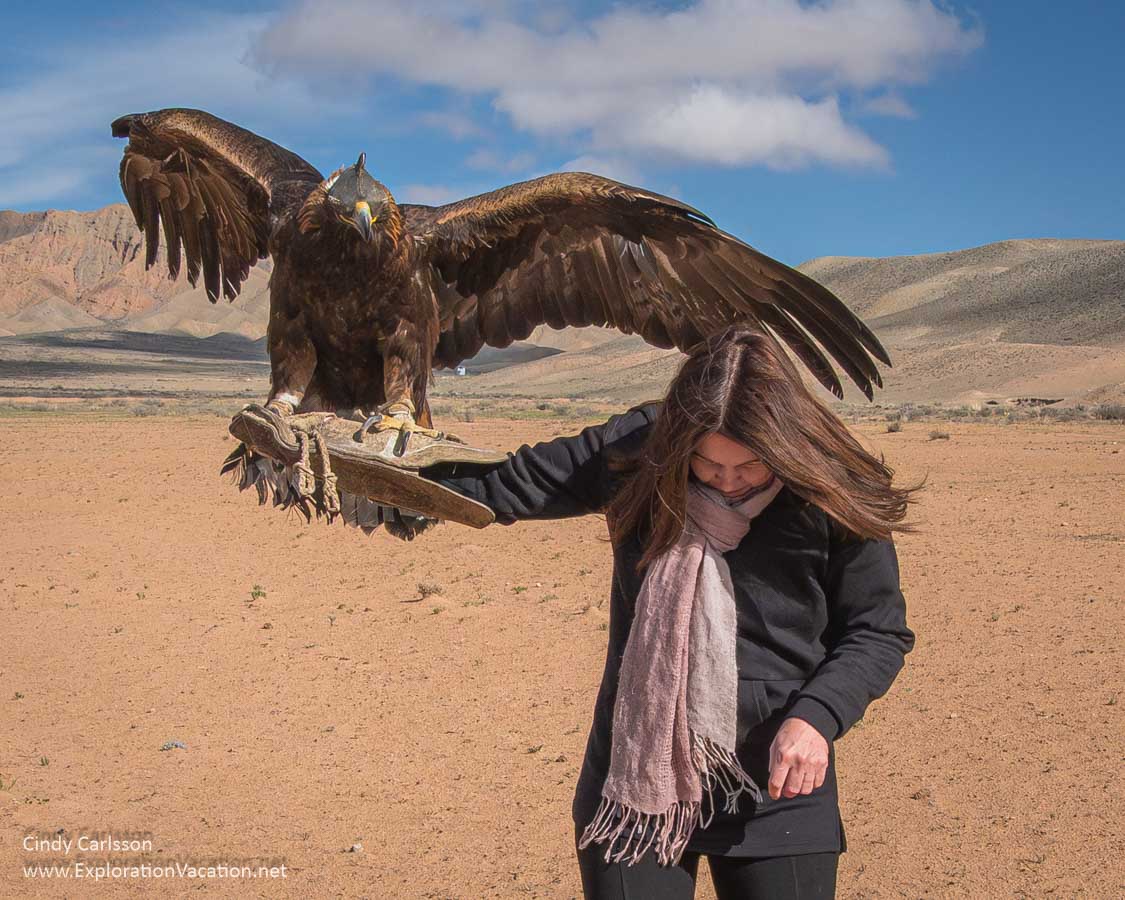
It’s not as easy as it looks. (This would have been me.)
👉 Read less
Training time
Once everyone who wanted to hold the eagle had done so, it was time to get down to training.
While hunting only occurs in the winter, birds are trained throughout the year to keep them in peak form. But you don’t want to train them too often, because every flight carries some risk of injury to the bird. (This eagle usually gets out a couple of times a week. Some are taken out less frequently.)
While no animals are killed or injured during this training, if you are uncomfortable with hunting and fur, you may want to skip this section.
👉 Learn more about training an eagle to hunt . . .
Training usually doesn’t involve killing anything. Usually, a fox pelt tied to a rope stands in for the animal being hunted. Although golden eagles can take a wolf, the risk of injury is high if they try to take anything larger than a fox. That means hares and fox are among the most commonly animals hunted with eagles in this part of the world.
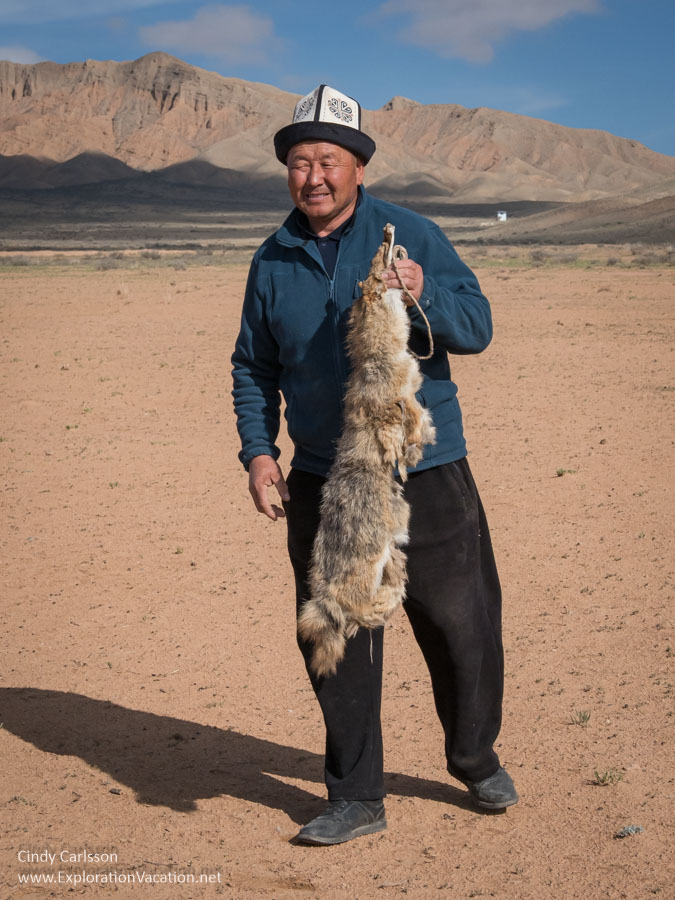
A pelt will do for a training session.
Meanwhile, the nephew took the eagle across the desert pan we were in and up a nearby hill.
Then it was time for the eagle to “hunt.”
On signal, the nephew released the bird and the berkutchi began running while dragging the fox pelt behind him.
The eagle made a bee-line for the back of the head on the pelt. On a live animal, this would instantly break its neck, killing the animal without much risk of injury to the eagle. But this time the pelt kept moving, so she had to strike it a couple of times before picking it up (rope still attached) and setting it back down in a spot where she could guard it until her human partner arrived.
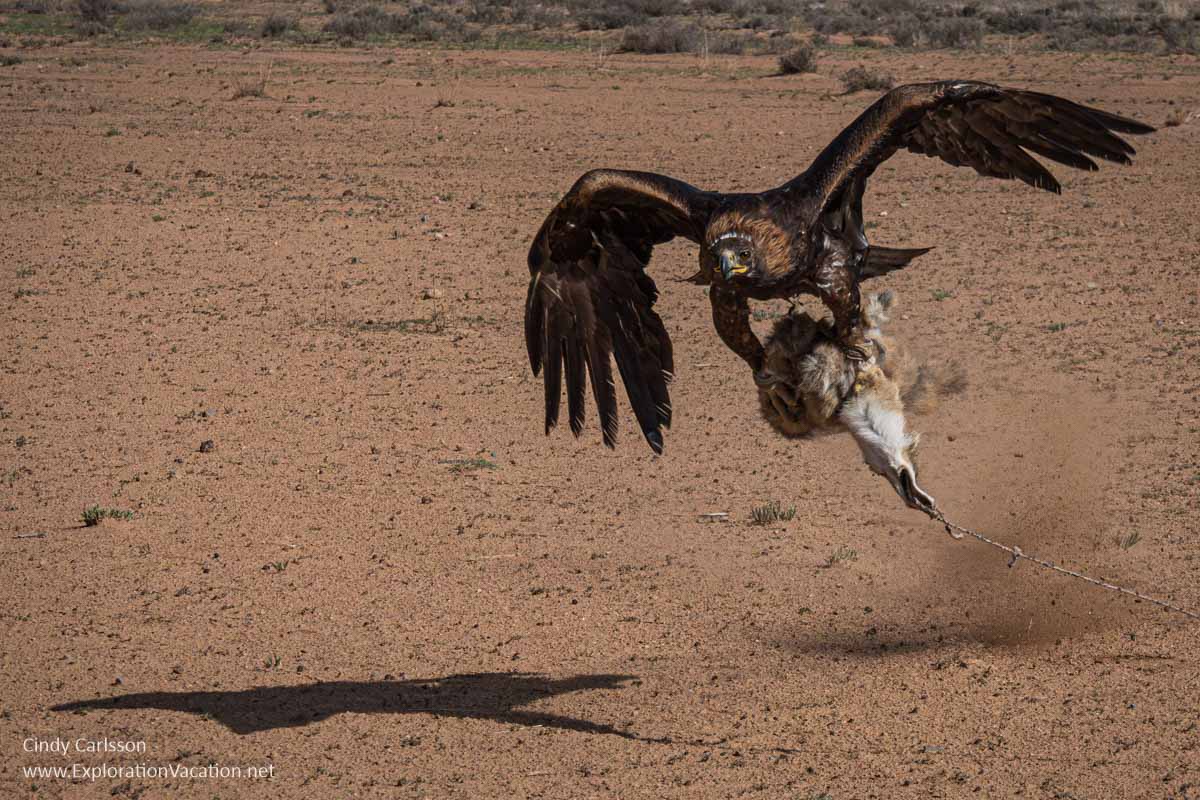
Carrying the captured “prey.”
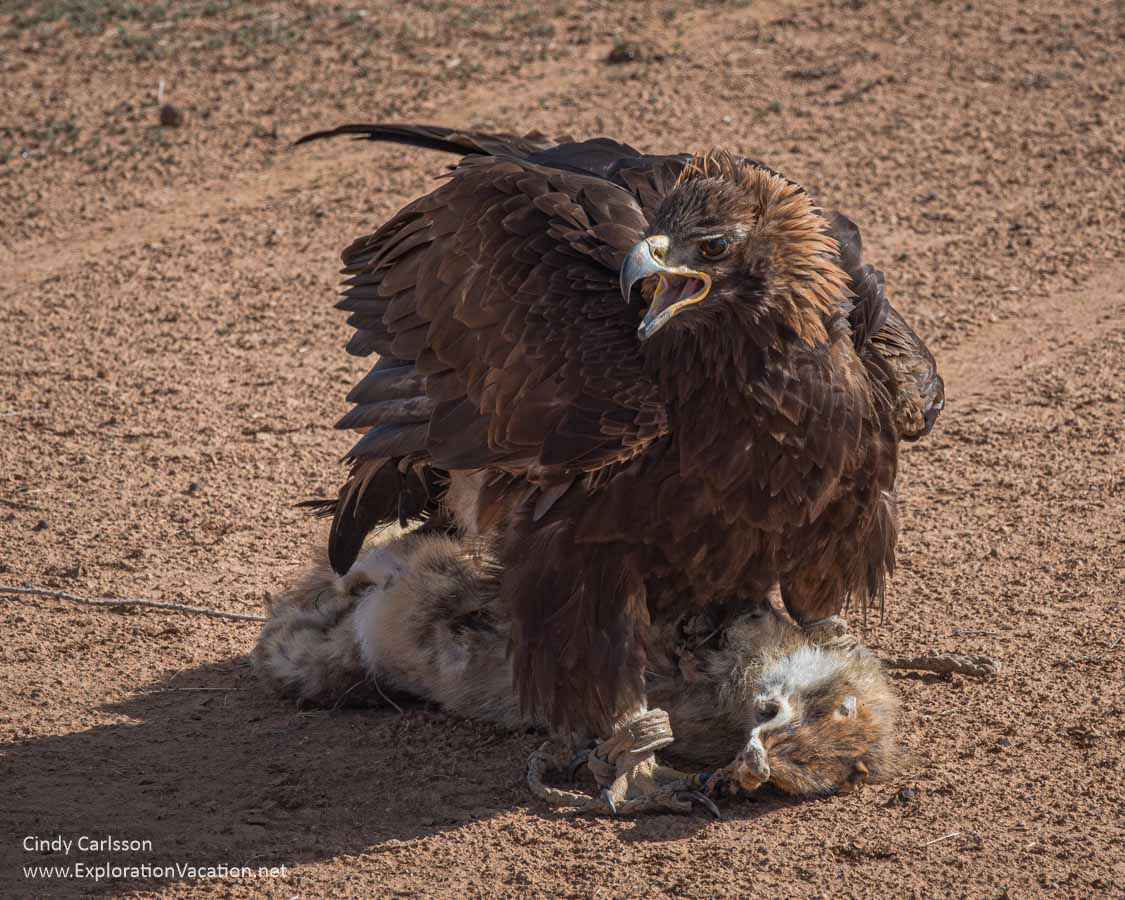
“Look over here! I got it!”
Training over, the eagle is fed chunks of meat. We talk with the berkutchi while he feeds her and, when she has finished eating, he carefully cleans her beak.
Hunting in the wild is usually done on horseback, where the hunter has a special armrest to help hold and balance the eagle until it’s hood is removed and it is released to hunt. But, otherwise spotting the kill, striking, and then guarding it until the human hunter arrives is pretty much the same.
With the day’s training over, then the hunters head home for the day while we get back on the road and off to our scheduled activities for the day.
👉 Read less
Where to see eagle training and hunting
Although it wasn’t on our itinerary, almost everyone on my tour wanted to see an eagle hunt or demonstration. We got lucky and just happened to drive through a town where a man holding an eagle was waiting for a relative along the side of the road. Just another day in Kyrgyzstan.
But we were also in an area where traditional eagle hunting is becoming more common again.
In Kyrgyzstan you are most likely find eagle hunters south of Issyk Kul Lake, and particularly around the town of Bokonbaevo. (Also written as Bokonbayevo, Bökönbay, Бөкөнбай, Боконбаево, and other variations. Language is complicated in this part of the world.)
Located roughly midway between Bishkek and Karkol, Bokonbaevo is also a good base for exploring more of this area.
Because Bokonbaevo is known for its eagle hunters, you’ll find notices around town with information on booking demonstrations and short tours. If you stay in one of the area’s many guesthouses, yurt camps, or other lodging, your host usually can offer suggestions and make contacts for you.
If you travel independently and want to book before you arrive, contact the Bokonbaevo Community-Based Tourism office to get information on eagle hunting demonstrations in the area. The Salburun Federation (Facebook), which was created to preserve and support traditional eagle hunting, also has resources and information for tourists. Either can help arrange and book your experience.
Of course, multi-day tours that include an eagle hunting demonstration are also available through sites like Viator, but these tend to be more expensive than tours booked directly.
In August each year, the Salbuurun Festival is held in Bokonbaevo. The festival features competitions, music, and cultural events. Many activities center around various aspects of traditional falconry with golden eagles.
When to see an eagle hunt
If you want to see an actual eagle hunt, visit in the winter. October to February is the usual hunting season, but it is also a little weather dependent. The season was over when I visited in March, thus we observed a training run.
On the other hand, demonstrations can usually be arranged at almost any time of year. And birds are usually trained at least once a week when they aren’t hunting. That means even if you don’t plan ahead, you might meet someone willing to let you tag along like we did.
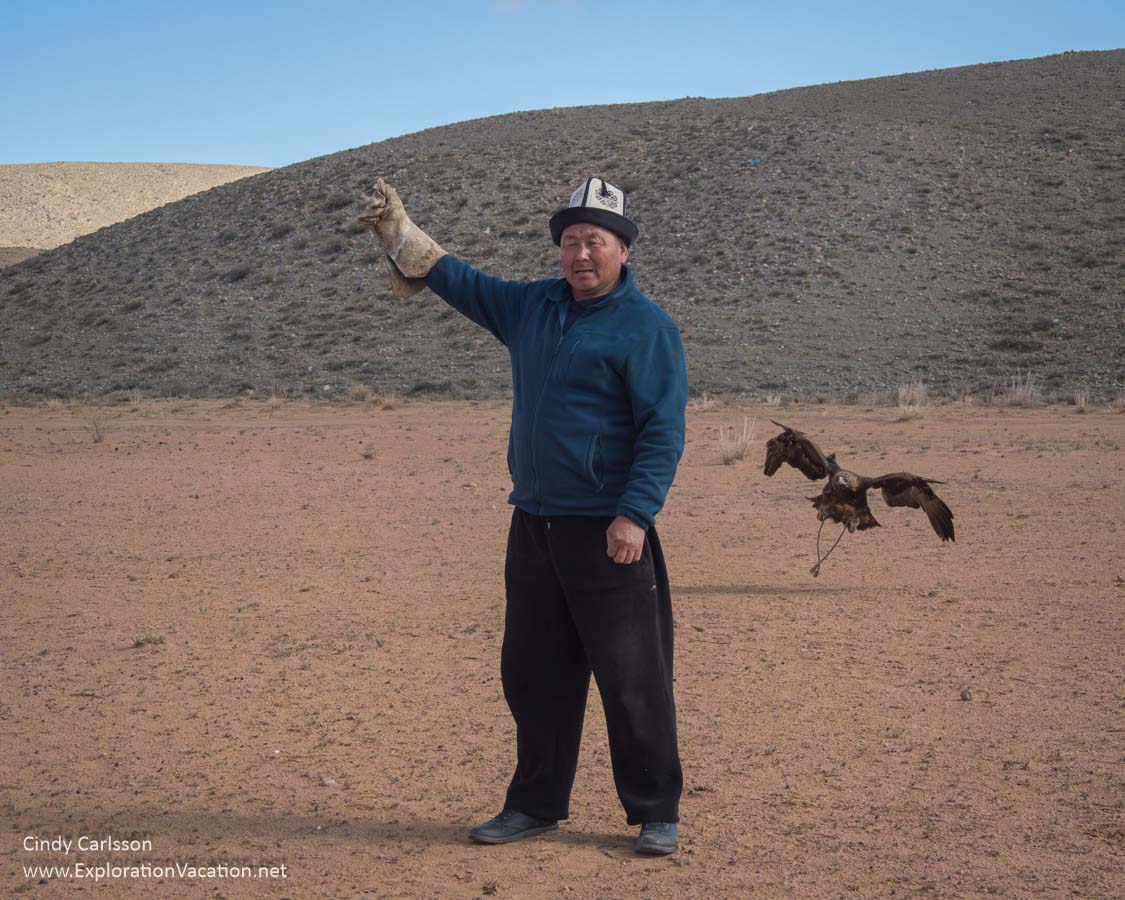
Hunting eagles will quickly return to their berkutchi on command.
You are least likely to see either a demonstration or training run during the summer. That’s when the birds molt (loose their old feathers as new ones come in), and often they aren’t flown much during this time. But not all birds molt at the same time, so birds are still being trained throughout the summer, just not as many at any given time.
Other things to do in the area
Although this area is unfamiliar to most North American tourists, Issyk Kul Lake is a popular destination for tourists from other places, particularly Russian tourists. This means there are plenty of tourist accommodations in the area, from yurts to spa resorts. However, English is not widely spoken or understood, while Russian is still understood by pretty much everyone.
While the area around Issyk Kul attracts a lot of visitors interested in hiking and/or spas, tours and local guides can connect you with a variety of cultural experiences. These include yurt building, textile arts, and traditional dining.
Keep in mind that most spas are on the north shore of Issyk Kul, which is quite a distance.
I traveled here as part of a general small group tour of several countries in Central Asia. However, it seemed that experienced travelers could visit independently without too much difficulty.
Skazka (Fairytale) Canyon
Kyrgyzstan offers a wide variety of hiking options, but you’ll find some of the most colorful and oddly shaped geology in Skazka Canyon on the way to/from Karakol.
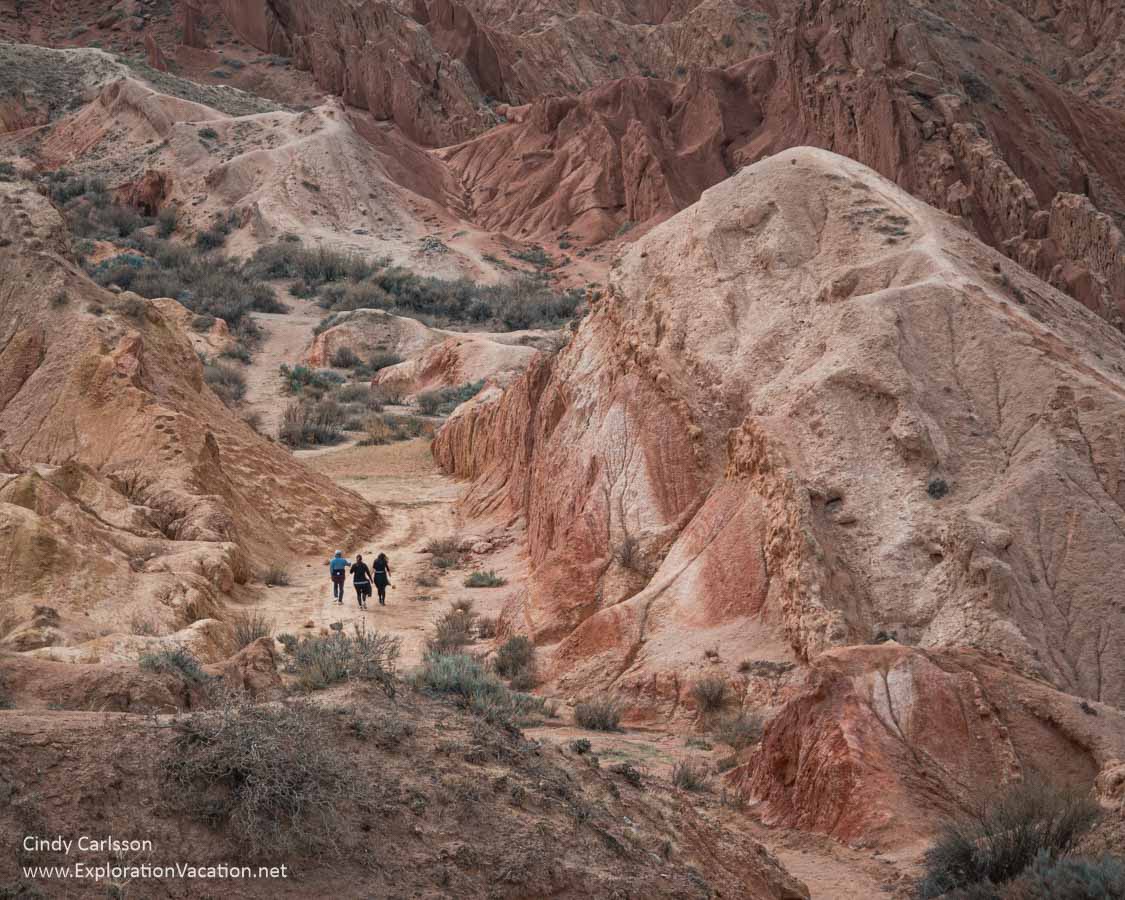
Hikers in Skazka (Fairytale) Canyon).
There isn’t really any signage or trail map here, but it’s not a huge site and well-worn trails make it pretty easy to find your way back to the wide valley at the main canyon entrance. And, even if you aren’t much of a hiker, there are plenty of flat trails that still offer eye-popping color and shapes.
Information from another website on planning a trip to Fairytale Canyon.
Learn how yurts are made
Yurts are the traditional housing of Kyrgyzstan’s nomads. Today they mostly serve as summer homes and guest lodging, for both local residents and tourists alike.
The Kyrgyz Friends homestay in Kara-Koo is owned by Ruslan and Gulnur, a delightful couple (with a great love story) who build custom yurts from scratch. Groups can arrange a tour that will show you how all the parts needed for a yurt are made, how to assemble them, and how the textiles were created and decorated both in the past and today.
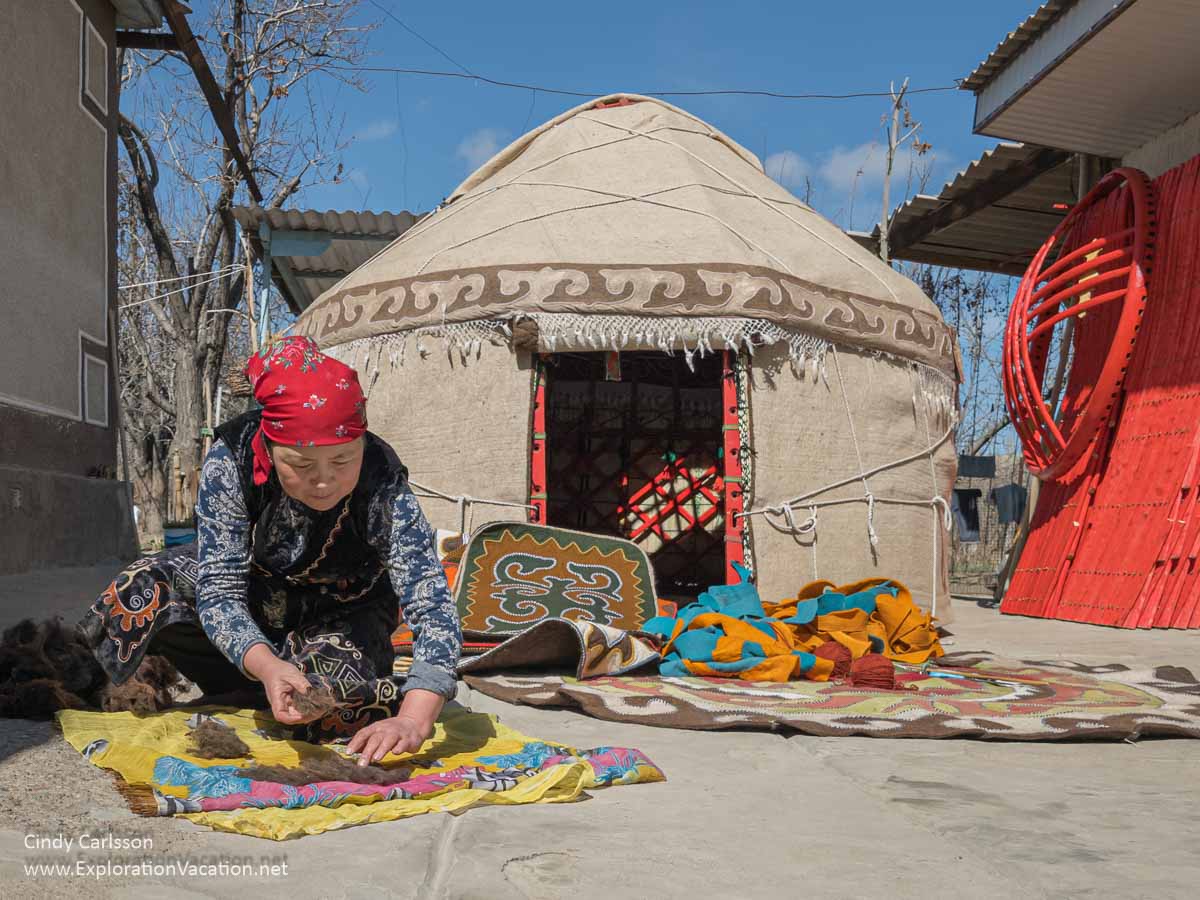
We didn’t have time for the yurt construction demonstration, a lavish meal, AND the traditional felting and applique demonstration, so we came back a second day. . . and on the way back we met the man with the eagle! So running out of time the first day was lucky.
They also offer lodging and can arrange to serve incredible traditional meals.
Stay in a yurt
Yurts are the traditional housing of Central Asian nomads. And, while there are very few true nomads left, there are still a lot of yurts in use.
So, as long as you visit during warm weather, you will have plenty of options for staying in a yurt.
But this is mostly a summer option. If you are traveling while nights are still cold (like in March, when I visited), traditional yurts are hard to find. We ended up staying at Guesthouse EMILY in Bokonbaevo. It has a mix of traditional yurts; stucco year-round “yurts” with western beds, heat, and en suite bathrooms; and a nice guesthouse. Traditional meals are served in a traditional setting – which means sitting on the floor.
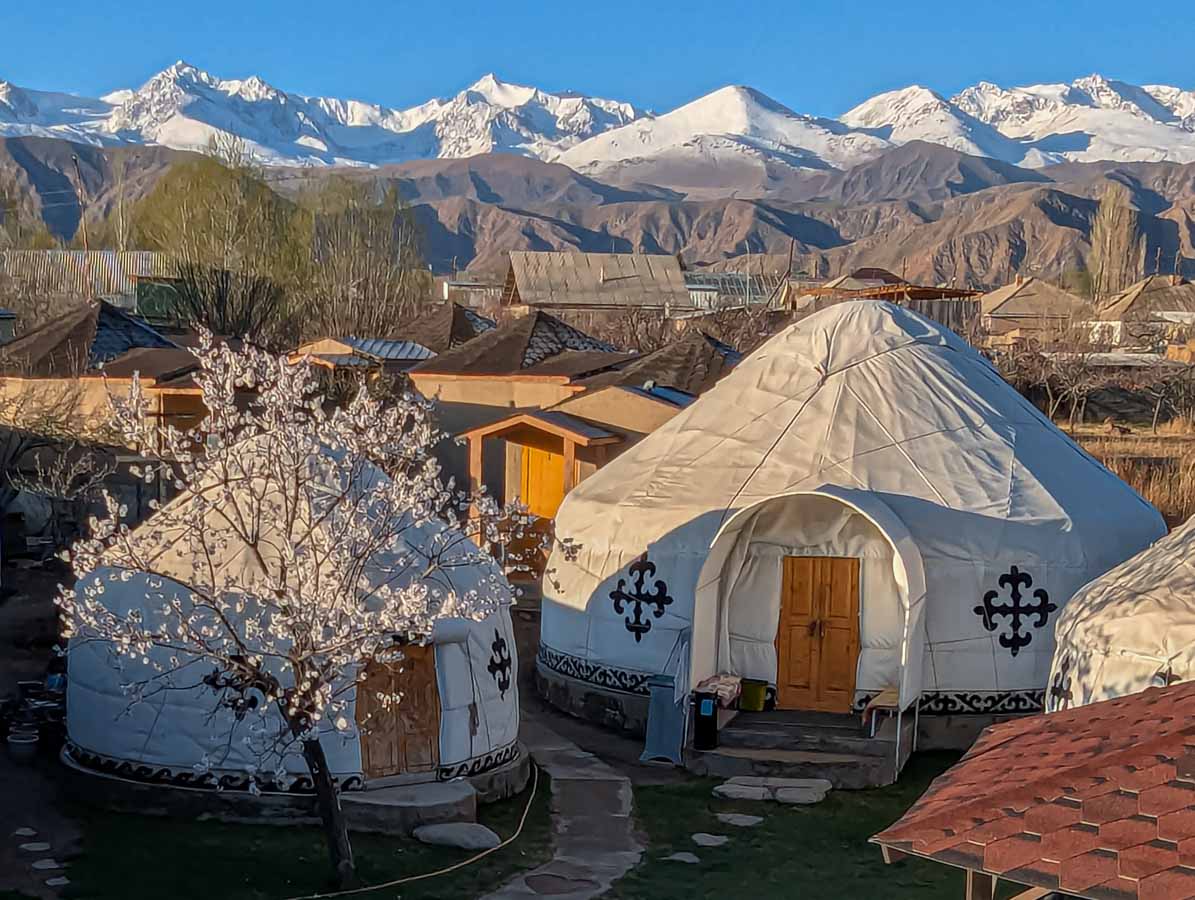
Morning at Emily’s. (Photo by Liz Walton.)
You might be able to book through Booking.com or TripAdvisor.
There are a lot of yurt and guesthouse options in and around Bokonbaevo. You can start your search by checking on Agoda or Booking, but keep in mind that many places are not listed on the big online booking services. And many of the best are often booked up by tour companies.
Notes on my trip to Kyrgyzstan
I visited Kyrgyzstan as part of an Intrepid tour that combined a separate tour of Uzbekistan with a tour of Kyrgyzstan and Kazakhstan to create a single itinerary option. This offered a nice range of sights at a reasonable pace. However, it’s a challenge weather-wise, as Uzbekistan’s weather for tourism doesn’t align well with that of Kyrgyzstan and Kazakhstan.
And, as I noted, a falconry demonstration was NOT included in our itinerary. Our guide added that when the opportunity arose.
Check this blog to learn more about falconry along the Silk Roads.
Wow, what great photos of this special experience! I had seen something about this on TV a long time ago. I’ve never considered visiting Kyrgyzstan, but can see it would be a unique destination to visit.
I really enjoyed traveling in this part of the world. Interesting cultures and friendly people and some dramatic scenery.
What a great experience. It was so fortunate to come across the falconer. It was also nice that your guide was willing to adjust and take the time to see this.
I think our guide was grateful, even though it put us even farther behind schedule. She knew we all wanted to see falconry and were disappointed that it wasn’t part of the tour. This was the first time they’d run this “premium” version of this tour and I think there were things about it that she didn’t think were ideal. No matter what, it was a lucky break for us! (Sorry for the slow reply. Real comments suddenly started ended up in the spam.)