
Last updated on June 12th, 2026
Dressed by Nature: Textiles of Japan at the Minneapolis Institute of Art (Mia) featured traditional textiles from Japan made from natural materials. That includes clothing made from a variety of plant fibers, paper, fish skins, and more – but no silk kimonos! There was even a section with clothing made for firefighters.
This special exhibit closed in September 2022. Keep reading to learn more about these unique pieces.

Firefighter’s clothing presented in a scene showing a historic scene of a fire.
I use links to improve your experience using this website. Some may be affiliate links that pay me a small commission if you use them to book a room, rent a car, or purchase goods or services. You don’t pay extra, but it helps keep this website running. To learn more, see my policies and disclosures.
An unusual collection of Japanese textiles
This special Japanese textile exhibit is a large one. It sprawls over more than half-dozen galleries and includes over 100 textiles dating from about 1750 to 1930. Items on display come from the far north of Asia (including Siberia and other parts of Russia), central Japan, and Okinawa in the far south. It also includes thematic displays on clothing for firefighters, travel, festivals, work, and more.
Robes for cold climates
Dressed by Nature begins in the far north of Asia, on the islands that run from Japan to Russia and into Siberia. Two different indigenous ethnic groups come from this area: The Nivkh people in the far north and the Ainu to the south.
Nivkh clothing
Nivkh people are native to Siberia and northern Sakhalin Island – areas that are part of Russia today. Traditionally, they were semi-nomadic fishermen and hunters.
The section on the Nivkh is one of the smaller exhibits in Dressed by Nature. However, it includes a couple of fabulous pieces. One favorite is an intricately appliqued and embroidered fish skin festival coat.

A 19th century pieced and appliqued Nivkh fish-skin coat from Russia.
This coat would have been worn by a woman attending a festival or other special occasion. It was made by piecing together carefully prepared fish skins and would have been worn over other layers to repel wind and water.
Read more about fish skin coats at Cleaned and repaired, fish skin coats from Siberia reveal indigenous knowledge.
Ainu clothing
Most of the exhibit on northern clothing traditions focuses on the textiles of the Ainu people, an indigenous people from immediately south of the Nivkh in the Russian Far East and down into Japan’s northernmost islands. The clothing displayed in this part of the exhibit was all made to be worn for special occasions and ceremonies.

The star of the exhibit is an unusual 18th century robe thought to have belonged to be a sea captain. Here it’s being examined by one of many visitors at the exhibit who dressed in their own finery for the occasion.
👉 Read more Ainu robes
The Ainu made their clothing using nettle and elm bark fibers, often decorating them with appliqued cotton and delicate embroidery using Chinese silk. The elaborate embellishments were designed to be both beautiful and protective: Designs cover the back of robes and openings to keep away disease, violence, and harmful spirits.
The Ainu of Sakhalin in Russia generally used nettle fibers to make their robes.
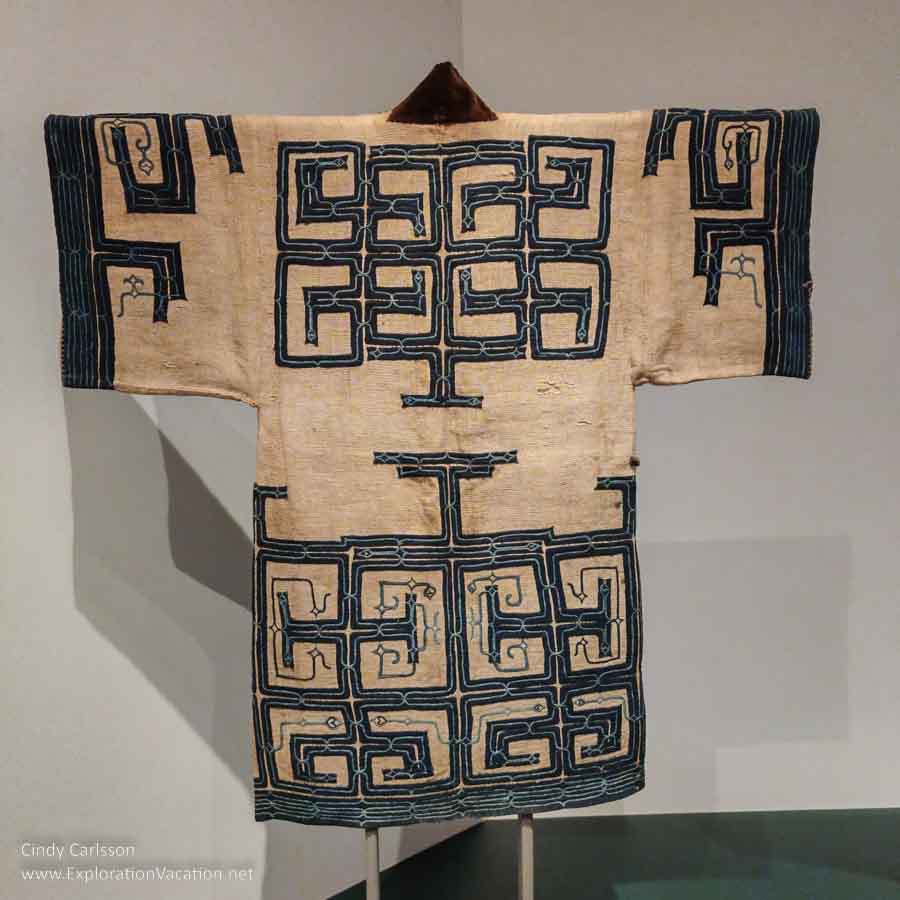
An 18th-19th century Sakhalin Ainu robe for made from nettle fiber.
Elm bark (attush) robes were far more common farther south, but they were a lot of work to make.
Creating a robe started with harvesting strips of bark from young trees, removing the outer layer, soaking it, and then scraping, washing, and drying it. Then they split the fibers and twisted them into a skein. Only at that point could it be woven into a fabric to make a robe!
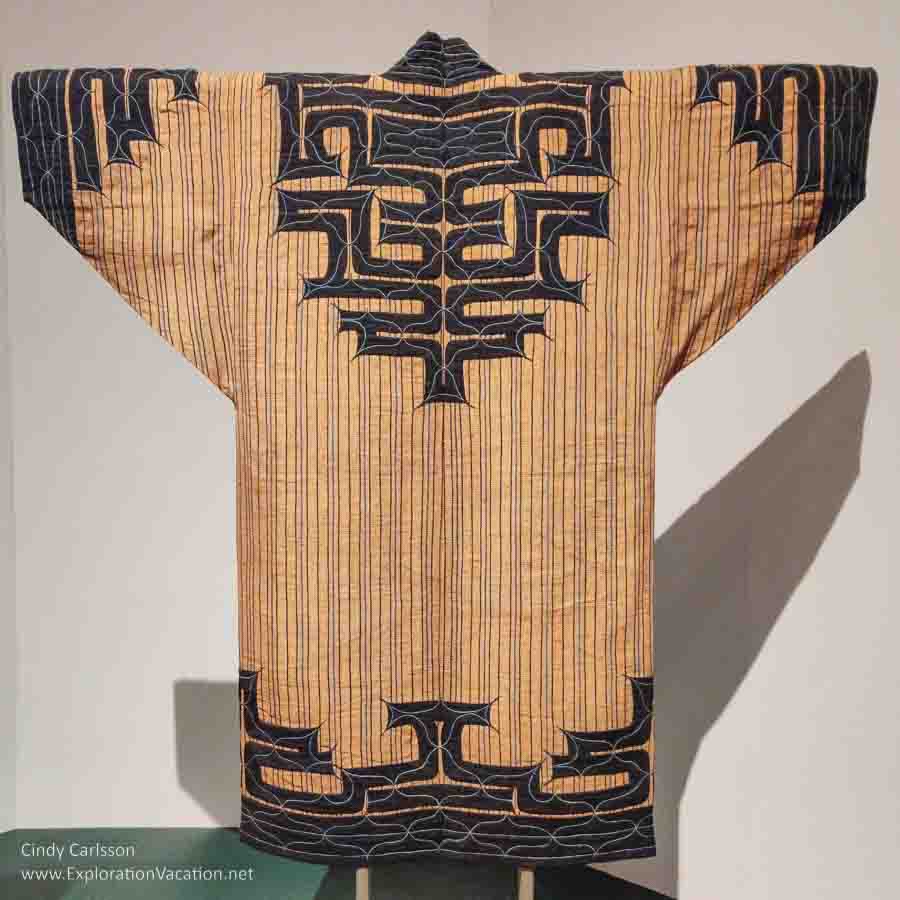
Late 19th – early 20th century Ainu elm bark robe from Japan.
As trade cotton became available, it became the basis for Ainu clothing.
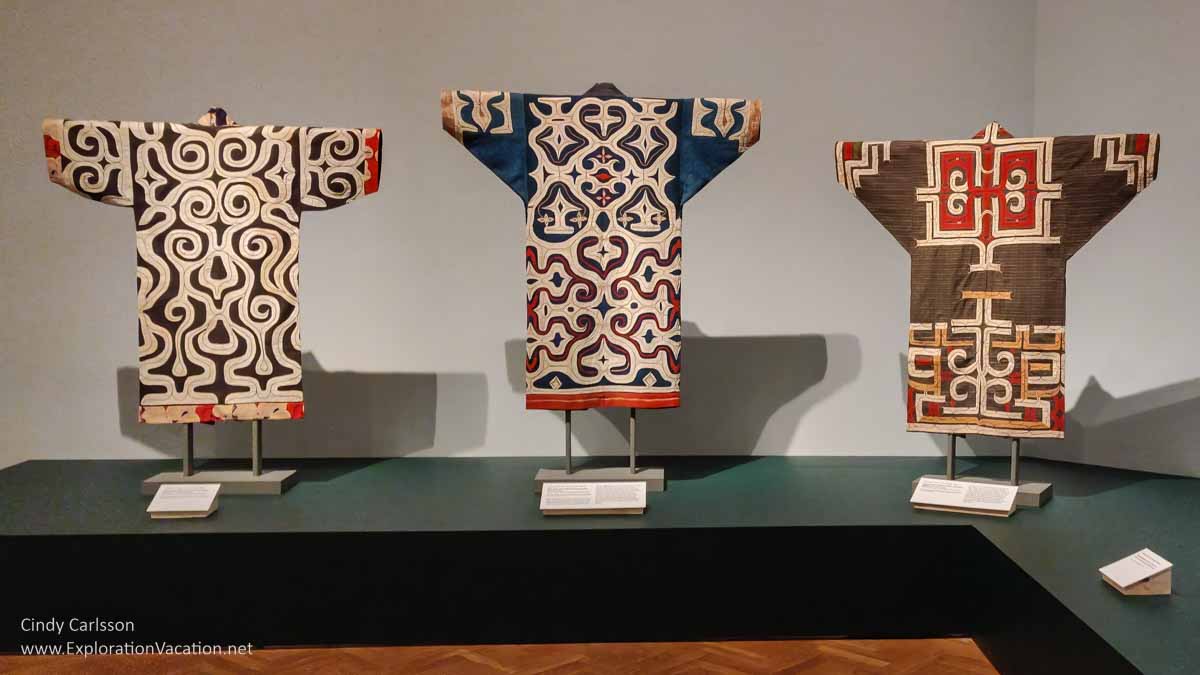
Late 19th – early 20th century cotton Ainu robes from Japan
Cotton material eliminated the need to harvest, prepare, and weave nettle fiber into fabric. And it was easier to embellish. This resulted in robes where almost the entire garment was covered in complicated appliquéd patterns and embroidery.
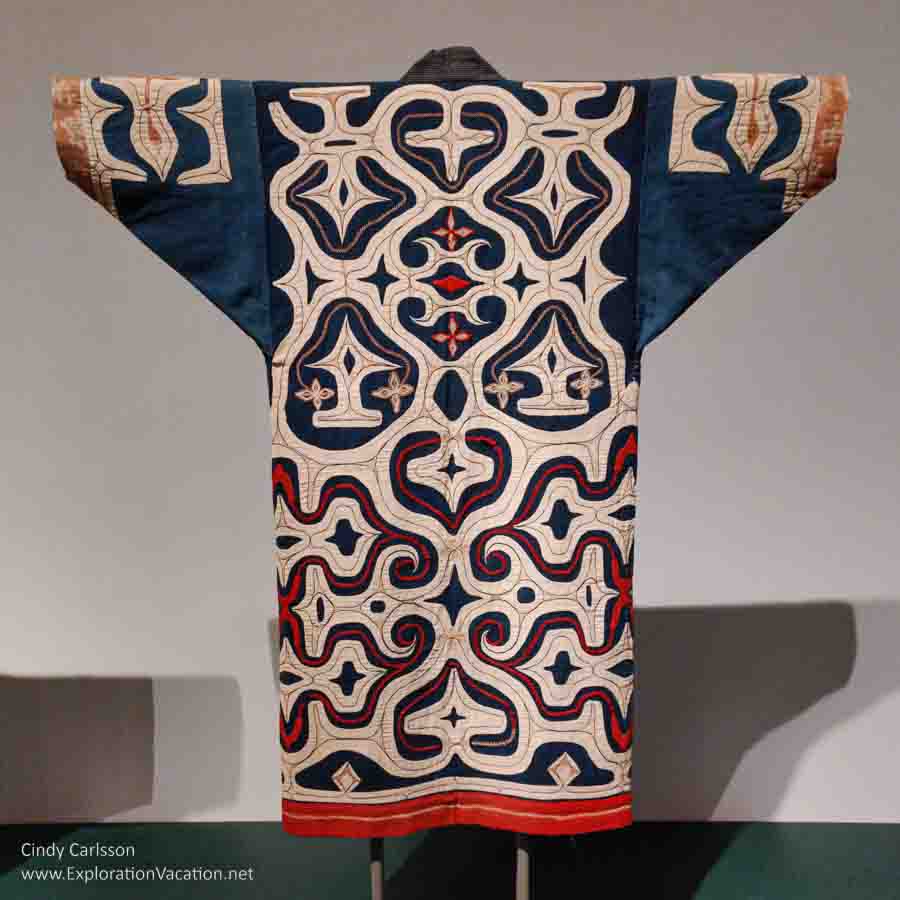
Late 19th century Ainu robe from Japan.
Read more about this robe at Divine threads: The making of an extraordinary robe in Dressed by Nature.
Most Ainu maintained their traditional culture and language into the last half of the 19th century, even as they began to work in the Japanese fishing industry. But in 1899 Japanese laws sought to end traditional Ainu life and culture. Only now are the Ainu of Japan discovering and reclaiming their culture.
👉 Read less
Robes for travel
A small selection of coats designed for traveling are also included in Dressed by Nature. These include a couple of capes and shawls, as well as a beautiful travel coat made of arrowroot and cotton and lined and trimmed in silk, and a paper rain jacket.

A selection of 19th and early 20th century Japanese textiles designed to protect travelers and their clothing from dirt and rain.
Yes, you read that correctly. The dark coat (a jacket, really) is made of paper!
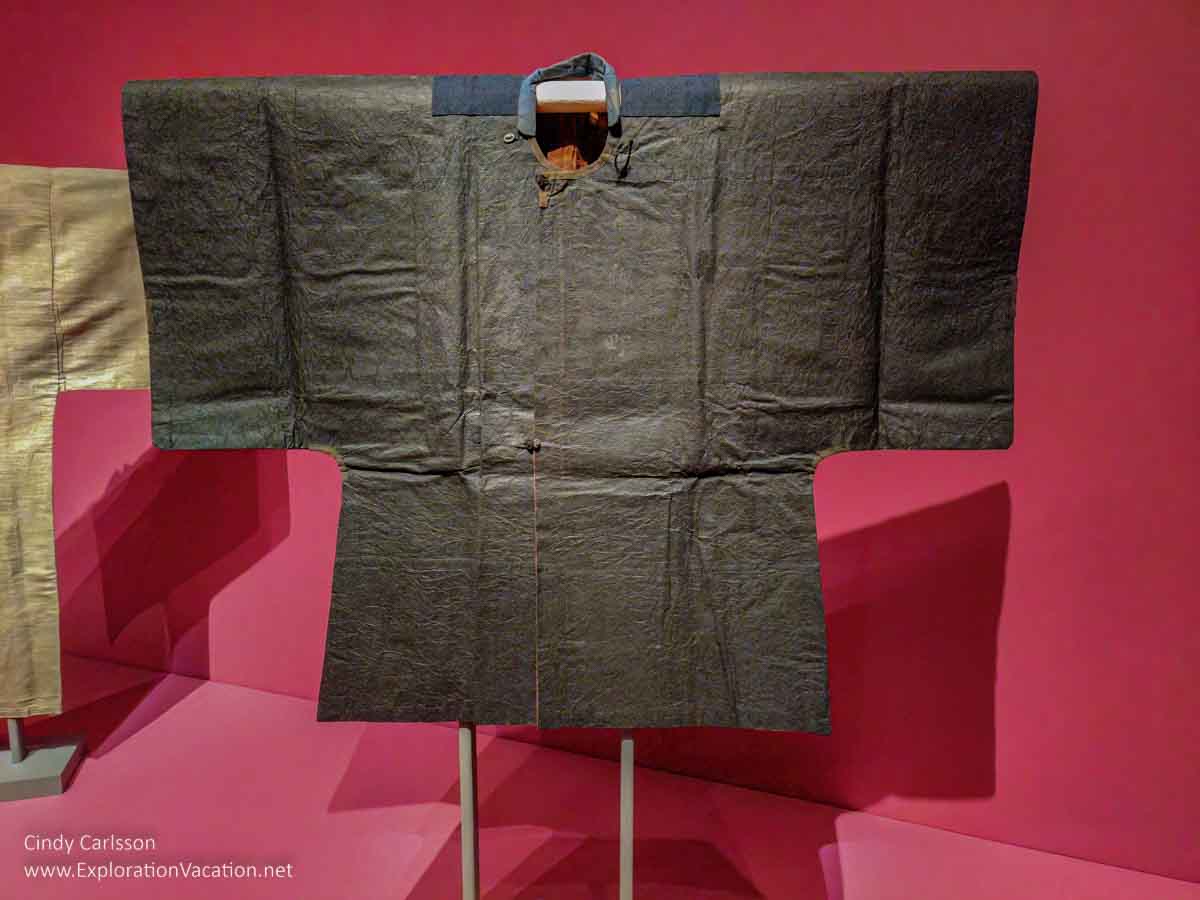
A late 19th or early 20th century Japanese raincoat made from mulberry paper.
Mia explains that paper raincoats were made of thick sheets of mulberry paper that were treated to make them strong, flexible, and (I assume) water resistant. These sheets were then glued together, dyed, and rubbed to give them a bit of shine and softness before being sewn into a coat or jacket like this.
Raincoats of this type were popular in Japan. They worked well enough, were lightweight, and cheap enough to simply discard when they got worn and dirty.
This one has an inscription on the front (impossible to see in my photo) that is thought to advertise a business. Like modern workers who wear jackets with the name of their employer emblazoned on them, this one was probably worn by the owner or an employee of this business while traveling.
Robes for firefighters
One of the coolest parts of Mia’s Dressed by Nature textile show is the gallery where some traditional firefighter gear and ceremonial jackets are displayed.
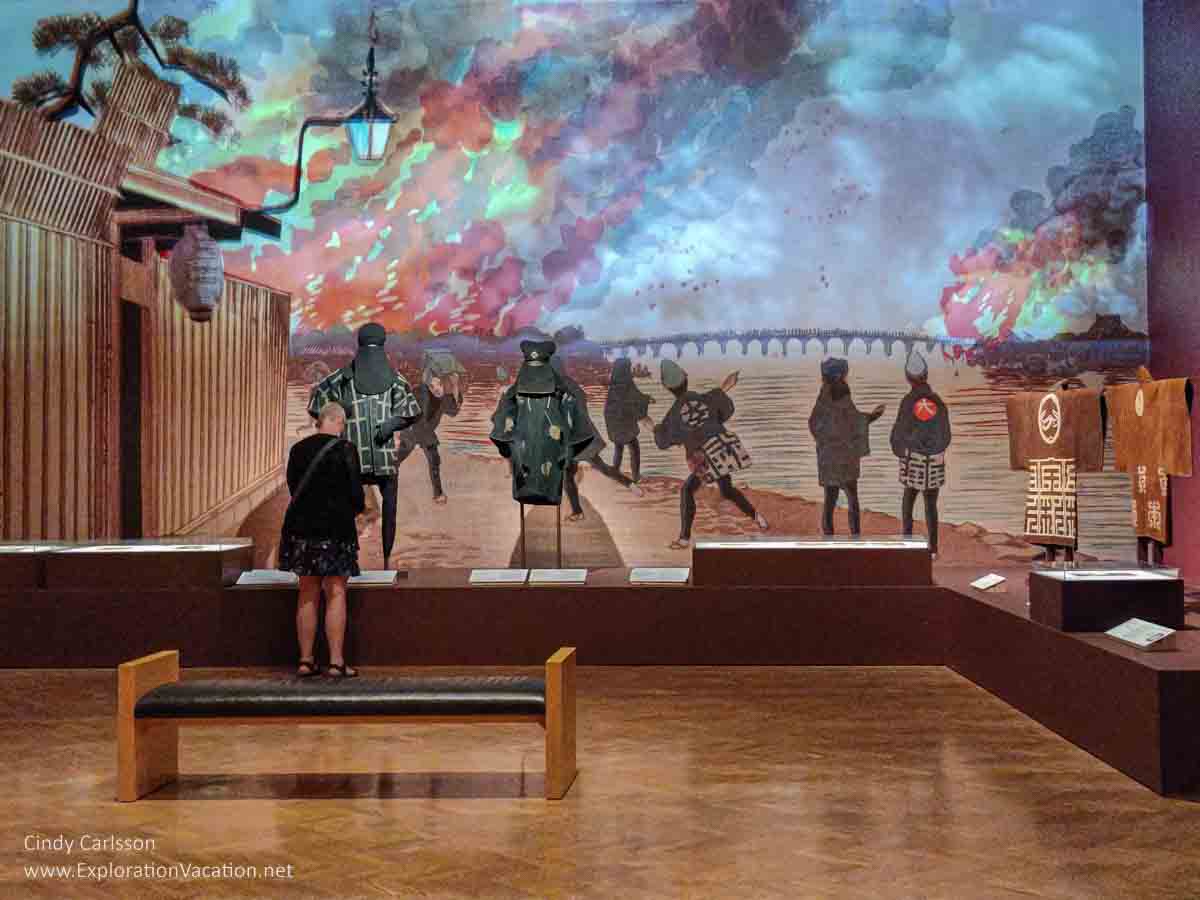
Mia devotes a large gallery to the traditional clothing once worn by Japanese firefighters.
With a flickering life-size enlargement of a Japanese city in flames (reproduced from a print), there’s plenty of drama on hand. And don’t those firefighters look like characters out of a superhero movie!?
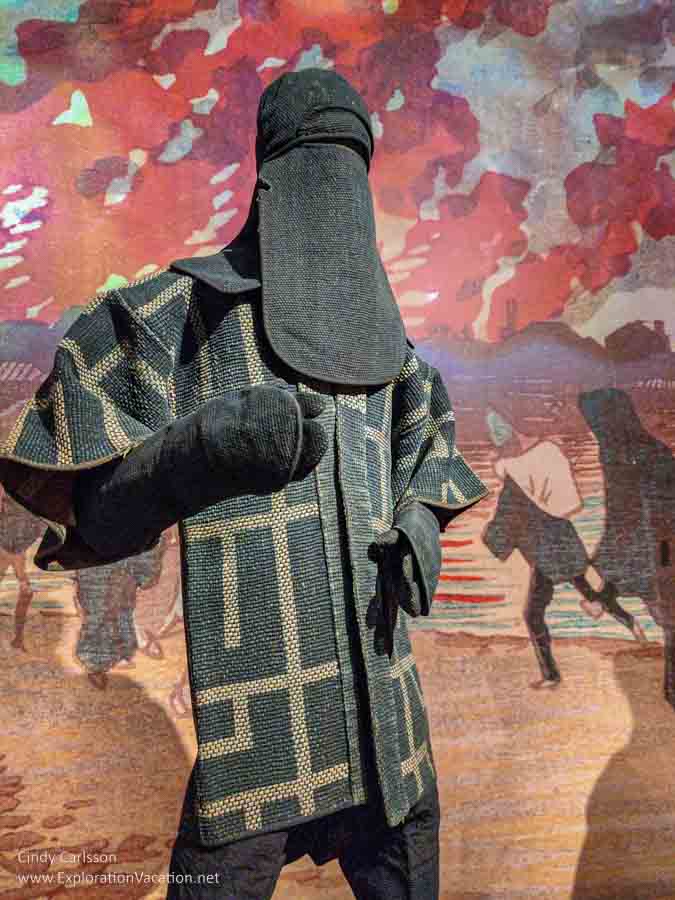
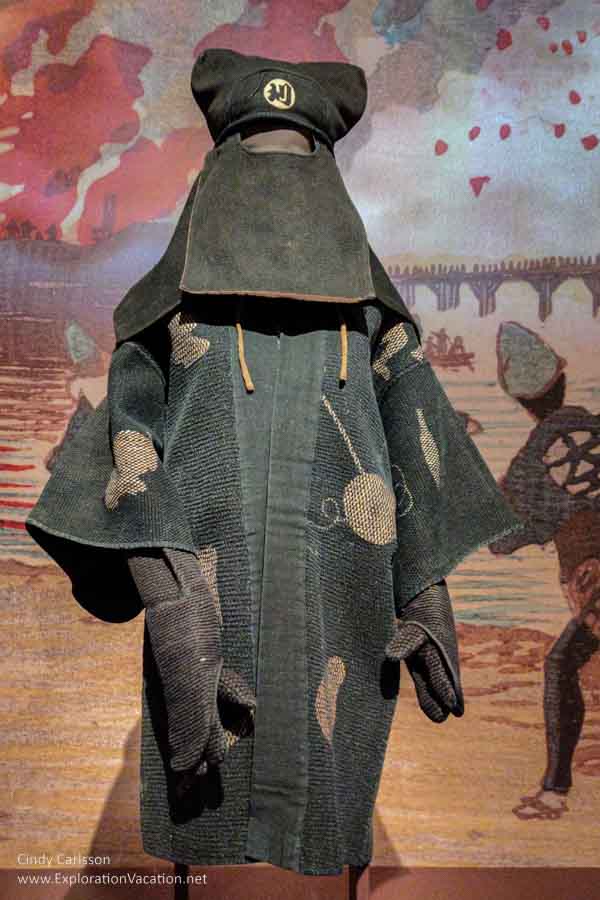
19th–early 20th century firefighters’ clothing made from layered and quilted cotton.
In a way, Japanese firefighters were superheroes.
👉 Read more Japanese fire fighters' robes
Japan’s cities were built of wood. And all of those wood buildings had paper lanterns and stoves inside. That made fire a regular, terrifying threat as thousands of people lived in Japan’s large, densely populated major cities. Fires could spread quickly with deadly results.
So, the men who battled these blazes were true heroes. But those dramatic firefighting outfits weren’t designed just to look impressive; they were intended to keep firefighters safe. Layers of fabric were quilted and then dyed with indigo to provide fire resistance. And then, before heading in to fight a fire, the fully dressed firefighters were soaked with water. When wet, the men were wearing up to 70 pounds of clothing.
Firefighters were revered and celebrated. Stories about firemen and their bravery were popular topics for Japanese theater.
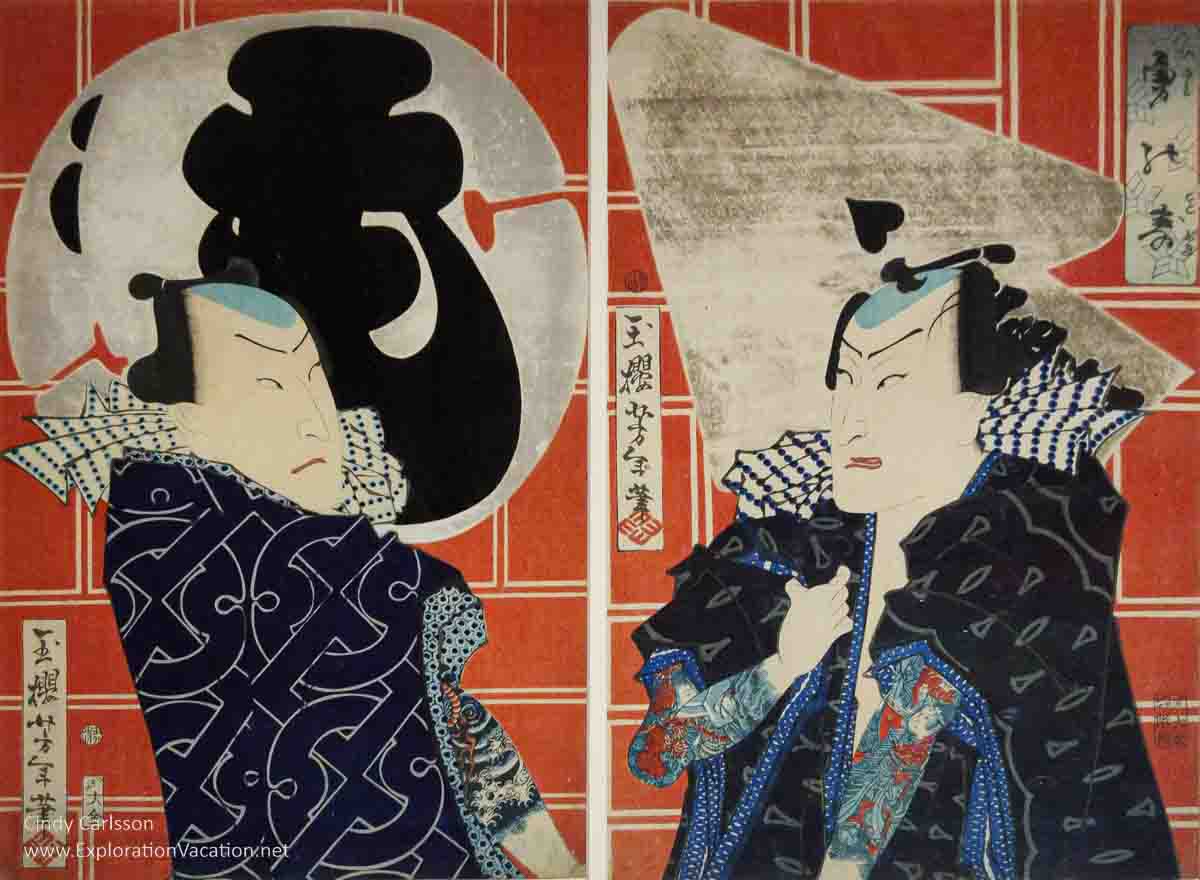
Kabuki actors portraying firefighters in an 1865 woodblock print by Tsukioka Yoshitoshi.
But real firemen were also well-known public figures.
As such, they participated in parades that celebrated firefighters and reminded people to be careful with fire. And, while most firemen made public appearances in their firefighting gear (usually with the jacket turned inside out to display its beautiful lining), fire brigade chiefs were often given rare and expensive leather coats to wear in parades. Coats that, like the clothing worn by athletes today, also happened to advertise the business that so generously provided them!
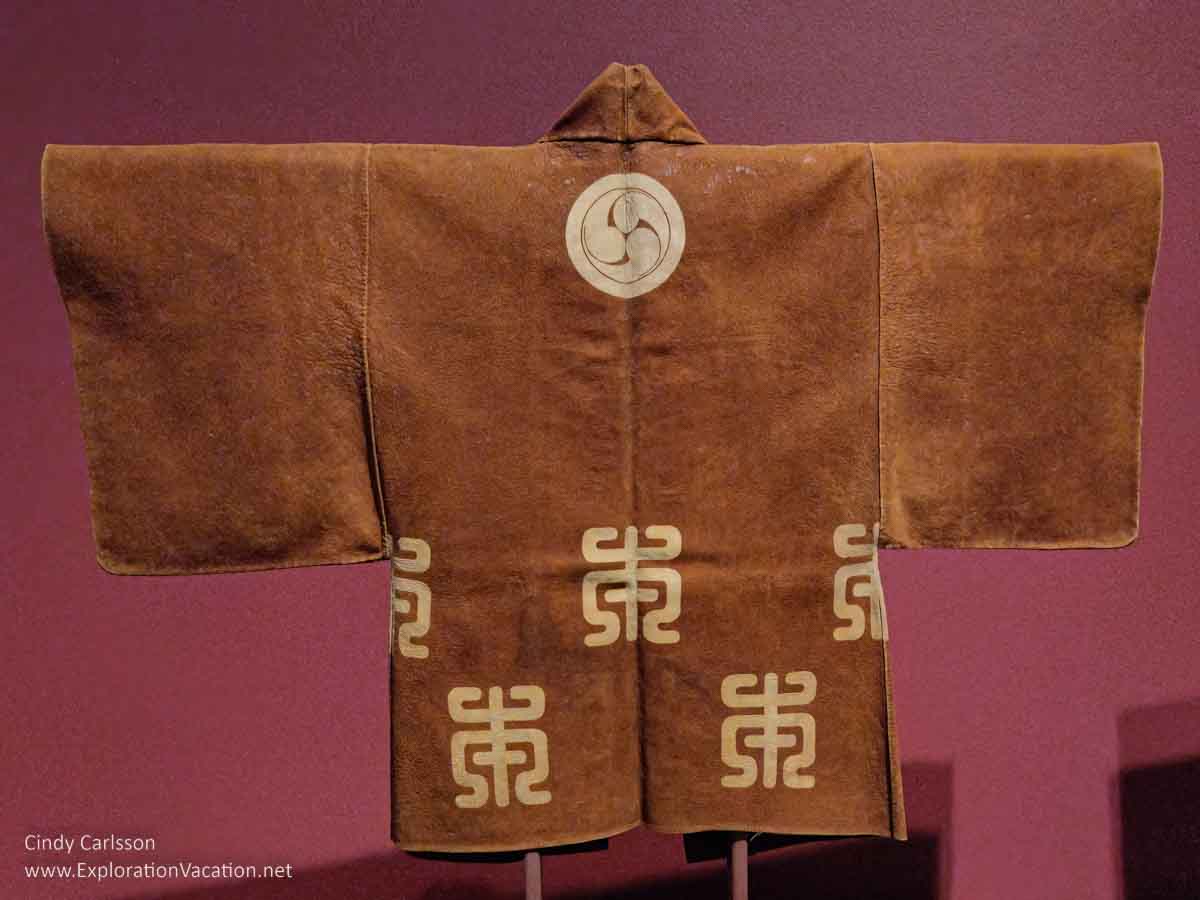
19th century Japanese fireman’s deerskin parade coat.
👉 Read less
Clothing for festivals, work, and more
The middle of the exhibit covers a number of things, some which don’t really seem to fit into one neat category. These included a selection of garments for festivals (although many of the garments throughout the entire show would only have been worn for festivals and other special occasions), indigo-dyed items (a lot of indigo items), work garments, and a few other items that demonstrate a variety of techniques for weaving, dying, or embellishing textiles.
A few of my favorites are included here.
A splendid shibori (tie-dyed) festival robe
Shibori is Japanese tie-dying, but it’s nothing like the tie-dying American hippies did in the 1970s. Proof of that can be seen in this incredible festival kimono featuring a carp.
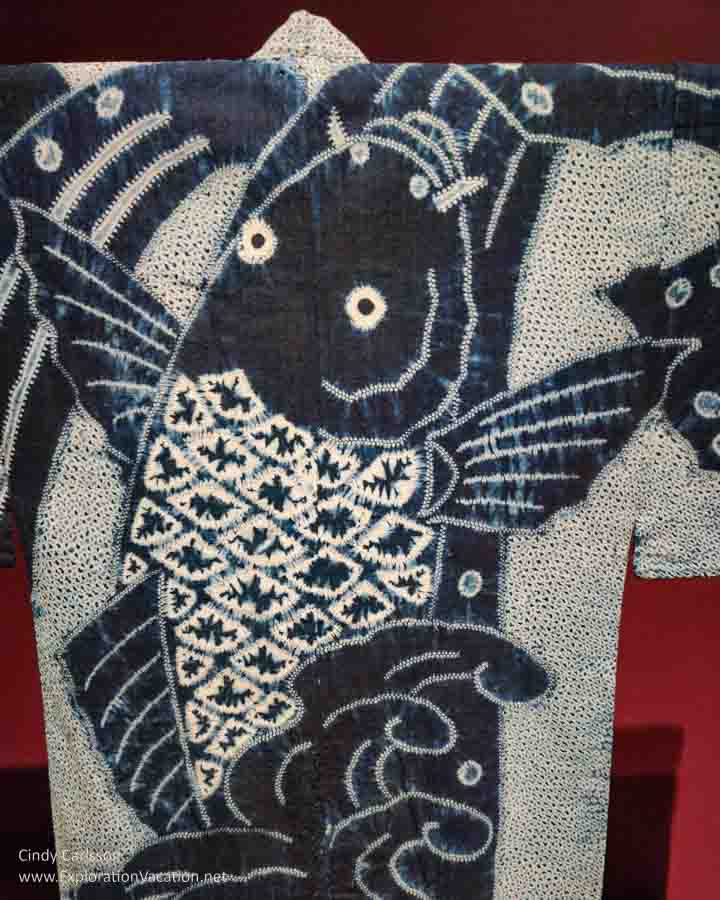
The pattern on a late 19th-early 20th century kimono from Akita prefecture was created using a variety of tie-dying (shibori) techniques.
Although the exhibit sort of explains how this was done, I still can’t imagine anyone actually creating this with tie-dying!
Double ikat weaving
I’ve long been aware of double ikat weaving. (I even went searching for weavers working with this technique while in Bali.) However, until this exhibit, I never really understood exactly how it was done. Now I do. And it is kind of mind-blowing.
It’s too complicated to explain here, but, at its most basic, it goes like this: Instead of dying the woven fabric to create a pattern, double ikat patterns are created by dying patterns in the fibers that will be used to form both the length and width of the fabric so they create a specific design when woven together. (In a single ikat, only the fibers used in one direction – warp or weft, but not both – are dyed to form a pattern.) This technique is very difficult, but the resulting patterns can be very complicated, as in this child’s kimono.

Late 19th century child’s double ikat woven kimono.
Indigo textiles
Mia’s Dressed by Nature exhibit includes a huge section on the use of indigo dye in Japanese textiles. That includes the double ikat child’s kimono above, where the fiber was tied to form patterns and dyed with indigo before being woven. But there are lots of other examples of indigo textiles, many of which are very different from each other.
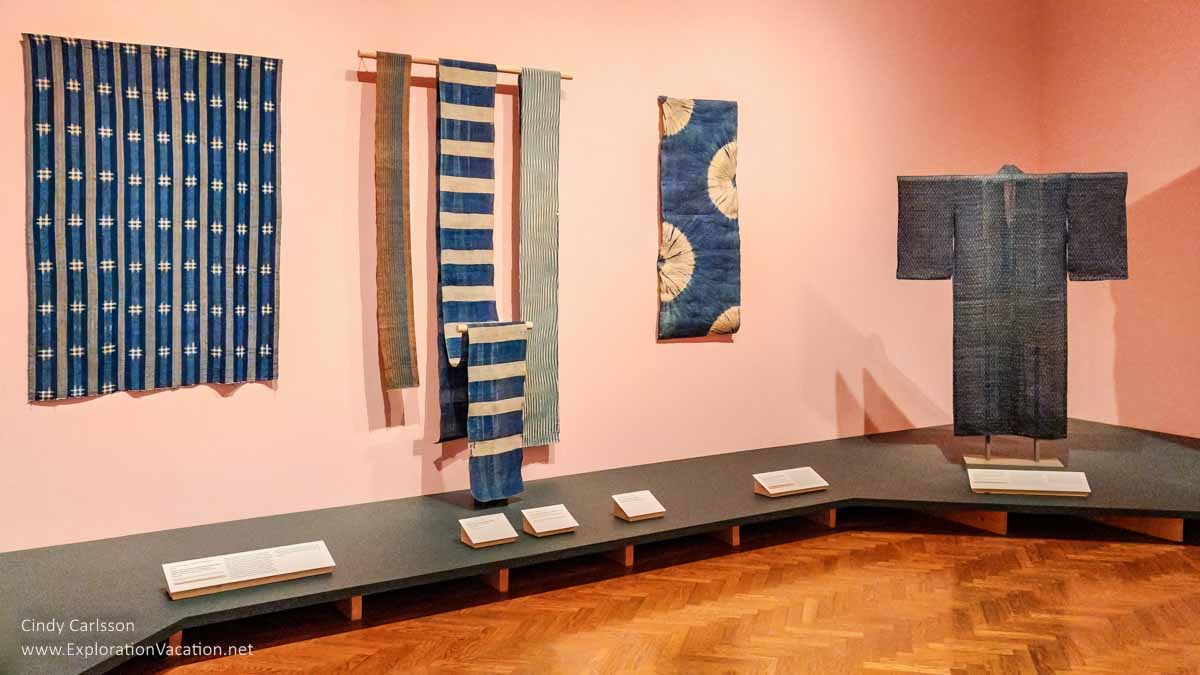
A selection of Japanese textiles dyed with indigo.
Some of the indigo textiles on display are dyed using stencils to create complicated patterns.
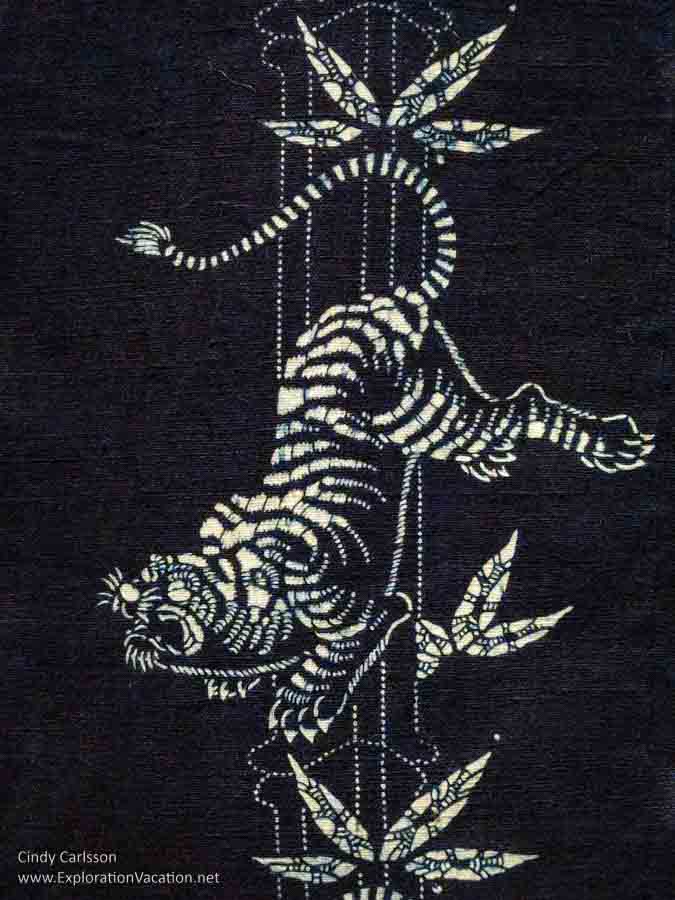
Detail from an early 20th century indigo garment with tigers stenciled on it.
Indigo was also used to create clothing for workers. This fisherman’s coat was dyed and then the entire surface was embroidered with white thread to create a beautiful garment from very basic materials.
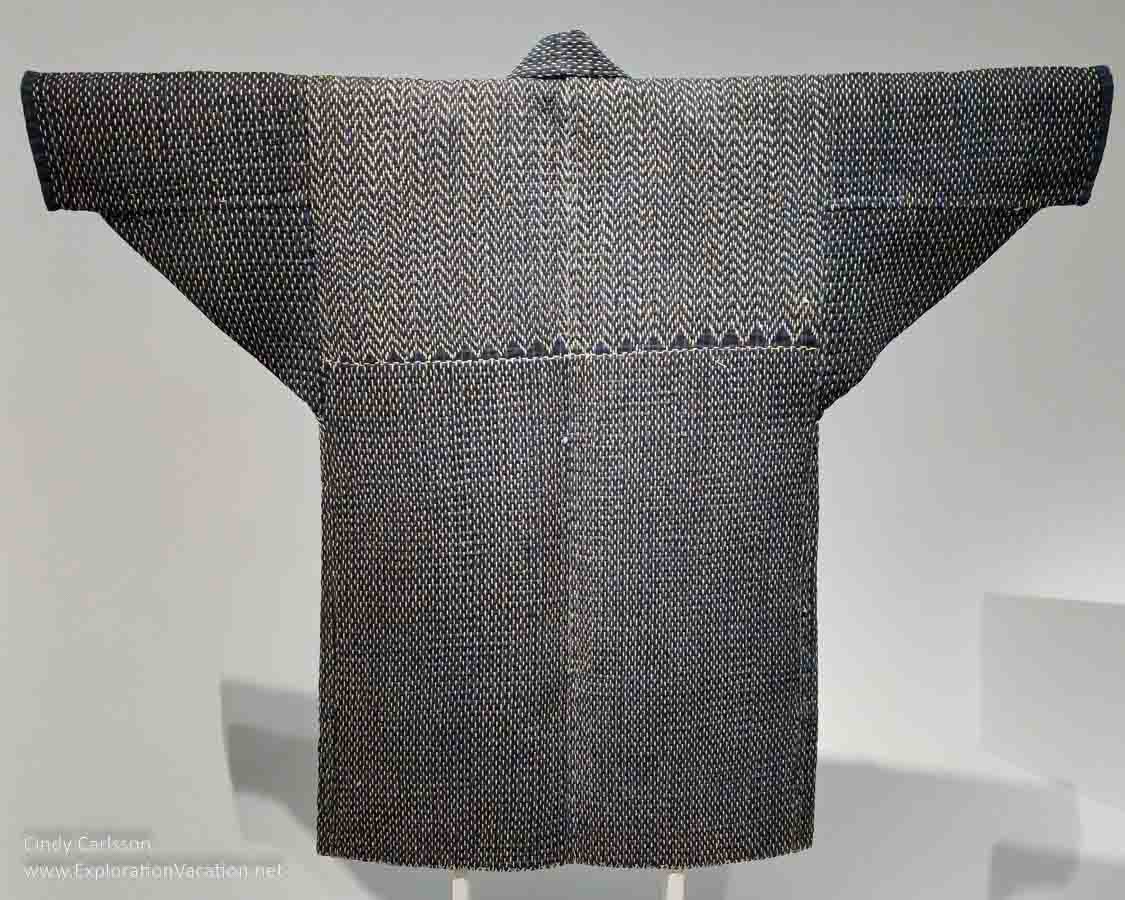
Embroidered 19th– early 20th century Japanese fisherman’s festival coat.
Traditional Japanese work clothes
Natural indigo dyes are more than a way to decorate textiles. The dye itself changes the property of the fabric, making it stronger and at least slightly resistant to fire. (The protective clothing worn by firefighters was dyed with indigo to help strengthen and fireproof it.) It also has antibacterial, odor-prevention, and insect-repellent properties. These features made it ideal for work clothing. Like American blue jeans, Japanese work clothing wasn’t dyed blue to make them pretty, but because indigo dye made them last longer.
Dressed by Nature includes a variety of everyday items and work clothes dyed with indigo.
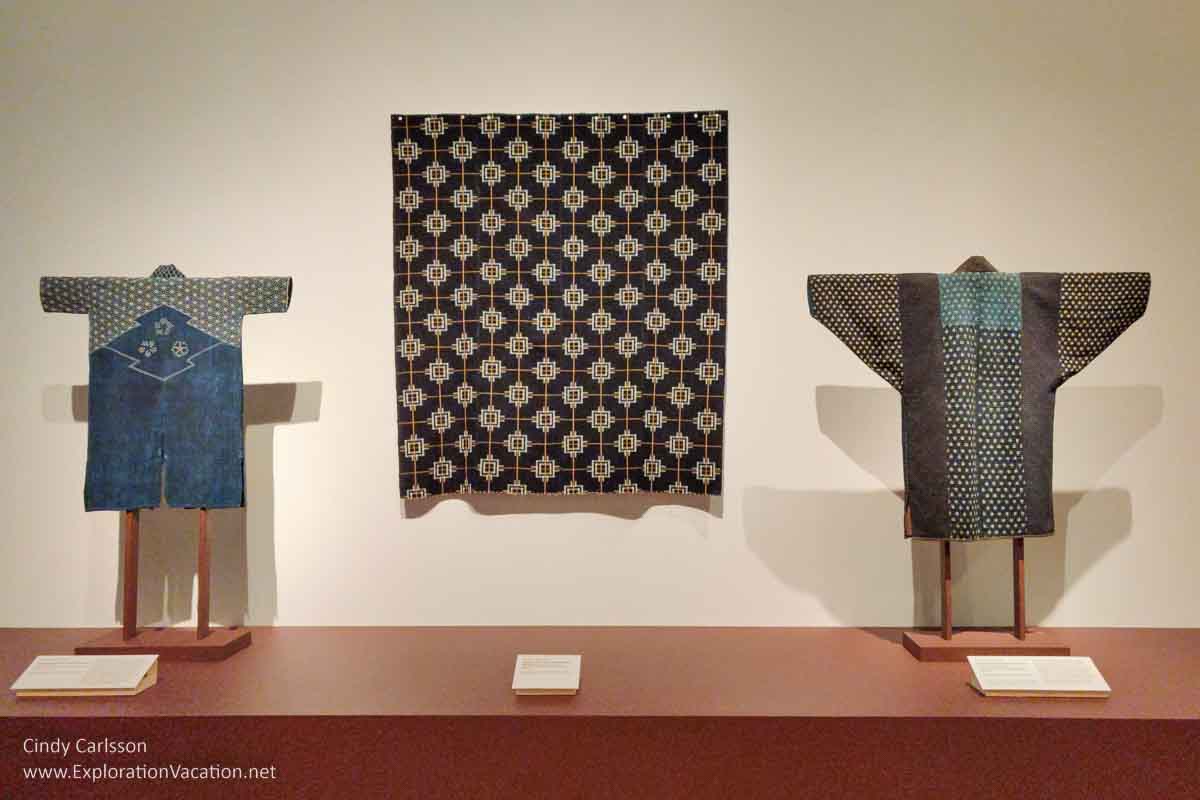
A mix of indigo items, including a boy’s uniform, a bed cover, and a farmer’s coat.
Much of the work clothes on display have a lot of simple embroidery. Like the indigo dye, this embroidery was as much functional as beautiful: Embroidery strengthens the material. It can also be used to create padding that makes the garment more comfortable when hauling loads.
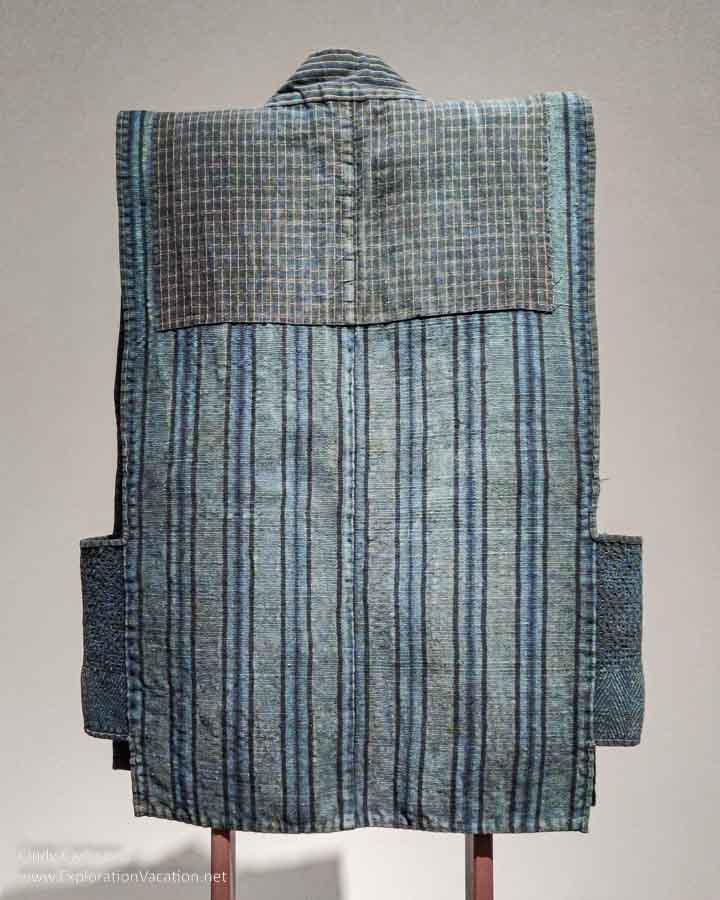
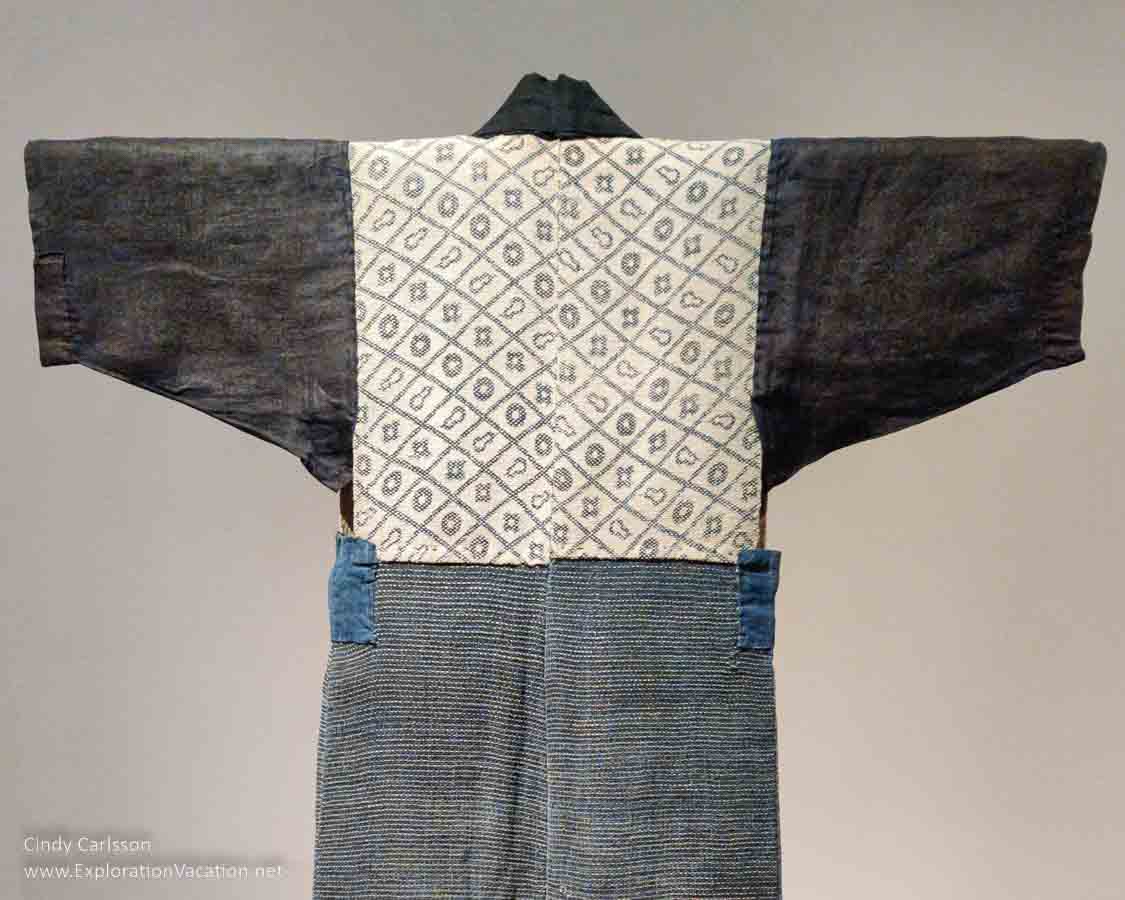
Embroidered indigo clothing for ordinary workers and laborers.
A few items where natural materials look really natural
Although the theme of the exhibit is Dressed by Nature with a focus on the use of natural, often hand-harvested materials in traditional clothing from Japan, in many cases the use of natural materials wouldn’t be obvious to the casual observer. But there are a few exceptions.
One of these exceptions is a rain cape made from rice straw, bark, cotton, and indigo dye. It would have been made by a man for his wife or fiancée to wear to a festival.
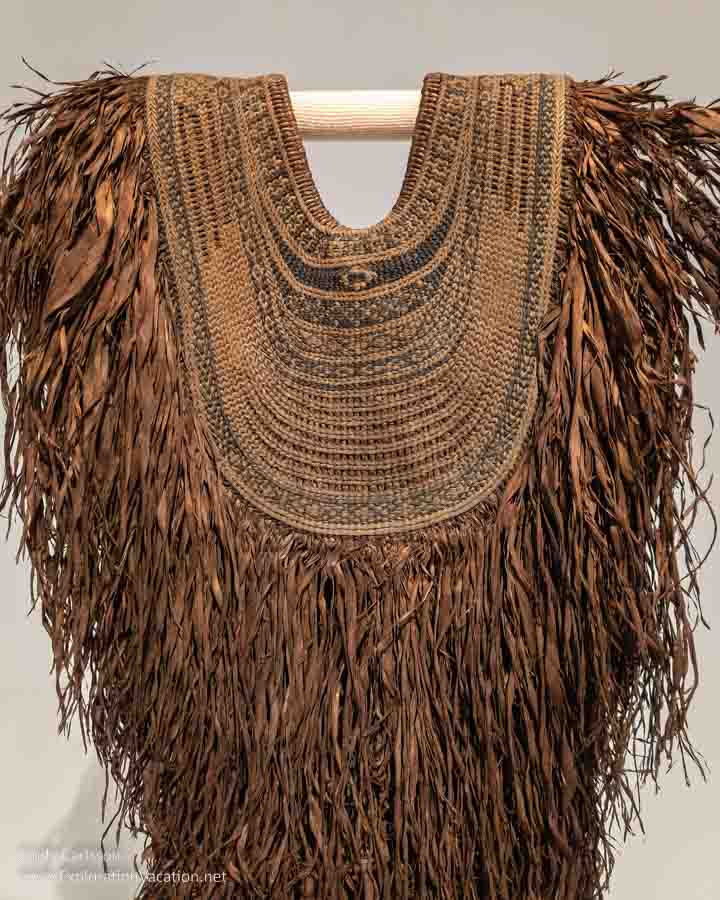
Would you guess this rain cape is from Japan?
Textiles from Okinawa
The last sections of Dressed by Nature feature textiles from Okinawa. And, while not traditional silk kimonos, these are more like what most of us probably think of as Japanese textiles.
Today the Okinawa Prefecture includes over 160 islands in the very south of Japan. But most of those islands were part of the independent Ryūkyū Kingdom until it was annexed by Japan in 1879. The finest of Okinawa’s textiles were created for the Ryūkyū aristocracy. However, they were also very popular with the Tokugawa shogunate in Tokyo!
This is a hot, humid area, and Okinawa’s textiles reflect those conditions. Traditionally, they are woven from ramie, nettle, and a type of banana fiber to create lightweight, breathable fabrics. The finest of these were considered as luxurious as silk, but much more comfortable in the heat of summer. Hence the demand for them as summer clothing in Tokyo.
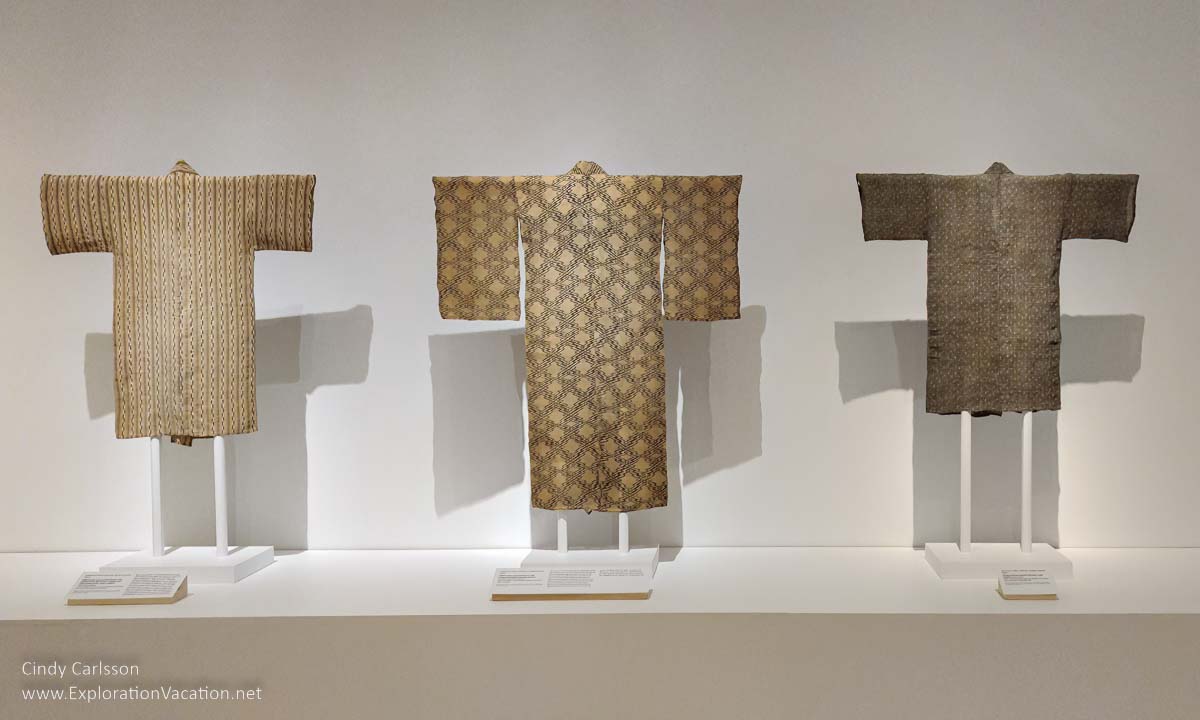
A selection of Okinawan textiles where the beauty is in the weaving
While these lightweight textiles were in high demand for their comfort, Okinawa was also famous for an intricate dyeing process that created elaborate patterns bursting with color.
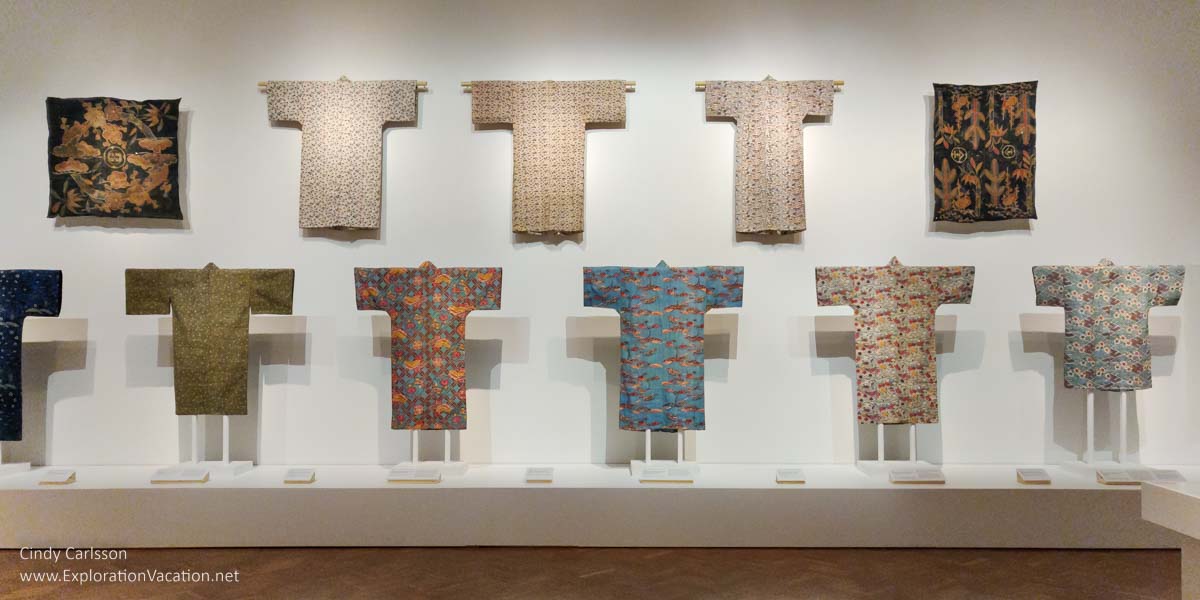
Dyed textiles from Okinawa were famous for their intricate designs and bold colors.
Called bingata, the dying technique used in Ryūkyū involved using stencils to control color placement. These stencils were used to create patterns with multiple colorful layers. The most complicated patterns had up to 18 layers.
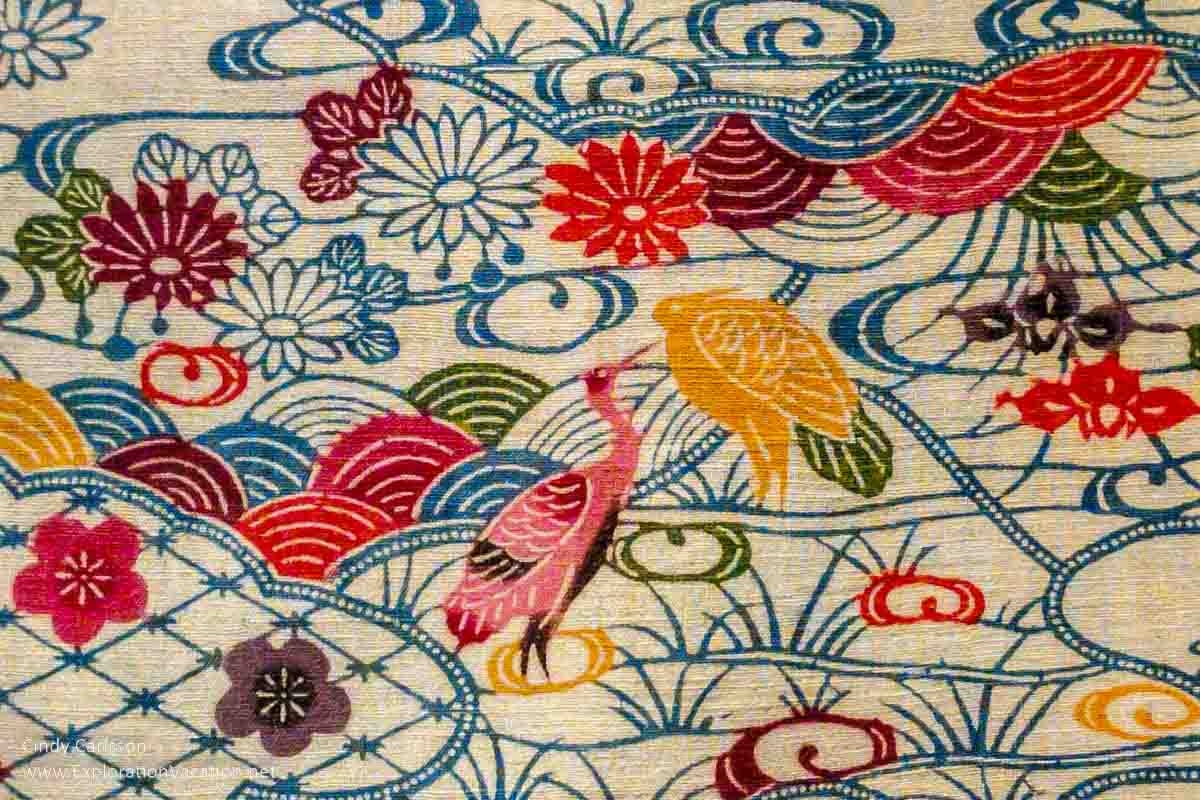
Close-up of the bingata pattern on the fourth of the five robes pictured in the lower row above.
In 2017 the Textile Museum in Washington DC held a large exhibit of Okinawan robes decorated using the bingata printing technique. They even had some of the stencils used to create these patterns. You can see some of those robes in my story on Bingata! Only in Okinawa.
These Japanese textiles are now part of Mia’s collection
All the textiles on display in Dressed by Nature are now part of Mia’s collection. And many are new to Mia, having been acquired in 2019 from California Asian art collector Thomas Murray. Those recently acquired textiles include 25 Ainu robes (14 of which are in this exhibit), giving Mia the largest collection of these robes outside of Japan.
I hope we will have many more opportunities to see these and other items from this wonderful collection.
Visit the Minneapolis Institute of Art
The Minneapolis Institute of Art (Mia) is located in south Minneapolis. It is Minnesota’s largest art museum and one of the larger ones in the entire USA. The collection spans thousands of years from pre-history to the present and includes artifacts, craft, fine art, architecture, religious items, and more. It includes items from the US and around the world, with a particularly strong Asian collection.
Over the past few years Mia has been updating galleries and exhibits in some very interesting ways. If you haven’t visited in awhile, it’s time to return. You’ve missed this show, but there’s plenty more to see!
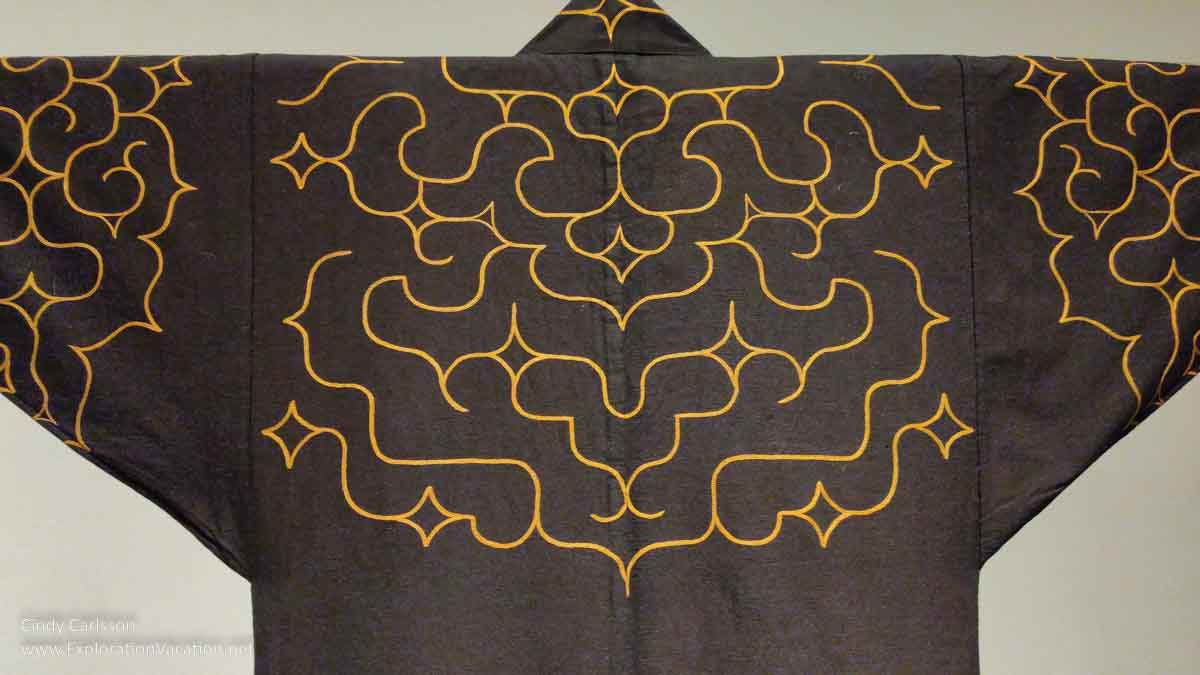
Embroidered cotton Ainu robe.
Mia is open Tuesday through Sunday.
While the museum itself is free, some special exhibits have a fee, with a discount for members. Donors and youth are free. Timed tickets are available online or at the museum.
Parking is available for a fee in Mia’s parking garage. Limited street parking is available around the museum. You can download a map with directions and parking information for the neighborhood on Mia’s website.
The museum is also accessible by bus. Route 11 runs right past the museum, but other buses also stop in the area.

You reminded me how wonderful this exhibit is. It’s well worth a visit. As an aside, THANKS for noting transportation to Mia beyond just the car…plenty of arty (and functional) bike racks outside too!
Yeah, thanks for mentioning the cool bike racks.