Last updated on March 28th, 2026
Just south of San Francisco, Filoli Historic House and Garden offers a glimpse into the lives of wealthy California families during the first half of the 20th century. The beautifully maintained mansion is interesting, but the elaborate formal gardens make this a stand-out attraction. It’s worth visiting whether your interest is historic houses, gardens, or simply looking for a day out of the city in a beautiful place.
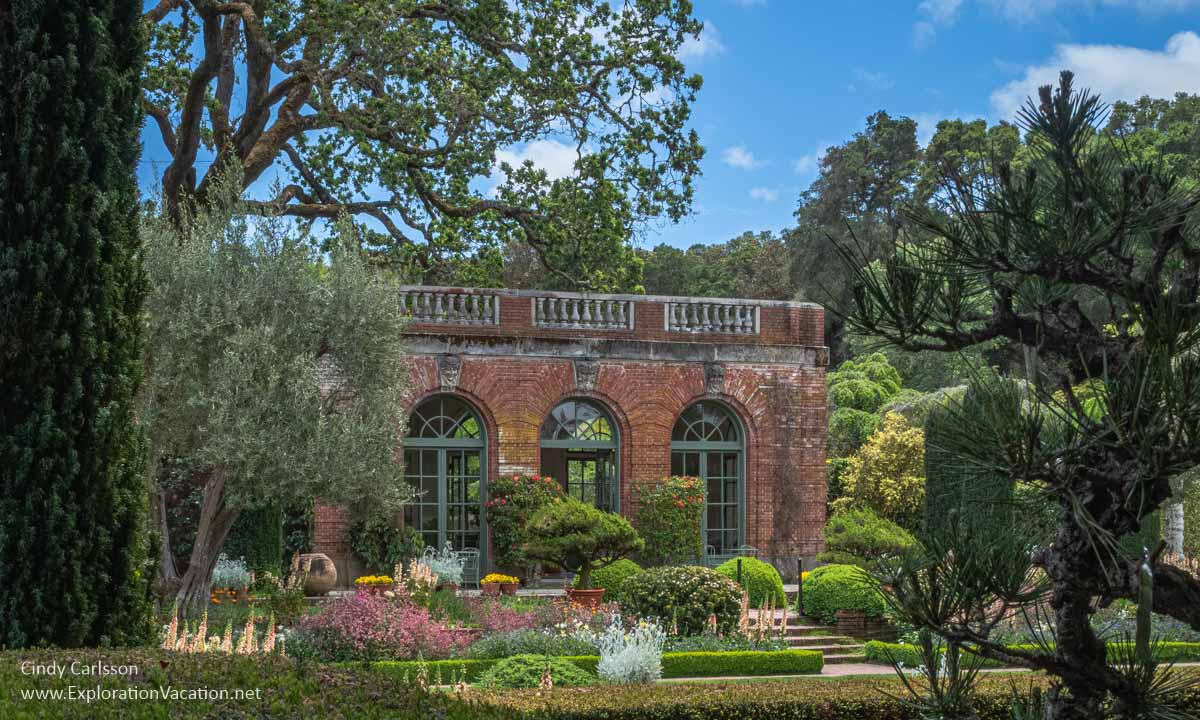
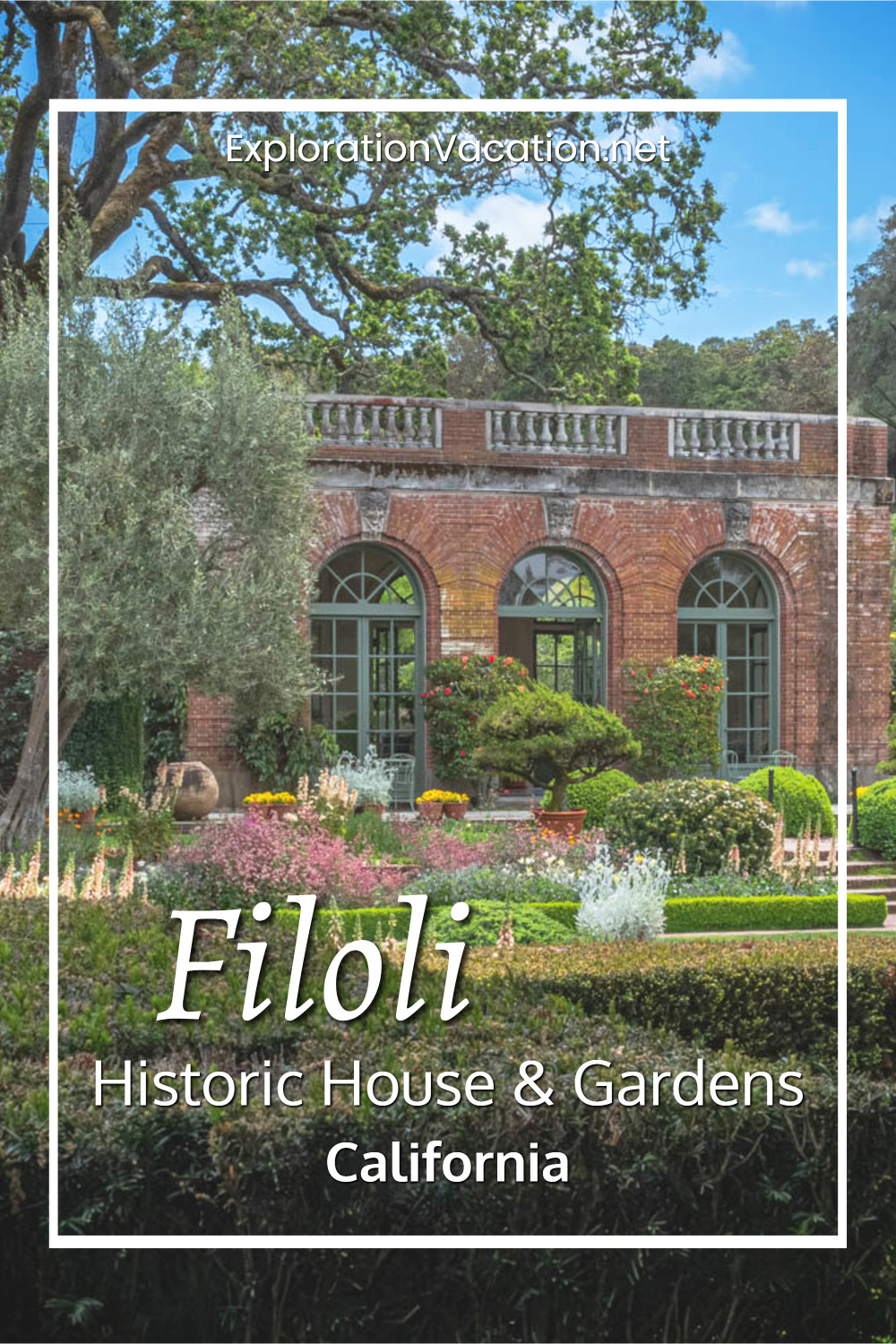
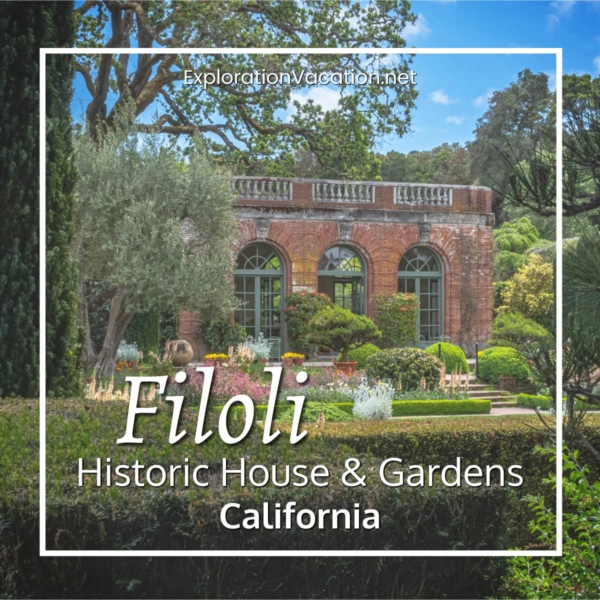
Filoli’s Garden House in spring.
Besides touring the house and gardens, Filoli offers a range of activities. These include walking trails, a café, tribal information center, gift shops, classes, and a variety of special events for both children and adults. And all of it is located a short drive from Half Moon Bay, making it part of a great day trip from San Francisco.
Keep reading to learn more about Filoli’s history, take a peek at the house and gardens, and get all the info you need to start planning your own day trip to this historic estate.
I use links to improve your experience using this website. Some may be affiliate links that pay me a small commission if you use them to book a room, rent a car, or purchase goods or services. You don’t pay extra, but it helps keep this website running. To learn more, see my policies and disclosures.
What is Filoli House and Gardens?
Filoli (the Bourn-Roth estate) is a grand country estate from the early days of the 20th century. Often described as a Gilded Age mansion, Filoli house wasn’t constructed until 1917 slightly after the Gilded Age. Overall, the entire estate seems influenced more by historic manors in Ireland and the British Isles.
While you might recognize the house from appearances in movies, TV shows, and other media, Filoli is best known for its exquisite formal gardens.
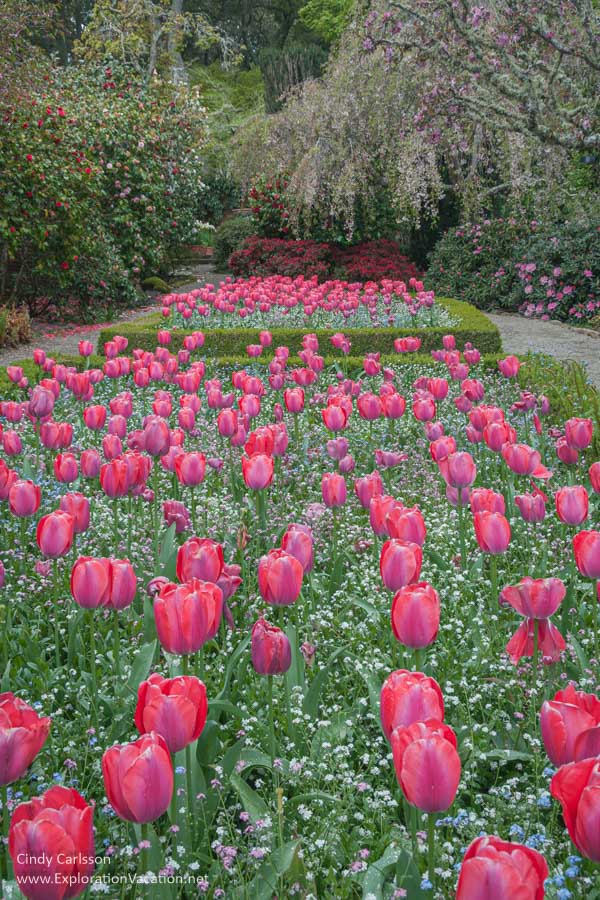
Spring flowers at Filoli.
Filoli was built as a country home for wealthy gold mine and utility investor William Bourn II and his wife Agnes. Following their deaths in 1936, the estate was sold to William Roth and his wife Lurline, the heir of an ocean shipping business. In 1975 Lurline Roth donated the estate to the National Trust for Historic Preservation, which opened it to the public. (The property is also on the National Register of Historic Places. [PDF] and is a California Historical Landmark.) Today, the estate reflects a mix of both the Bourn and the Roth families’ time here.
By the way, the name “Filoli” is a made-up word based on Bourn’s personal motto:
Fight for a just cause; love your fellow man; live a good life.”
How Filoli came to be
While William Bourn II built several businesses and buildings in the San Francisco area, Filoli’s story begins in Ireland.
The Bourn family regularly traveled to Europe and, on one Atlantic crossing, Bourn’s daughter Maude met an Irish lawyer named Arthur Vincent.
The couple married a few years later. However, Arthur Vincent wasn’t from a wealthy noble family. He was a judge in Zanzibar prior to his marriage to Maud. However, Bourn did not want his only surviving child living in Zanzibar. To resolve this problem he purchased Muckross House, an estate in County Kerry, Ireland, and gave it to the couple – along with a promise to pay the estate’s enormous operating expenses.
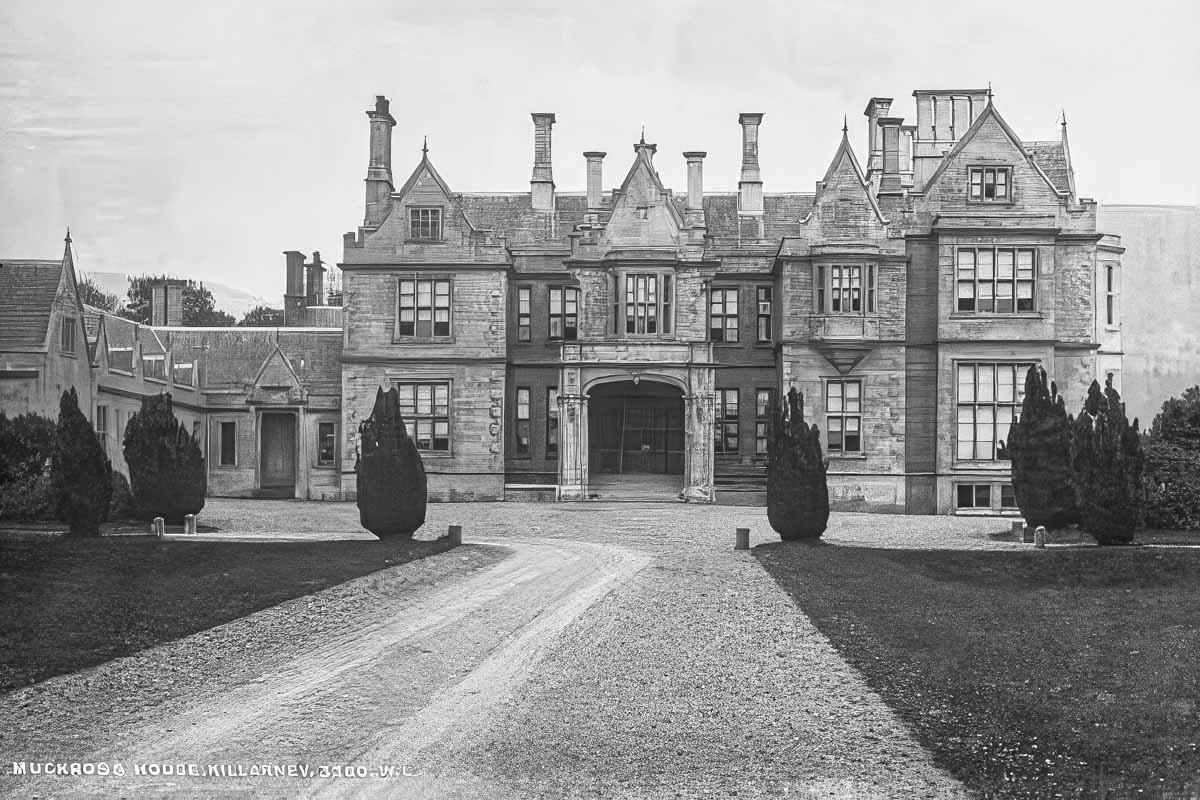
Photo of Muckross House taken some time between 1880 and 1914, possibly after the Bourns began living there in 1910. (National Library of Ireland on The Commons, No restrictions, via Wikimedia Commons.)
Bourn didn’t purchase Muckross out of the blue – he was already leasing the estate and living there part-time before Maude’s marriage. So, he knew and appreciated the property’s beauty.
Once Bourn had turned Muckross over to the newlyweds, he turned his attention to building a “country house” back in California. A house that would evoke Muckross.
An escape from the city
Bourn’s decision to build in the rural hills outside San Francisco was likely also influenced by the 1906 earthquake and fire that decimated the city.

The 1906 earthquake and fire destroyed much of San Francisco.
While Bourn’s own home survived the catastrophe, many others in his social class were less fortunate. In response, San Francisco’s elite were leaving the city for new mansions built in the (seemingly) safer hills to the south. And a man of Bourn’s wealth and social status needed to show that he too had the money and foresight to build in a “safer” location. (Filoli, like many other country homes built by San Francisco’s elite at that time, stands almost on top of the San Andreas fault.) However, his experience in Ireland also played an important role in choosing the location.
Bourn wanted a peaceful place to relax and grow old. He wanted a sprawling, self-sustaining country estate with lovely views. Like Muckross.
The centerpiece of his country estate was the house designed by noted San Francisco architect Willis Polk and completed in 1917. Built in the Georgian style so often seen in Ireland, the two-story mansion was surrounded by lush formal gardens, household gardens, orchards, pastures, and sweeping views over the landscape.
The Bourns remained in the house until their deaths in 1936.
A new owner assures Filoli’s future
After the Bourns passed, the property was purchased by William and Lurline Roth. Lurline was an heir to the Matson shipping company; the first to use standard-size shipping containers on its routes across the Pacific. She was also a champion horsewoman who rode and bred show horses on a farm near Filoli before becoming Filoli’s owner. (Fun fact: Lurline was named after a yacht.)
While the Roths seem to have made relatively few physical changes to the house, they renovated and expanded the formal gardens. Tasks they accomplished with the aid of the same horticulturist who helped design the original plantings for the Bourns.
Lurline remained in the house until 1975, more than a decade after the death of her husband. At that point it was simply too large a house for her. While her original intent was to sell the house and property, she decided instead to donating the core of the estate to the National Trust for Historic Preservation. Her decision ensured the public would have access to the house and garden and shows she valued the Bourns’ creation as much as they had.
Filoli is too beautiful to be private.” (Lurline Roth)
Filoli on the screen
Does Filoli look familiar? That’s because you’ve probably already seen bits of it, as Filoli is a popular film location for movie and television shoots.
Remember Dynasty? (Not to be confused with Dallas, the much more popular TV show about oil barons in Texas.) Well, maybe not, since it has been 40 years since the TV series about a family of oil barons in Denver hit the small screen. But for those remaining Dynasty Fans out there, Filoli is the house featured in the opening credit’s flyover. The interior also appeared in the show, but generally in scenes shot on sets in Century City that replicated Filoli’s interior.
Filoli has also appeared in Heaven Can Wait, The Joy Luck Club, The Wedding Planner, Rent, and other flims, series, and more.
Filoli House basics
Construction of the Georgian Revival house began in 1915. Built as a retirement house for William and Agnes Bourn, it took almost three years to build and construction costs went well over budget. The final cost was $425,000 or about $8.5 million today. (Some of that extra expense was due to the steel superstructure that provides support during eartquakes. A feature that got its first test shortly after the Bourns moved in.)
The house has about 56 rooms on two floors, with “public” spaces like the dining room, ballroom, reception rooms, and various other spaces on the main floor and bedrooms on the second floor. Areas used by servants, including living quarters, are located in the south wing. (The chauffeur and head gardener had living spaces in other places on the property.)
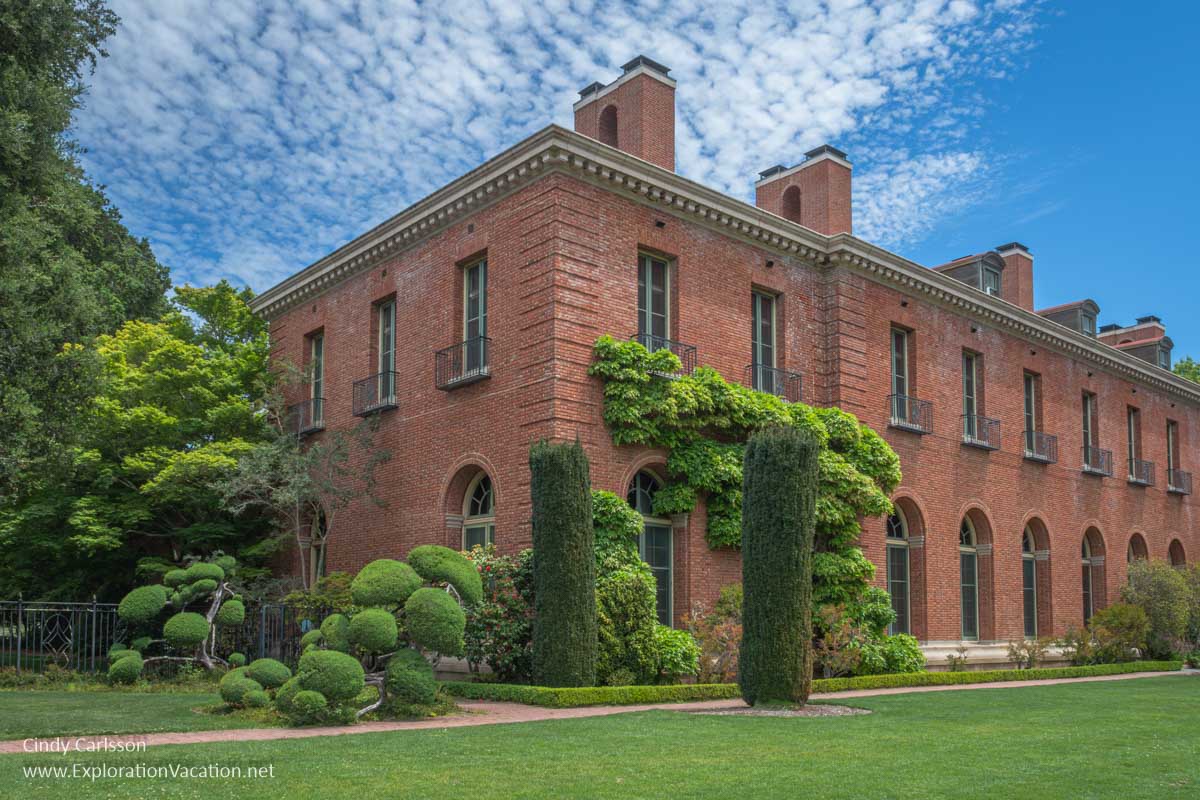
Filoli house – photographed from a rear corner – hints at the house’s size and symmetry. (The front of the house is largely obscured by large live oaks and other mature trees.)
The Bourns furnished the house with a mix of valuable art and antiques from around the world, art by California artists, and inexpensive items like travel souvenirs. The Roths purchased the house completely furnished, but sold many pieces before moving in. While they added their own personal touches, the house remained much as the Bourns left it. When Lurline downsized, she sold all the art and furnishings she didn’t need. (A decision she apparently regretted after deciding to donate, rather than sell, the house.) That means the house was empty when transferred to the National Trust in 1975.
Today, the house is fully furnished to look much as it would have when the Bourns and/or Roths lived here. That includes some original furnishings donated or purchased for the house. (The Roth family has donated many items back over time, but other donations have also helped fill the house.) And efforts are underway to locate and acquire more items. Still, much of the decor and furnishings simply mimic the look of the house when it was a family home.
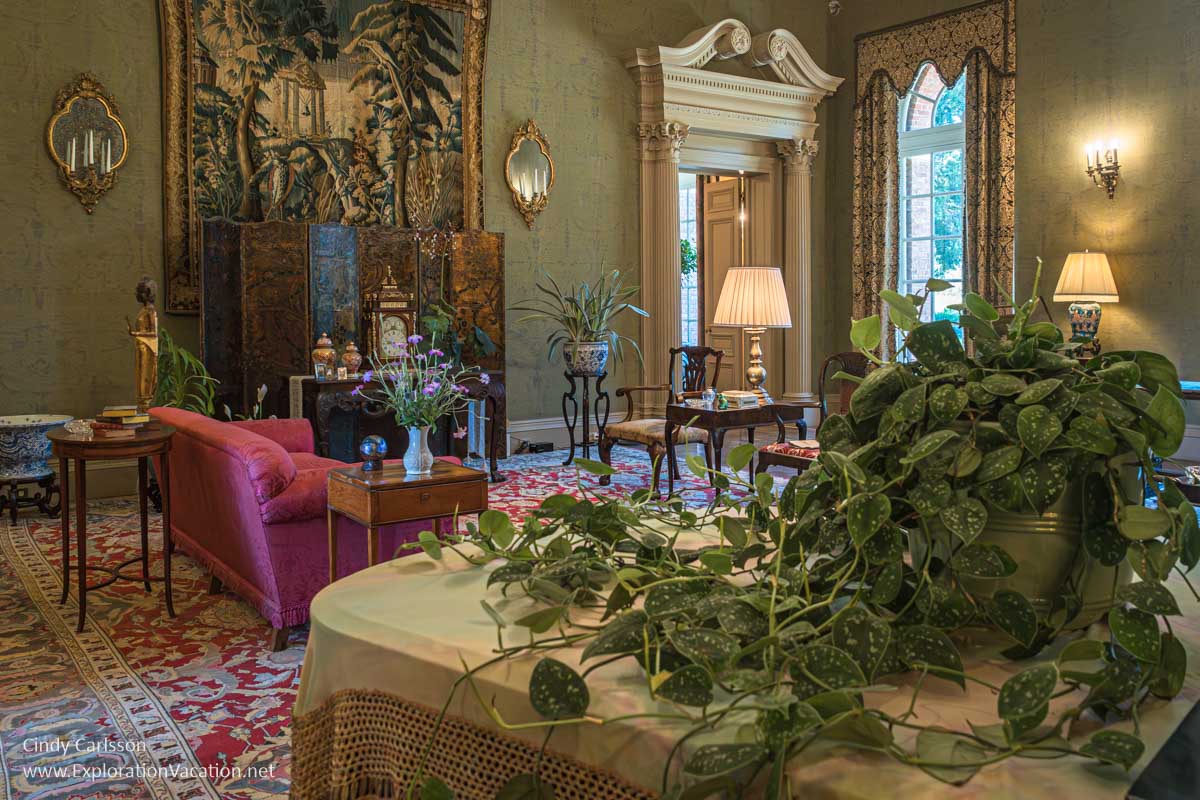
Guests were met in the reception room after handing their coats to the butler.
Touring Filoli House
Baring restoration projects and special events, the main floor is always open to visitors. That includes a few areas once dedicated to the large staff who kept the house running.
Apparently, many of the ten second floor bedrooms are used for meeting rooms, office space, and such. The Bourns’ suite was at one end of the house. Lurline Roth’s suite (complete with breakfast terrace) at the other.
I’ve never been on the second floor and don’t know anyone who has. However, it is occasionally open for tours. In 2025 a monthly curatorial tour was available through fall. That particular tour seems to have ended, but the upstairs IS included in December’s sold-out Filoli Unwrapped tour. Given years of interest in the second floor, expect to see some sort of tour that includes it again in the future. And, long-term, Filoli hopes to return some of these rooms to something closer to their original state and open them to visitors.
The following offers a glimpse of some of the rooms that are usually on view.
(I know this would be easier to visualize with a floor plan, but Filoli apparently no longer provides that unless you buy a guide to the house. There are a few old ones floating around on the internet, but I’ve been unable to find one I can use here. Instead, I suggest you take a look at Archisyllogy, which has floor plans for every floor, not just the main floor.)
Ballroom
Filoli has grand spaces for entertaining guests. The grandest is the ballroom. It features gilded trim, large windows, and the crystal chandeliers and fireplace created in Paris to mimic ones at Versailles.
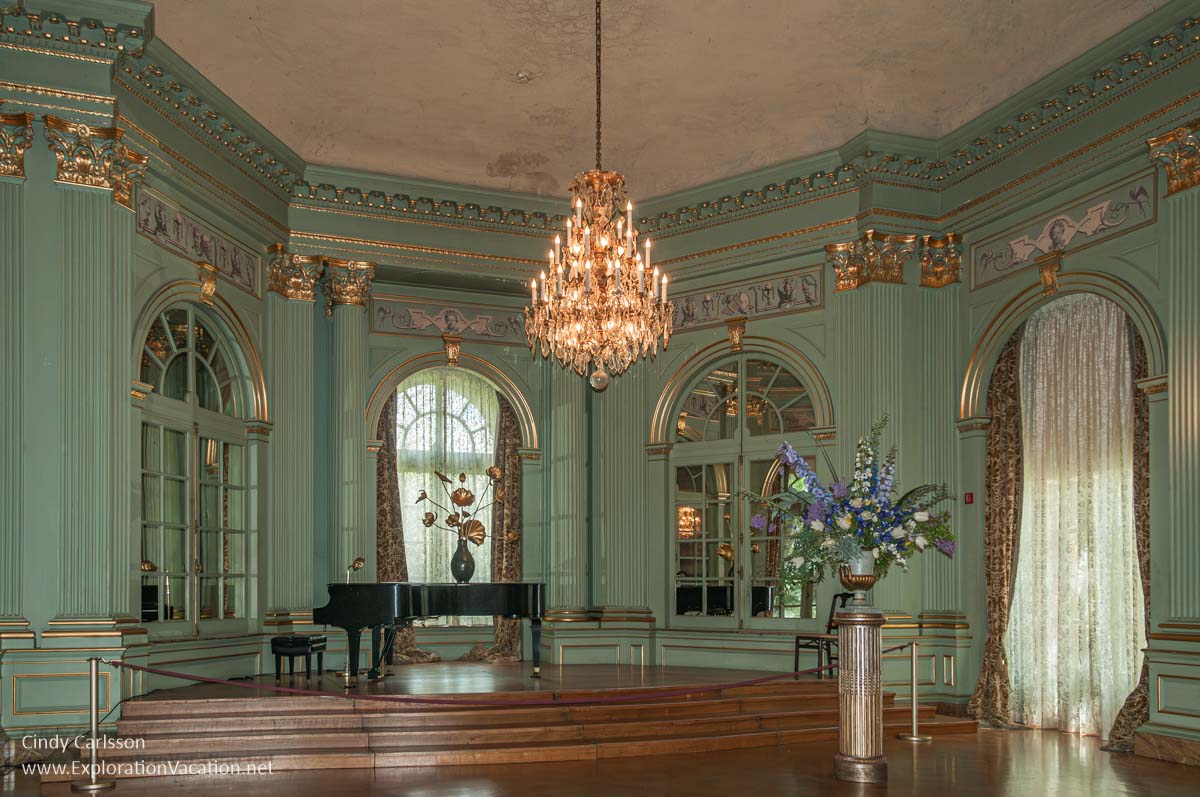
Grand parties needed entertainment, and the ballroom was designed with that in mind. However, the height of the stage in this photo was not original. It has since been lowered somewhat.
But the ballroom’s most dramatic feature may be the large-scale canvas murals with scenes of and around Muckross House.

A scene that brings a bit of Muckross to Filoli.
The murals (actually large canvas paintings, rather than true murals) were painted a few years after the house was constructed when a stroke left William Bourn unable to travel. Since he could no longer go to Muckross, he (or maybe Agnes) commissioned Ernest Peixotto to bring Muckross to Filoli in the form of paintings for the ballroom.
The ballroom was the scene of many extravagant parties. That was especially true when the Roths lived here. No expense was spared when hosting a party, with decorations alone running over $100,000 for their daughters’ debutante ball!
A major ballroom renovation was in progress when I visited in 2024. It’s complete now and the restored room should be stunning.
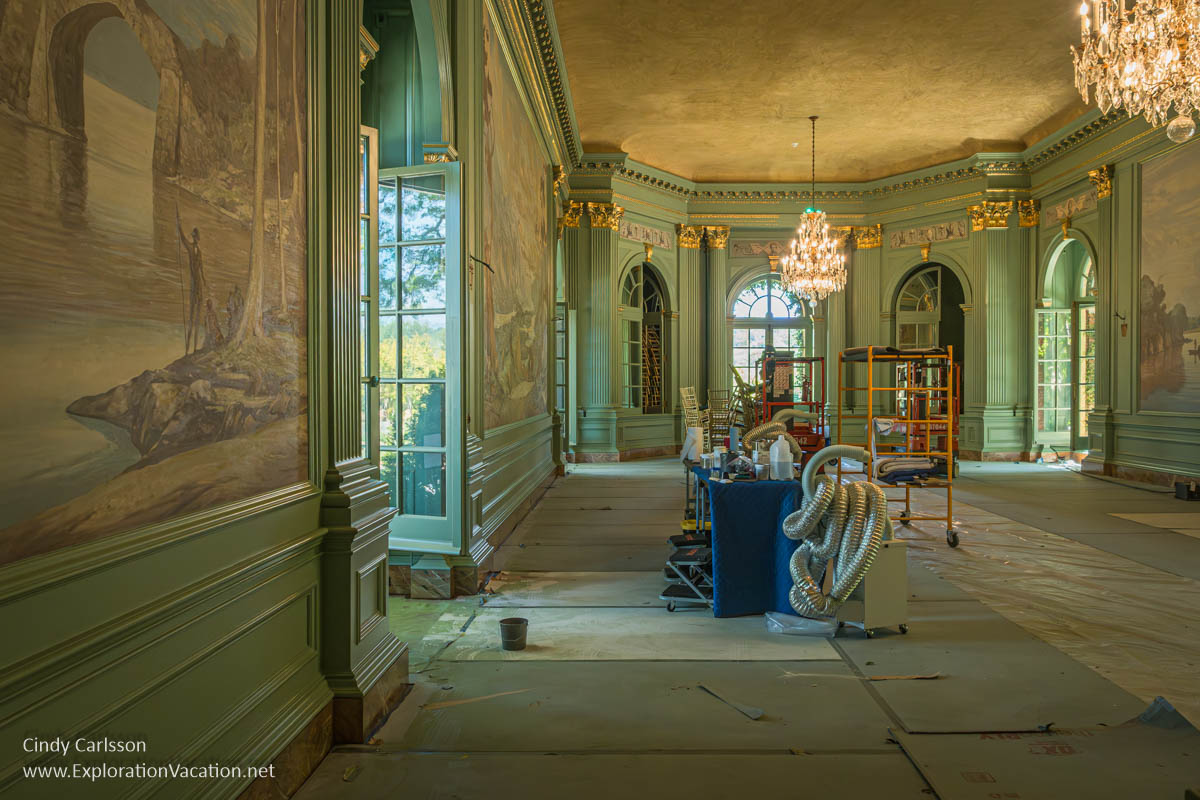
The ballroom during the 2024 restoration project. Note the “windows” along the stage that conceal storage space for chairs and other furnishings when not in use.
Dining Room
Surprisingly, while the oak-paneled dining room was regularly used for elaborate dinner parties, there isn’t much information on it or its furnishings.
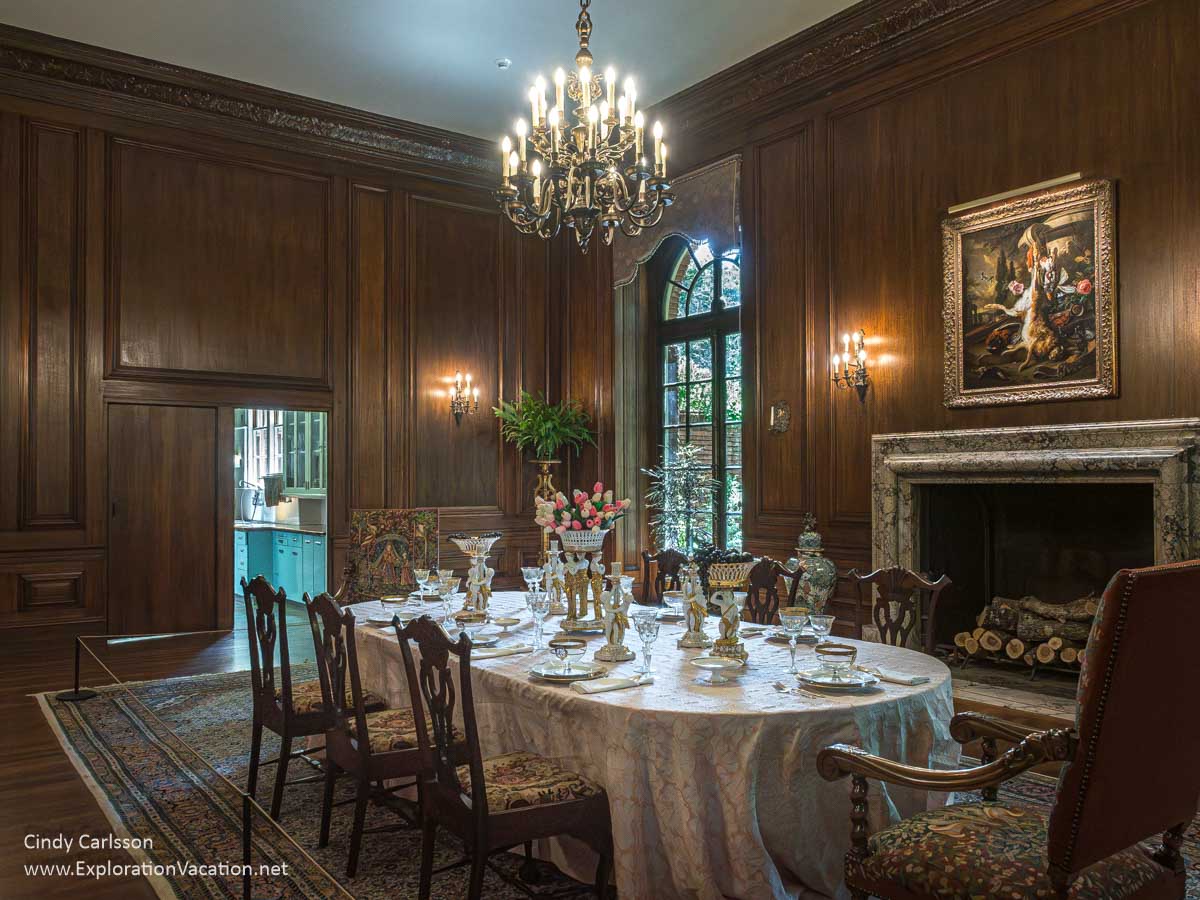
The dining room at Filoli with a glimpse into the butler’s pantry. (I’m guessing a screen would have kept the entry to the pantry out of sight when guests were present.)
(I realize the dining room painting is by a Dutch master and that decorating the dining room with paintings of dead animals is an old tradition in wealthy homes. But yuck.)
Study/Family Room
The rooms that feels most like it’s actually lived in is the family room. It’s decorated much as it would have been in 1962 when the Roths lived in the house. That includes Matson Travel brochures for Hawaii on the table and l Love Lucy (complete with vintage commercials) on the black and white TV. It’s easy to pretend the family just stepped out for a moment.
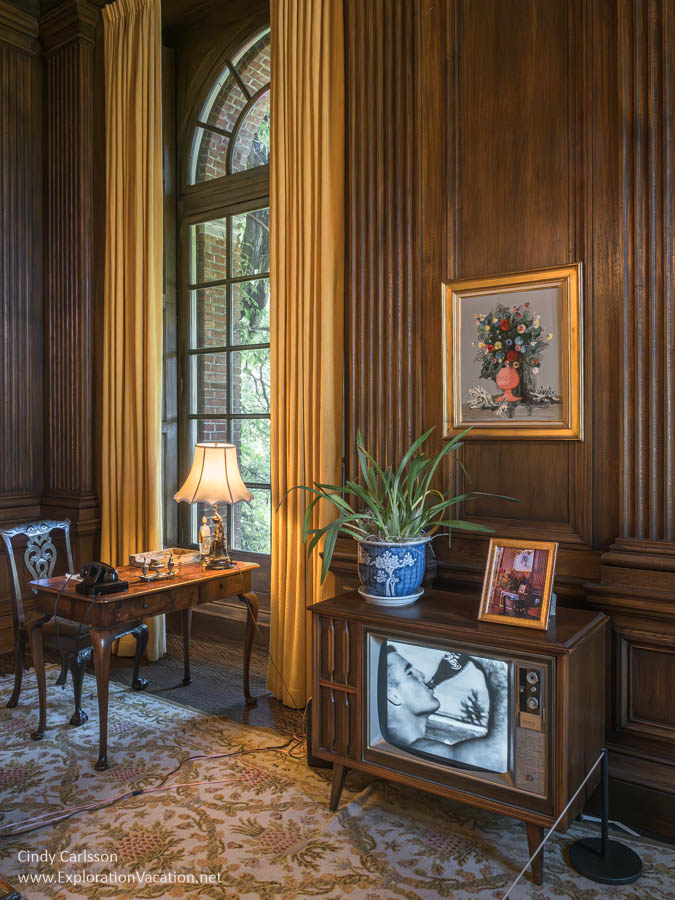
I watched part of an episode of I Love Lucy – complete with vintage and vintage-looking commercials. (Watch for a bit when you visit and guess which “commercial” was created for this room.)
To me, this is the only room that feels lived in. Almost every other space feels like a stage set. Which, in many ways, most of these rooms were. They were backdrops for social functions, not places where people actually lived. That seems particularly true for the Roths, who entertained on an epic scale and made this room their private living space for family and close friends.
However, originally, this room was William Bourn’s personal study. As such, it had one of several vaults located in the house. I’m guessing Bourn used this one for cash on hand and valuable documents related to the household and his business interests.
The Roths wouldn’t have needed a walk-in safe in their family room. But in an era when household servants no longer poured and brought your drink to you while you watched television or played cards, having the ability to pour yourself a cocktail or a glass of wine without leaving the room would be convenient. Thus, a small closet became the wet bar and the walk-in vault became wine storage.

The small bar hidden in the Family Room features wallpaper with prancing horses – clearly a legacy of Lurline Roth’s time at Fioli!
The Library
The large, but relatively cozy-looking library seems set to look much as it might have while the Bourns here. I say that because a large painting by California artist Mary Curtis Richardson of William Bourn’s mother Sarah gazes out at visitors from a prominent place on the wall and the desk is awash in a jumble of receipts and tickets from a European holiday.
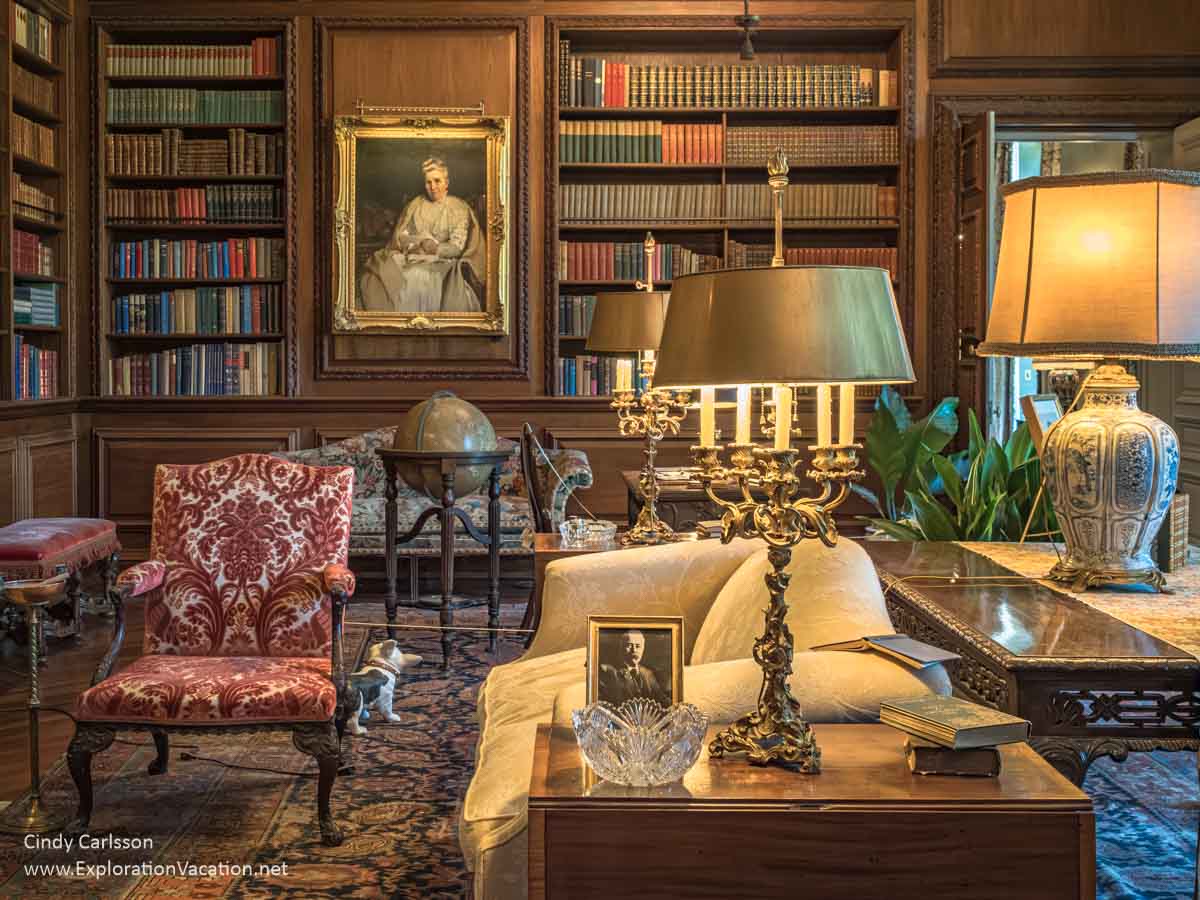
A portrait of Bourn’s mother keeps watch over the cozy library while a ceramic bulldog brings the family’s dog Toto to mind.
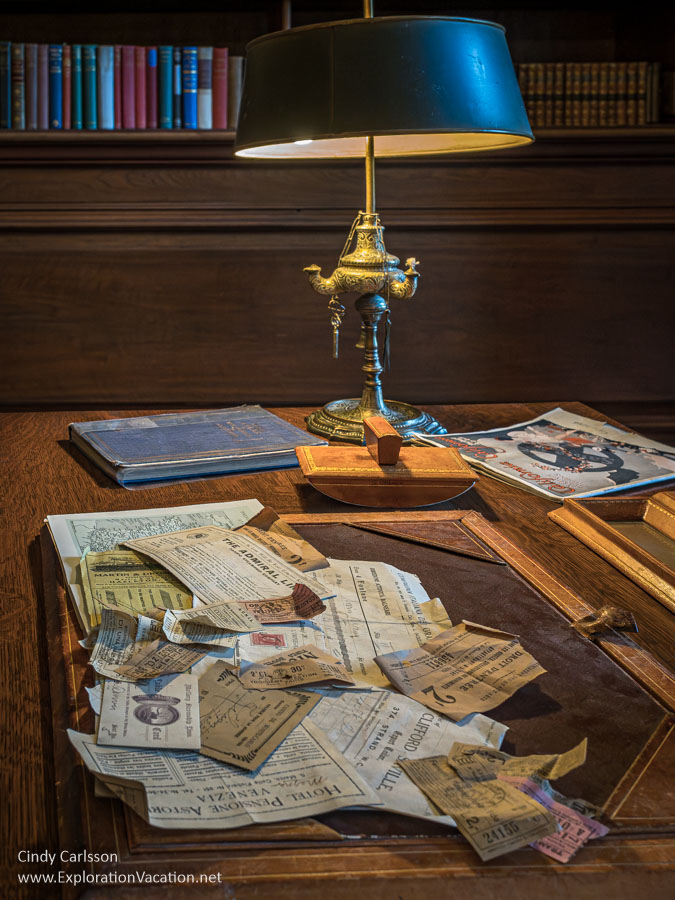
Both families were well-traveled. The Bourns made numerous trips to Europe before William’s stroke.
Unlike most of the house, the library has walnut, rather than oak paneling. That adds to the room’s warm feeling.
Gentlemen’s Lounge
The Gentlemen’s Lounge has changed dramatically over the years I’ve visited Filoli. The Roths displayed Lurline’s equestrian trophies in here, although it seems likely the room was still generally a game room (largely for male guests) during that time.
A few years ago what was for years a rather bland museum-type display area with pale linen wallpaper, was transformed into a Gentleman’s Lounge. It now looks much more like it would have when the Bourns lived here.
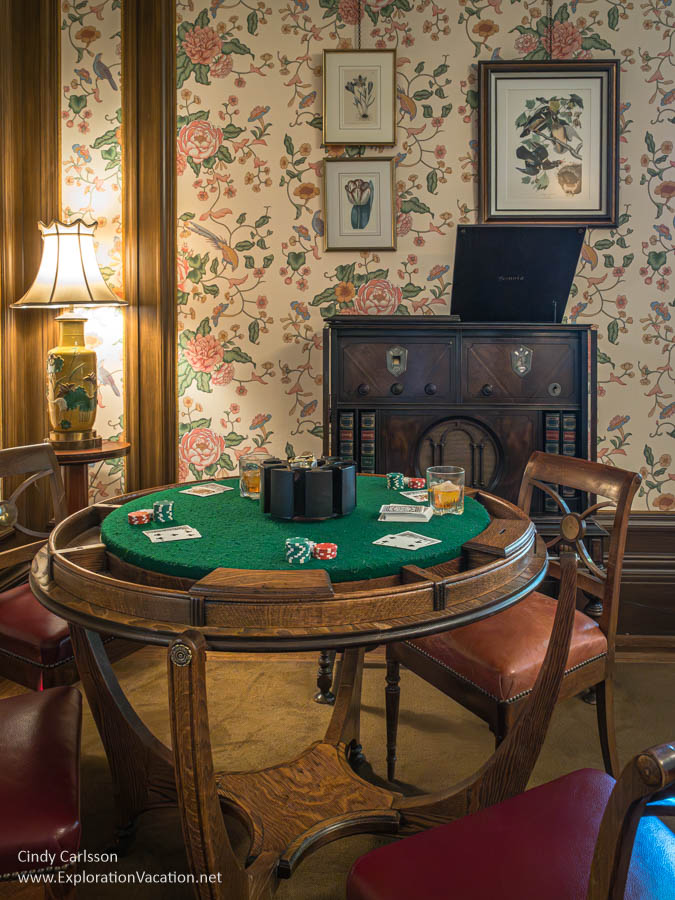
Bourn very likely would have had a poker table in this room. We know from photographs that the room had unexpectedly bold wallpaper with large peonies.
Kitchen and butler’s pantry
One wing of the house was dedicated to staff work spaces and housing. When the Bourns lived here, up to 35 staff lived on the property. Originally, household staff cleaned, cooked, greeted guests, served meals and drinks, procured groceries and other household items, cared for the family’s clothing (probably even assisted with dressing), and maintained the house, garden, equipment, and vehicles.
But expectations changed over time. Even before the Roths moved into the house, a much smaller staff lived and worked on the property.
Despite their importance in the household, very few spaces once occupied by household staff are open for viewing. Of those that are, the most interesting and dramatic is the kitchen.
The kitchen itself is big, bright, and airy. Many features are impressive, but a few are also rather unusual.
Take the stove, for example. While the hood is the same one Bourns installed, the original stove broke in the midst of World War II. With all metal directed to the military, buying a replacement wasn’t an option for the Roths. So they pulled one out of a Matson ship and installed it in Filoli’s kitchen. It still has locking oven doors and controls located above to prevent accidents in rough seas.
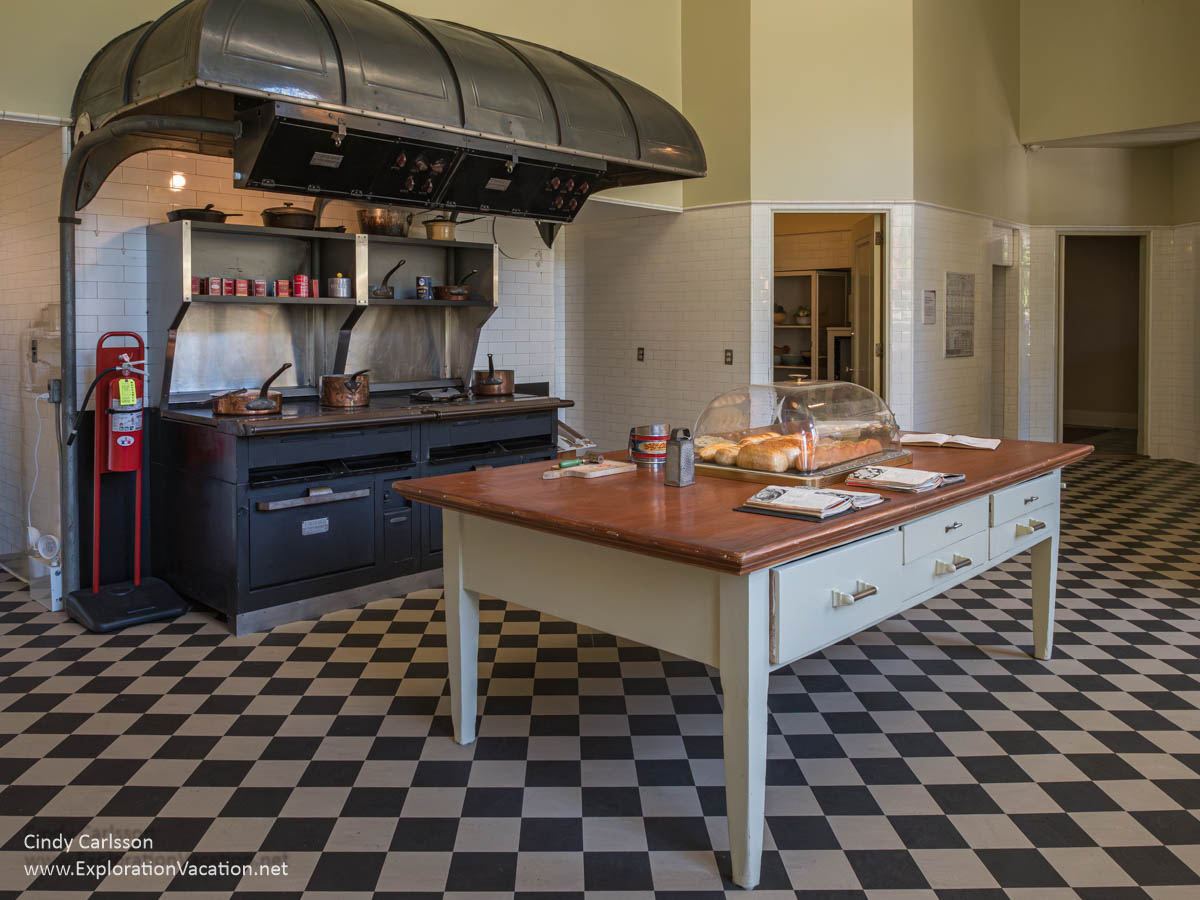
This is not your typical household stove.
The adjoining butler’s pantry has lots more work and storage space. That includes a walk-in vault where the family’s silver was stored in cabinets lined with anti-tarnish cloth.
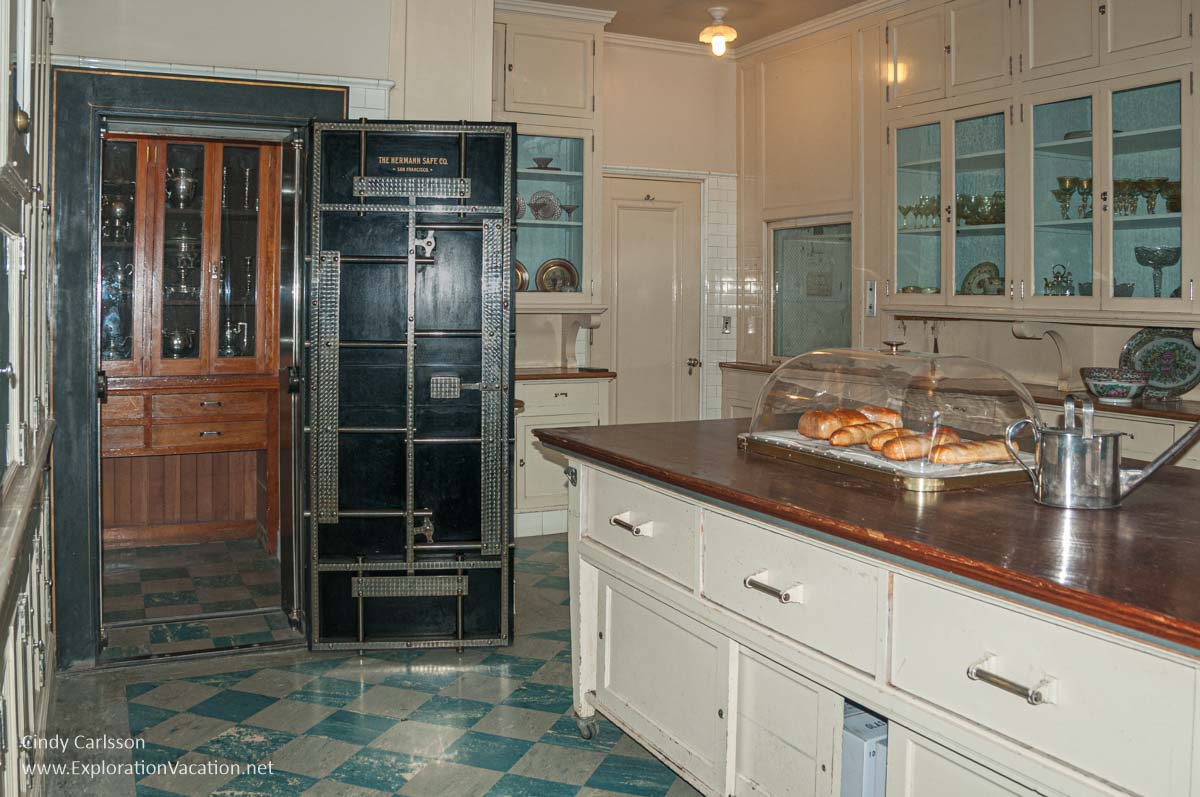
There’s a place for every item and every activity in Filoli’s kitchen, pantries, and work areas.
Filoli’s gardens
While the house is interesting, the property is likely more important for its beautiful gardens. And those gardens are why I keep coming back.
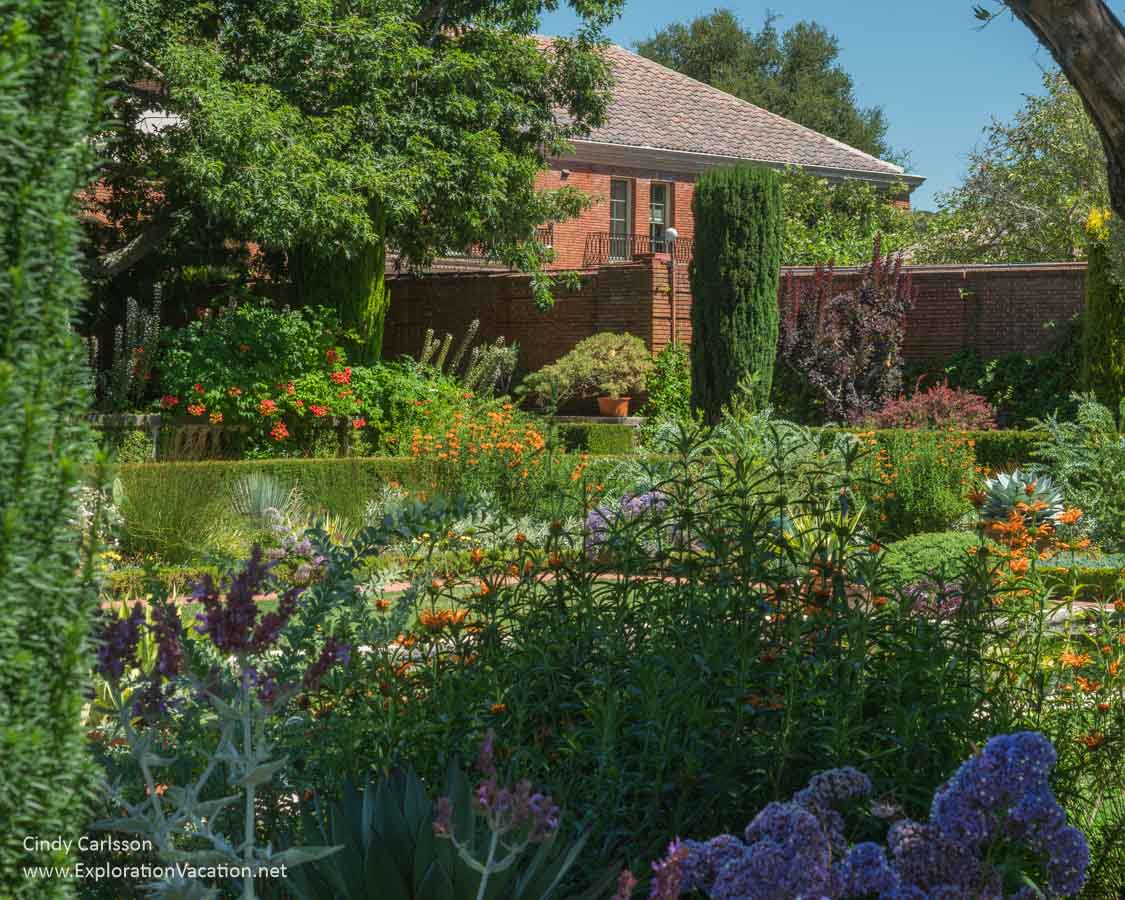
My favorite gardens are the ones overflowing with a wild mix of plants.
Filoli’s English Renaissance-style gardens cover 16 acres. They include a Sunken Garden, a multi-room Walled Garden, Rose Garden, and Knot Garden. But you’ll also find working gardens for growing cut flowers and vegetables, orchards, a woodland garden, and more. Seasonal bulbs and annuals enhance the vast array of woody plants, perennials, and cacti. A few trees date back not only to the Bourn’s original garden, but to the gardens at Muckross House where they were taken as cuttings.
Garden history
The gardens you see today retain the spirit – as well as many plants – of the gardens developed by the Bourns and then modified and expanded by the Roths. Part of that continuity is due to the continuing involvement of both a key designer (Isabella Worn) and head gardener (Louis Mariconi) for decades. Both Worn and Mariconi were part of the team working on the gardens when they were created in 1918. Worn remained involved most of the time until her death in 1950. Mariconi continued overseeing the gardens until his death 1965.
However, many of the gardens were in rough shape by the time the Trust for Historic Preservation started managing them. That was particularly true of the “gentleman’s orchard,” which the Roths did not maintain. And, as the local climate becoming warmer and drier, some plantings just aren’t very suitable anymore. So, like the Roths before them, the Trust has replanted and redesigned the gardens over the years. While a some of the vast vegetable and cutting gardens were turned into formal gardens consistent with the existing formal gardens, the goal was to retain the look of the original gardens.
I think they did a wonderful job.
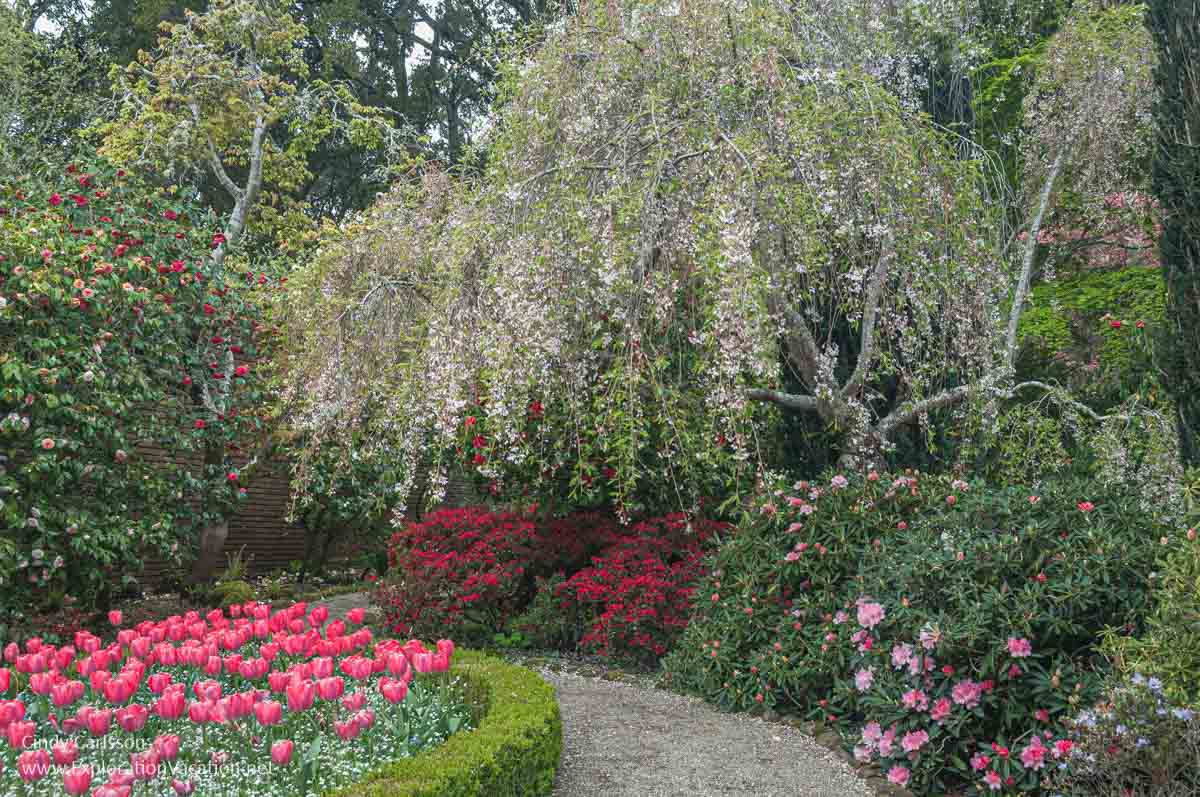
Spring is glorious in Filoli’s gardens!
Change and continuity in the garden
The Bourns wanted a country estate with lush gardens. And, as plant collectors at a time when exotic plants from Asia were first becoming available in California, they likely also wanted to show off their collection.
The task of turning the Bourns’ ideas into reality fell to San Francisco artist and landscape designer Bruce Porter and horticulturist, floral arranger, and garden designer Isabella Worn. While Porter established the layout for the original English interpretation of Italian Renaissance gardens, it was Worn who selected plants and color schemes for each garden.
Worn continued to work with Agnes Bourn arranging flowers for events into the 1920s. However, as the Bourns became less active, Worn’s involvement eventually ended.
That changed when the Roths moved in to Fioli in 1937.
The Roths wanted to renovate and expand the estate’s original gardens. To accomplish this, they convinced Worn to return to Filoli to oversee the gardens on a regular basis. For the next 15 years, Worn designed new gardens, including the pool garden, and chose plants for the gardens. A noted plant collector, Lurline added camellias, rhododendrons, magnolias, and many more roses to the property.
The gardens you see today largely date from this period, although they were renovated once again after being neglected for some years before and after the property was turned over to the National Trust for Historic Preservation.
Traditional European gardens
The original gardens designed by Porter for the Bourns were inspired by European gardens. These include allées, a sunken garden, rose garden, walled garden, cutting gardens, and a daffodil meadow. But, as Bourn fancied himself a “gentleman farmer,” he also planted vegetable gardens and an orchard.
Clippings of yew, holly, and myrtle came to the garden from Muckross. But plant species from across the globe can be found here, along with as California natives. Walls, fences, walkways, and other infrastructure both divide the garden into separate “rooms” and tie it all together.
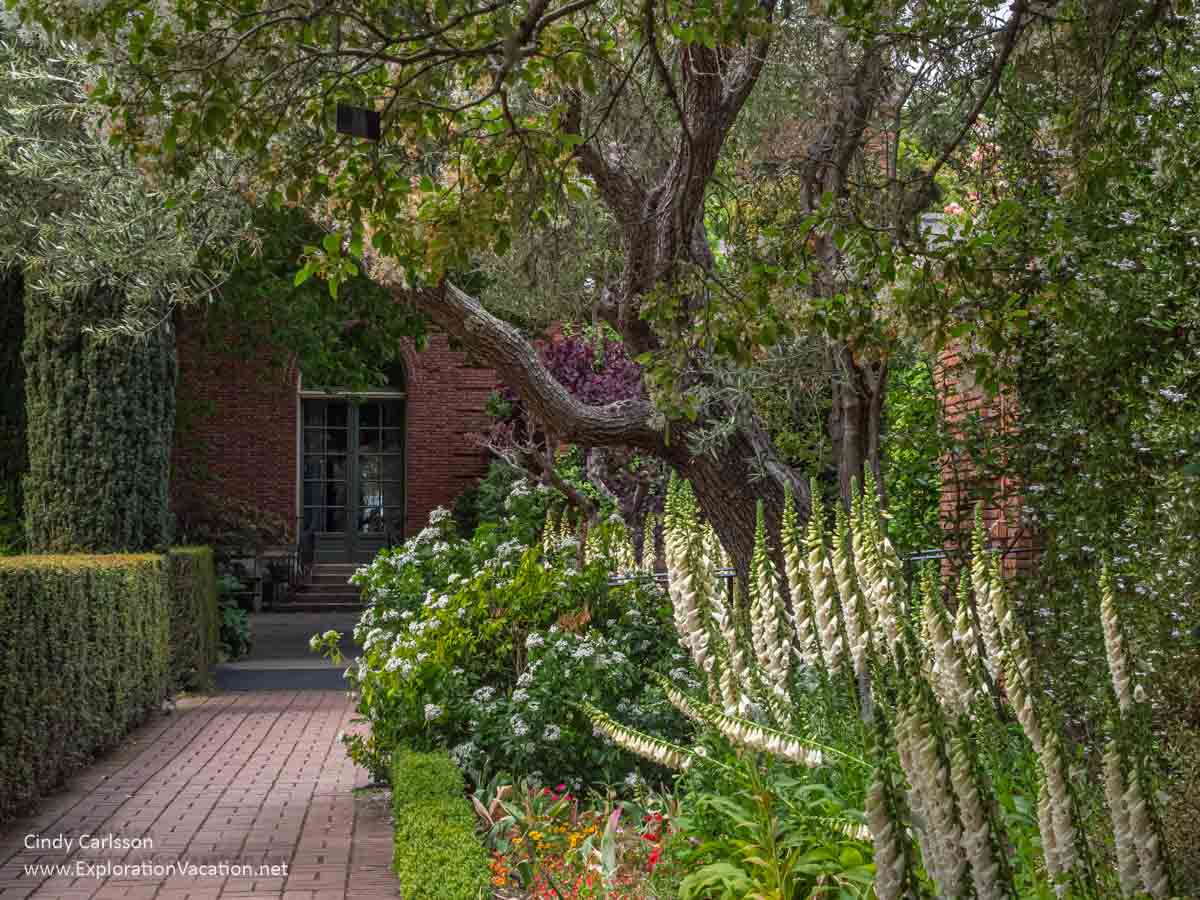
Lush gardens along the house act as distinct outdoor rooms.
The Sunken Garden
The Sunken Garden was designed to be viewed from Agnes Bourn’s second floor bedroom. From her room, she would have looked over the lily pond to the other gardens and the hills beyond.
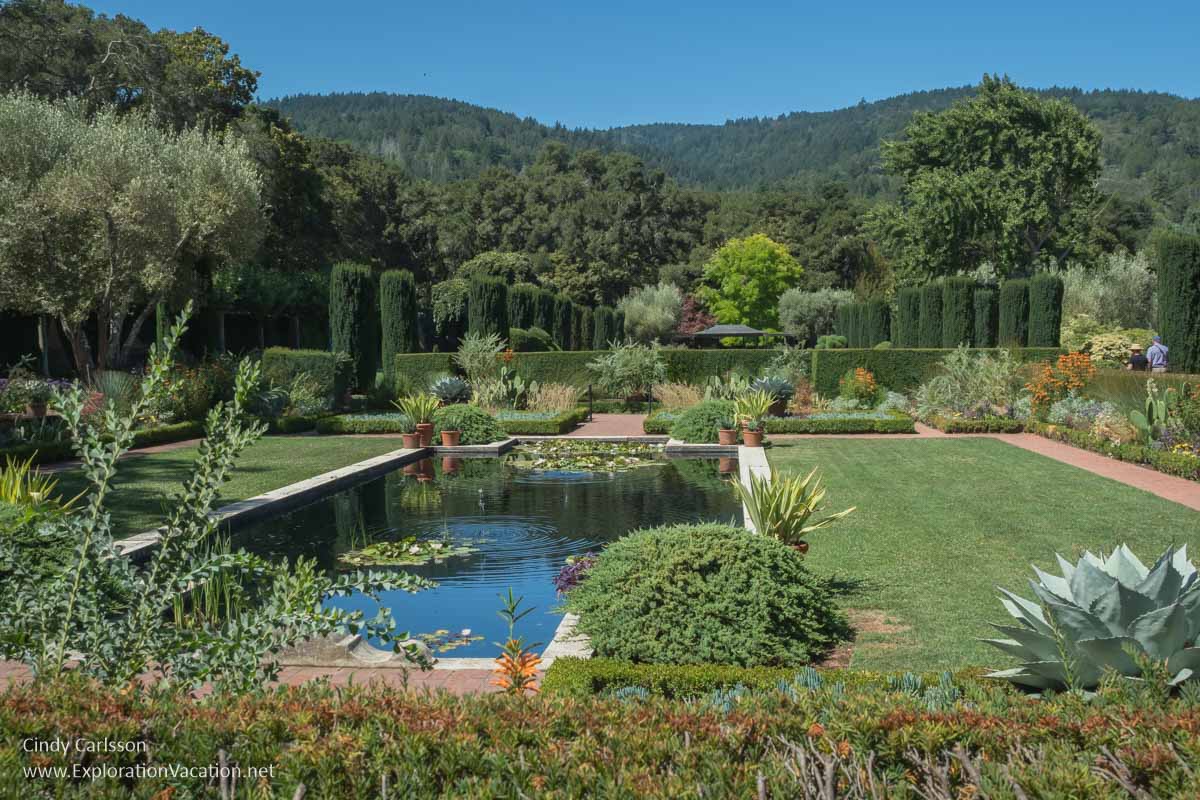
Agnes would have viewed the Sunken Garden from a slightly different angle, but from above she would have had a lovely view of the over most of the formal gardens all the way to the surrounding hills.
While she would have had a wonderful view from her room, visitors have the best view if they walk around the garden.
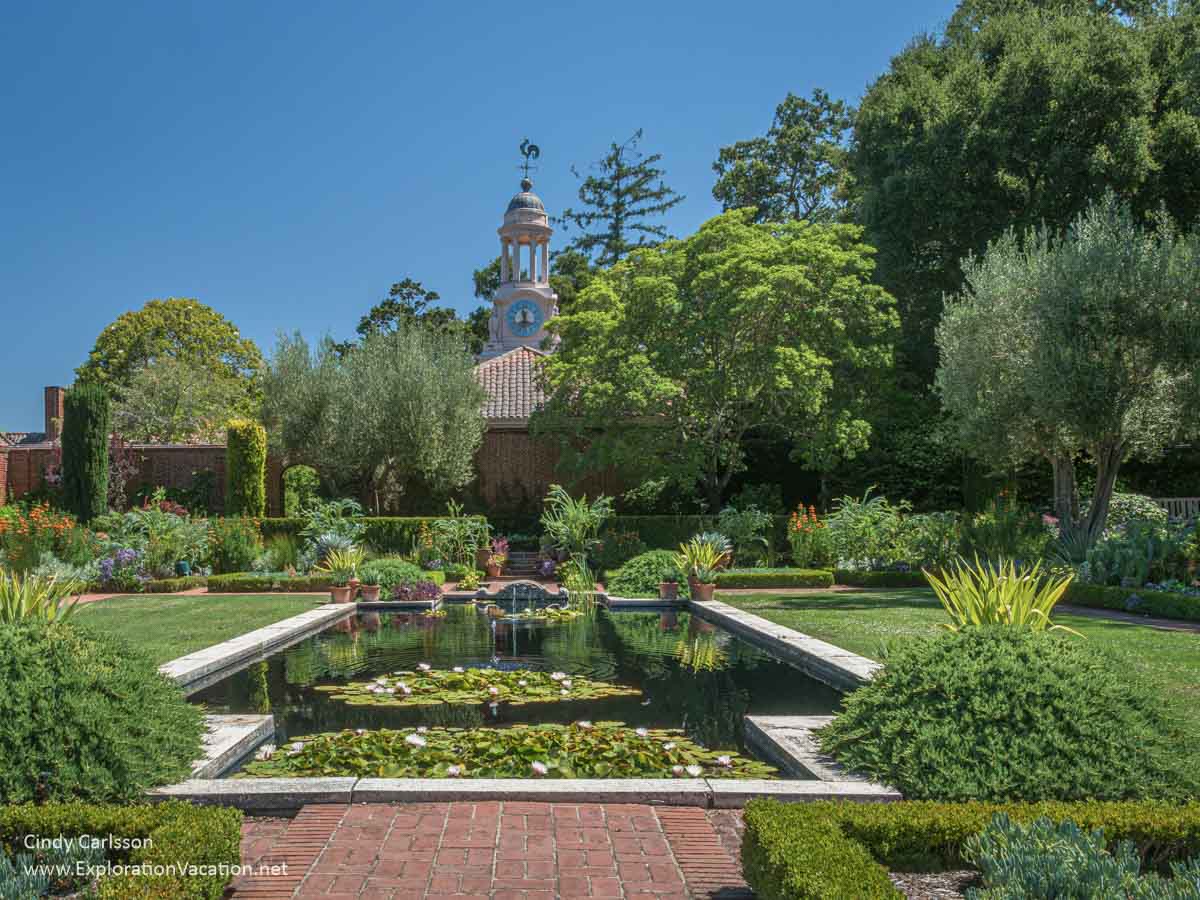
The sunken garden features a reflecting pool and waterlily pool, but the clock tower really makes the scene.
That clock tower is a decorative feature built above the garage. And yes, the garage was constructed at the same time as the rest of the house. William Bourn must have been convinced the automobile was here to stay, as he included an eight car garage and chauffeur’s quarters in his house plans. (Today the space houses the estate’s gift and garden shops.)
Walled Garden
I think the most beautiful gardens on the Filoli estate are within the half-acre Walled Garden. And that is particularly true in spring, when thousands of spring bulbs and a wide variety of flowering trees and shrubs put on an extravagant show.

A mix of spring bulbs and clouds of pink blossoms from flowering trees make the Walled Garden a magical place.
Surrounded by 10 foot brick walls and subdivided into separate garden rooms by clipped hedges, this is the most European-feeling garden at Filoli.
Rose Garden
You’ll find roses in many places within Filoli’s gardens, but there is also a large garden just for roses.
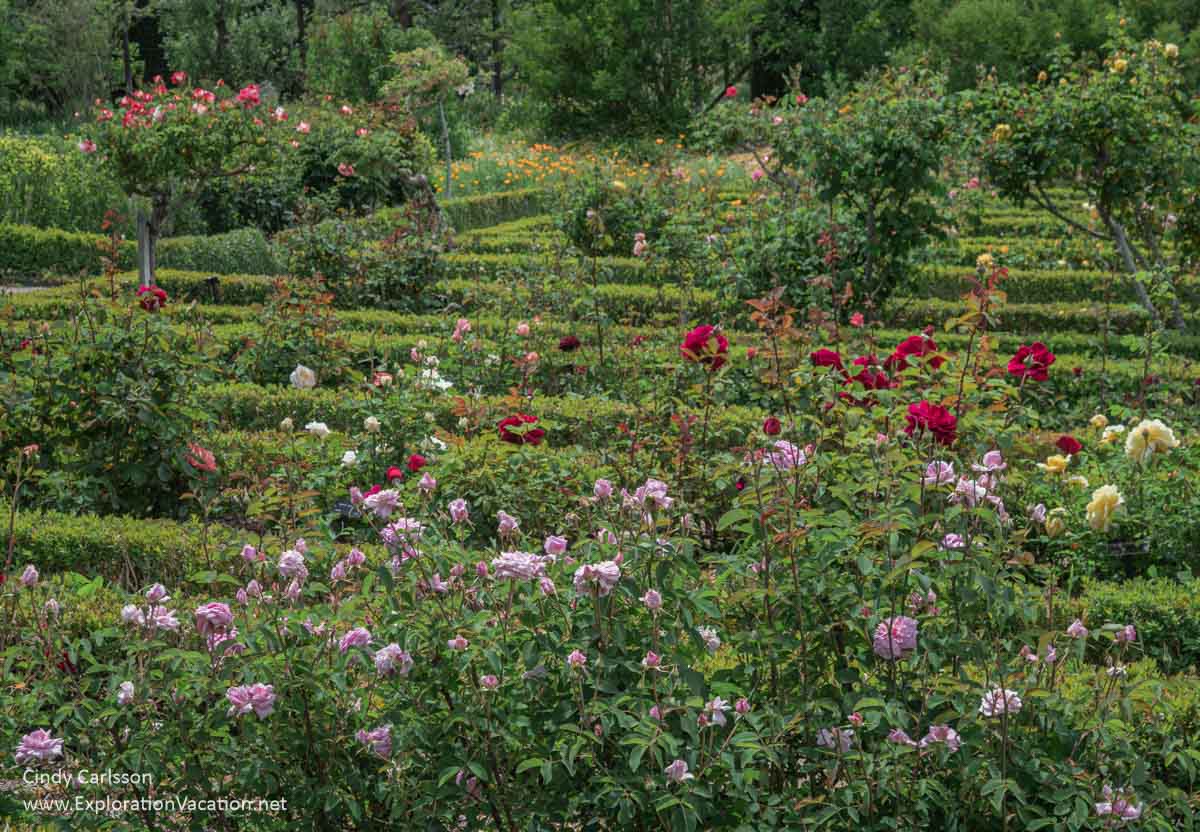
A portion of the Rose Garden in May.
The garden was designed to have over 400 rose bushes in beds separated by low hedges. While roses in other gardens were intended to be enjoyed in the garden, the rose garden was basically a fancy cutting garden. But different types and colors of roses are mixed together, making it a very attractive cutting garden!
Knot Gardens
Although knot gardens (picture a Celtic knot made using different colored plants) became popular in England during the 16th century, Filoli’s knot gardens are relatively late additions.
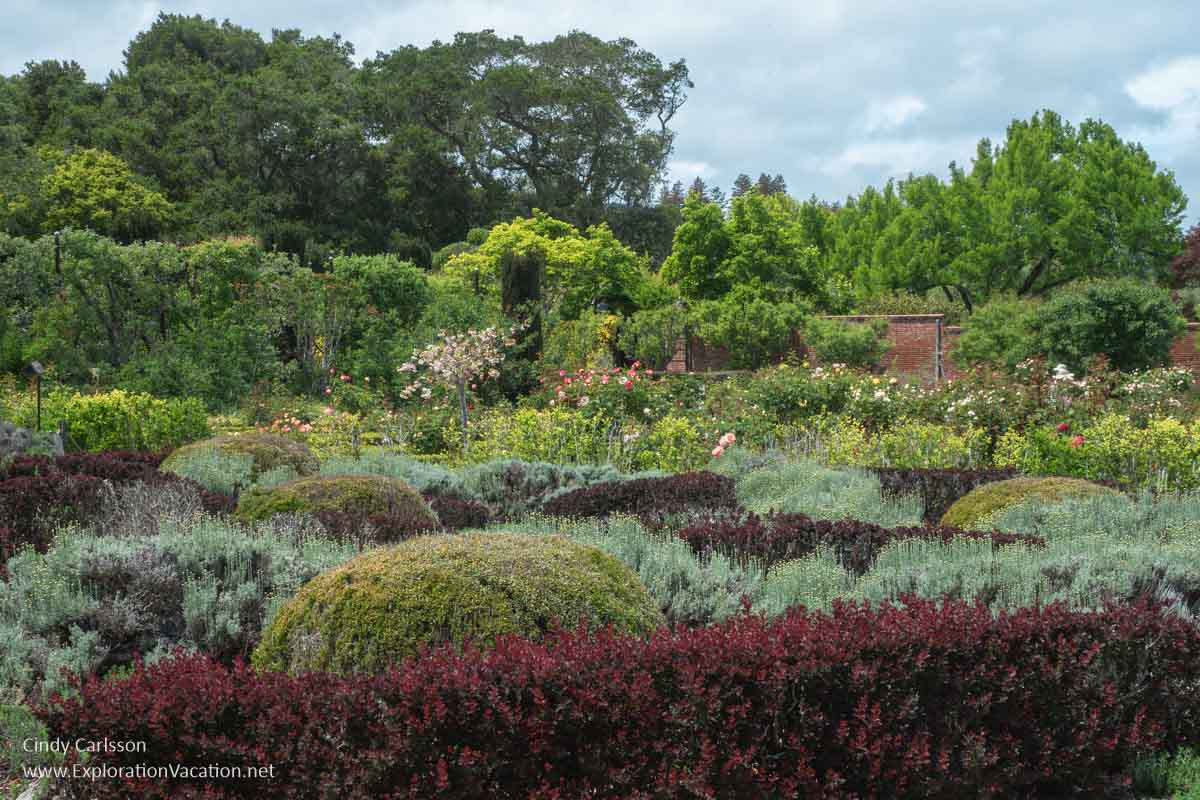
From ground-level it’s hard to see the pattern in a knot garden that uses larger plants like those a Filoli, but they are still lovely. .And they would be stunning viewed from the second floor bedrooms.
Originally this area was one of several large cutting gardens. (Both the Bourns and Roths used a lot of cut flowers inside the house.) However, once the gardens were open to the public, cutting gardens didn’t impress visitors as much as formal gardens. And there was no longer any need for as many cutting gardens. So, two knot gardens were designed and planted to add a little more interest to the gardens.
After 40 years, the knot garden was completely renovated a few years ago. All of the plants were removed and replaced. The new garden still needed to fill in a bit when I visited in 2024, but it should be looking good again now.
The Garden House
The Garden House, which sits between the Sunken Garden and the walled garden, is one of the most picturesque buildings on the site.
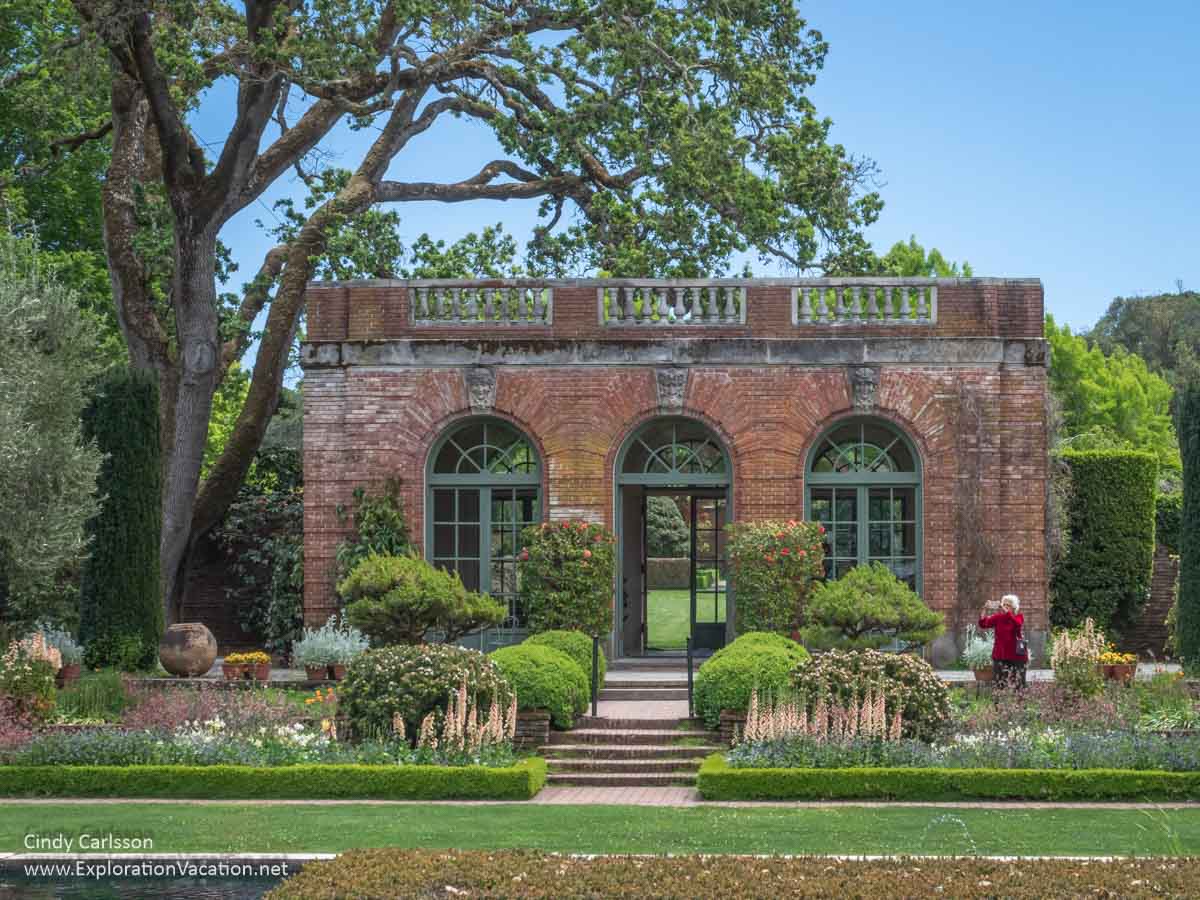
The Garden House is always surrounded by lovely plantings.
Originally constructed for Agnes Bourn as a tea house, the Roths used it for serving cocktails. Today it is still used for both tea parties and cocktail parties, as well as luncheons, meetings, and other events. It houses a variety of indoor plants and is open whenever the garden is — as long as it isn’t being used for a private party, ticketed event, or other special activity.
Woodland Garden and Daffodil Meadow
A few “gardens” at Filoli feel more like flower-filled natural areas than gardens.
Woodland Garden
The woodland garden is largely a transition zone between the formal gardens and the natural areas. But it has lots of camellias. Camellias tend to bloom in mid-winter. That makes this a good spot to wander on a winter day when relatively few things are blooming in the formal gardens. Of course, if you like camellias as much as I I do, make sure to take a look back here anytime between fall and spring to see what’s in bloom.

A camellia in bloom.
Daffodil Meadow
Daffodils are a big deal in the gardens at Filoli. In spring, you’ll find them everywhere.

You’ll find daffodil meadows at Filoli, but daffodils have also always been used in mixed gardens, under trees, and along walkways.
But the largest plantings are in the Daffodil Meadow. Or maybe Daffodil Meadows, since there are a couple of areas today that seem to fit this name! The original daffodil meadow dates back to the garden’s creation. However, today, the largest and most meadow-like area with daffodils didn’t exist before 2009.
Whatever the garden’s name, you will find daffodils everywhere at Filoli from February through spring. And quite a number of those daffodils actually go back to Filoli’s very earliest days.
That’s because the “Great Daffodil Renaissance” was well underway when Filoli was built. This was a time when the type of garden daffodils we know today were being developed in England. And, as something new, beautiful, and exotic, there was quite a demand for these often-expensive bulbs in the USA. After all, they were a beautiful way of showing how wealthy one was! At Filoli, that resulted in vast daffodil plantings in the groves and orchards, along walkways, and in an open meadows.
Over the years more daffodils were added to the mix. Today Filoli grows both historic and new varieties of daffodils both for their beauty and to test varieties for use in other California gardens.
Check Filoli’s website to learn more about about Filoli’s daffodils and daffodils in general.
Vegetable and cutting gardens
While the elaborate Renaissance-style pleasure gardens are the stars of the show for visitors to Filoli, vegetables and flowers from the vast household gardens took on a staring role inside the house.
William Bourn wanted a self-sustaining estate that produced most of the food needed for the couple and their large staff. That made a large vegetable garden a necessity.
Today the half-acre vegetable garden serves as an attractive demonstration garden. Of course, it also produces all sorts of good things to eat at special events, sell in the gift shop, or distribute to local food banks.
It’s fun to wander through the vegetable gardens – especially if you aren’t from a region where things like artichokes are common garden vegetables. But, like both Agnes Bourn and Lurline Roth, most visitors will probably be more interested in lingering in the cutting gardens.
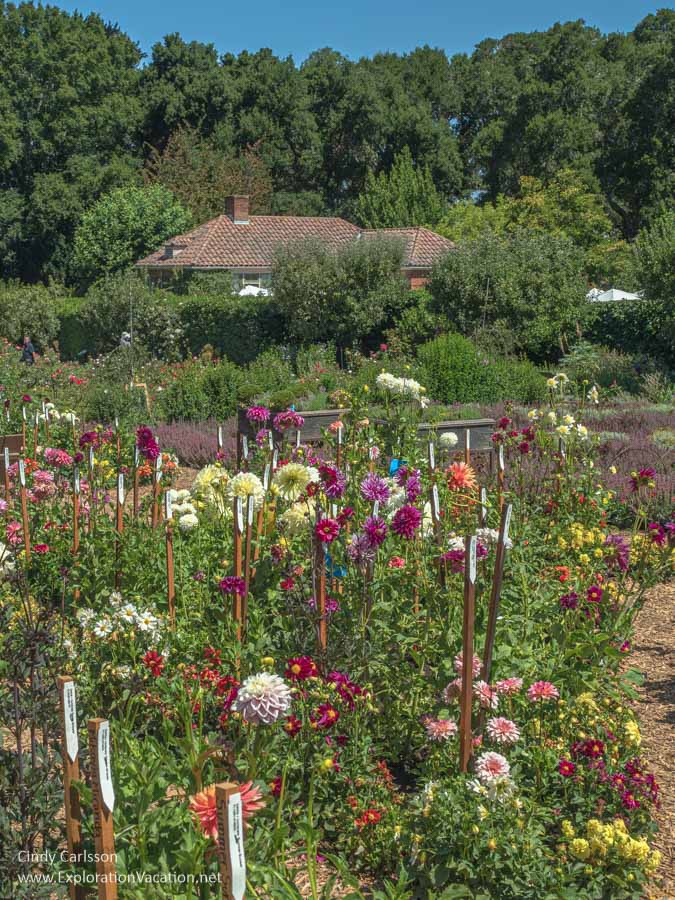
Dahlias in a cutting garden.
Flowers were a very, very big deal in the first half of the 20th century. Fresh flowers have always been appreciated, but they are also a bit of an extravagance. So, filling your home with bouquets of flowers not only surrounded you with beauty, but is also signaled your wealth and sophistication. And all the more so if those bouquets were overflowing with the latest, rarest, and most exotic varieties!
This was one of the reasons Isabella Worn had an ongoing presence at Filoli. Not only was she in demand for her garden design skills, but even more so for her talent at flower arranging. Her innovative arrangements were highly sought-after by the Bay Area elite. So, at Filoli, she not only designed the ornate decorative gardens, but she also chose plants for the cutting gardens. Plants that assured she had the materials she needed to create elaborate floral arrangements for regular use throughout the house, as well as for special occasions.
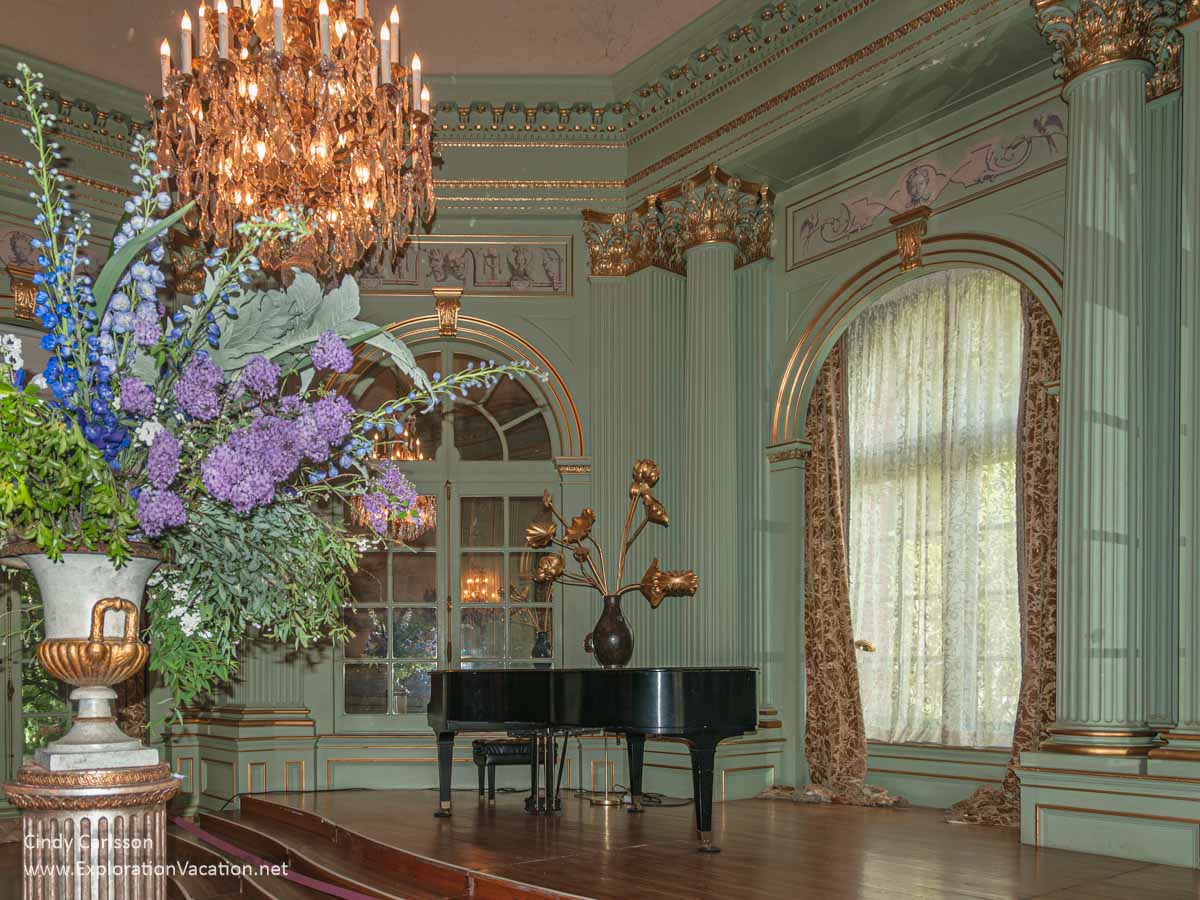
You’ll still find flower arrangements throughout the mansion, but these are small, simple bouquets compared to those favored by the Agnes and Lurline!
Pool Pavilion
The swimming pool, with its pavilion and associated gardens, was added in 1946 for William Roth’s use as he recovered from a stroke.
Of course, the Roth family had always enjoyed various outdoor sports and activities. The grounds already included a Bowling Green for games like croquet and a clay tennis court. Adding a swimming pool doesn’t seem like a big leap. And the Roths had Isabella Worn design the lawns and gardens around their new pool, ensuring it would blend into the rest of the gardens and landscape.
At least when I last visited in 2024, the pool garden was more nice landscaping than what I think of as a garden. But it does blend well into the rest of the property.
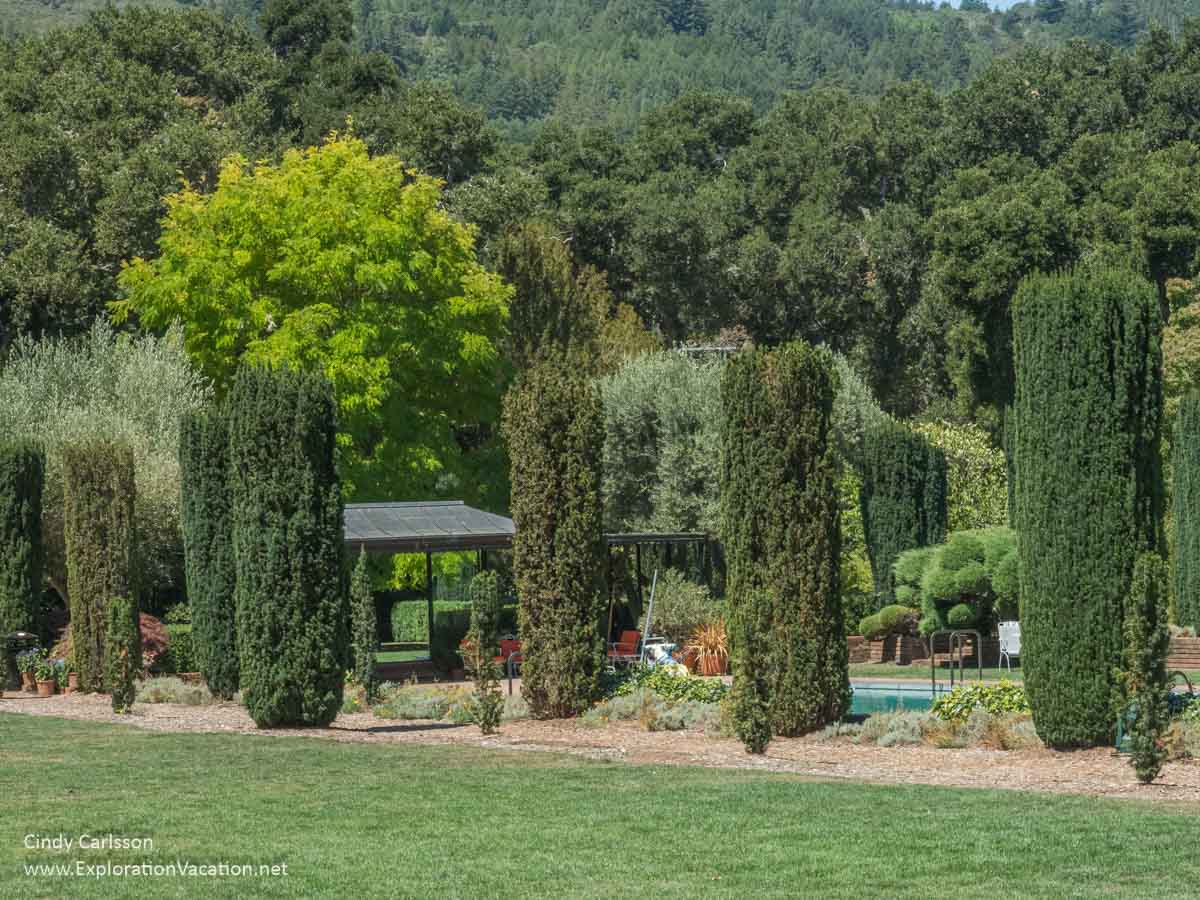
The pool garden includes some of the original yews from elsewhere in the garden.
Howerver, unlike most pools at historic estates, this one is maintained as a working swimming pool. And you can swim in it! Either rent it for a private party or get a ticket for one of Filoli’s regularly scheduled summer pool parties.
The orchards and olive grove
Bourn wanted Filoli to be an American version of self-sustaining European estates like Muckross. And, living in what was at that time a pretty remote area, there were practical reasons for producing much of the household’s food right on site. So, along with the traditional vegetable gardens, the estate had a large orchard and olive grove.
Filoli’s orchards
Bourn’s view of himself as a gentleman farmer required that he grow fresh fruit for the household. To do so, he planted 1,000 fruit trees of many types.
The Roths, came along later when the site was less isolated. And they were in the business of shipping goods across the Pacific, so likely were far less concerned about raising their own food. While no doubt appreciating the orchard’s fresh fruit, they did little to maintain any of the orchards.
And, when they first acquired the property, the National Trust didn’t do much to maintain it either. (The Trust likely had many, many more pressing needs to attend to.)
The Trust began restoring the orchard in the 1990s, caring for about 115 trees that remained from Bourn’s original plantings and then adding more. But not just any fruit trees go into this orchard. It’s home to historic fruit varieties that may have been common in the past, but are rare today.
Visitors are generally aren’t allowed in the large Gentlemen’s Orchard and don’t get to taste fruit from any of the fruit trees except at special harvest events or in the form of fruit butters, jams, or other treats from the gift shop. And a lot of fruit is donated to local food banks.
The Olive Grove
The Bourns planted about 175 mission olive trees. It’s a little unclear why the olives were planted – and maybe they were intended to serve multiple purposes. They may have both provided olives for the household and been an attempt to make some money, as canned olives were big business in California at the time. However, maintaining the olive trees proved to be a lot of work and they became more of a decorative feature over time.
The Roths seem to have ignored the trees, letting them grow far too large for the space available. That led to a couple of attempts to prune them back to a manageable size. The most recent attempt was obvious when I visited in 2024. The trees don’t look very attractive after drastic pruning, but they are quickly becoming beautiful (smaller, but still beautiful) once again.
Other areas to explore at Filoli
The house and gardens are absolutely the highlights of Filoli. But there are a few other things to see if you have time. Most of these are well separated from the house and main gardens and accessed via short hiking trails.
Filoli’s natural lands
Filoli’s site was chosen in part because it reminded the Bourns of the landscape around Muckross in Ireland. (And Bourn was president of the water company that controlled the nearby Spring Valley Reservoir, which provided both a scenic view from the estate and a plentiful supply of water for the household and gardens. The scenic view is now hidden by trees.) But the landscape around Filoli was far from “natural” even when the Bourn’s began building and grazing sheep here.
Long before the arrival of Spanish soldiers and missionaries in the area, the Lamchin tribe of the Ramaytush Ohlone not only lived in the area, but had a village on this land. After Mexican independence in 1821, land in the area was turned over to political allies. What is now Filoli was part of one of these very large “ranchos.” The rancho cut and sold lumber, raised cattle, and grew crops. After becoming part of the USA, more intensive logging occurred on the property as San Francisco boomed during the Gold Rush. The remains of several of these historic sawmills are thought to be located on Filoli property.
Today Filoli’s “natural” lands include several ecosystems: Oak-madrone forests, redwood circles (areas where new trees sprouted around the stumps of trees cut by long-ago loggers), and chaparral scrub land that was grazed by sheep or other livestock. The property also includes springs and creeks. The landscape is recovering from more than 100 years of abuse, but few areas remain in a truly natural state.
Exploring the landscape
Two short nature trails run through a bit of these areas. Plans also exist to create at least one longer trail. However, I don’t think that has happened yet.
I haven’t walked the full length of either trail. However, the most interesting-looking takes advantage of the fact that Filoli’s property sits on the San Andreas Fault. Cross over the aptly named Fault Creek Bridge on the California Trail and you are crossing between the North American and Pacific plates.
Rose Wonders
Filoli is also on the Thomas Dambo train. You can now find the 27 foot tall wood sculpture Rose Wonders in the Redwood forest. (She arrived after my last visit, so I don’t have a photo of her.) It seems like Dambo’s charming reclaimed wood giants are taking over the world, but if this trend is new to you, check out his website to see what you’ve been missing. Then plan a short hike to check out Rose.
Lamchin Interpretive Center, Red’s Barn, and other outbuildings
A handful of outbuildings are open as exhibit areas. These include the Lamchin Interpretive Center (formerly the nature center) and a building (a former stable?) with a new/old tack room exhibit. There’s also something called “Red’s Barn,” which may have been a house moved to the property or built as a stable for Lurline Roth’s prize stallion. Or maybe some combination of the two. (Stories vary.) I have not visited all of these – or, at least, I haven’t visited any recently enough for what I remember to be relevant! And information on the most of the outbuildings is either non-existent or contradictory.
All require a short hike. And these don’t show up on all maps.
Lamchin Interpretive Center
Apparently, this building was used as a foaling barn by the Roths. I remember it as Filoli’s nature center. However, as of June 2024, it is the Lamchin Interpretive Center, a project undertaken with the guidance of local Ramaytush Ohlone leaders.
The Interpretive Center seems to have two parts:
- Life in this place before the arrival of the Spanish and the impacts of colonization.
- Current work by the Ramaytush Ohlone to care for the environment and the people of their homeland.
Libraries (closed)
Filoli USED to have two libraries related to the families and estate, local history, botanical art, architecture, gardening, and more.
- The Friends Library Collection had books, videos, oral histories, lectures, copies of movies filmed on the property, etc. These were available to Filoli members as a lending library.
- The Sterling Library was a research collection of books and journals. It was only open to Filoli members and researchers and all materials had to be used in the reading room.
Neither appear to be open to anyone anymore and references to online-only access have disappeared from the website.
Plan your visit to historic Filoli House and Garden
Filoli probably isn’t near wherever you are, and it isn’t near a lot of other attractions Nor is it cheap to visit. This means you really need to do at least a little advance planning.
Unfortunately, Filoli’s website seems to provide less information every time I look at it, with many links simply leading back to the same few pages. I’ll try to guide you through some of the basic info you need, but begin your planning knowing some really basic info may be hidden in unexpected places or missing entirely from Filoli’s website.
Maps of Filoli’s grounds can be found on the website. Special maps are posted when there are seasonal events and special exhibits.
Filoli also has an app. I haven’t used it in the garden, but it does have information on some rooms in the house and a few gardens, as well as a link to what’s happening at Filoli. And, of course, you can buy your tickets on the app. It also has a GPS function that can guide you through the garden.
And Filoli produces a Morning in the Garden podcast. It sometimes includes stories related to what is happening in the garden at that particular time. But it also has stories about the house and its history and even occasional visit other gardens. It’s more inspiration than planning tool, but it’s a pleasant and interesting listen. Unfortunately, fewer and fewer epsisodes seem to be getting released. . .
When is the best time to visit Filoli?
While the house is open and pretty much the same throughout the year, the gardens change considerably with the seasons. And both the house and the garden get gussied up for holidays.
Filoli is in a part of California where there’s something blooming pretty much year-round. And you don’t have to worry about extreme winter weather. (Fog, but no snowstorms.) That means there is something to see in the gardens whenever you arrive. Personally, I think the gardens are at their best in spring, but if you love roses, you’ll want to visit a little later. December and January have the fewest flowers in bloom, but you’ll find festive decorations and lots of camellias blooming. Fall has colorful leaves. So, really, the garden is worth visiting in any season!
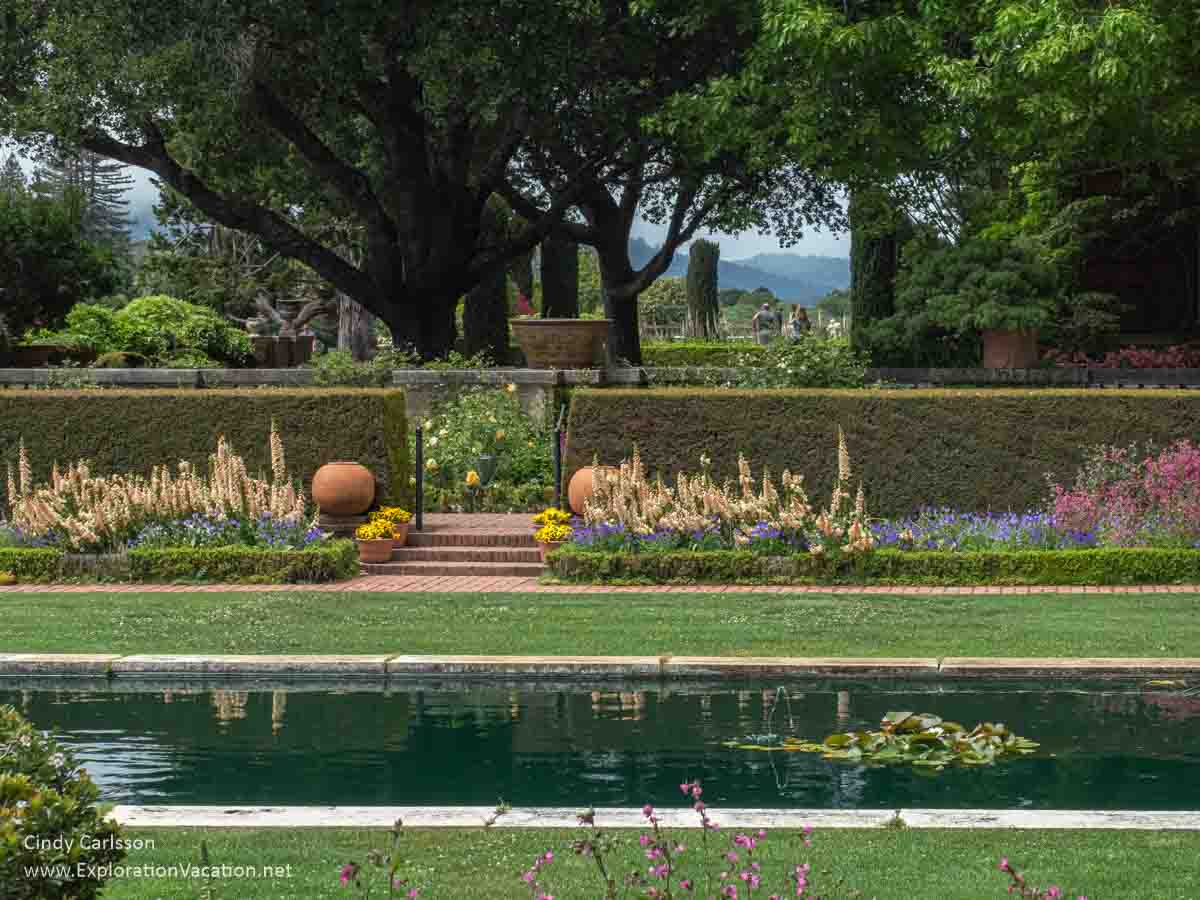
Every season offers something beautiful.
Filoli has a “What’s Blooming” page. There’s no date on the web version, but the app version gives you the month. Skip the “Visit the Garden” link on the web page, as it just goes back to one of the general “visit” pages. (It doesn’t even link directly to the “garden” page!) But check the Bloom Calendar below that link. The handy graphic gives you a pretty good idea of what might be in bloom when.
Sadly, the “What’s On” tab does NOT link to a page that briefly covers all seasonal activities, tours, events, themes, etc. You have to open a tab for each one separately.
Make a reservation before you go
Reserve your tickets in advance. At least make a reservation before getting in your car. Filoli only has so much parking and can only comfortably handle so many visitors. That means there are times when you will not get in without a pre-booked reservation. And that’s true for everyone, including members.
Advance tickets have a one-hour entry window, although it’s not clear how strictly that’s enforced.
Reserved tickets can be changed, but only in advance of your scheduled visit and with a $10 fee.
Ticket prices
Because I have a friend with a membership at Filoli, I have never had to book or pay for a ticket to visit. So, it was a bit of a surprise to discover that the precise cost of a general admission ticket isn’t available without going into the booking page. (I figured out that’s because the price for general admission tickets varies depending on when you want to visit and, maybe, when you book.) Just start with the ticket site and see what options and prices are available when you want to visit. You can search a couple of months out, so, if your dates are flexible, take a look at all of them to see what the price is for various dates and times.
General admission tickets for adults in 2025 normally ranged between $40-$45. However, some holiday tickets cost as much as $55. And that’s just to get into the mansion and grounds. You’ll pay more (often much more) if you want to take a tour or participate in an activity. And children’s ticket prices aren’t much cheaper unless they are under 5, when they are free.
Filoli members get a much better deal, with a Filoli membership paying for itself after as few as three visits – or even fewer for seniors or students who make full use of their memberships. Members can visit the house and grounds for free, with a discount for tours, special events, and other activities. Members also get free membership in the National Trust for Historic Preservation.
Although there is nothing about it on Filoli’s website, it appears that members of the National Trust for Historic Preservation are eligible for some sort of a discount at Filoli. But it may just be for guided tours, which tend to be pretty pricey even with a discount.
General admission tickets are also discounted for CalFresh SNAP cardholders and for reservations made through local library museum pass programs.
Filoli does NOT participate in the American Horticultural Society’s Reciprocal Garden Admissions Program.
Getting to Filoli
Filoli is located 30-some miles south of San Francisco between the Santa Cruz Mountains and the sea. It’s in the city of Woodside, which is on the mountain and Pacific Ocean side of chain of cities that stretch from San Mateo south to Palo Alto. It’s just off I-280.
Despite the traffic, the easiest way to get there is to drive. And parking is included in your ticket.
You can take the bus to Redwood City or the train to Belmont. The distance from either station to Filoli is less than 8 miles, but there doesn’t seem to be any public transport that would get you within walking distance.
Things to do at Filoli besides touring the house and grounds
Whether you explore on your own or take a guided tour, there are a few more things you might want to do during your visit.
Get a bite to eat
Filoli’s Quail Cafe is open throughout the day, every day. I haven’t eaten a meal there, so can’t tell you if it is any good, but it has a nice patio. It’s casual and you cannot make a reservation.
Depending on the time of year, a few kiosks and cute trailers around the grounds offer beverages and snacks. The Trailhead Store also offers hiking snacks and beverages. These usually aren’t open for the entire day, so check the hours when you plan to visit. There are also areas where they will set up a bar and serve appetizers during special events.
Various formal tea services are available throughout the year by reservation only. These are elaborate affairs with hefty price tags. The Holiday Tea is held in the Garden House.
There’s now a lovely casual patio over by the vegetable garden. They weren’t set up to serve food there when I visited, but it was a pleasant place to sit and enjoy a beverage from the cafe.
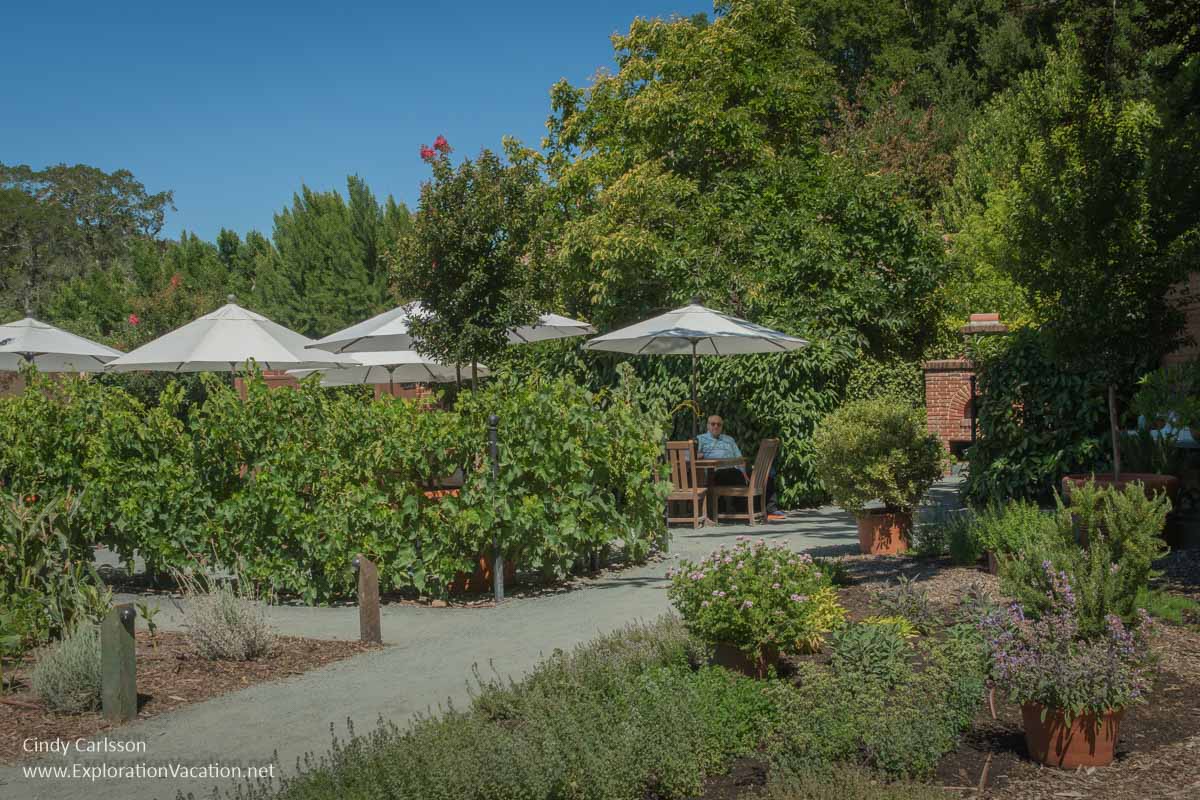
The best spot in any vegetable garden is a shady patio!
Shop
The service area under the clock tower is home to Filoli’s gift shop. If you are looking for plants, you’ll find a wide selection in the courtyard outside the shop and Staghorn Potting Shed.
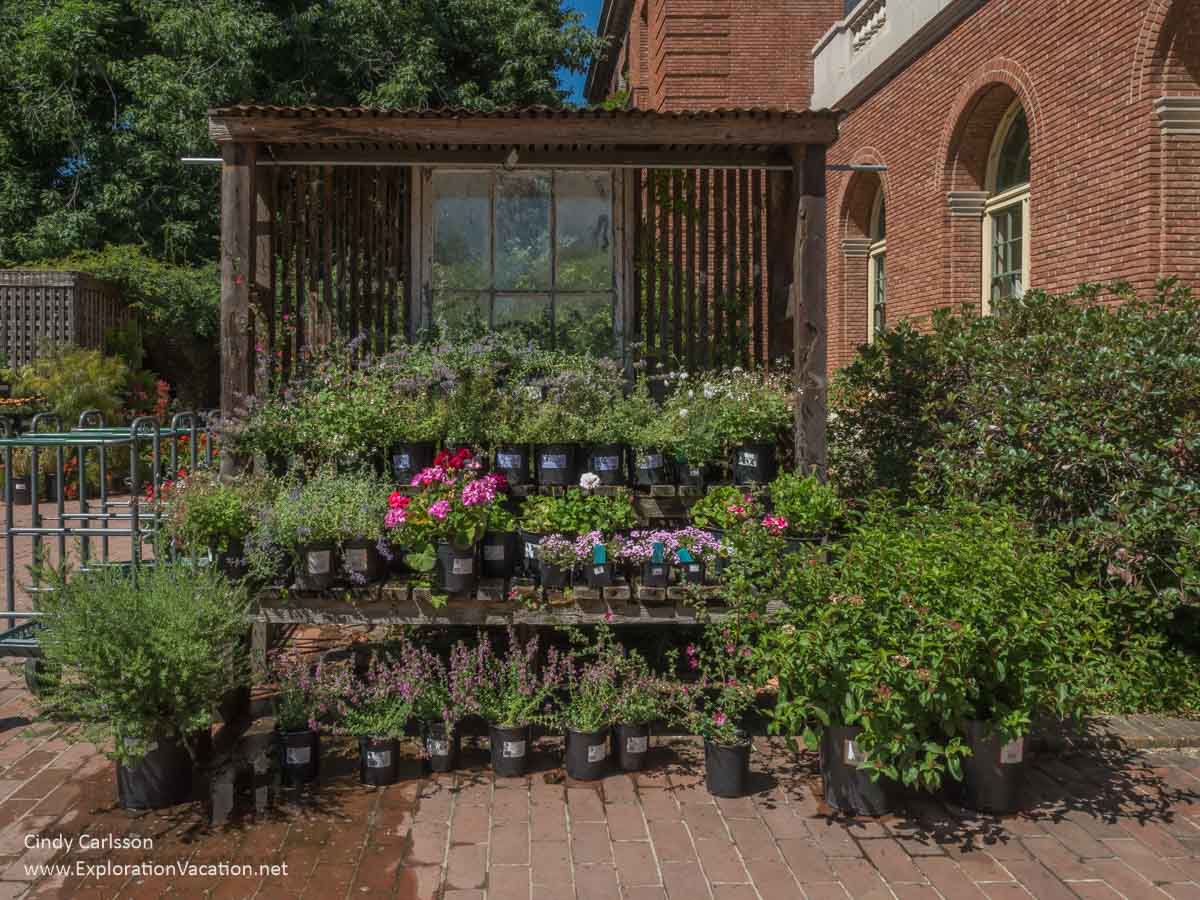
You’ll be forgiven for not immediately realizing that the plants in courtyard between the house and service area are not a garden display, but are actually available for purchase.
The Trailhead Store out in the redwoods has a few souvenirs and hiking supplies.
Enjoy a special event
Filoli runs special events throughout the year, including galas, light shows, concerts, and more. Check the website for what’s happening and when.
While you’re in the area
While Filoli isn’t exactly surrounded by tourist attractions, you are very near several mountain nature preserves, Burleigh H. Murray Ranch State Park, and not far from a string of beaches and the little beach town of Half Moon Bay.

You’ll find a nice mix of beaches, hiking, art, and good food along the Pacific Coast around Half Moon Bay.
Lodging
Of course, there are thousands of places to stay throughout the San Francisco Bay Area, including in the cities between San Francisco and San Jose.
However, if you want a change from the city, consider spending a couple of nights in Half Moon Bay. Take a look at what’s available on Booking.com or Expedia.
Learn more about Filoli and its people
You can learn a little more about Filoli through its trees. It’s a fun way to learn a bit about the estate.
Bourn owned a major stake in a company that provided water to San Francisco. Water has always been, and remains, a concern in this part of California.Filoli’s water use was extravagant for the time. Today water use at the estate is being reconsidered.
The Daily Journal has a nice biography of William Bowers Bourn II, particularly focused on some of the challenges he faced and his business acumen.
Isabella Worn had an exceptional a talent for blending textures and colors into beautiful floral arrangements and gardens. But she was also a strong-willed business woman who worked for California’s elite at a time when that was rare. Read more about her work at Filoli, Hearst Castle, and more in Pacific Horticulture’s Driving Miss Worn, and More and Eden’s The Indomitable Isabella Worn (pdf)
Other sites related to the Bourn family
Muckross House in County Kerry, Ireland
Now part of Killarney National Park, Muckross House dates back to 1843. The extensive gardens were constructed a decade later, at the same time renovations were completed inside the house in preparation for an 1861 visit by Queen Victoria. The gardens were later renovated by Maude and Arthur Vincent. You can read more about the Bourn Vincent family’s time in the house on the Muckross House website.
Muckross House and gardens are open to the public.
Empire Mine State Park
William’s father built the family fortune with the Empire gold mine. After the death of his father, William turned what had been a failing gold mine into a source of tremendous wealth once again. While William sold his interest in the mine in 1929, by the time it closed for good in 1956 it was one of the richest and longest-operating gold mines in the state.
Today it is on the National Register of Historic Places (PDF) and part of Empire Mine State Historic Park. It’s located about halfway between Scramento and Reno.
Bourn house in San Francisco
William and Agnes Bourn’s original house was designed by Willis Polk and built in 1896. (Before Polk designed Filoli.) It’s a blocky English-style brick townhouse in the Pacific Heights neighborhood. The house has 28 rooms and 14 fireplaces, so it’s big, but much smaller than Filoli. It’s been through a lot over the years (it was an infamous party house in the 1970s). Which means it was in terrible shape when last offered for sale. You can walk by and take a look at the exterior, but it’s not open to the public. (You can see the origianl front door at Filoli, when entering the gardens from the nursery shop area.)
Filoli sits on the unceded ancestral homeland of the Lamchin, an independent tribe of the Ramaytush Ohlone peoples, the original inhabitants and stewards of the San Francisco Peninsula.
Want to see more photos of Filoli? Search Filoli House and Gardens on CindyCarlsson.com.