


Last updated on June 15th, 2026
With two distinct Sonoran Desert landscapes, Saguaro National Park outside Tucson, Arizona, is the perfect place for a road trip to see giant saguaros and more.

Saguaro National Park is two parks in one.
I use links to improve your experience using this website. Some may be affiliate links that pay me a small commission if you use them to book a room, rent a car, or purchase goods or services. You don’t pay extra, but it helps keep this website running. To learn more, see my policies and disclosures.
Saguaro is really two parks
Saguaro National Park consists to two “districts,” one to the east of Tucson and one to the west.
Although separated by only 30 miles, these districts are different both geologically and biologically. What they have in common are vast stands of saguaros.
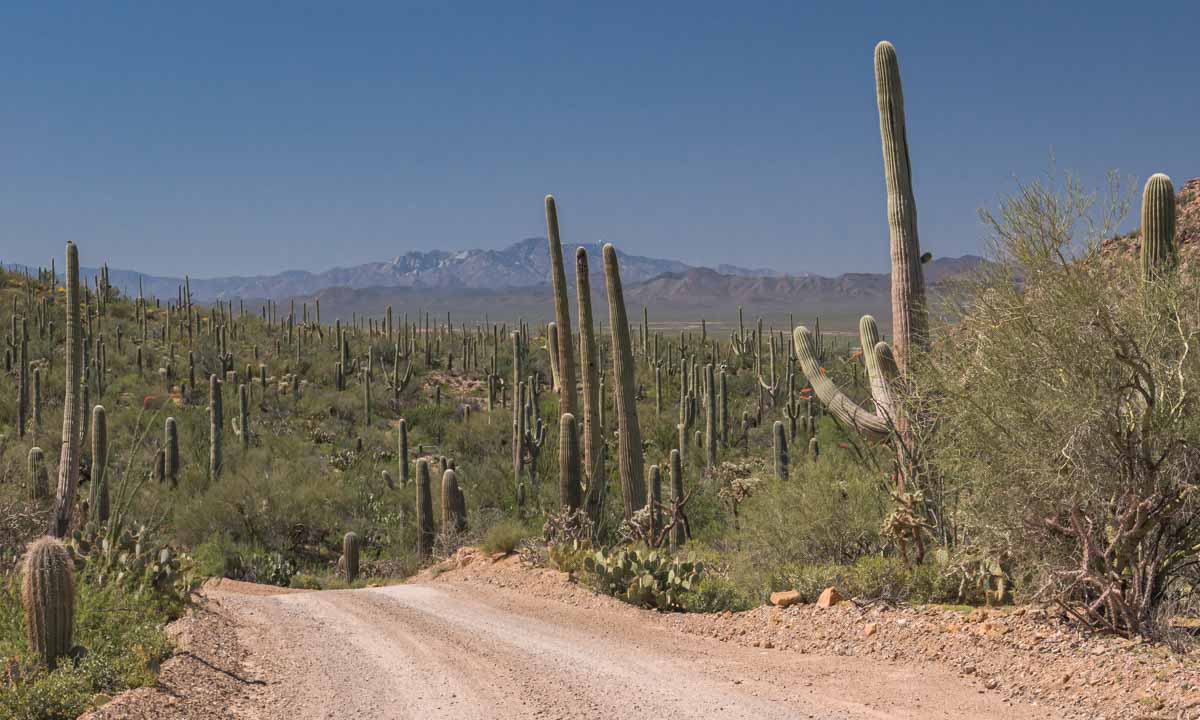
By visiting both districts, visitors can experience different aspects of the saguaros’ Sonoran Desert home.
East of Tucson, the Rincon Mountain District became a National Monument in 1933 to protect a dense stand of mature saguaros. This is the highest and wettest part of Saguaro park. That means it not only has spectacular scenery, but also huge amount of biodiversity. Horseback riders and backcountry hikers can travel from saguaro forests to forests of Douglas fir and ponderosa pine as they move up into the mountains from the desert floor.
The western Tucson Mountain District is the smaller of the two park districts. It protects a part of the Sonoran Desert that is much lower in elevation and, thus, hotter, drier, and less diverse. But it has a very large, dense forest of younger saguaros.
Both districts have a scenic driving loop, visitor center, picnic areas, and variety of interpretive and hiking trails. The eastern Rincon district also has wilderness backpacking trails.
Park history
Long, long before Saguaro National Park was established, the area was the site of Hohokam villages. The Spanish came along much later, founding Mission San Xavier to the south in 1692. But the area that is now Saguaro National Park remained relatively undeveloped until homesteaders, ranchers, and miners began arriving late in the 19th century. Mining continued inside the park until the 1940s and a few ranches remained until the 1970s.
Bits of this all this history can be seen today, in the form of petroglyphs and other archaeological sites, abandoned mines, and historic buildings.
Saguaro National Monument
Like many national parks in the United States, Saguaro began as a national monument.
The driving force behind its creation was the Natural History Society of the University of Arizona. These university scientists believed it was important that a “forest” of the iconic cacti that symbolized the west be protected for future research and study.
👉 Learn more about the establishment of Saguarl National Park . . .
They tried to raise funds to buy and protect the land themselves in the 1920s. The university purchased some land, but creating a park was too big a project for the scientists alone. And their dreams didn’t really interest either the US Forest Service or the National Park Service.
The project looked doomed until a well-connected local newspaper publisher and civic booster saw the potential tourism value of the iconic saguaros. He took the cause directly to President Herbert Hoover.
Hoover created Saguaro National Monument in 1933.
Not that the area’s new status solved all the park’s problems. The park area was a mix of federal, state, and private land with differing goals with varying degrees of ability and interest in actually protecting the cacti. “Cactus rustlers” stole large healthy saguaro while many young cacti were trampled by grazing cattle. Not surprisingly, the health of the vast saguaro forest deteriorated.
Nonetheless, between 1936 and 1939 the Civilian Conservation Corps (CCC) built the Cactus Forest Loop Drive and other infrastructure to bring visitors into the park. A visitor center came later, in the 1950s.
Tucson Mountain Park
At about the same time the plant scientists were trying to figure out how to protect the saguaro forest along the Rincon Mountains, hunters and outdoor recreation enthusiasts were looking to protect some wilderness on the other side of Tucson. In 1929 the county succeeded in getting the federal government to prohibit the establishment of mines or homesteads on a track of land east of the city, and the Tucson Mountain Recreation Area opened in 1932.
Like Saguaro National Monument in the Rincon Mountains, it too protected a significant stand of saguaros.
During the 1930s and 1940s the CCC created picnic shelters and other facilities in the park (PDF). But the county only owned some of the land. The rest was leased from the federal government. And, in 1955, at the request of a mining company, the federal government decided not to extend the county’s lease in order to allow mining on the property.
By 1959 the Bureau of Land Management gave in to public pressure and again prohibited mineral exploration on the property.
These 25 square miles of federally-owned land in what had been the Tucson Mountain Recreation Area became the Tucson Mountain District of Saguaro National Monument in 1961.
And now, a national park!
In 1994 Congress turned Saguaro National Monument into a national park.
The designation had the advantage of bringing a younger, healthier saguaro forest into the park’s boundaries. At the same time, the end of mining and ranching within the original boundaries of the Saguaro National Monument brought signs of regeneration.
Visitors today can see lots of healthy saguaros in both sides of the park
👉 Read less
What’s so special about saguaros?
The Sonoran Desert is home to a lot of types of cacti. However, only two of them, the saguaro and the organ pipe cactus, have federal parks dedicated to them.
So, what’s so special about these giant cacti?
A western icon from Arizona (and Mexico)
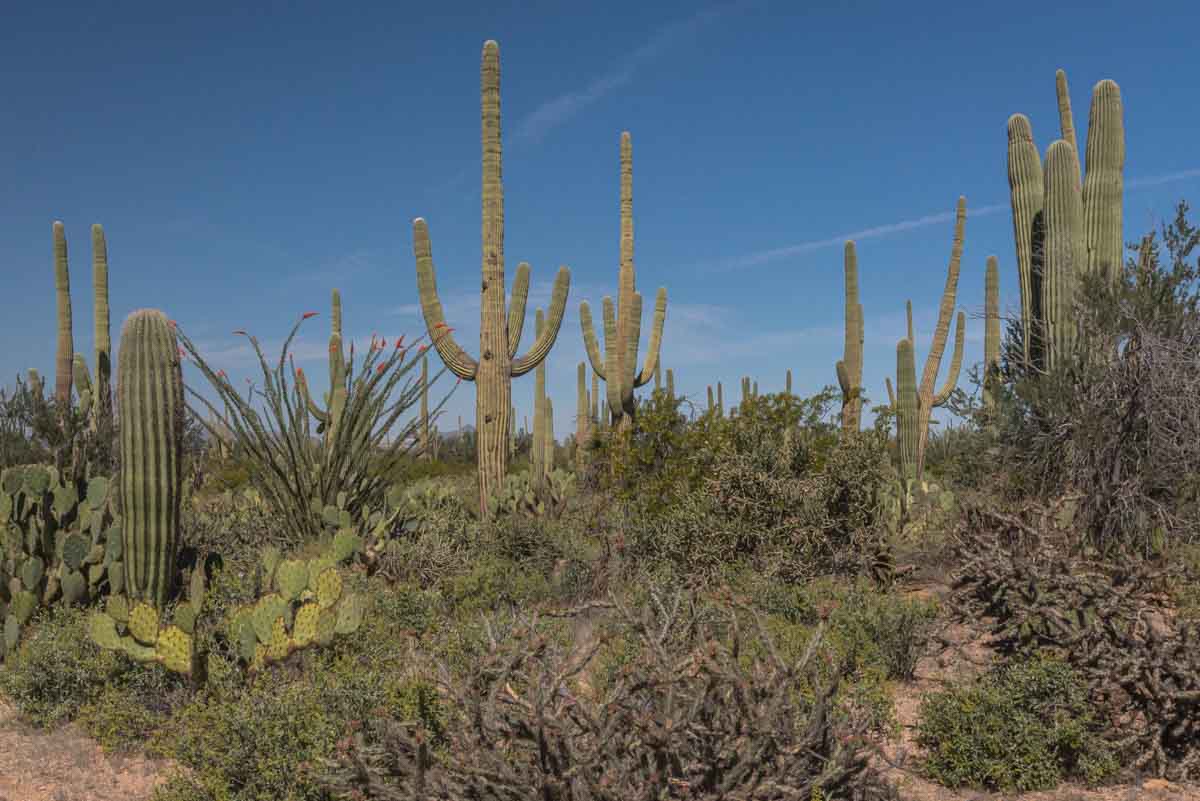
Saguaro are icons of the American West. But in reality, this slow-growing giant (Carnegiea gigantea) is only found in the Sonoran Desert. And only in part of the Sonoran Desert at that. Saguaros only grow in the southern half of Arizona, a tiny bit of California, and a chunk of northern Mexico. Within that range, they generally only grow at elevations below about 4,000 feet.
👉 Read more about saguaros
This means saguaros do not grow in New Mexico, Texas, Colorado, Wyoming, or other places traditionally associated with the Wild West. Only Arizona, Mexico, and that teensy-tiny bit of California.
Saguaros are ubiquitous in American Westerns because most film sets were located in Arizona during the 1920s and ‘30s when Westerns became wildly popular. The saguaros happened to be there, so they ended up on film. But they became an essential element of the genre for generations of fans.

Lobby card for The Fighting Fool (1932) Columbia Pictures
How old is that saguaro?
Given their size, it’s probably not surprising that saguaros have a long lifespan.
A healthy saguaro can live between 150 and 200 years and grow more than 40 feet tall and 10 feet around. But saguaros grow slowly – depending on growing conditions, it can take a saguaro seedling up to 50 years to get three feet tall!
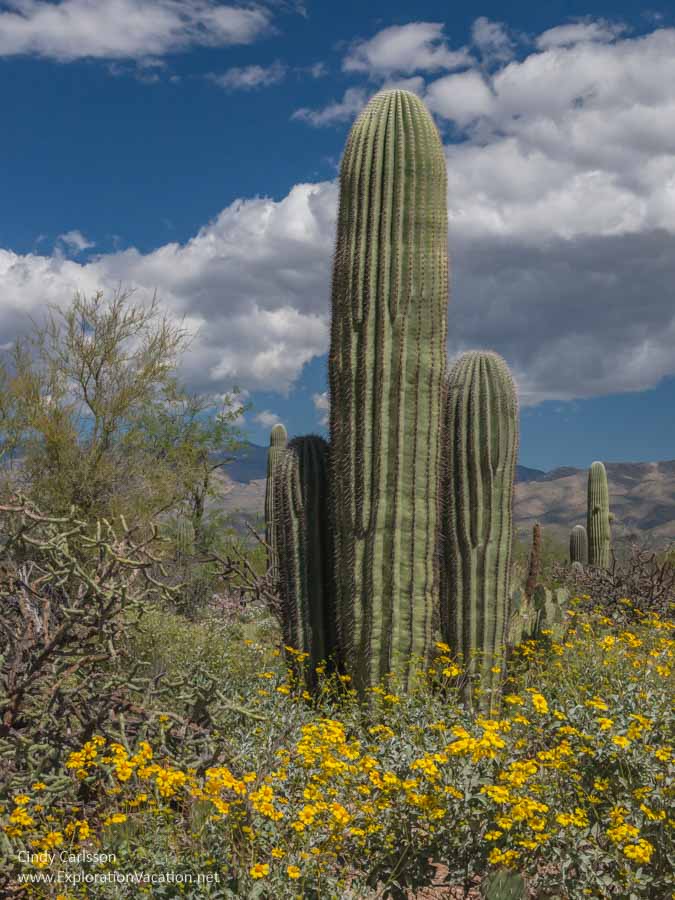
And those iconic arms usually don’t form until the cactus is getting to be 75 years old. Even then, some saguaros never form arms, while others may have dozens of them.

A full-grown saguaro can weigh over a ton. That massive weight is supported by internal “ribs,” a woody skeleton that grows within the cactus.
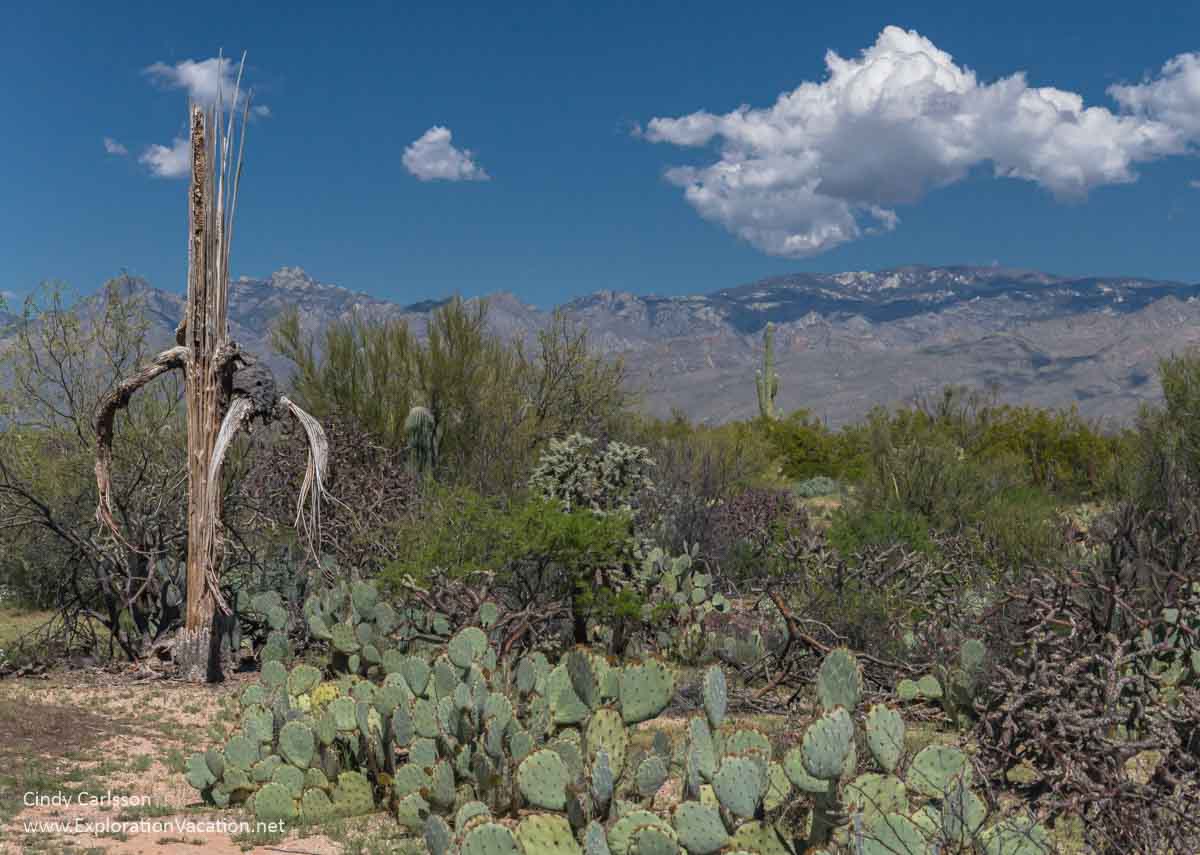
Crested saguaros
Occasionally, saguaros form a “crest” on top or at the end of an arm. These cristate saguaros have multiple fan-like ridges instead of the usual orderly pleats.
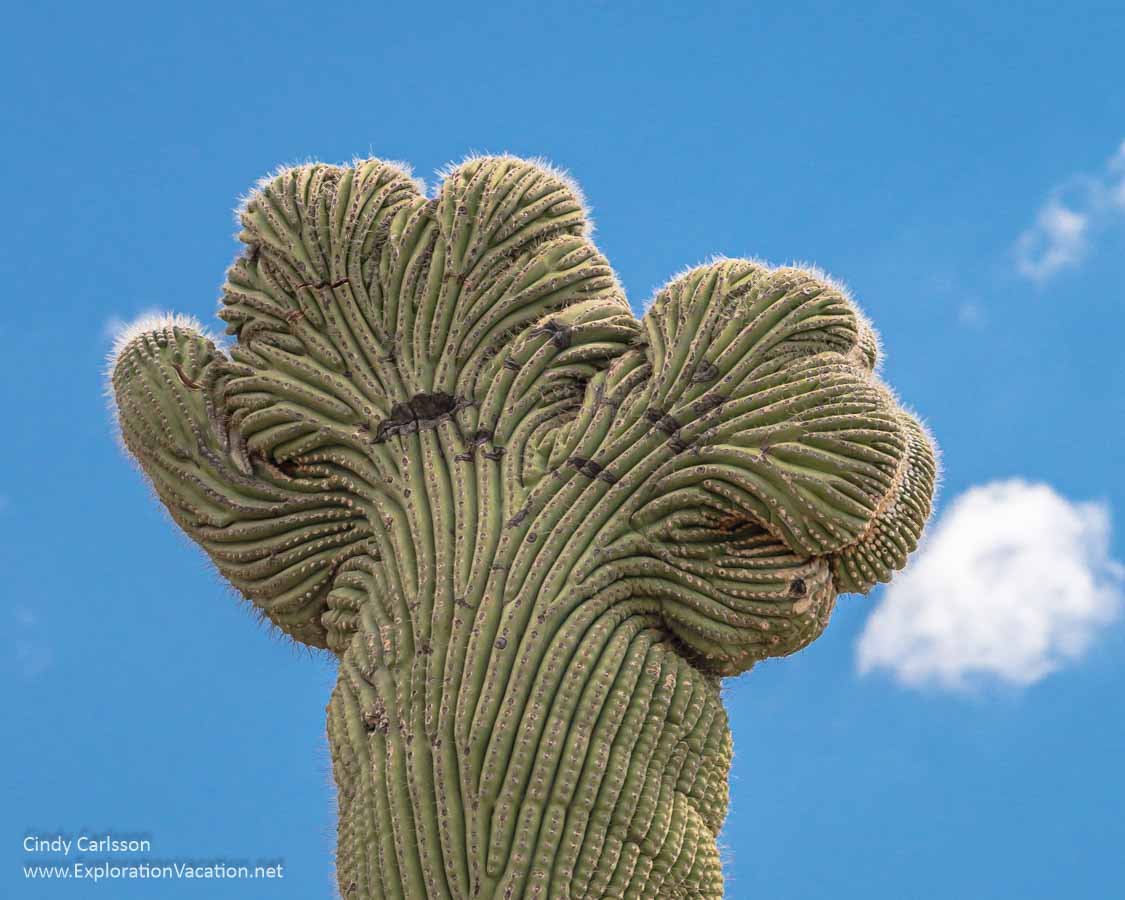
This relatively rare phenomenon occurs when growth points start growing laterally (in a line) instead of their usual circular form. There’s speculation that damage by lightning strikes or freezing may trigger this type of growth. However, no one really knows whether this odd growth is results from damage or a genetic mutation.
While crested saguaros aren’t common, they aren’t impossible to find either. Saguaro National Park seems to have 50 or more of them (different park sources cite anywhere from 25 to 75 known plants), several of which are easy for park visitors to spot without hiking into the desert.
Saguaro blossoms
Once a saguaro reaches about 50 years old, it will start to bloom.

A single saguaro cactus can have a hundred flowers, with only a few blossoms opening at a time. The milky white flowers open at dusk and close by mid-afternoon the next day. Flowers open only once, but with up to a hundred buds on each cactus, a cactus may bloom for weeks.
Although flowers can form at any time, saguaros usually bloom between late April and early June.
The saguaro blossom is the state flower of Arizona.
Saguaros produce a red fruit that ripens in June and early July. Each fruit has sticky red pulp and a few thousand tiny seeds. Wildlife love saguaro fruit, but they aren’t alone.
The local Tohono O’odham have harvested the fruit for generations to create syrup, jam, and other foods. And, of course, once a year it’s eaten fresh.
👉 Read less
Come along on a virtual tour of Saguaro National Park
While Tucson creeps right up to the edges of Saguaro National Park, this is by no means an urban park. Both districts contain large tracts of wilderness. The Rincon district also abuts another wilderness area, creating a large expanse of protected land in and around the park.
But there is plenty to see without hiking into the wilderness!
Rincon Mountain District (East Saguaro)
Saguaro’s Rincon Mountain District it the place to go for spring wildflowers and eye-popping scenery year-round. This eastern district protects both the historic cactus forest and the slopes of the Rincon Mountains, with elevations over 8,000 feet. It’s a gorgeous place even if you aren’t a huge cactus fan!
The Rincon visitor center is located just inside the park. It’s a good spot to learn a bit about the Sonoran Desert, check out trail conditions, find out what might be in bloom and what wildlife is around, and pick up a map.
For cyclists and visitors with limited time, the 8-mile paved Cactus Forest Loop Drive offers wonderful scenery and plenty of places to stop and take a closer look. There are several trails to explore, but there is also a lot to see right from the road!
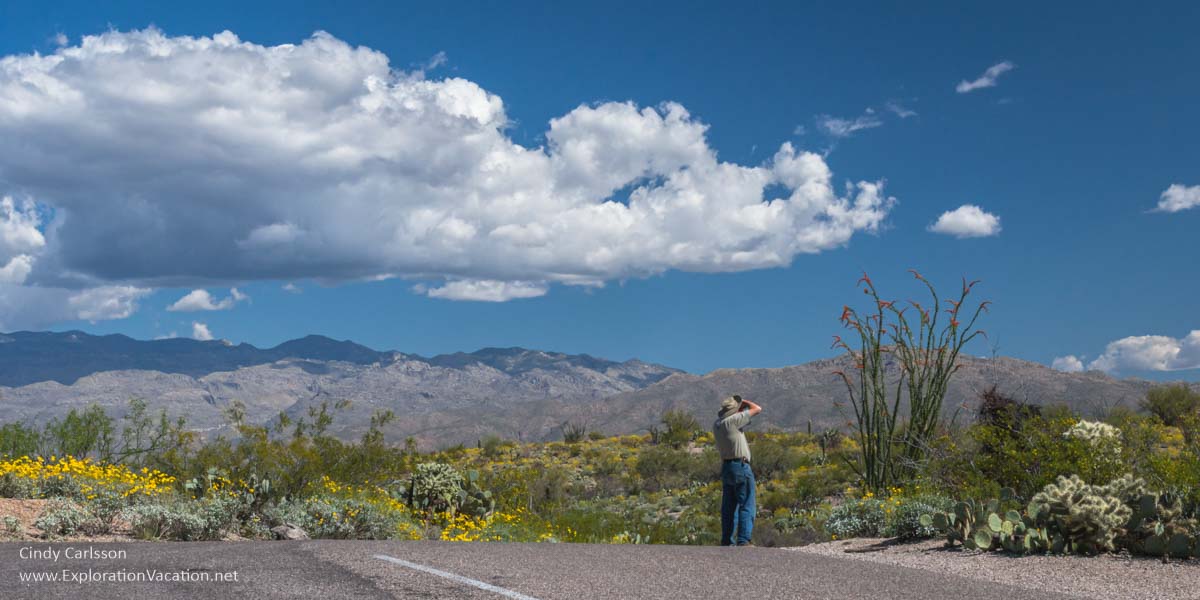
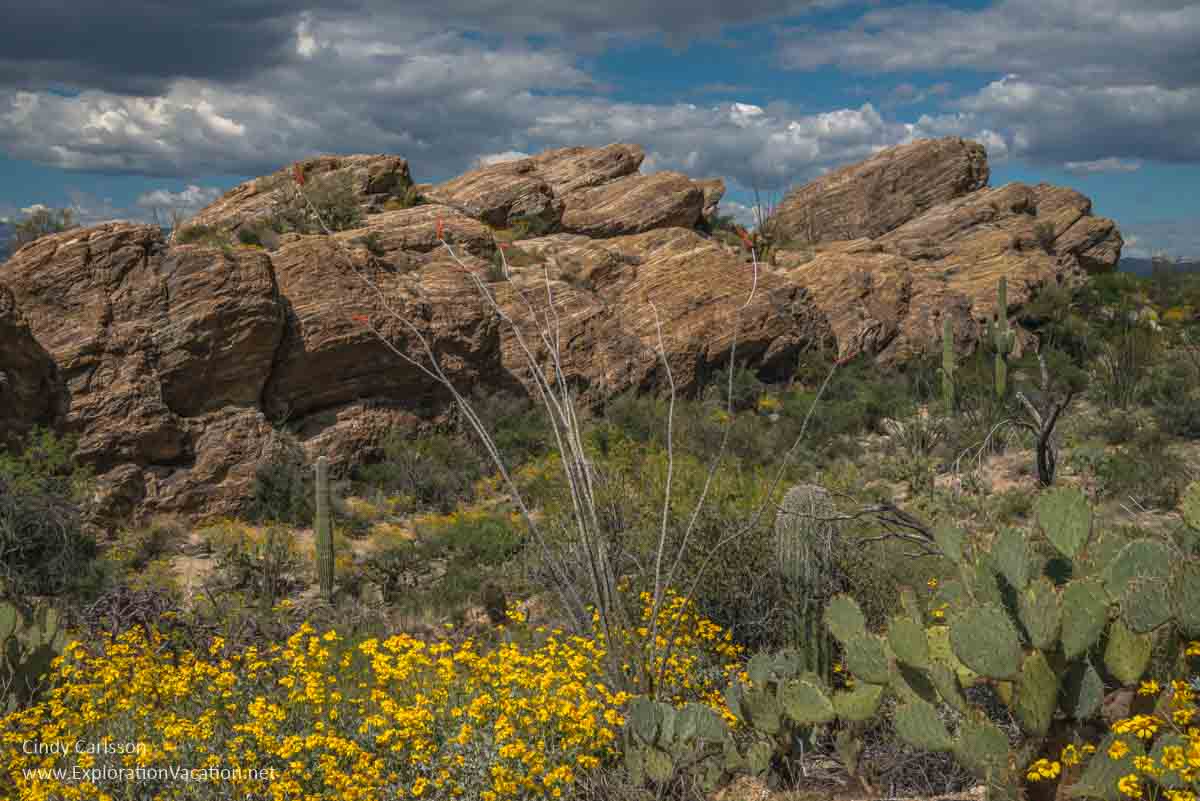
The road begins just beyond the visitor center. Much of it is only open to one-way vehicle and bike traffic. To drive the full loop, go to the left (north). From there you will travel into part of the cactus forest that spurred creation of the park. (Today the once-dense cactus forest features a few enormous old saguaros and many very young ones.) The saguaros are in a beautiful setting, with dramatic rock outcrops, wildflowers, and the Rincon Mountains as a backdrop.

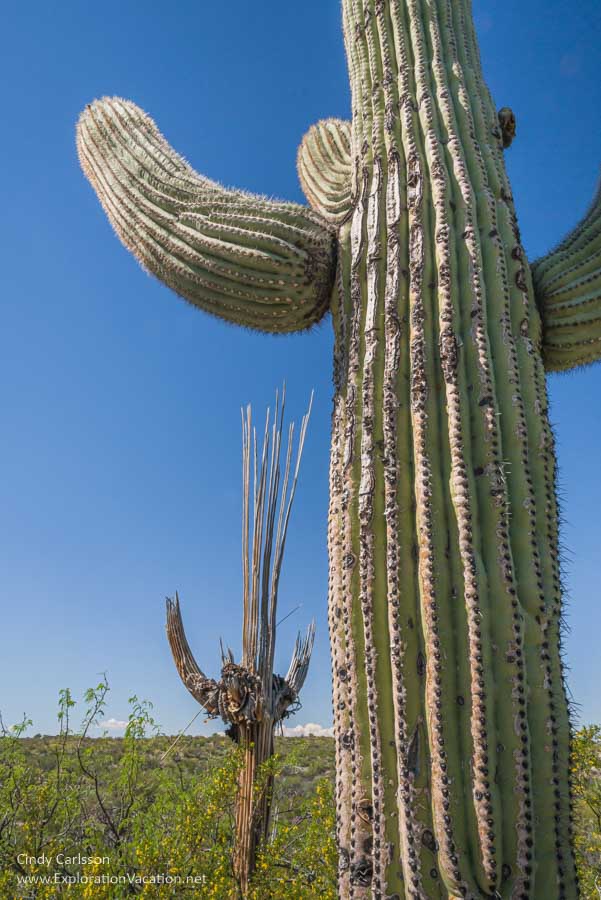

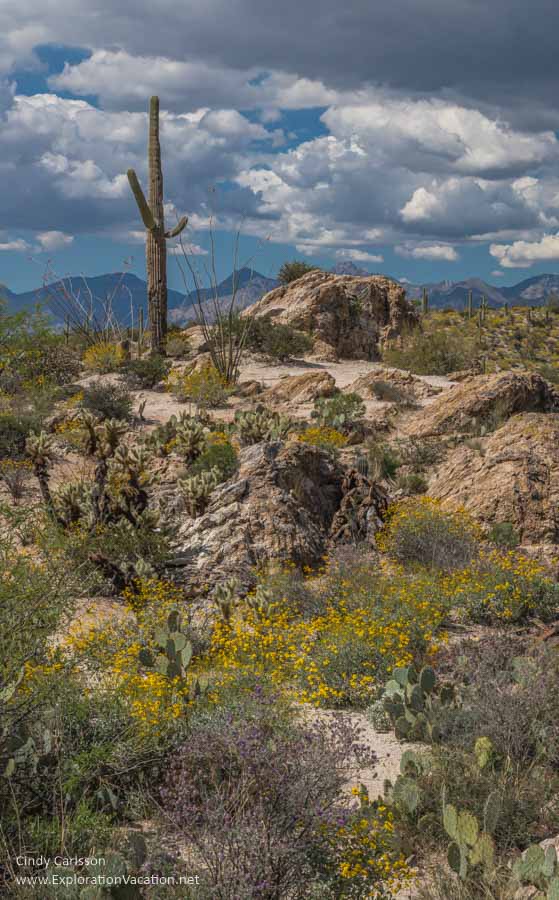

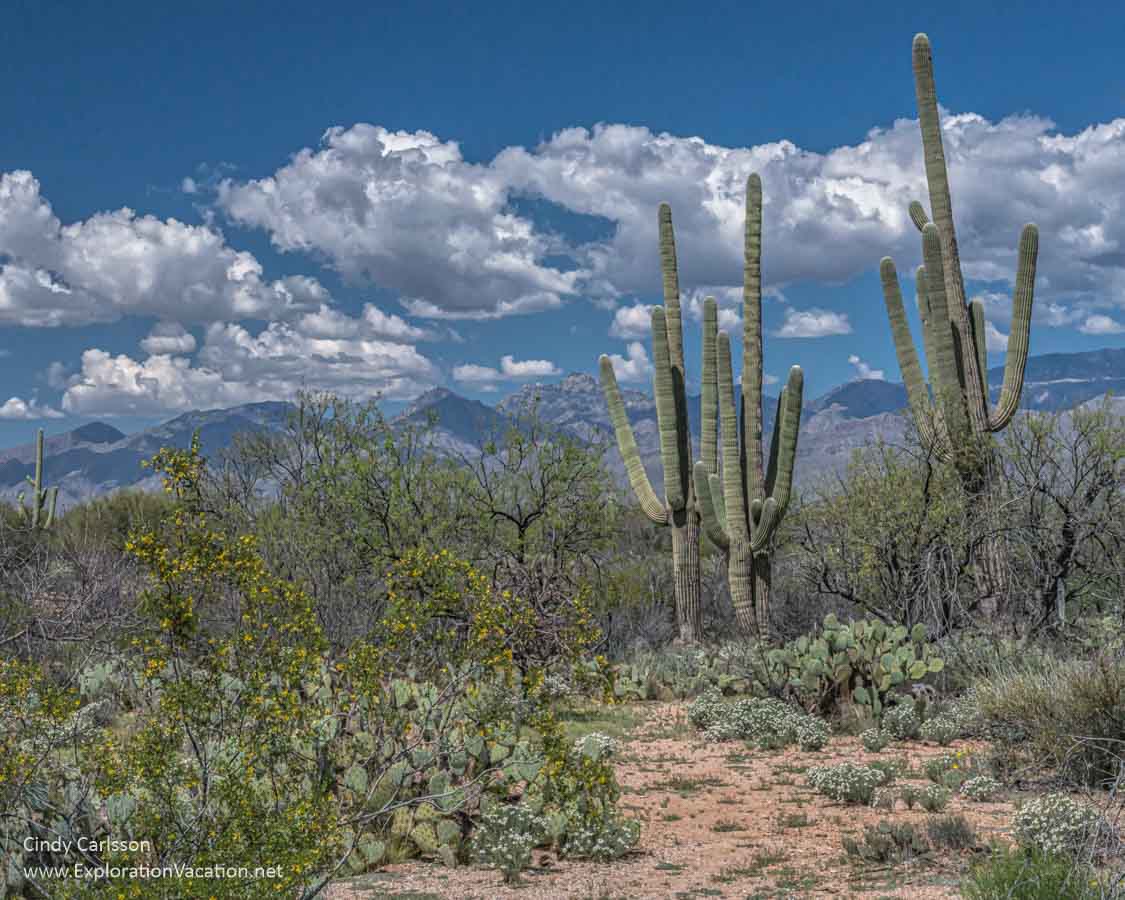
Several hiking trails can be reached from the loop road. Both the Desert Ecology Trail (1/4 mile, paved) and the Freeman Homestead Trail (1 mile) offer easy options for exploring the desert and getting close to a few saguaros. Both offer interpretive signage to help you understand what you are seeing.
Longer trails thread through the cactus forest and link to back-country trails up into the mountains.
Tucson Mountain District (West Saguaro)
Located to the west of Tucson, the Tucson Mountain District is the smaller of the park’s two districts. But don’t let its size fool you. It has a lot to offer with historic picnic areas, petroglyphs, and a variety of hiking trails that provide a close-up look at an impressive forest of the park’s namesake cacti.
The cacti forest starts before you even get into the park and continues all along the drive to the visitor center.

Unfortunately, there really aren’t many places to pull over and admire the scenery until you reach the visitor center. But once there, the visitor center is offers pretty great scenery right from the shaded patio.

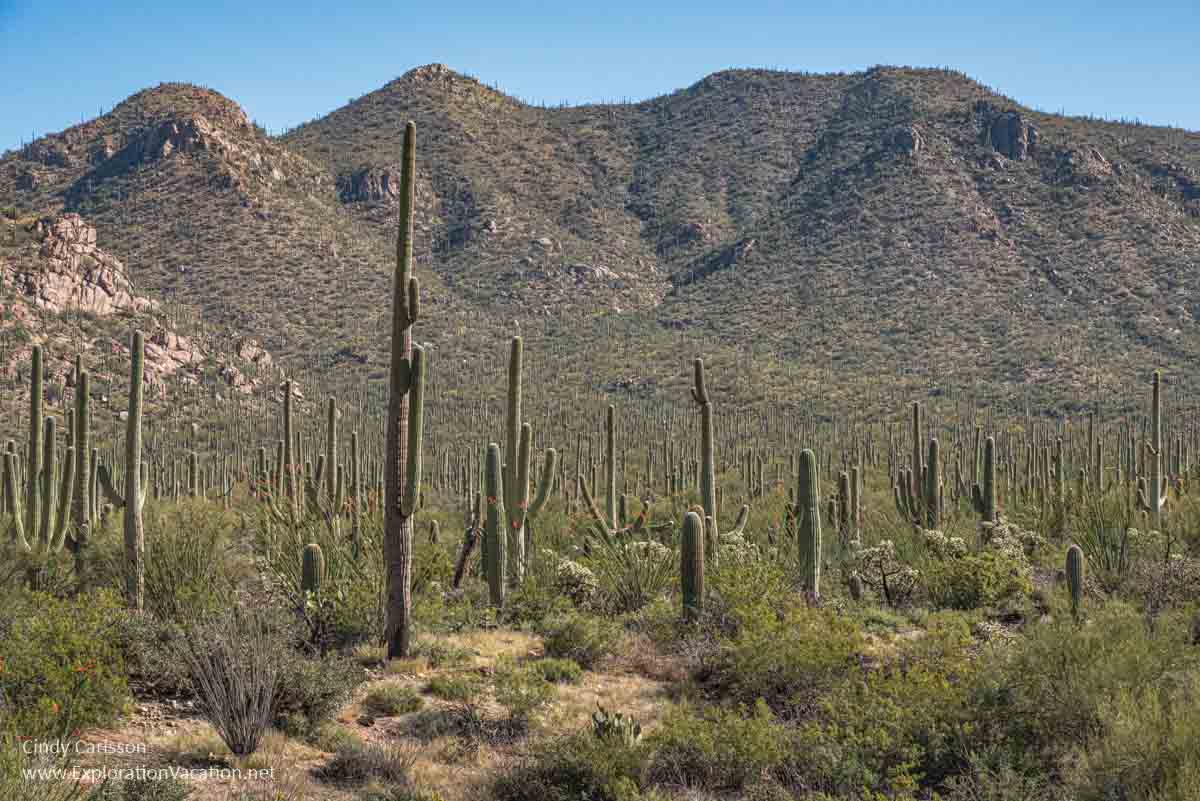
As in the Rincon District, the Tucson Mountain Visitor Center is a good place to stop for information and maps.
Heading further into the park from the visitor center, the Desert Discovery Trail offers a lot to see along a very short interpretive trail.

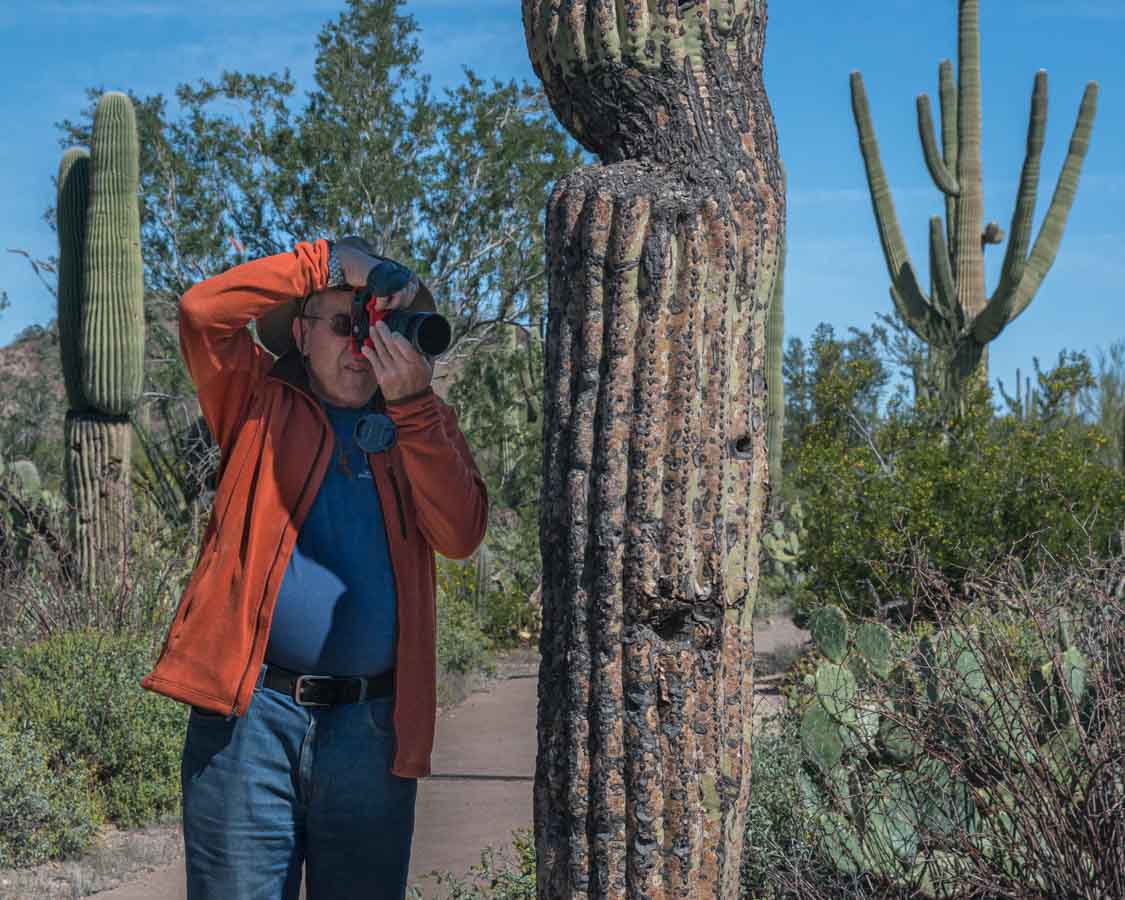
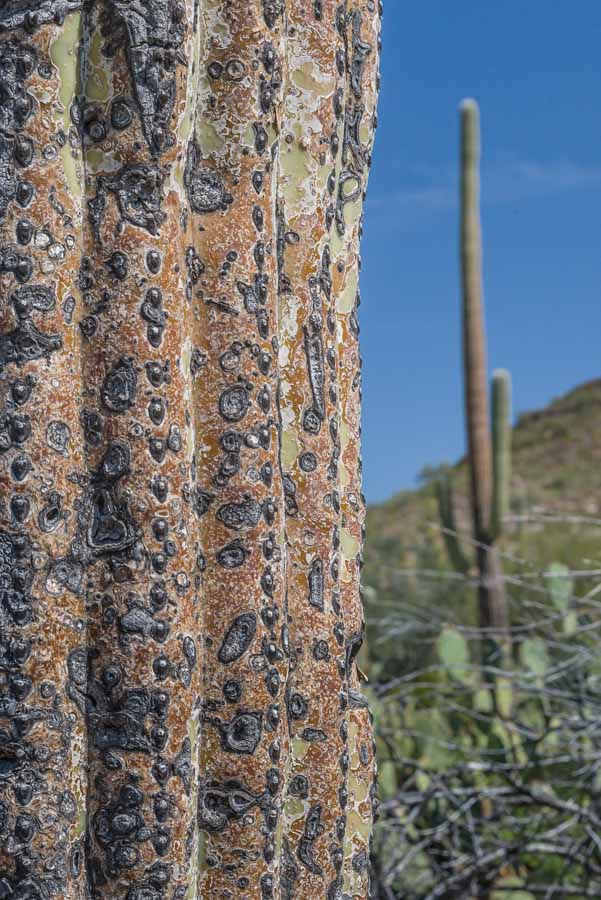
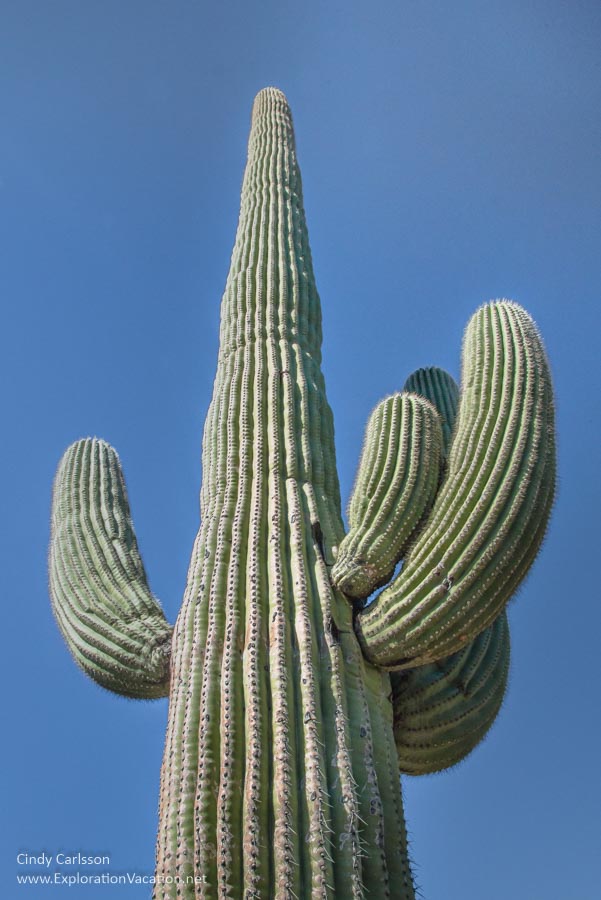

Continue along to reach the 5-mile Scenic Bajada Loop Drive. This unpaved loop road connects most of the highlights in this part of the park.

Like the Cactus Forest road in the Rincon District, the Bajada Loop Drive also has a one-way section. This time you’ll need to start on the southern half of the loop to do the entire circuit. This road is unpaved, but suitable for most regular automobiles. It’s not suitable for large vehicles.
Stops along the road include the petroglyphs at Signal Hill and various trails. Even if you don’t hike far, it’s worth getting out of the car to walk the first part of a trail. There’ll be plenty to see wherever you stop.
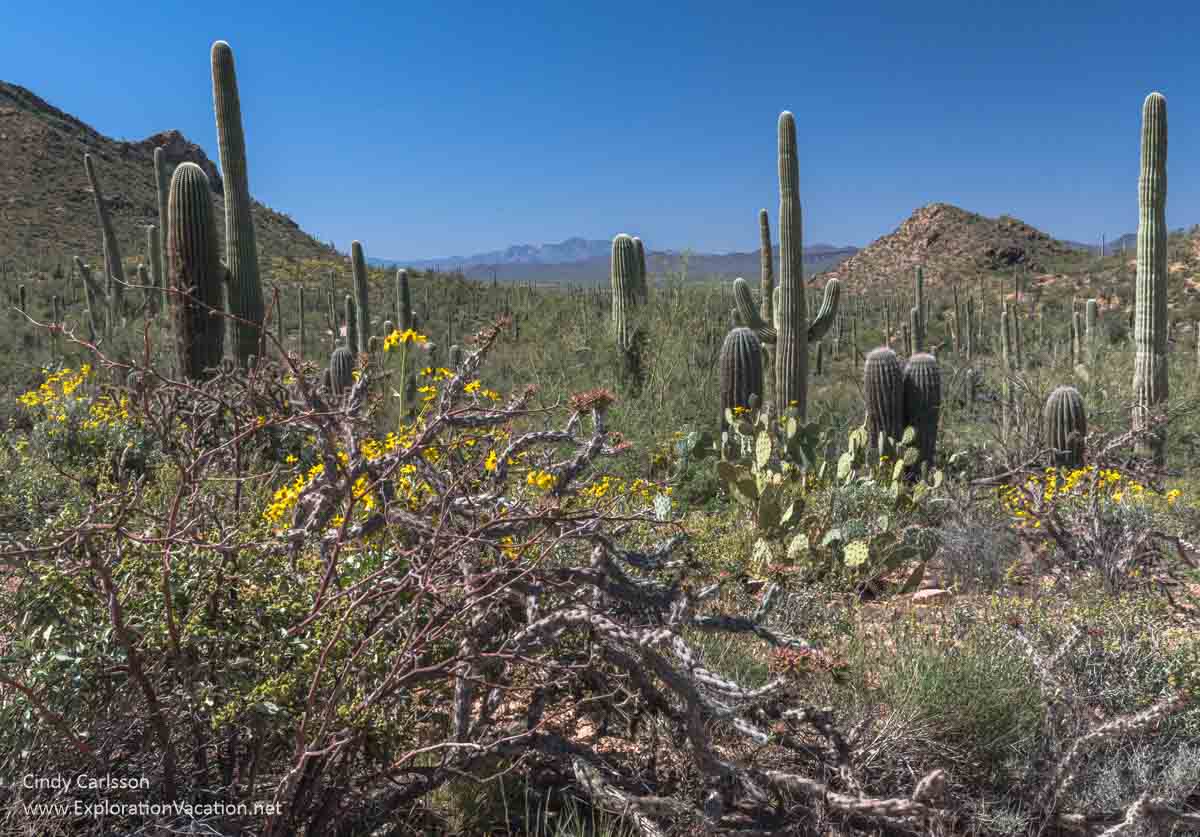

Plan your visit to Saguaro
Saguaro National Park is an easy day trip from either Phoenix or Tucson. Visitors staying in Tucson can visit each park district on a different day, but still should plan their visit for early morning or late afternoon.
When to visit
October through April is generally considered the best time to visit the park, although winter temperatures can be cold. Snow and frost are rare, but possible during winter.
👉 Lean more about planning your visit to Saguaro National Park
Saguaro National Park regularly has summer temperatures exceeding 100 degrees. Hikers should bring extra water and avoid being out between 10 am and 4 pm during the hottest time of the day.
March and April: Spring wildflower season
I timed my park visit to coincide with wildflower season in late March.
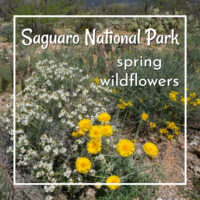
After a wet winter, March through April can be spectacular as the Sonoran Desert erupts with colorful flowers. The greatest number and variety of flowers will likely be found in the cooler, wetter Rincon District. However, I actually found fewer flowers, but more variety, in the western Tucson Mountain District.
Good timing and knowing where to look are the keys to seeing lots of wildflowers. If you want to see the most (and most interesting) flowers, stop at a visitor center and ask what’s blooming where.
Mid-morning is generally the best time to look for wildflowers, as some won’t open until the sun is out and/or the temperature has warmed, but others will close when it starts to get hot.

For more information on visiting the park when the wildflowers are blooming, see Spring Flowers in Saguaro National Park.
April through June: Saguaro blossoms
Saguaro flowers arrive as the Sonoran Desert is beginning to heat up for summer. Although saguaros generally flower at some point between April and June, May probably offers the best chance of seeing flowers.
Look for flowers in the morning, as they open during the evening and close by the middle of the next day.
June through September: Summer monsoon season
The Sonoran Desert has a summer monsoon season when heavy rainfall can flood roads. In Saguaro, the monsoon season runs from June 15 to September 30, although the season often doesn’t begin until July.
During this time, visitors can expect severe thunderstorms to form each afternoon. These storms can include lightning and heavy rainfall. Lightning can and does strike both trees and saguaros, while heavy rains create flash floods in washes that cross roads and trails.
Stay indoors in the afternoon. And, if you are caught out in the park during a storm, never try to cross a flooded wash and stay as low as possible to avoid lightning. Avoid hiking in washes when there are storms anywhere in the area, as flash floods can occur even if it isn’t raining where you are.
While this may seem like a good time of year to avoid the park completely, photographers will find dramatic skies both early in the day as storms build and in the evening as they dissipate.
Getting to and around the park
The Rincon district of Saguaro National Park is located along and in the mountains to the east of Tucson.
The Tucson Mountain district is located on the other side of the city, about 35 miles to the west.
Due to the physical distance between the two sections of the park (about 35 miles) and the fact that the city lies between them, driving from one park to another can take an hour or more.
While driving between the two parks is pretty straightforward, large vehicles are not permitted on some of the most obvious routes into the western part of the park.
It’s entirely possible to make a quick visit to one part of the park in the morning and the other in the late afternoon. However, to the west, the Saguaro adjoins Tucson Mountain County Park and the Arizona-Sonora Desert Museum, both of which are also destinations worth visiting while in the area.
Driving in the park
Both park districts have a scenic loop road that is suitable for regular vehicles, but not large vehicles or trailers. The road in the eastern Rincon District is paved, but narrow and twisting. The road in the Tucson District is dirt.
Vehicles are only supposed to stop at designated pull-outs and parking spaces, but slow-moving or stopped vehicles are common. In addition, both of these roads are also open to cyclists and pedestrians.
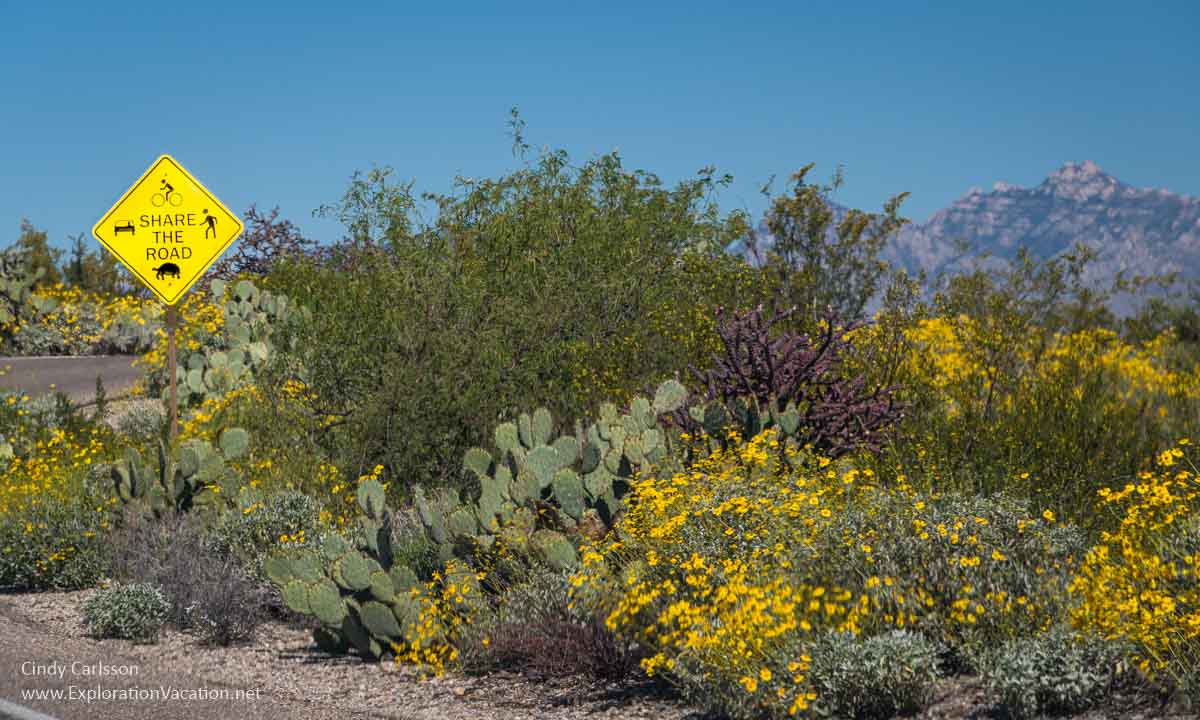
Do not randomly stop along the road to take pictures. If you want to take pictures, find a designated parking area and get out and walk back to that perfect photo you passed by or follow a trail into the cactus forest to get a better look.
Complete information on driving, biking, riding, and hiking in the park can be found on the park website.
General park information
While located at the edge of a major city, Saguaro is a desert park, and visitors should bring everything needed to be out in the desert, including water, sunscreen, a hat, etc.
An entry fee or pass is required
Annual and lifetime America the Beautiful National Park and Federal Recreational Lands passes are accepted at the park.
An annual Saguaro National Park pass is available.
Weekly passes are also available for vehicles, motorcycles, and those entering by bicycle or on foot.
There are no daily passes for this park.
Information on fees and payment options is on the park website.
Bring your own water
Even if you are just touring the park from your car, be sure to have plenty of water with you.
Hikers must carry all the water they will need (at least a gallon per person, per day), as there are no reliable sources of water in most of the park.
Both visitor centers and the Rincon bike ramada have stations where you can refill your water bottles.
There is no bottled water available at either park district.
Stay on the trail
Between the two districts, Saguaro has over 150 miles of trail. Visitors must stay on the trail at all times unless they are hiking above 4,500 feet in the mountains.
While it may look like nothing but dirt around the trail, desert soils are home to both microscopic plants and the seeds and roots of seasonal flowers. These, and the soil itself, are very fragile and easily damaged by foot traffic. STAY ON DESIGNATED TRAILS!
Enjoy a picnic, but be smart
Food is not available in the park, so pack a picnic to enjoy lunch or dinner in one of the park’s picnic areas.
Grills are available in most picnic areas, but bring your own wood or charcoal. Do NOT collect wood in the park. Never leave a fire unattended (even in a grill) and make sure your fire is “out cold” before you leave.
Keep picnic areas and campsites clean. There is wildlife in the park, including mountain lions, and you really don’t want them hanging around while you eat lunch.
Don’t feed the wildlife. It’s bad for the wildlife, and it can attract other, larger and more dangerous animals.
Visitor centers
Each unit of the park has a fully-staffed visitor center with restrooms.
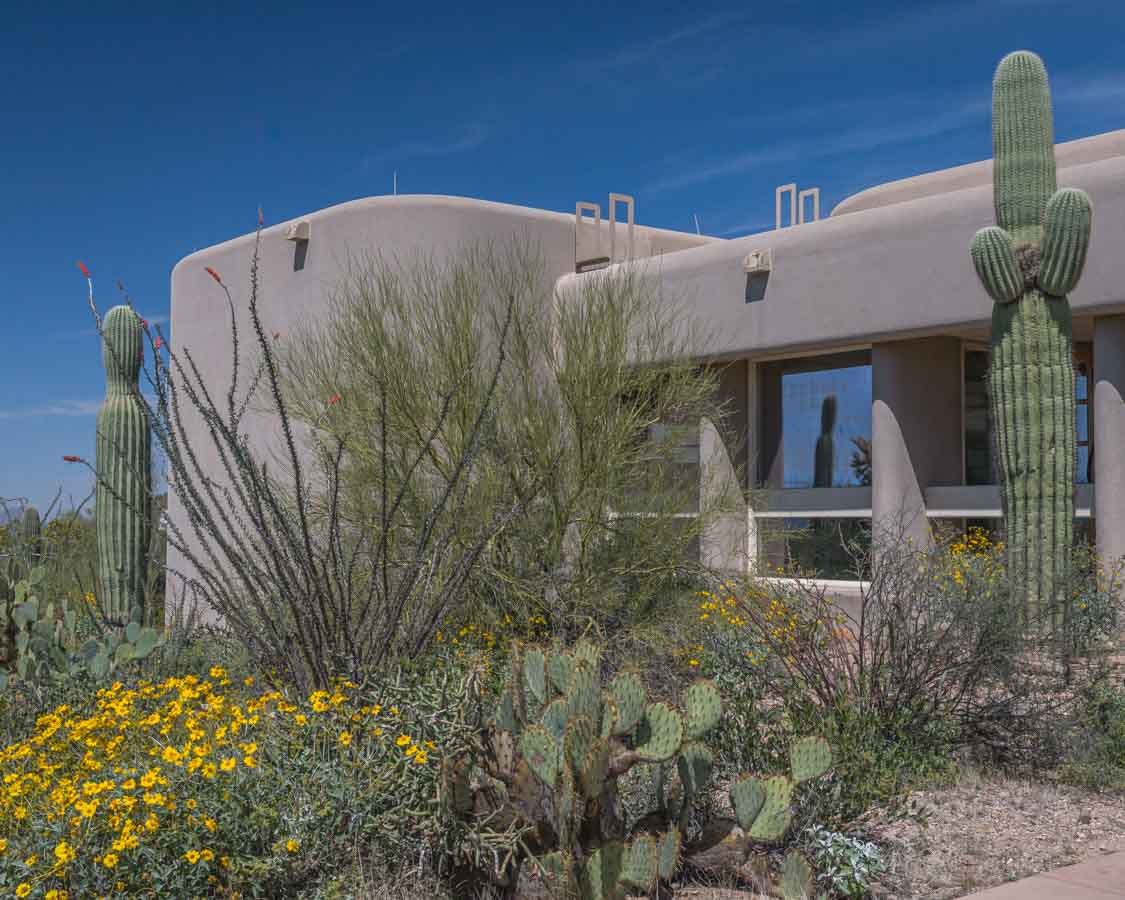
Saguaro National Park has daily activities and events scheduled throughout the year, although many more options are available during the peak December through March season.
👉 Read less
Hazards in the park
The following isn’t intended to scare visitors unfamiliar with desert hiking from visiting the park. In all my years of short hikes in the Sonoran Desert, I’ve never had heat stroke, never gotten caught in a storm while on foot, never gotten a cholla stuck anywhere but on my hiking boots, haven’t been stung by killer bees, have only seen two rattlesnakes, and am still hoping to see a mountain lion someday.
Part of my good luck is simply the time of year I like to visit the Sonoran Desert: Spring, when severe storms are rare and snakes are just coming out for the season. My closest call was actually the killer bees, as I didn’t realize there were Africanized bees in the park and, with all the flowers in bloom, the sound of bees wasn’t as alarming as it should have been.
I love the desert. But visiting the desert isn’t like visiting other landscapes. It’s a harsh, potentially deadly, place. And first-time visitors are particularly likely to either over- or under-estimate the dangers.
If you want to hike, know what you are doing. If you aren’t comfortable hiking in the desert, you are in luck, as you can have a wonderful park visit on your bike or even by car. Just stop and walk at least a little bit to really see the marvelous landscape through which you are passing. It is an amazing and beautiful place.
👉 Learn more about hazards in the park
Weather
Most of the park is open and very exposed to both heat and storms.
This means summer visitors need to be prepared for extreme heat (over 100 degrees in the shade) during the day and severe afternoon storms that may include lightning strikes and heavy rain.
All year, but particularly during summer, dehydration, heat exhaustion, and heat stroke are real dangers for hikers. Bring plenty of water (the park recommends drinking 1 quart of water for every hour spent hiking in hot weather), take frequent breaks, and bring sports drinks or salty snacks to replace electrolytes. Drink water even if you don’t feel thirsty!
But during any season, bring plenty of water, have something to replace electrolytes, and turn back once half your water is gone.
Always bring a hat and sunscreen. Have a good map with you even if you only plant to take a short walk.
Cacti
It should go without saying that cacti and many other desert plants protect themselves with sharp spines, some of which are very difficult and painful to remove.
Avoid contact with desert plants. Don’t even get near some species of cacti, like members of the cholla family, if you can avoid it. Cholla are particularly unfriendly, in that their fuzzy appearance is created by nasty spines that easily separate from the plant and become firmly embedded in whatever is near – including skin, clothing, and even hiking boots.

The park recommends carrying a large pick comb, tweezers, and a multi-tool to remove cactus segments and/or spines if you will be out and about in the park
Killer bees
Yes, there are killer bees in Saguaro National Park.
Actually, all bees in the park are probably “killer” Africanized honey bees, as are most bees in Arizona.
Unfortunately, Africanized bees are found throughout the park. That includes along roads and trails. (I came across a large swarm while walking along the road.)
Fortunately, they won’t hunt you down and attack if they don’t see you as a threat. If they are just feeding on flowers, they’ll usually ignore you. As long as you don’t kill one, they will only attack if they see you as a threat to their hive. (Kill one or get too close to the hive, and they’ll all be after you immediately.) Pay attention and stay away from large groups of bees or areas where bees seem to be coming in and out of a (potentially hidden) hive. If bees start to bump into you without stinging, that is a warning to leave immediately.
If you are attacked:
- Run as fast as you can. (Bee attacks usually end once you are ¼ to ½ mile away – but that’s a long distance to travel while being repeatedly stung.)
- Cover your head and face with clothing. (Africanized bees go for the eyes, ears, nose, and mouth.)
- Never kill an attacking bee, as it will release an alarm scent to attract more bees.
- Do not flail or swat at bees, as it will make them attack more fiercely.
- Scrape, but do not attempt to pull out embedded stingers. (Squeezing the stinger to pull it out releases more venom.)
- Call 911 and go to a doctor.
- Report attacks to the visitor center.
Africanized bee venom is the same as that of European honeybees. If you aren’t otherwise allergic to bee venom, the danger is in the number of stings.
Snakes
Snakes just want to be left alone. They won’t attack and they’ll only bite if you get too close.
The park is home to six species of rattlesnakes:
- Western diamond-backed rattlesnake (Crotalus atrox)
- Sidewinder (Crotalus cerastes)
- Black-tailed rattlesnake (Crotalus molossus)
- Tiger rattlesnake (Crotalus tigris)
- Mohave rattlesnake (Crotalus scutulatus)
- Western rattlesnake (Crotalus viridis)
When it’s cool enough for them to be out in the sun, they will generally give you a warning about the same time you are likely to see them. But when it’s hot, they hide in the shade of bushes or rocks where you won’t see them and where they don’t expect to be disturbed. Never put your hands or feet anywhere that you can’t see. If you step or reach into their space, they don’t have time to warn you of their presence and will bite.

Oh, and they also have Sonoran coral snakes, which are small and unlikely to inflict a deep bite, but have venom similar to that of a cobra. It’s best to give them plenty of room too.
Find pictures of all the park’s snakes, both venomous and harmless, on the park’s website.
Mountain lions
I really don’t think mountain lions are a big threat, but there are mountain lions (pumas or cougars) in the park, so there is always a risk of coming upon one unexpectedly.
Solo hiking and jogging isn’t recommended because individuals and children are most likely to attract the attention of cougars. And this is a park where children shouldn’t roam on their own anyway, but here’s another reason to keep a close eye on them.
If you do encounter a mountain lion:
- Give it plenty of space to get away.
- Do NOT run. Instead, face it, make yourself look as big as possible by raising your arms, and speaking loudly and calmly.
- Throw things at it IF you can reach something to throw WITHOUT bending down or turning your back.
If you are attacked, fight back hard.
Rabid animals of all types
Rabies is sometimes found in park wildlife. Stay away from animals of any size and report wildlife that acts strangely or aggressively.
👉 Read less
Camping and other lodging in and around the park
Unlike many national parks, Saguaro isn’t set up for most overnight visitors. However, there are plenty of campgrounds, hotels, inns, and other lodging available just outside the park and in the city of Tucson.
Backcountry camping in Saguaro
The Rincon Mountain area has a number of backcountry hiking trails. Hikers on these trails are allowed to camp at any of six wilderness campgrounds. These sites can only be reached by hiking. A permit is required to camp at these sites.
Additional resources
Saguaro National Park once had a number of excellent informational brochures related to specific aspects of the park, including park geology, wildlife and birds, saguaro cacti, and Africanized honey bees. Maybe you can still find these on site. . . they don’t seem to be on the web anymore.
The Saguaro Sentinel (PDF) from a few years ago has a nice combination of history and visitor information, including hiking trail details and maps.
Maps and hiking guides are also available on the park website. Just be sure to check in at a visitor center before hiking to check for trail closures or other issues.
Need a little desert beauty to brighten up your home or office? View images and order prints of spring flowers at Saguaro National Park.

The information you shared in your blog is really precise and informative. Writing is a gift to be cherished. I see that you’ve grown your passion into something outstanding.
Thank you, that’s very kind.