
Last updated on June 10th, 2026
The WAG (Winnipeg Art Gallery in Canada) holds the world’s largest public collection of Inuit art, with around 14,000 pieces in the museum collection and another 7,000-plus pieces on loan from the Nunavut fine art collection. But for decades limited exhibition space allowed visitors to see only a small portion of it.
That all changed in 2021 with the opening of Qaumajuq, the WAG’s new Inuit Art and Culture Center.
(Now that I’ve visited several times, I expanded my original 2021 story to give you a first-hand look at the museum.)
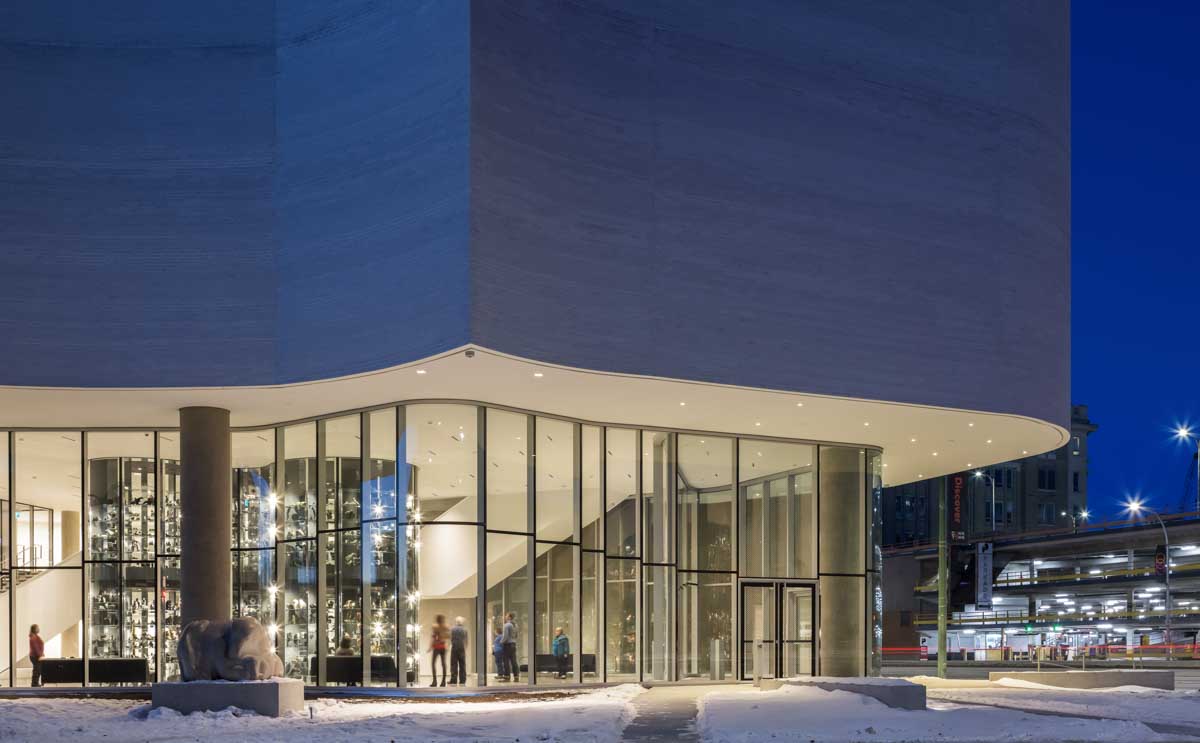
Qaumajuq, the Inuit art and cultural center at the Winnipeg Art Gallery. Photo by Lindsay Reid, provided by WAG-Qaumajuq.
More than just providing much-needed gallery space for displaying Inuit art, Qaumajuq is a gathering place where art, culture, research, and education come together. It’s also envisioned as “a place where art and technology offer direct connections to the land, people, and cultures of Inuit Nunangat, the homeland of Inuit in Canada.”
(The Inuit are the indigenous people of far northern Canada and Greenland. There are four Inuit regions in Canada, collectively known as Inuit Nunangat. In addition, both the Inupiat people of Alaska and the Siberian Yupik are also related to the Canadian Inuit. All of these cultures are represented in the museum’s collection, but the Canadian Inuit are the primary focus.)
It’s a grand building with a big mission.
And it is definitely worth visiting – even if you have never even heard of Inuit art before!
I use links to improve your experience using this website. Some may be affiliate links that pay me a small commission if you use them to book a room, rent a car, or purchase goods or services. You don’t pay extra, but it helps keep this website running. To learn more, see my policies and disclosures.
Qaumajuq brings new gallery space and more
Although well integrated into the existing Winnipeg Art Gallery, Qaumajuq feels like an entirely separate museum. A museum that just happens to be operated by and physically integrated with the WAG.
But it does look a lot like a separate building. A building designed to evoke the scale and light of the north.
That was by design, as architect Michael Maltzan‘s task was to design a building that evokes the Arctic while respecting the character of the existing WAG building. (A triangular modernist structure from 1971 designed by Gustavo da Roza.)
Maltzan’s Arctic influences are obvious from the exterior, where waves of sculpted white granite rise above the entrance’s glass façade like a mountain of windblown snow.
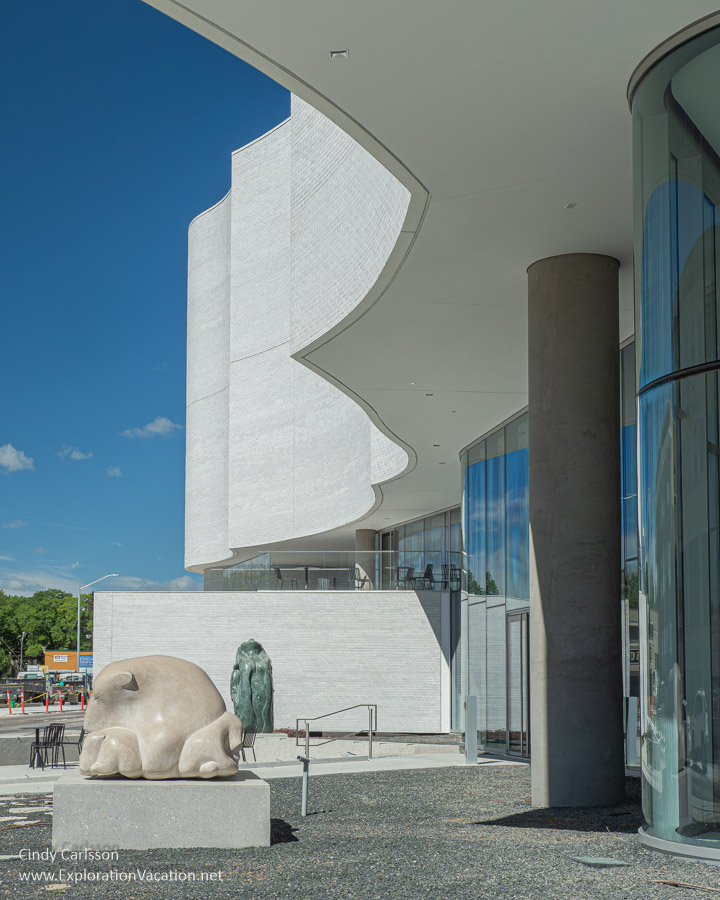
The entrance to Qaumajuq.
Inside, visitors can easily move between the Qaumajuq building and the main building. The two also share a fine gift shop and a very basic coffee shop.
Qaumajuq’s Visible Vault
Rising above the lobby, the Visible Vault is Qaumajuq’s most unusual feature. And it’s the one that most directly responds to those of us who used to complain that too little of the collection was on display at any given time!
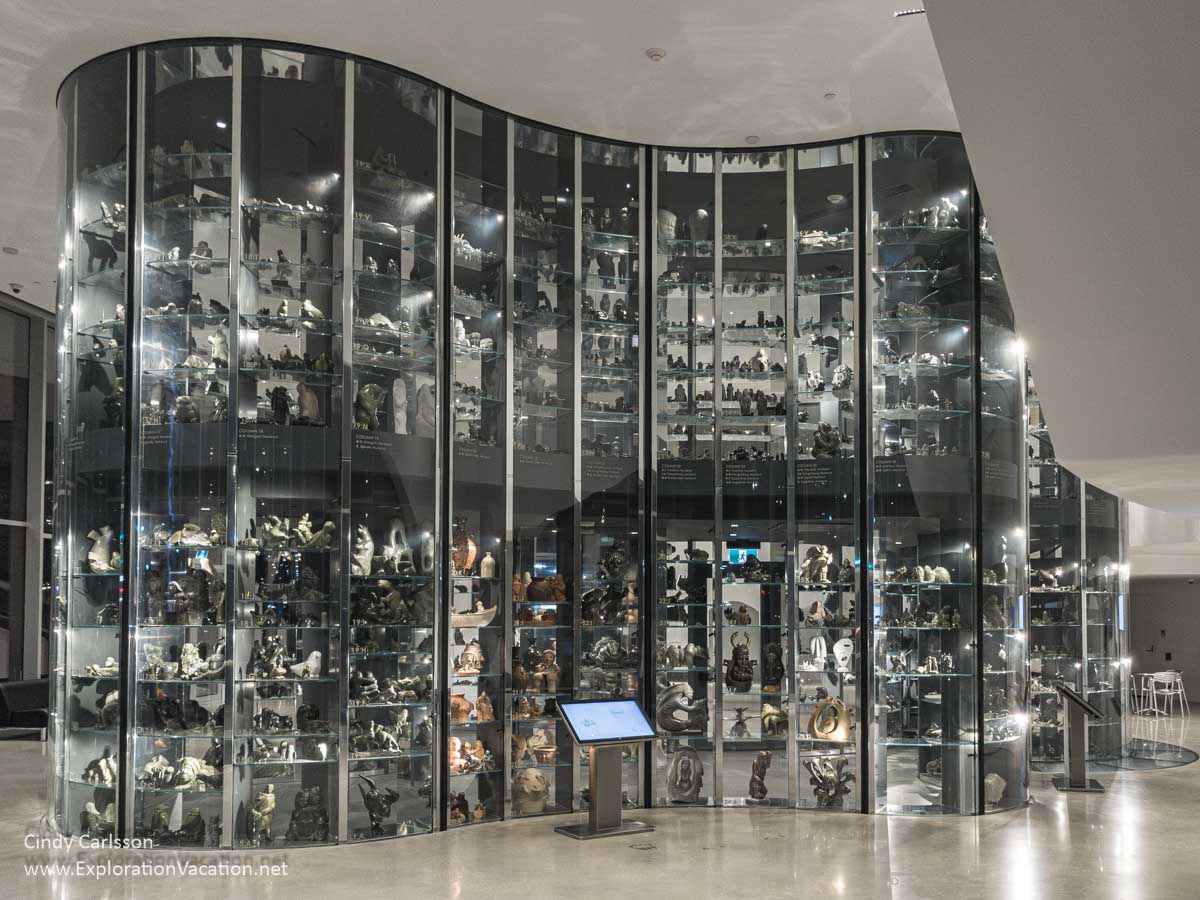
The innovative Visible Vault serves as both storage and display space.
👉 Read more about the Visible Vault . . .
Inside, Inuit carvings fill about 500 shelves that rise through the building from the basement. With some limitations, the public can view it from all levels of the museum.
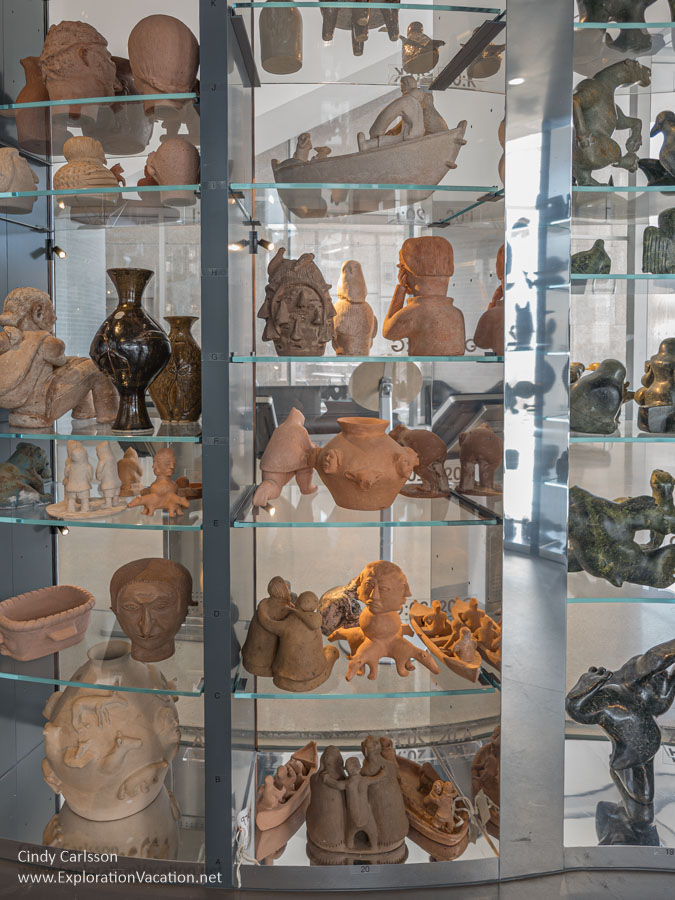
Most of the pieces in the Visible Vault are carved stone, but there is also some Inuit pottery and other things.
Of course, a lot of that art is not sitting where you can take a very close look at it.
Part of that problem is solved by a computer touch screen system with a mix of photos and other information for all 5,000 or so pieces in the Visible Vault. Just type in the code on the vault for a piece you would like to know more about, and (when the system is working) the screen brings up information on that piece and neighboring pieces.
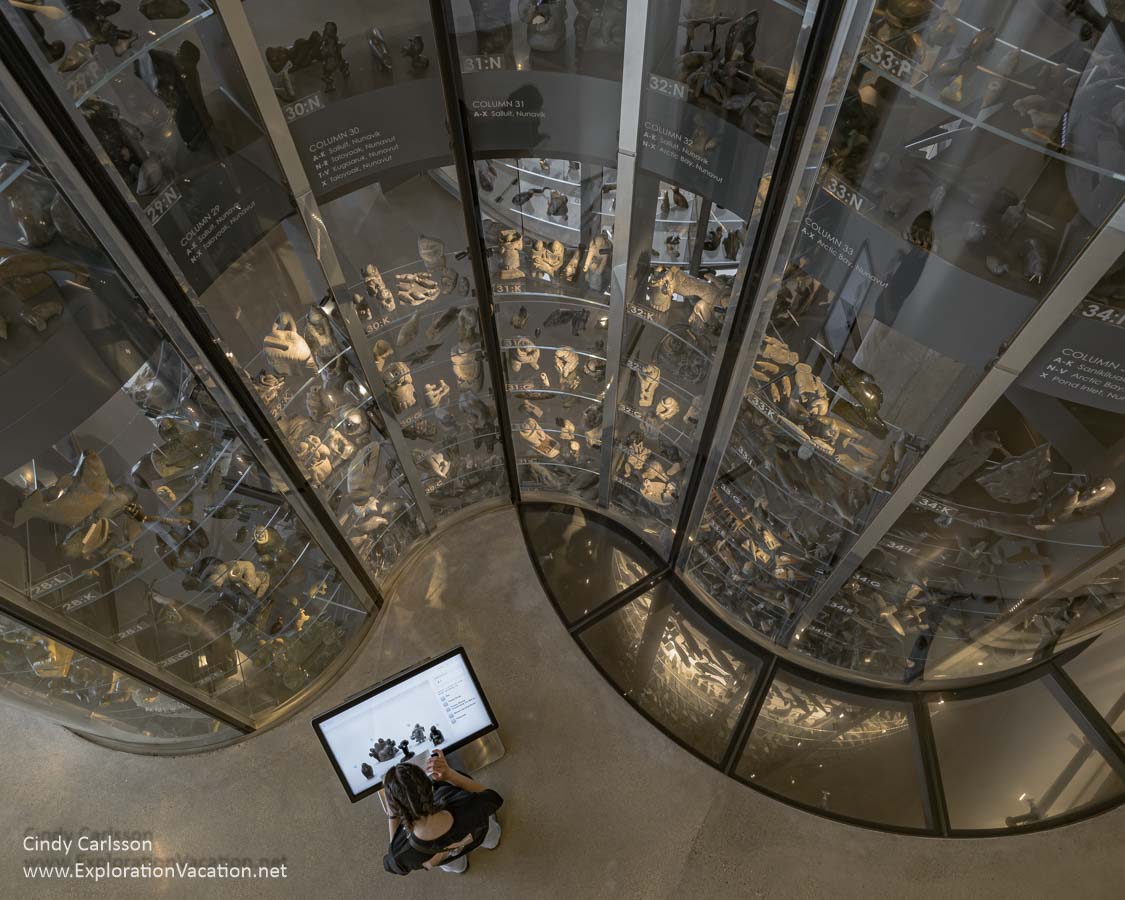
Type in the code number for a shelf, and a computerized search system brings up all the information the museum has on each piece on that shelf.
So now a significant portion of the art in storage is also part of a very large permanent exhibit!
But it’s not perfect
As cool as it can be, I have a love/hate relationship with the Visible Vault. Thus, I recommend you keep your expectations in check when it comes to this part of the art museum.
At least for the first few years, the electronic information boards seldom (mostly never) worked when we were visiting. However, most recently, they were all working beautifully – and it sounded like they had gotten a major upgrade that would keep them working for a while. But software always gets buggy over time (and the public can be really hard on electronics), so the museum will really have to stay on top of this to keep these working.
The bigger issue is the location, design, and materials used to construct the Visible Vault itself. While the concept is brilliant and it’s a gorgeous piece of architecture, the vault’s functionality as an exhibit space leaves a bit to be desired.
That elegant curved glass surface is HIGHLY reflective. And it’s located by large windows on two sides with nothing to block the incoming light. That results in so many reflections and glare that it can be impossible to actually see anything in large portions of the vault at various times of day.
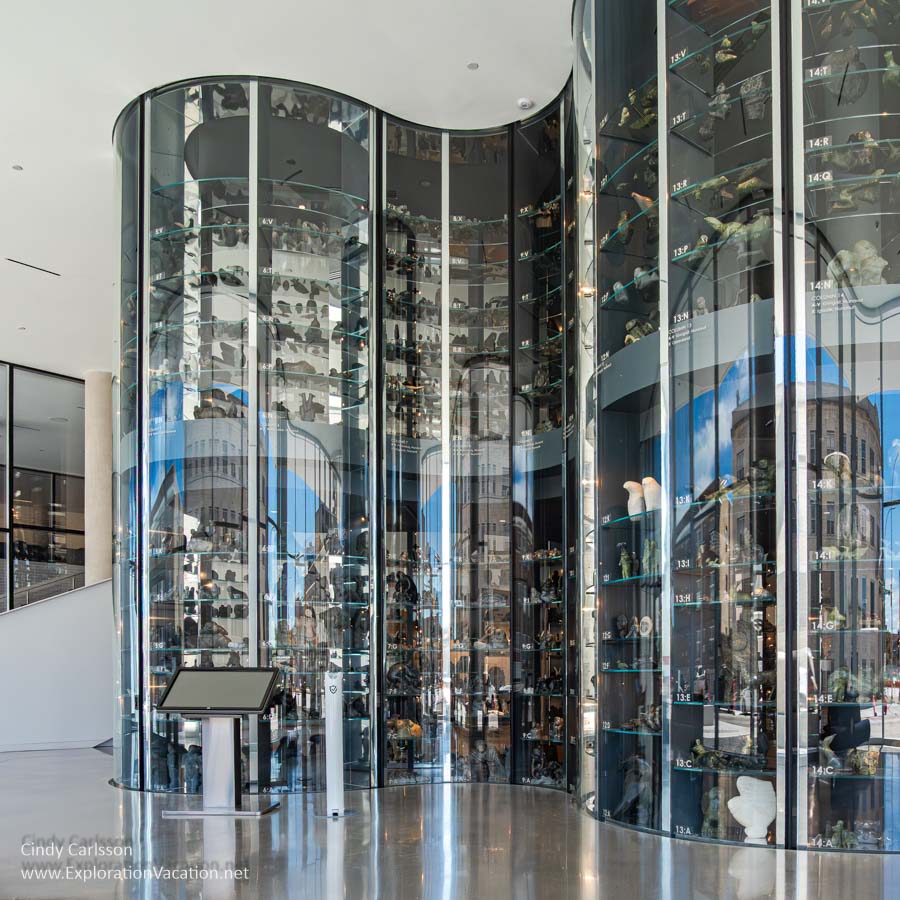
Look at all those cool buildings reflected in the glass! Too bad they make it just about impossible to see the art in the case behind them.
The thing is, this would be absolutely fabulous in a darkened room.
But it isn’t in a dark room.
Tips for viewing the art in the vault
The glare and reflections on the glass move with the angle of the sun throughout the day. That means you should look at the vault when you first arrive and then again just before you leave. You will be able to see into at least somewhat different areas each time.
Evenings or really dark, rainy days, might be the best time to visit. However, I think bright cloudy days are just as bad as sunny days. (Different, but still not good.)
Inside Qaumajuq’s Visible Vault
The Visible Vault is actually part of the Winnipeg Art Gallery’s working storage area. It’s even set up with a hideaway work area on each level where staff can work with a piece without moving it out to another area.
This space isn’t open to the public. However, tours are occasionally available for collectors and art groups. So, if you are really into Inuit art, you might come across an opportunity to get INSIDE the Visible Vault.
If so, don’t pass it up!
You probably won’t get to spend much time in there, but it’s cool to be surrounded by a tower of art.
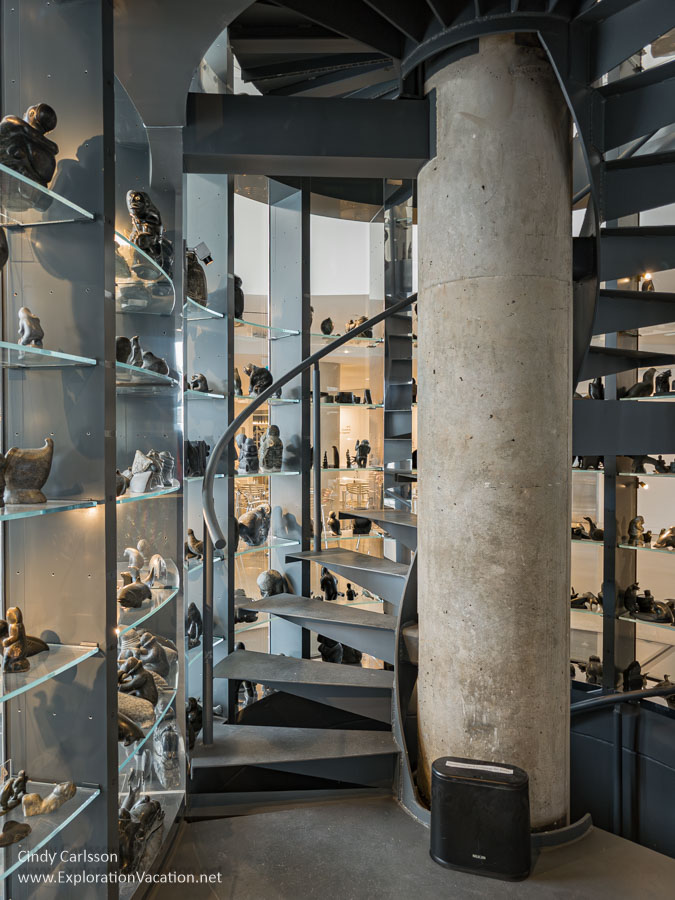
The view from inside the Visible Vault.
It’s a smaller space in there than I anticipated, and I didn’t get to climb up to check out a higher level. But it was really fun to see it from inside.
👉 Read less
Other storage and workspaces
Vault tours may also allow you to see the main conservation and storage area located below the Visible Vault. This is where many larger pieces and other art that can’t go in the Visible Vault are stored and where conservation and other work happen. It’s also where pieces on loan are packed and unpacked as exhibits open and close.
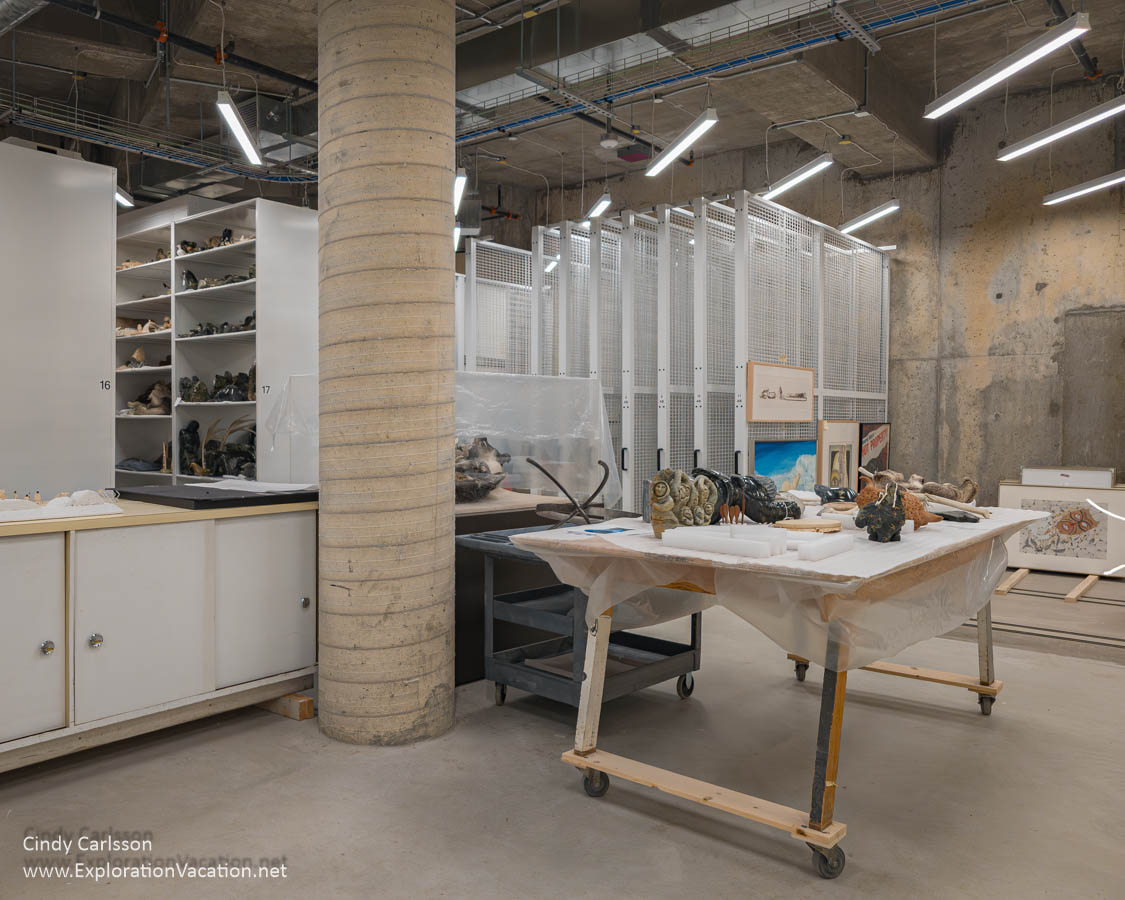
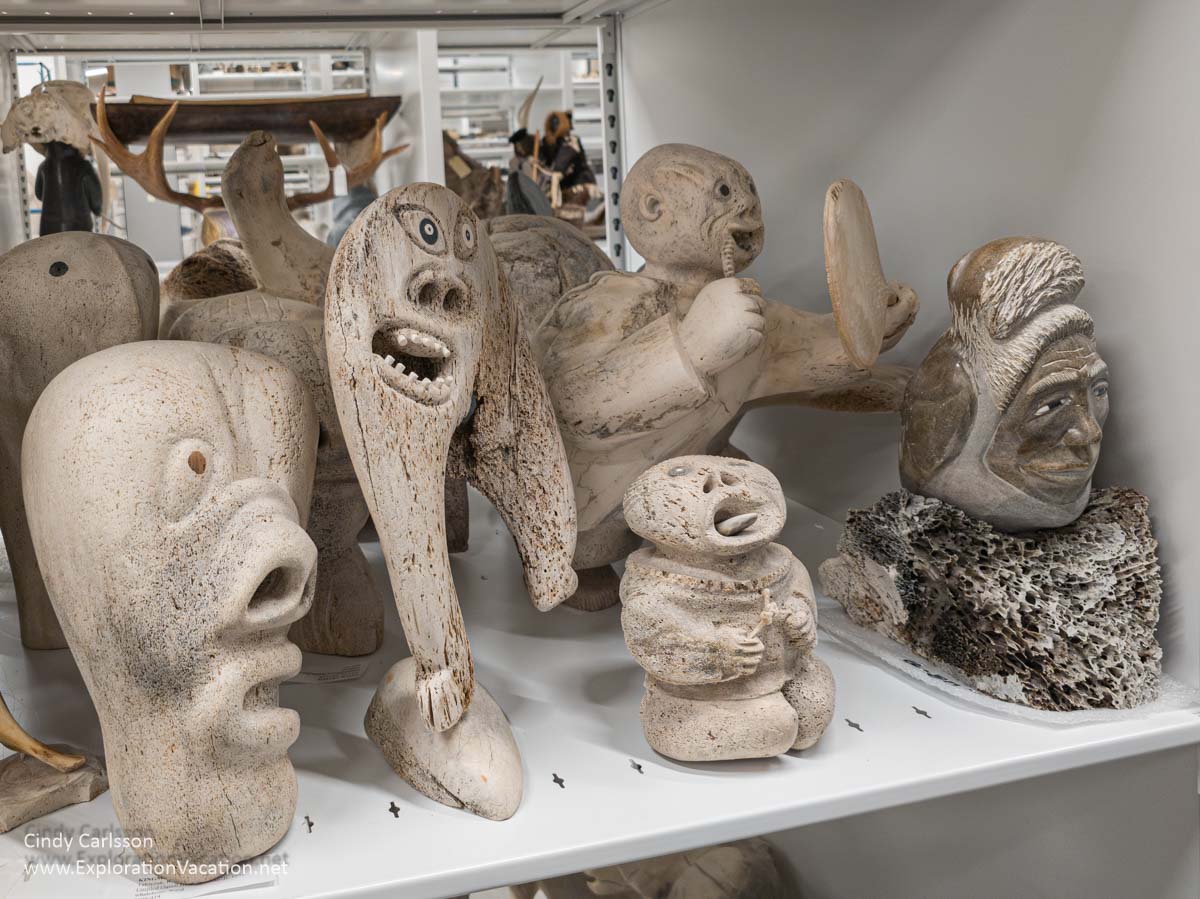
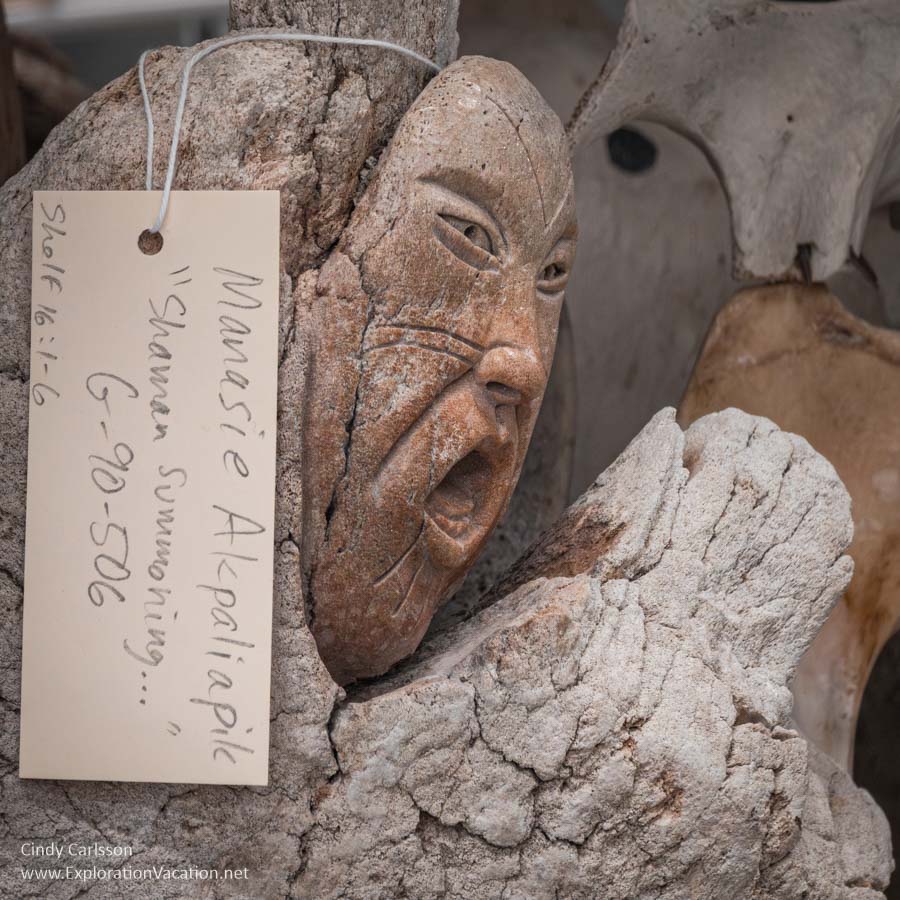
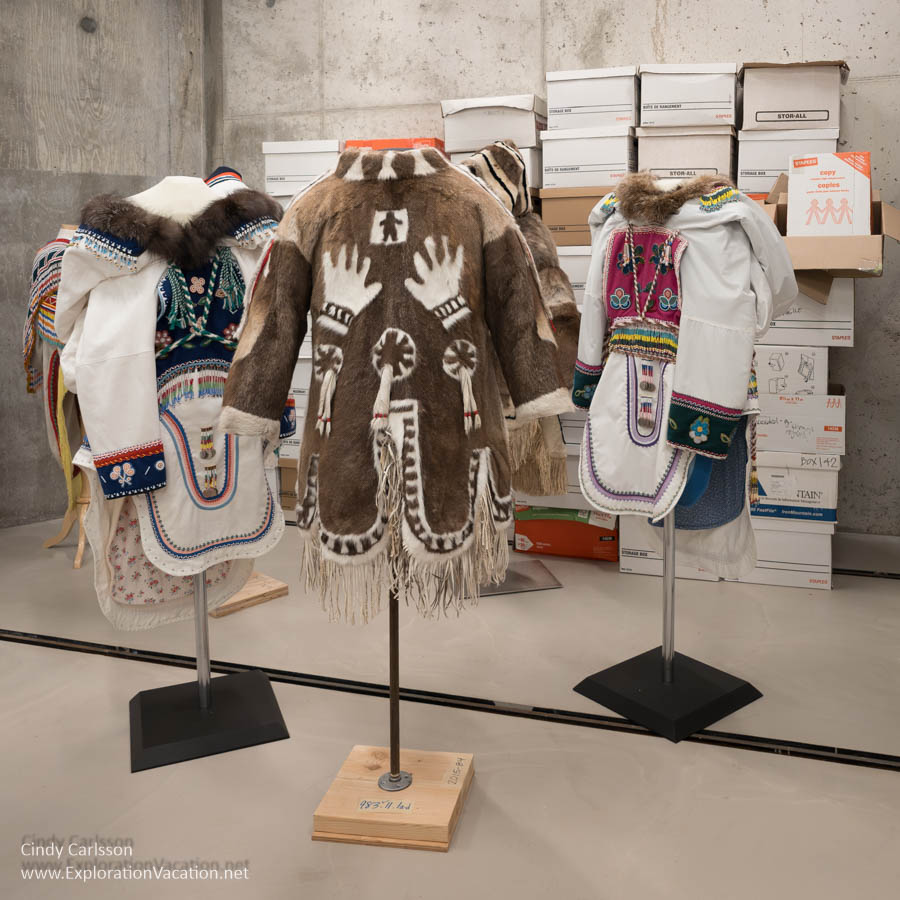
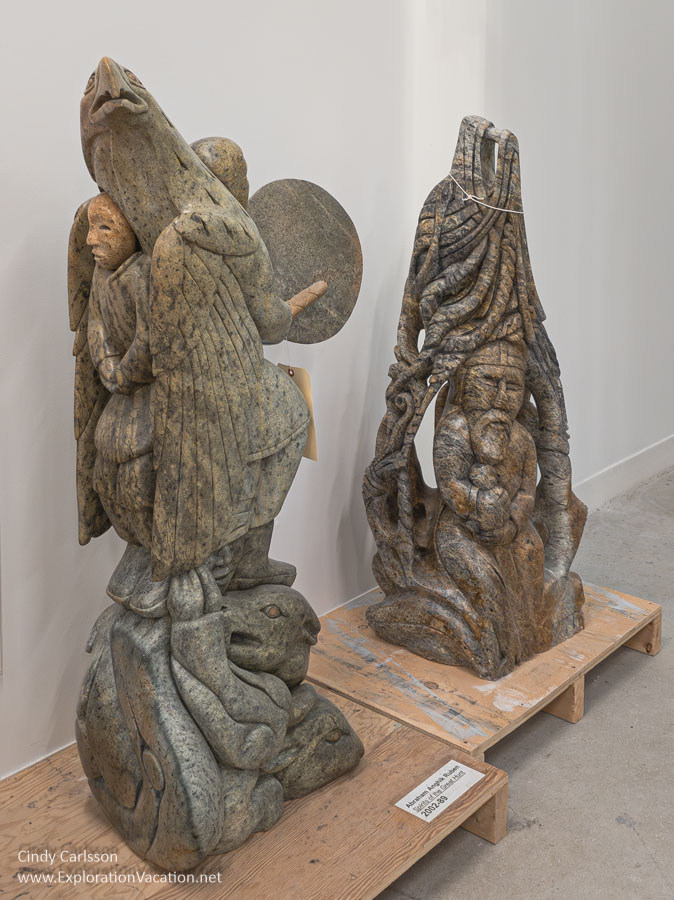
Below the Visible Vault, a large storage and conservation area holds all sorts of treasures.
While some of this space is long-term storage, other areas are used to store and prepare pieces for exhibits and for research and conservation work. That means there can be all sorts of surprises down here.
Like the Visible Vault, if you have an opportunity to actually see this behind-the-scenes workspace, you should take it.
Gallery space in Qaumajuq
While the Visible Vault displays the largest number of pieces, rotating exhibits are held in three distinct gallery spaces.
The names given to these galleries (and other spaces in the new building) are in Inuktitut (an Inuit language), Anishnaabemowin (Ojibway), Nêhiyawêwin (Cree), Dakota, and Michif (Metis). These recognize not only Canada’s Inuit people, but all the Indigenous people of Manitoba.
Qilak (The Main Inuit Gallery)
The main Inuit gallery is Qilak, meaning sky in Inuktitut. It has 8,000 square feet of exhibition space for Inuit art.
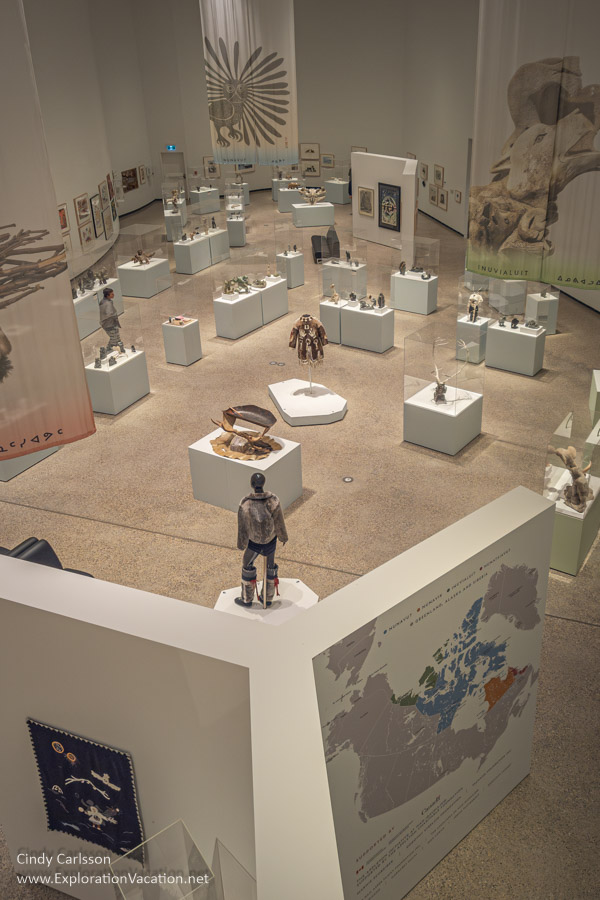
View of the Qilak Gallery from the mezzanine during the Inuit Sanaugangit exhibit.
This towering expanse of white is intended to reflect the natural environments of the far north, putting the art exhibited here into a setting reminiscent of the place where it was created.
👉 Lean more about WAG-Qaumajuq's galleries . . .
I get that the idea is to express the vastness and isolation of the landscape in which Inuit art is (traditionally) based and created. And, for some exhibits, the space works reasonably well. But in other instances it overwhelms the art.
Giizhig/Kisik (The Mezzanine Gallery)
On the upper level, the Giizhig/Kisik Mezzanine Gallery is a broad balcony overlooking the main gallery. The name means sky, heaven, day in Cree/Michif/Ojibway. Despite its openness, it is far more intimate than the main gallery below. It’s also a great spot for smaller exhibitions, events, and ceremonies.

Qilak, Main Inuit Gallery, Qaumajuq, the Inuit Art Centre at the Winnipeg Art Gallery. Photo by Lindsay Reid
I love the look of this gallery. It appears to offer a perfect balance between vast open spaces and the ability to closely connect with the art. And, as intended, it should be a wonderful performance space. I can imagine words and music drifting down to those below like voices from the spirit world.
Pimâtisiwin (The Focus Gallery)
The third formal exhibit space is the Focus Gallery. Its name is Pimâtisiwin, a Cree/Ojibway phrase meaning life and the act of living, to be alive. The name reflects the use of this gallery for video, film-based exhibitions, or shows that require a more intimate, light-sensitive environment.
One of the exhibits held in this room was Dark Ice, featuring glowing photos, paintings, and videos that looked at climate change in the north.
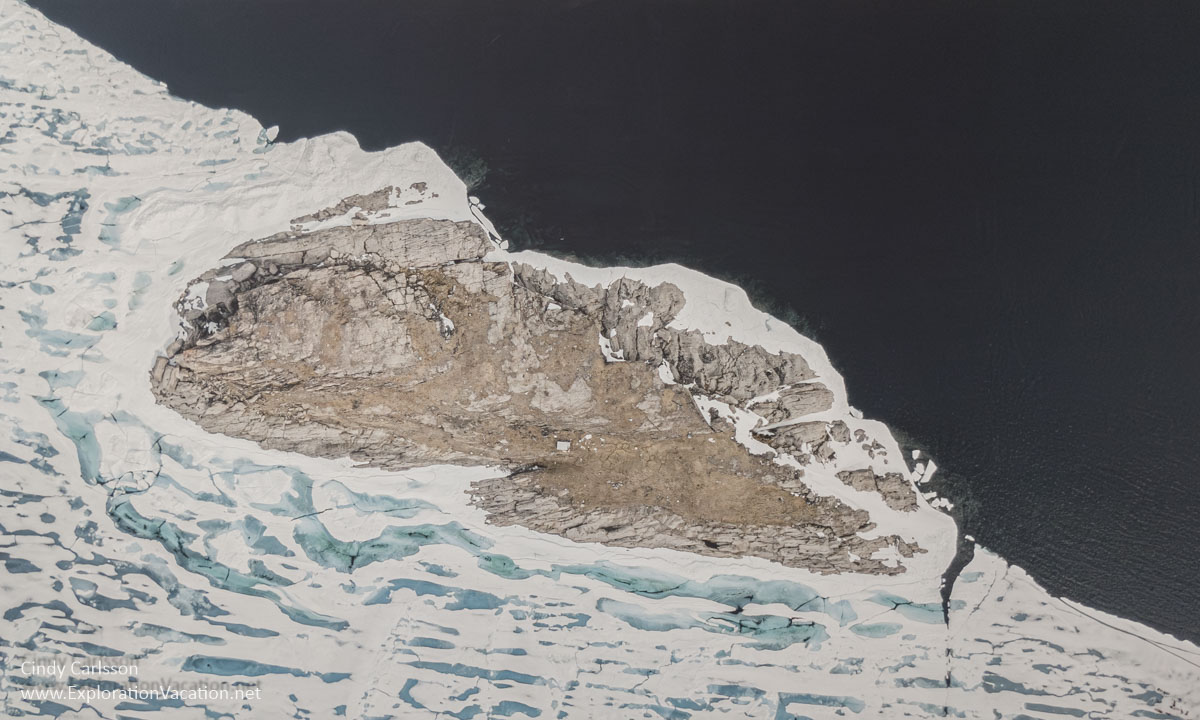
A drone image of Umiujaq (Agnes Monument) by Robert Kautuk in the Dark Ice exhibit.
👉 Read less
The gift shop at WAG-Qaumajuq
If you are looking to buy Inuit or other Canadian art or crafts, the WAG-Qaumajuq is very much worth a stop. They carry a good selection of fine art, crafts, books, textiles, and nicer Canadian souvenirs at fair prices.
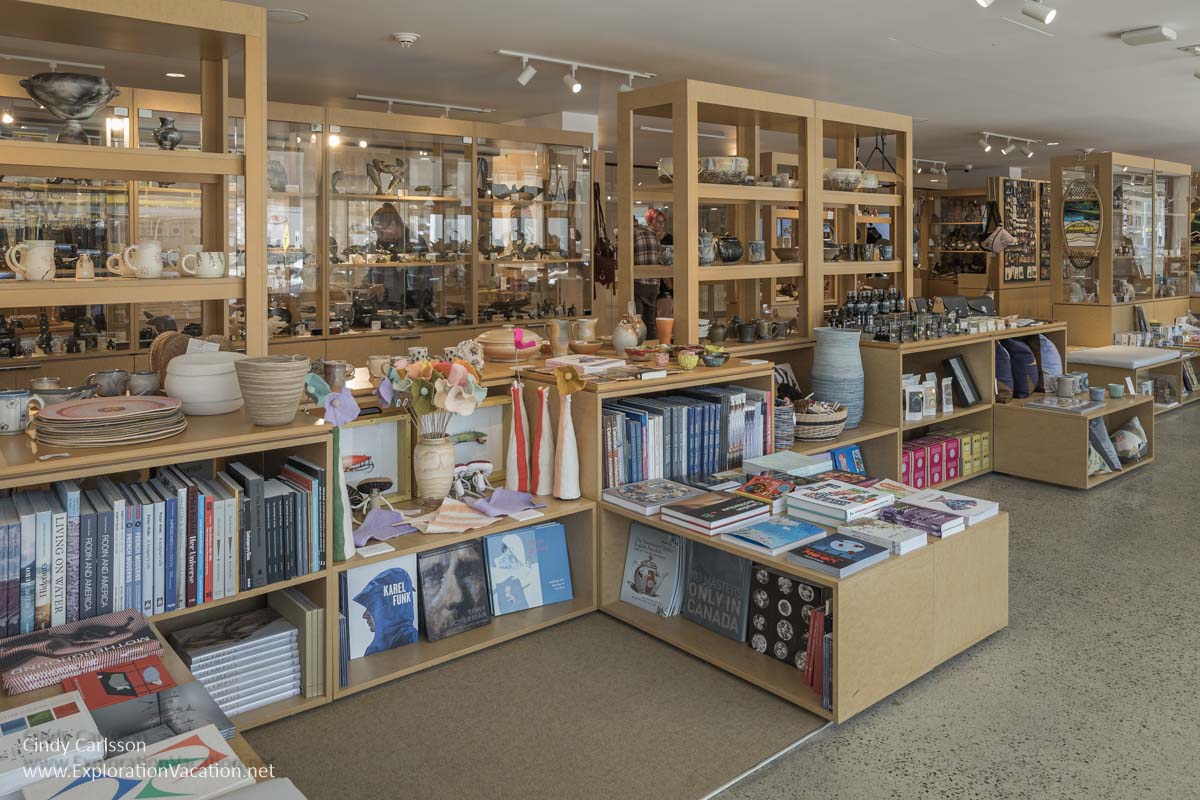
From fine art to toys, you’ll probably find it in the WAG-Qaumajuq gift shop.
Museum members get a discount, so you can save money by joining the museum if you plan to do some serious shopping before you leave.
And you can shop online too!
Other spaces
While Qaumajuq offers a lot of gallery space, it also has a great theater, reading room, expanded library, and studio space for classes and demonstrations.
Exhibits at Qaumajuq
Since Qaumajuq’s opening in 2021, three major exhibits have filled the main gallery. A number of smaller exhibits have used the smaller gallery spaces. And keep in mind that Inuit art is also displayed in lobby areas, outdoor plazas, and as part of some exhibits in the original WAG building. (More on what you’ll find there below.)
As of winter 2026, Qaumajuq has been the site of three major (and I do mean major) exhibitions:
- (2025/2026) A retrospective of work by Abraham Anghik Ruben
- (2023/2025) Inuit Sanaugangit, a pan-Arctic survey of art from 200 BCE through the present day
- (2021/2023) INUA, Qaumajuq’s inaugural celebration of Inuit art, curated by Inuit artists and scholars
Major exhibits tend to remain for about a year. Sometimes they are extended to stay around a bit longer, but the curators do a wonderful job of finding pieces held by other museums and galleries, private collections, and the artists themselves. That makes it challenging to change the exhibition schedule.
Abraham Anghik Ruben (through May 2026)
Abraham Anghik Ruben is a master sculptor whose work is featured in major museums and collections around the world. This exhibit is a major retrospective that follows milestones in his life and how they influenced his work. It includes many personal reflections on what ideas shaped each piece.
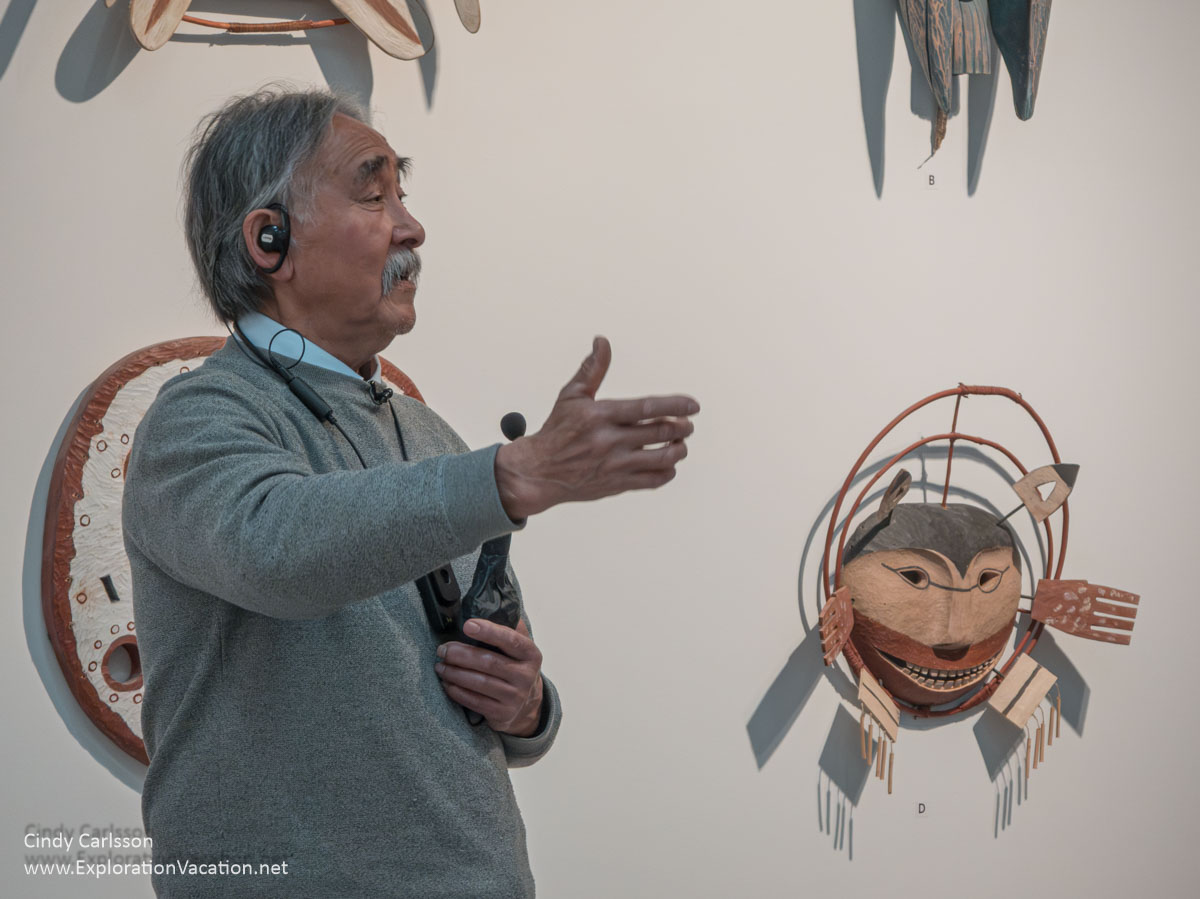
Anghik Ruben discussing the masks he created modeled after the masks his grandfather used as a shaman.
Anghik Ruben was born into a traditional family that migrated between hunting and fishing camps with the seasons. That life ended when he was 8. Like his siblings and so many other indigenous children in Canada, he was removed from his home and sent to a residential school where he remained until he was an adult. From there, Anghik Ruben studied art, using traditional materials to tell the ancient stories of the Inuit. Over time his interest in Inuit and Norse contact long ago became a major theme in his work.
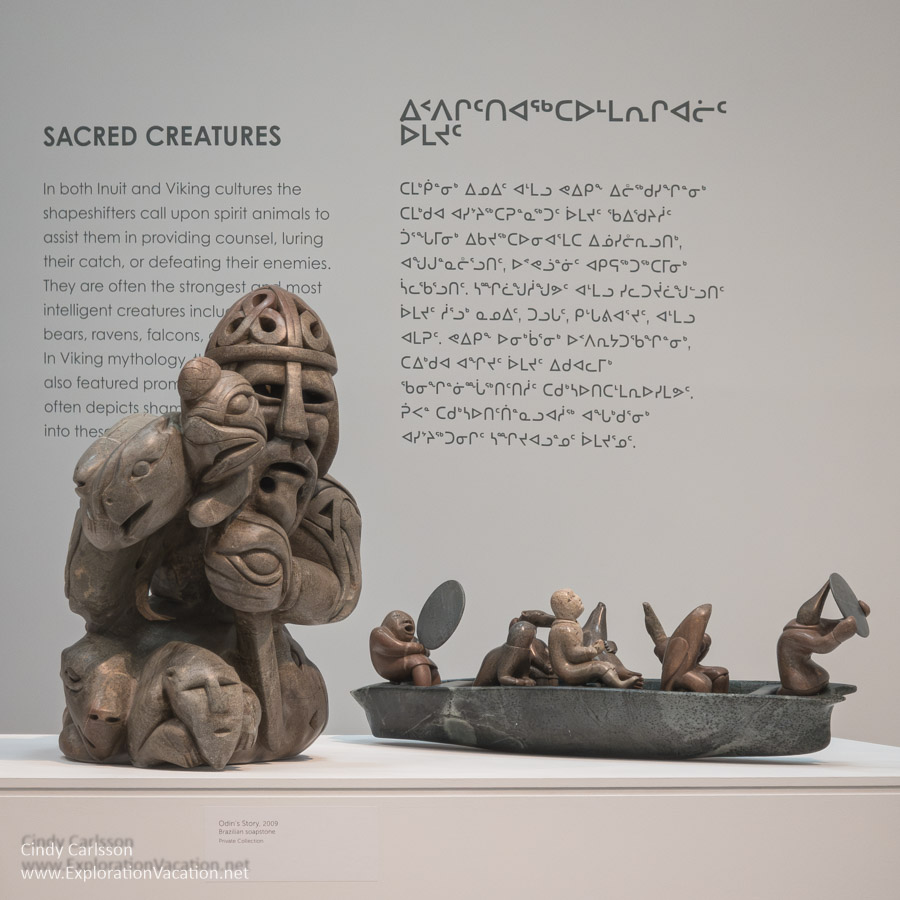
“Odin’s Story” and “Into the Sunset.”
The WAG-Qaumajuq retrospective includes over 100 sculptures and paintings created between 1975 and 2025. These include pieces in the WAG’s collection, as well as work from other public, corporate, and private collections. The number of pieces from private collections is especially notable, and you are unlikely to see these in other exhibitions.
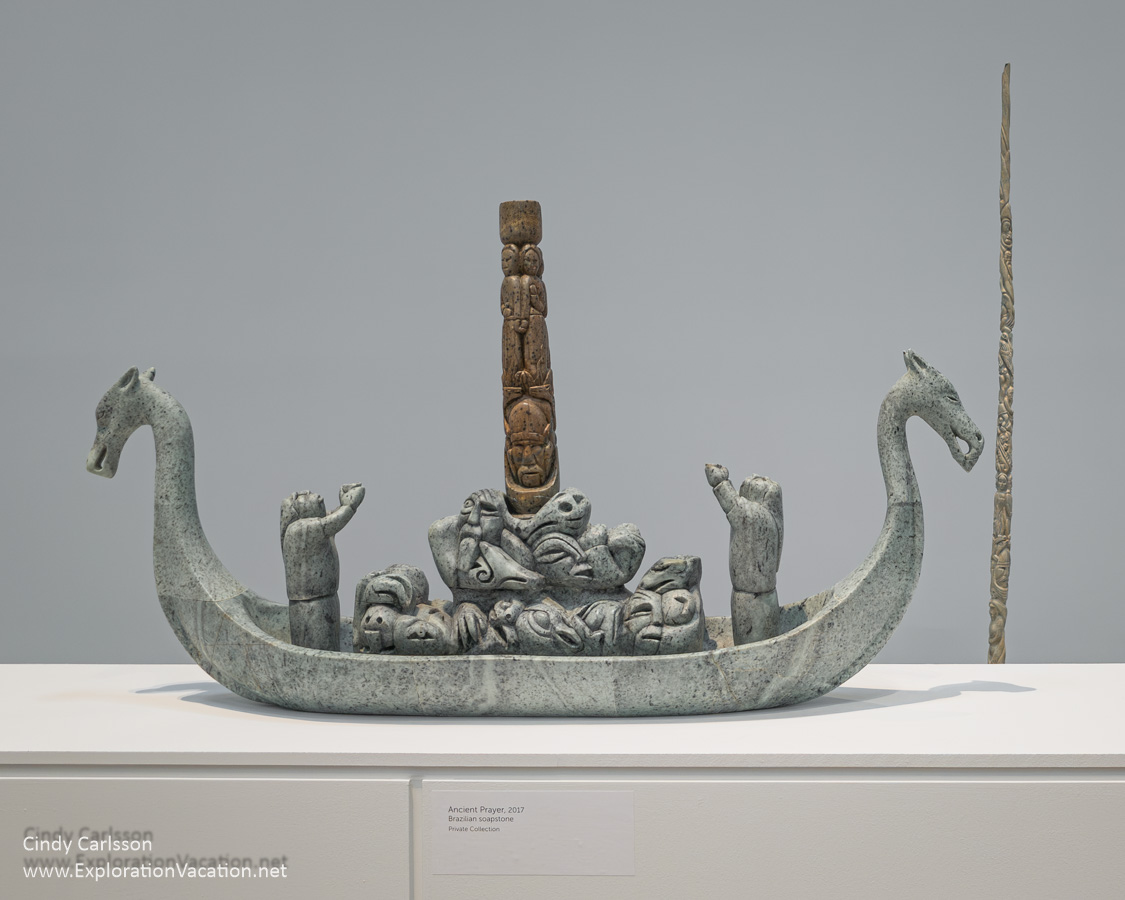
“Ancient Prayer” with a bronze that looks like a carved narwhal tusk called “North Atlantic Saga.”
The gallery space is arranged more or less by themes such as Beginnings, Shapeshifters, Sacred Creatures, Life Givers, Migration, and more. But there are many pieces that fit multiple themes.
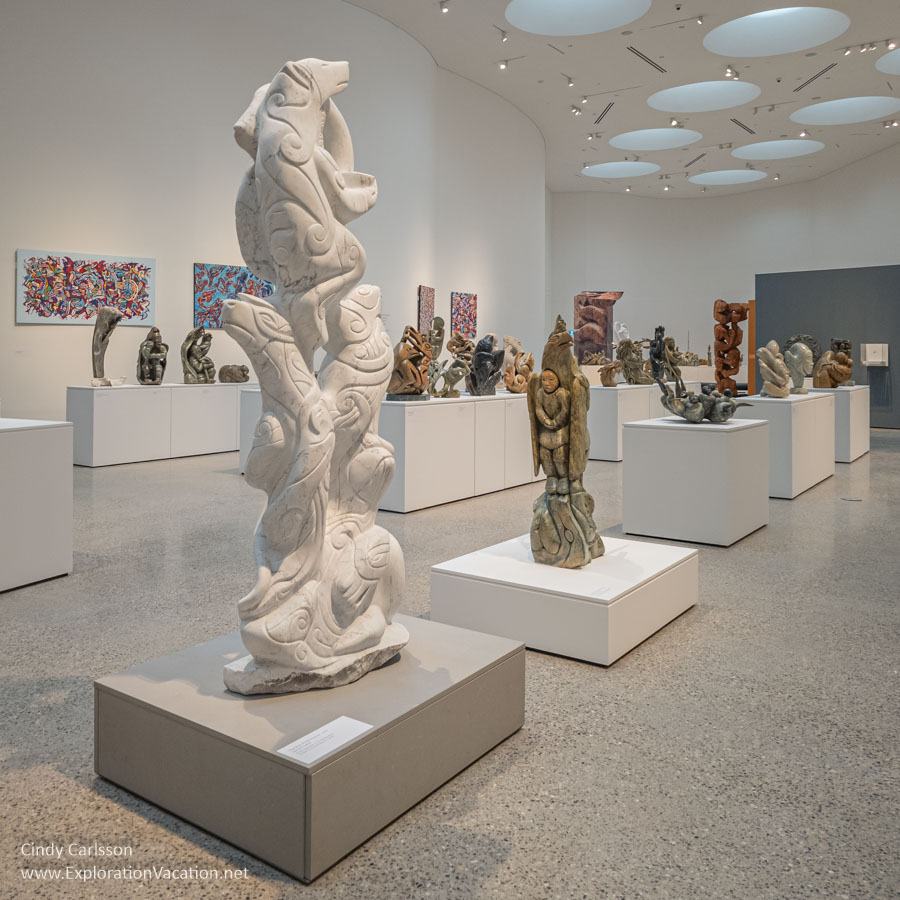
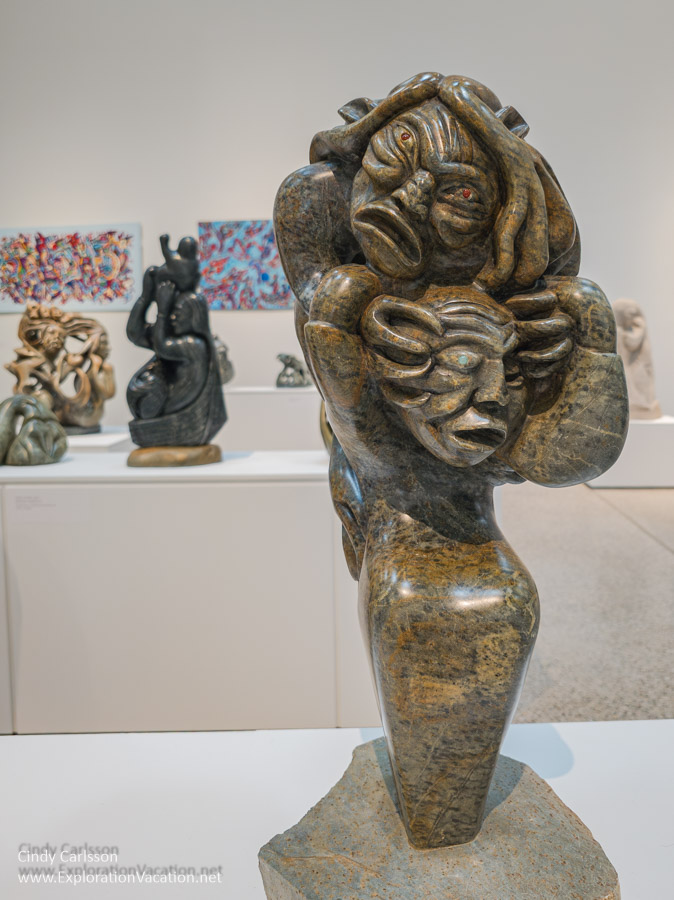
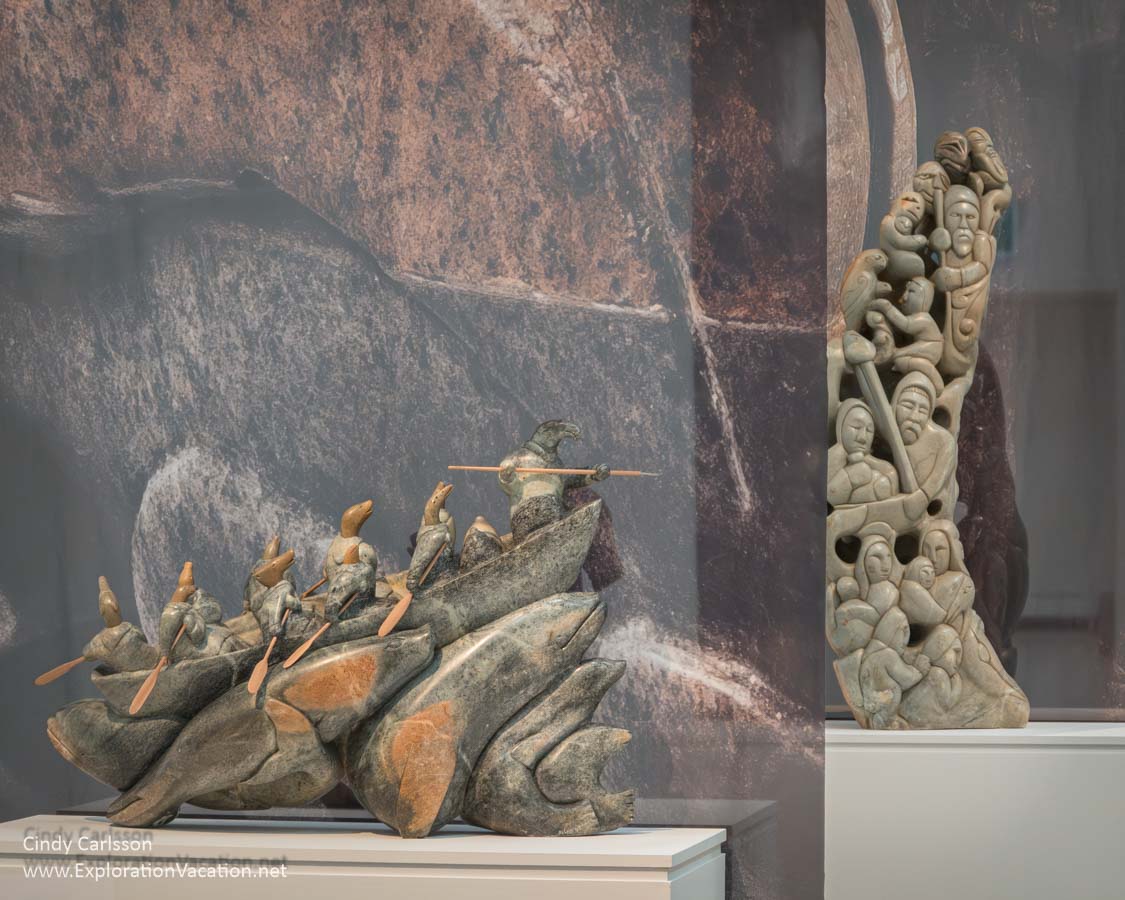
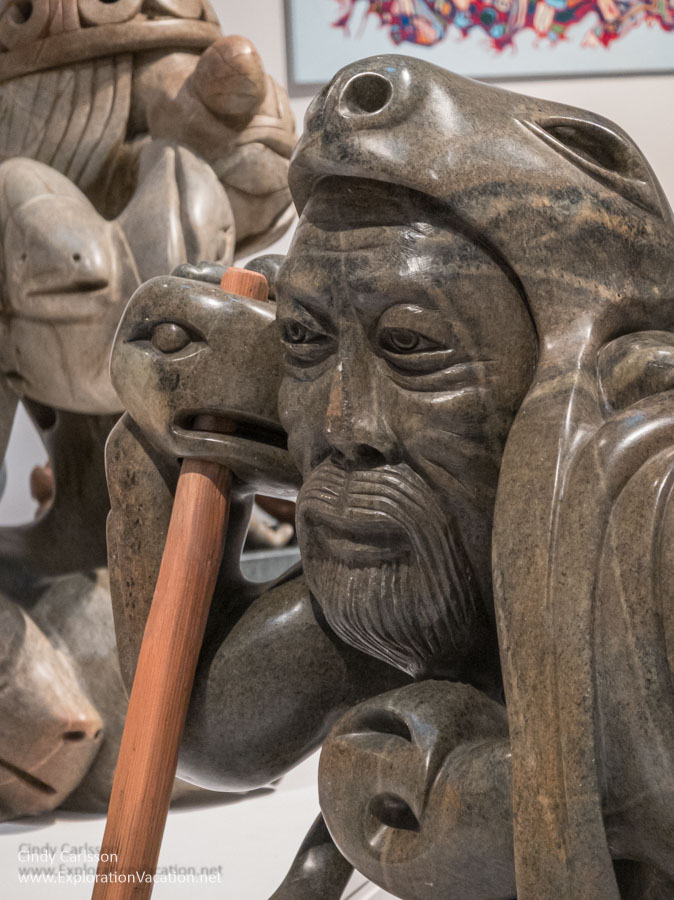
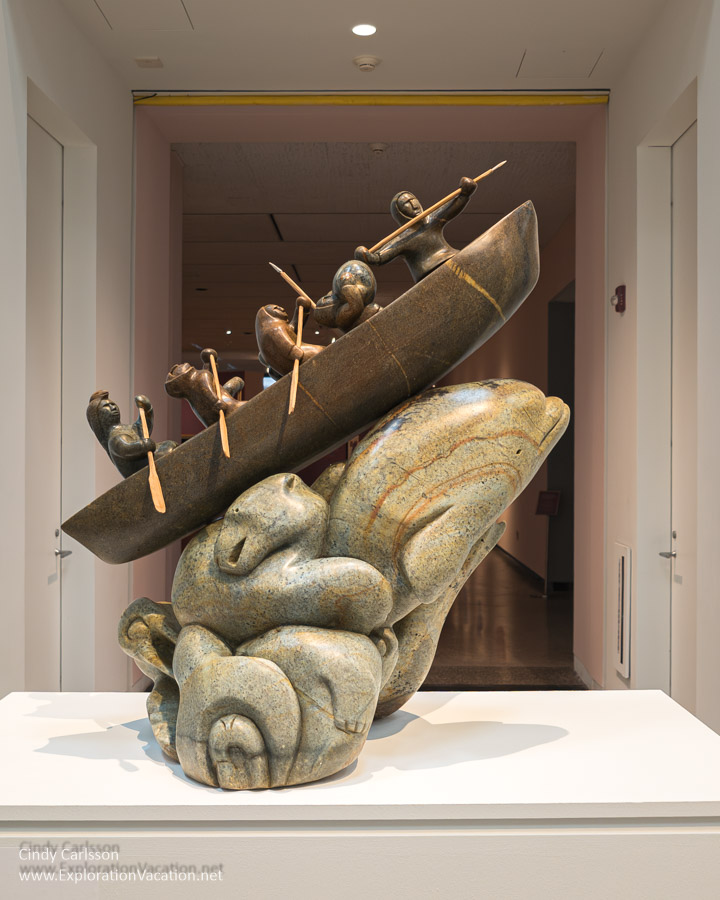
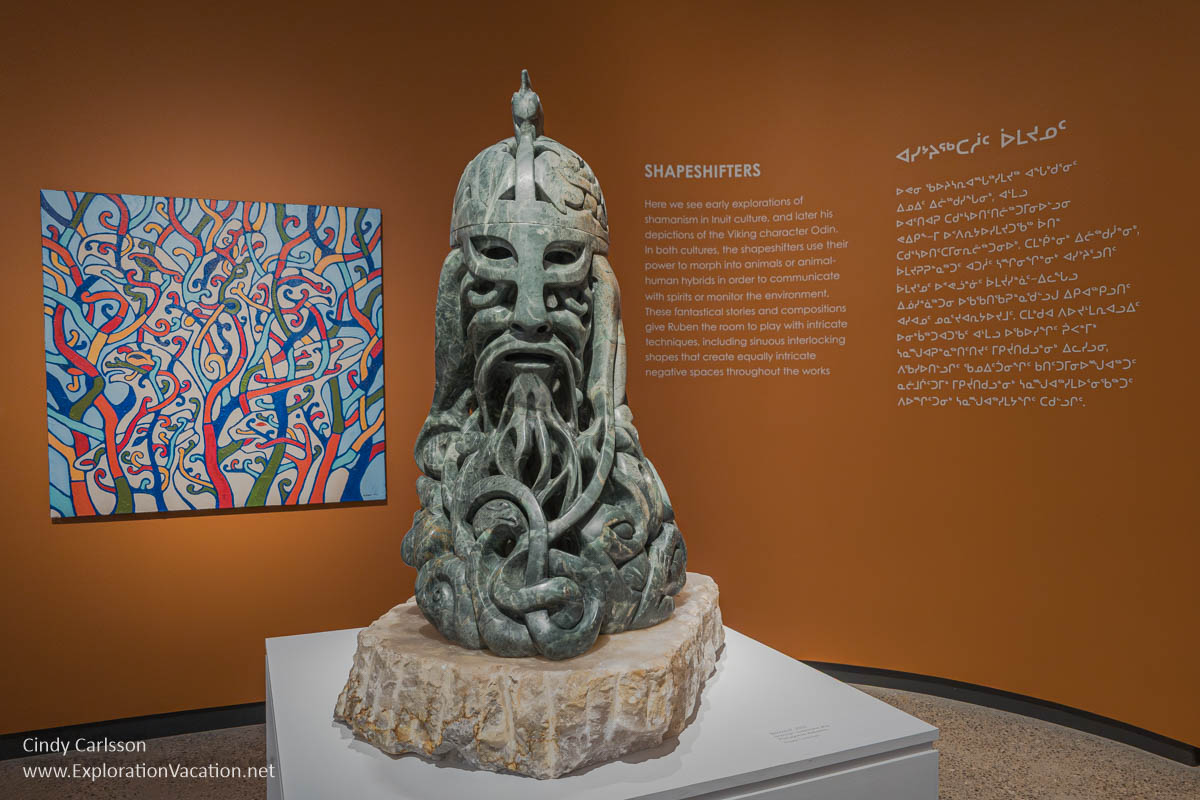
Just a few of the wonderful pieces included in the Abraham Anghik Ruben retrospective.
Learn more about Abraham Anghik Ruben and his work
The WAG-Qaumajuq page on the exhibit includes links to a number of interviews with Anghik Ruben. (Scroll almost to the bottom of the page.) Anghik Ruben is a deep thinker and a good storyteller. That means it is well worth checking out some of the interviews. He’s thought deeply about what his own work means and how it is based in his life experiences and what he has both learned and imagined about the intersections of Inuit and Nordic culture.
You might also want to splurge on the gorgeous book Darlene Coward Wight produced for the exhibit. It’s beautifully illustrated and includes Anghik Ruben’s stories about each piece. (Museum members get a discount.)
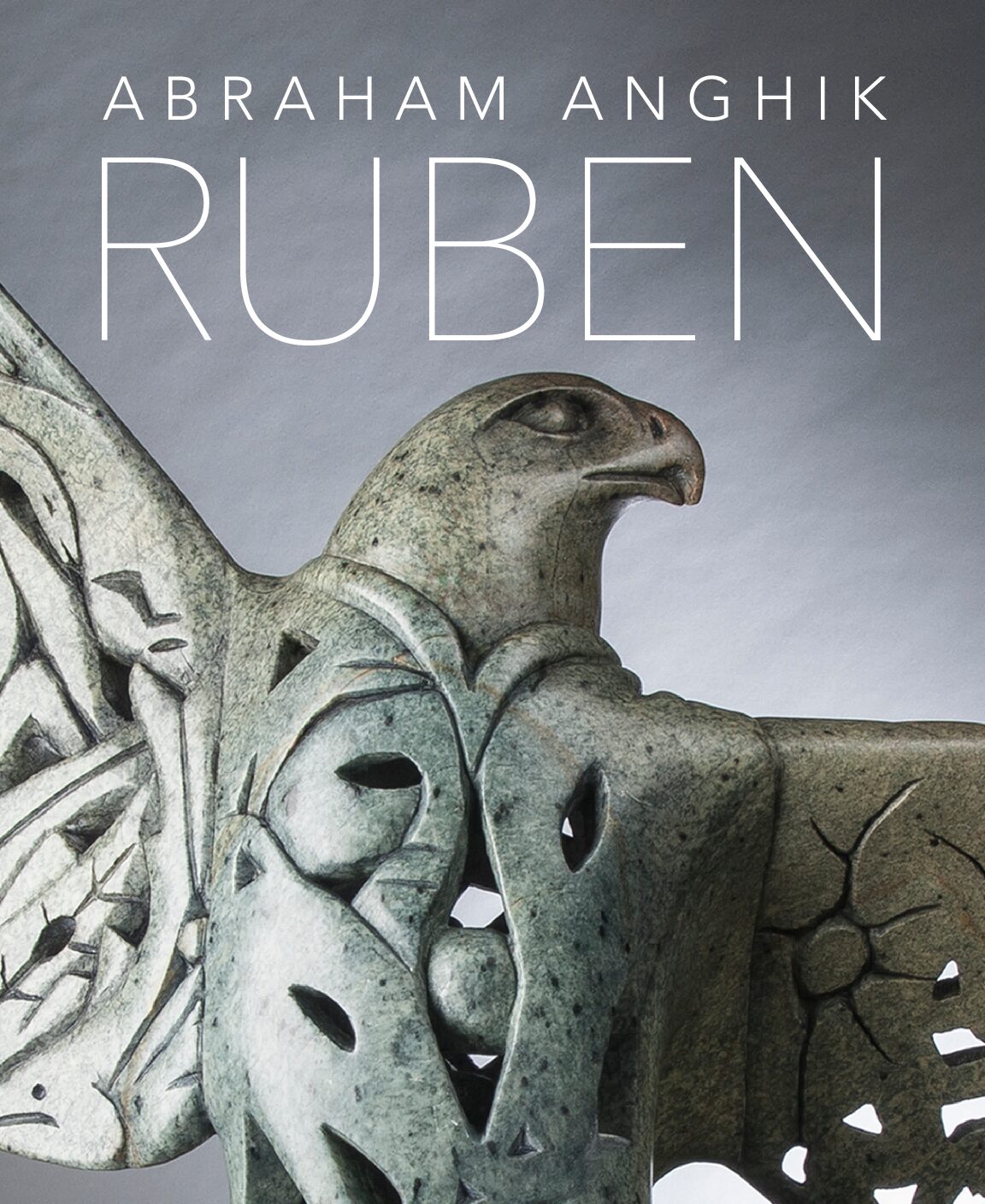
The WAG always does beautiful exhibit books, and the personal stories make this one a standout. (Photo from the WAG-Qaumajuq)
Inuit Sanaugangit: Art Across Time
The second exhibit held in the main gallery was Inuit Sanaugangit: Art Across Time.
This survey of Inuit art from across the Arctic was on view between April 2023 and February 2025. With nearly 400 pieces created by artists from Alaska, Canada, Greenland, and Siberia between 200 BCE and the present, this was an absolutely massive exhibit.
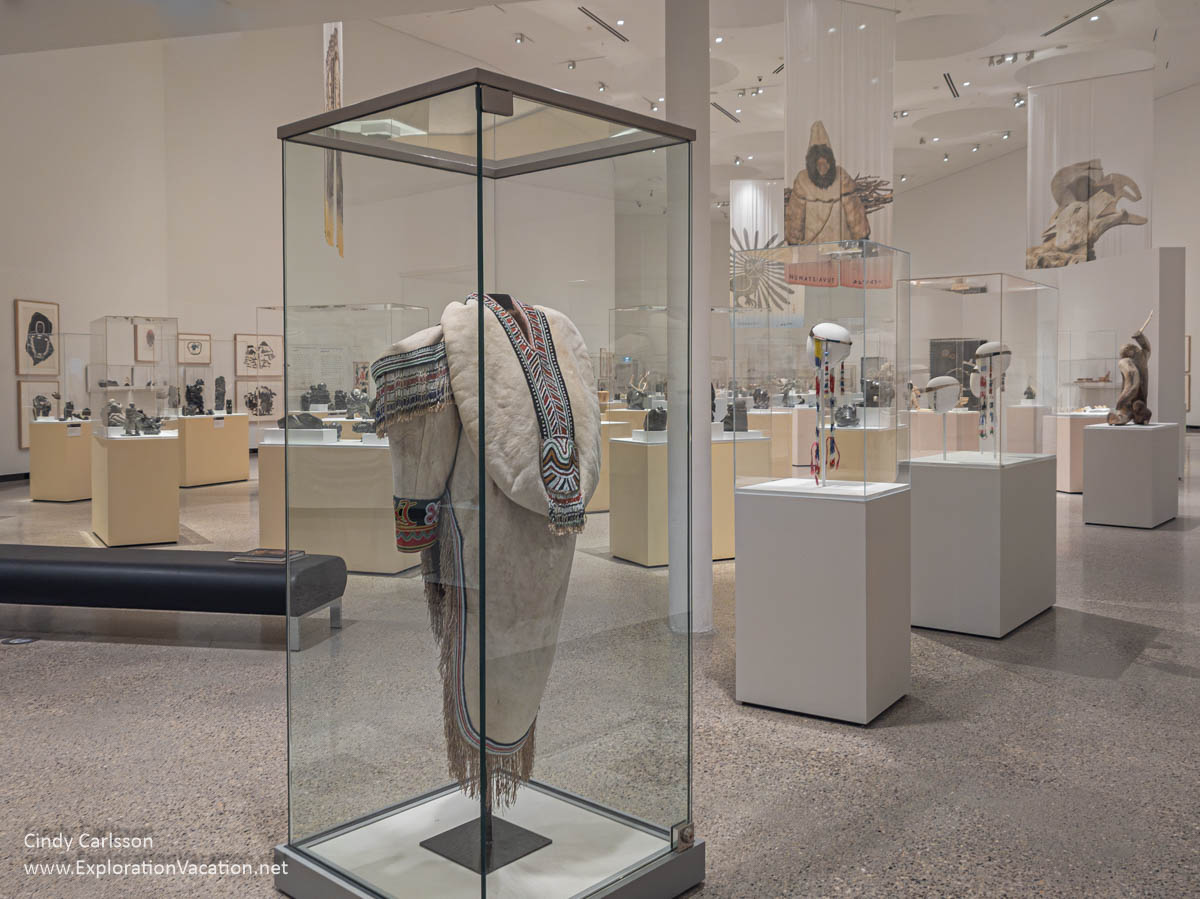
Clothing, tools, toys, fine art, and more spanning time and the Arctic . . . This exhibit had it all.
By focusing on highlights from many regions and communities, Inuit Sanaugangit reveals the widely distinctive modes of expression that characterize the art from different regions and time periods. These differences are evidenced in media, subject matter, as well as stylistic and aesthetic approaches.” (WAG-Qaumajuq)
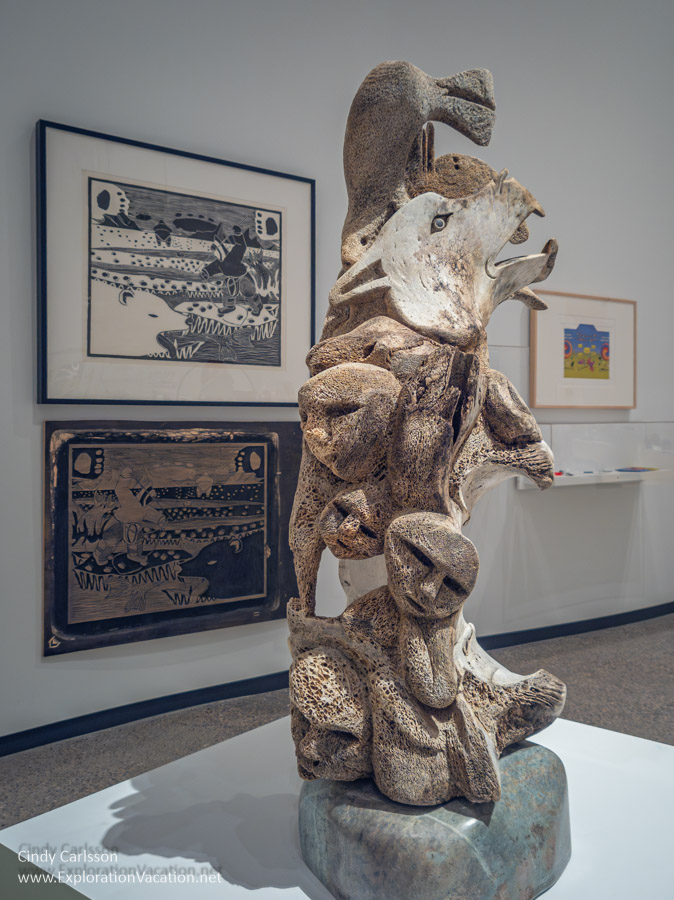
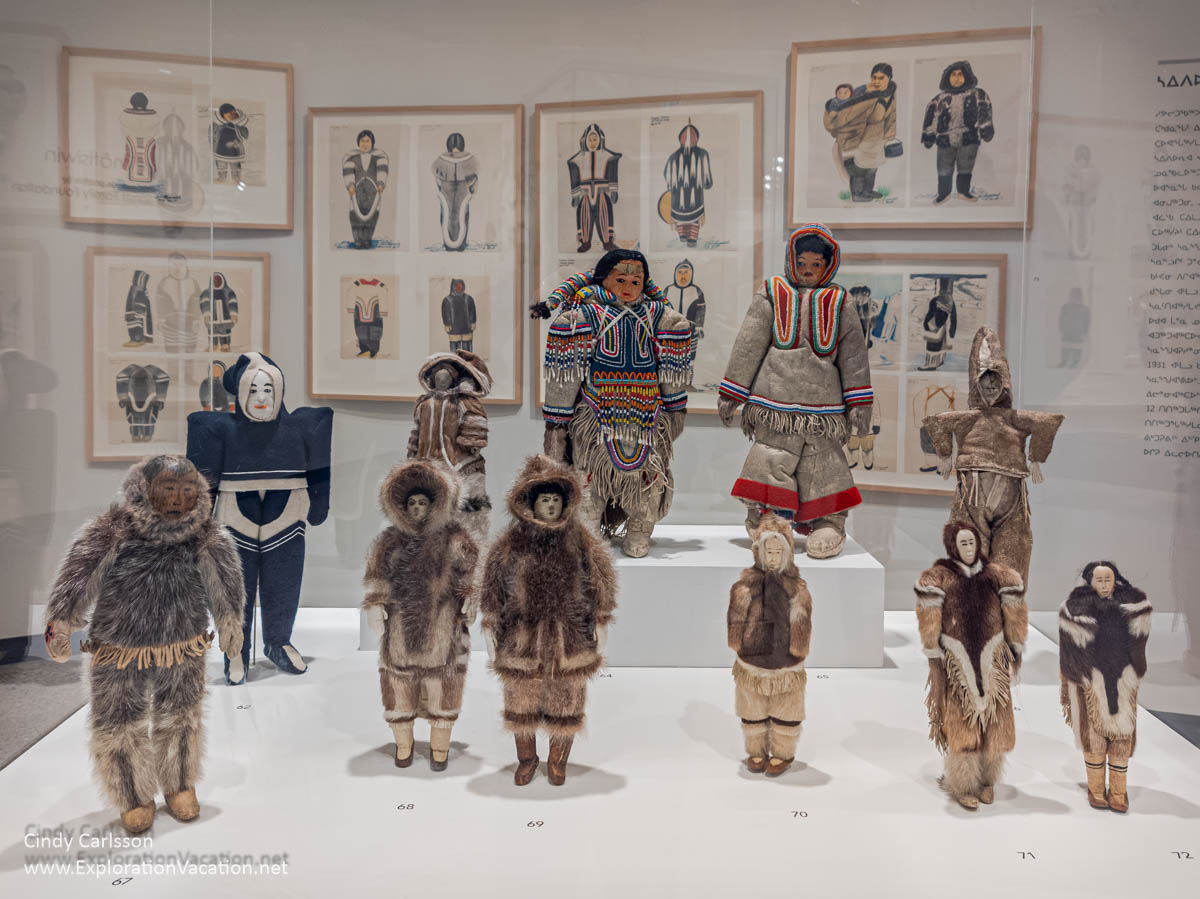
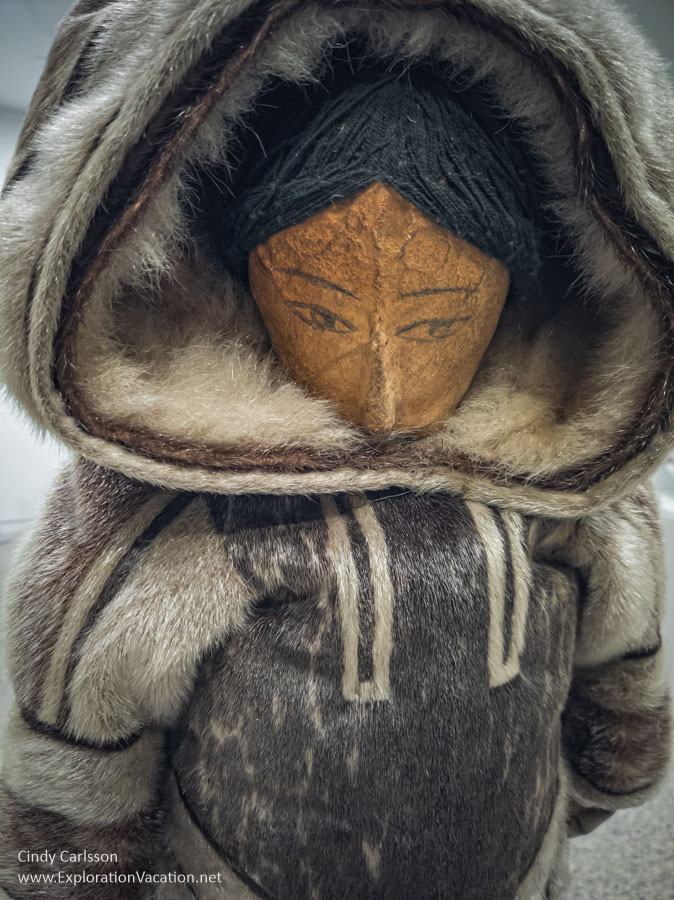

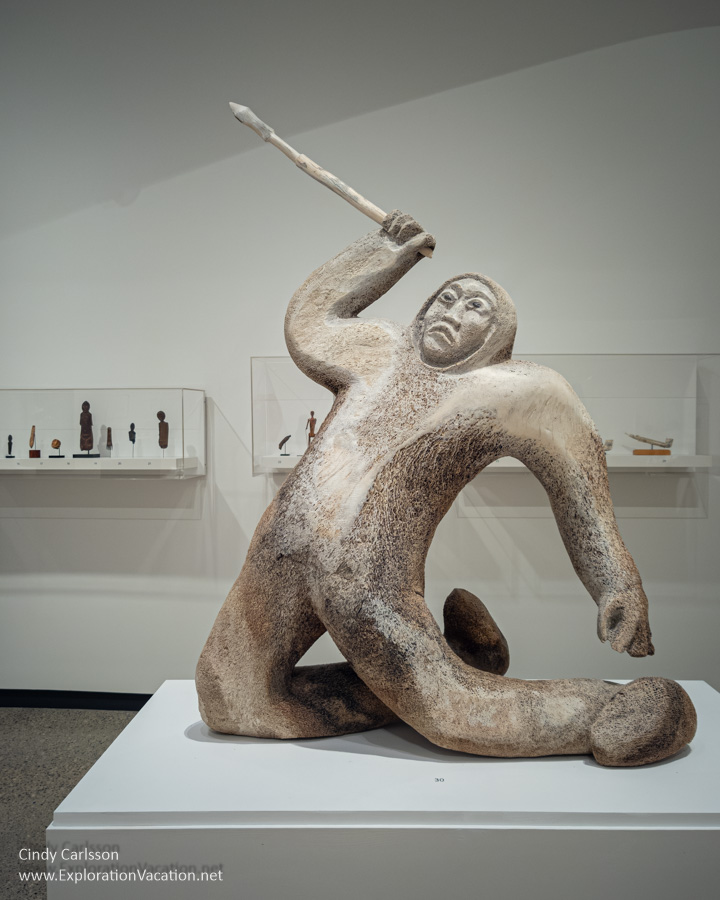
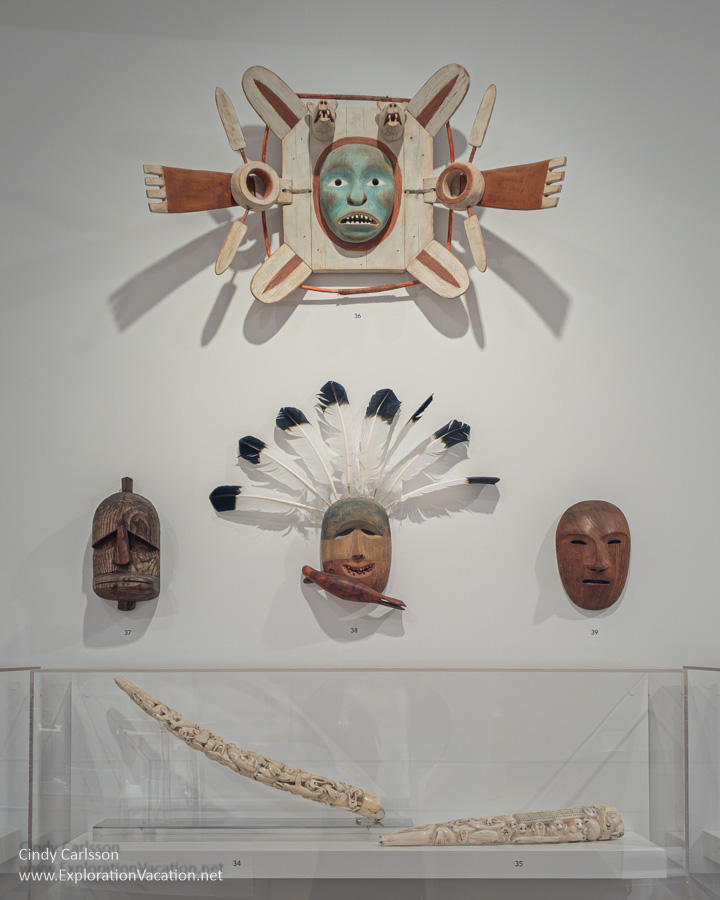
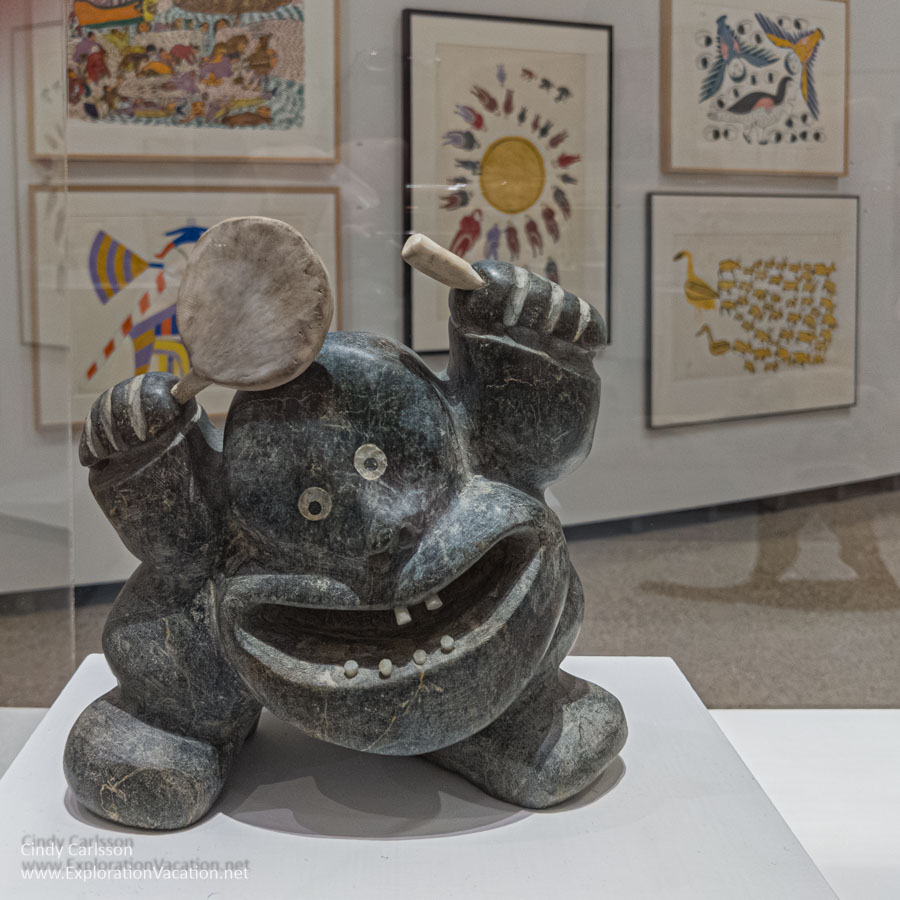
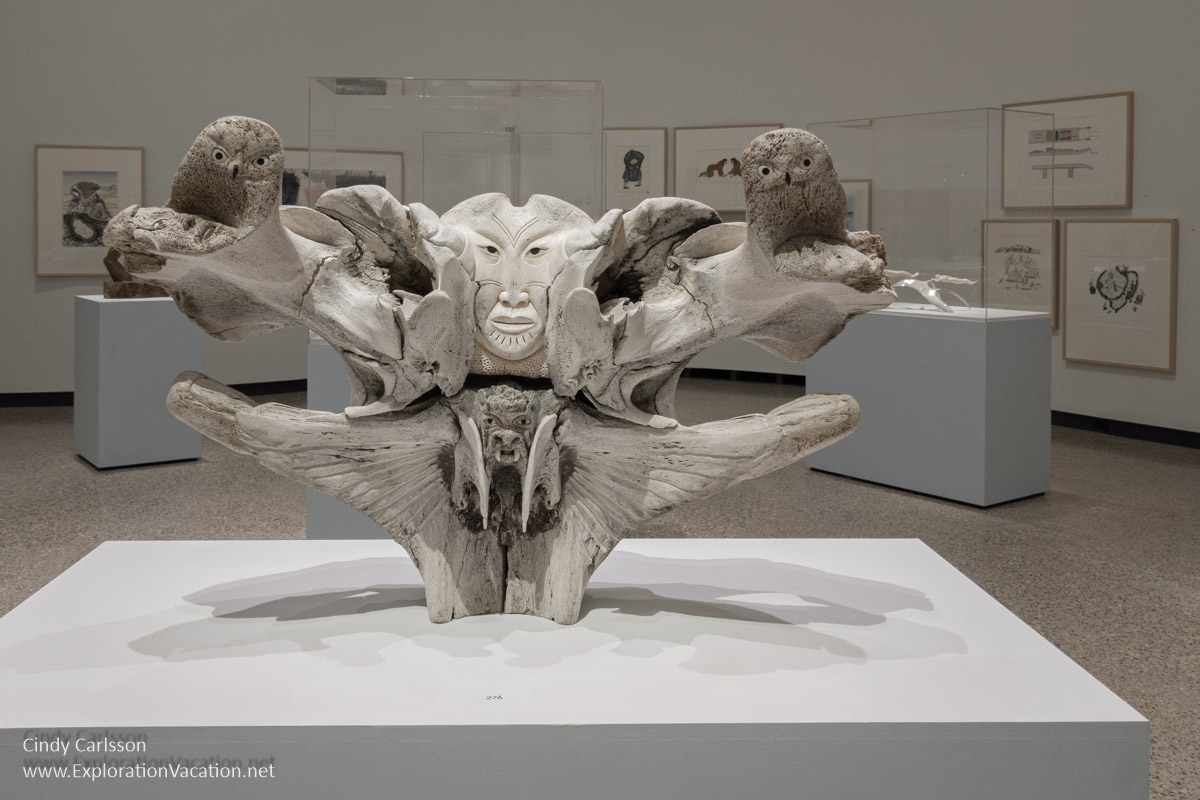
Just a tiny sample of what was included in the exhibit.
This show was so large it was completely overwhelming. We really needed to visit over a couple of days, but we didn’t get up to Winnipeg until shortly before closing and needed to get back home over a snowstorm!
Qaumajuq’s opening exhibit: INUA
INUA was the first show held in Qaumajuq’s main Qilak gallery. The exhibit ran from March 2021 through February 2023.
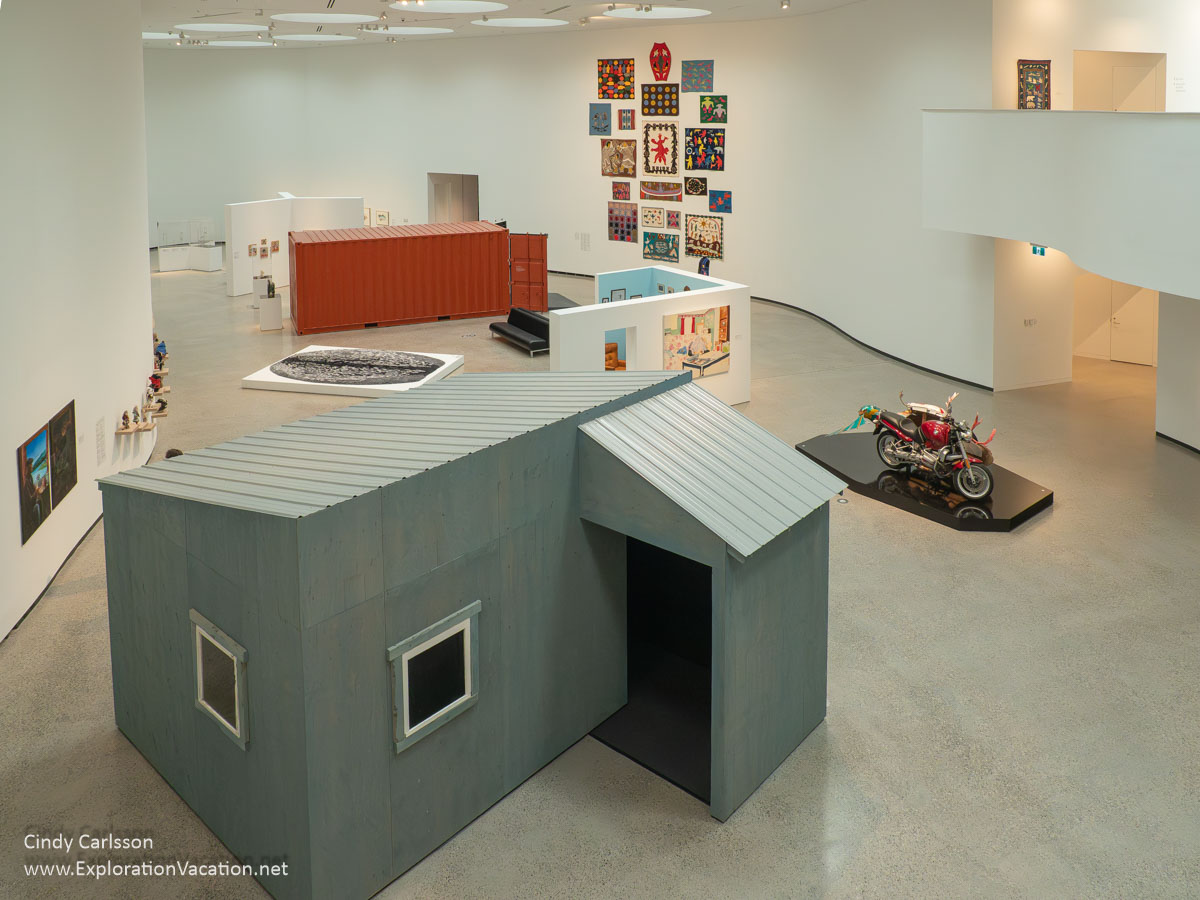
INUA included a wide variety of Inuit art, including several installations designed for viewing videos.
INUA has two meanings that speak to both this particular exhibition and the broader goal of Qaumajuq:
- Spirit or life force, which is a concept used throughout the circumpolar world.
- An acronym for Inuit Nunangat Ungammuaktut Atautikkut (‘Inuit Moving Forward Together’), which articulates the collective vision for Qaumajuq as a site where Inuit from across Inuit Nunangat can collectively gather, share, be inspired by previous generations, and create new pathways forward in Inuit art.
The exhibit included a wide range of work by Inuit artists from across Canada, as well as work by artists from circumpolar regions like Alaska and Greenland. Work in the exhibit ranged from traditional stone carvings and prints to digital media, installation art, mixed-media sculpture, painting, photography, and more. (Many pieces used traditional themes or techniques in very contemporary ways.) New work commissioned specifically for the exhibition was featured along with pieces drawn from existing collections.
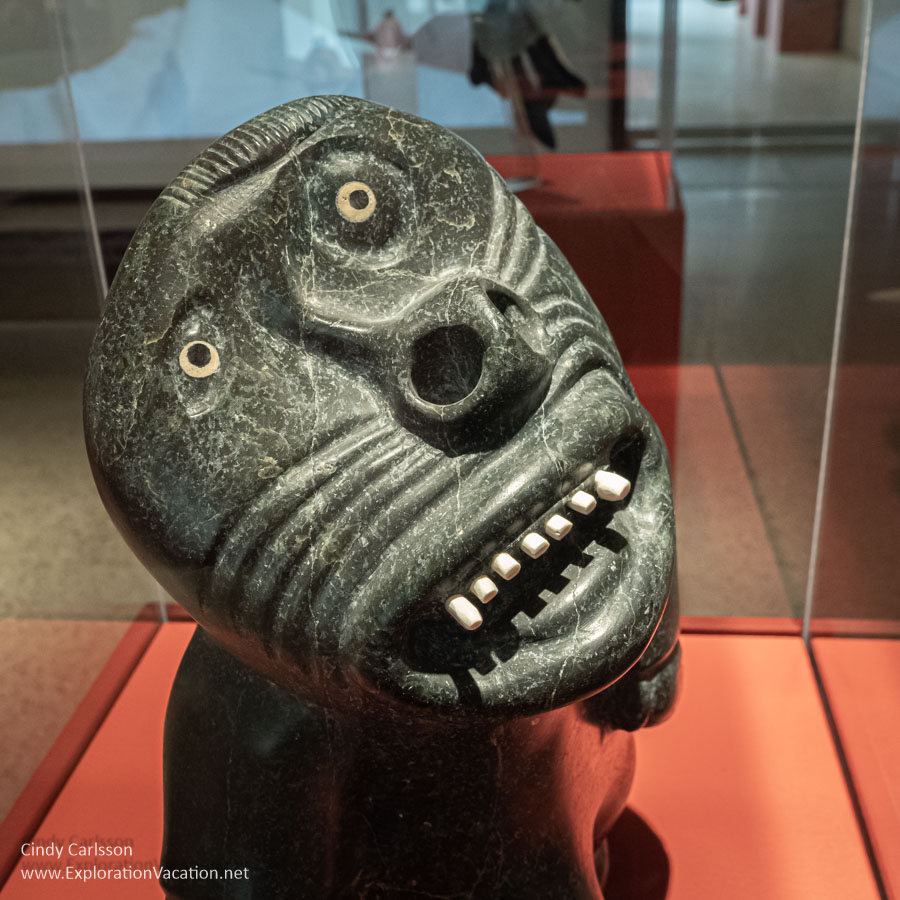
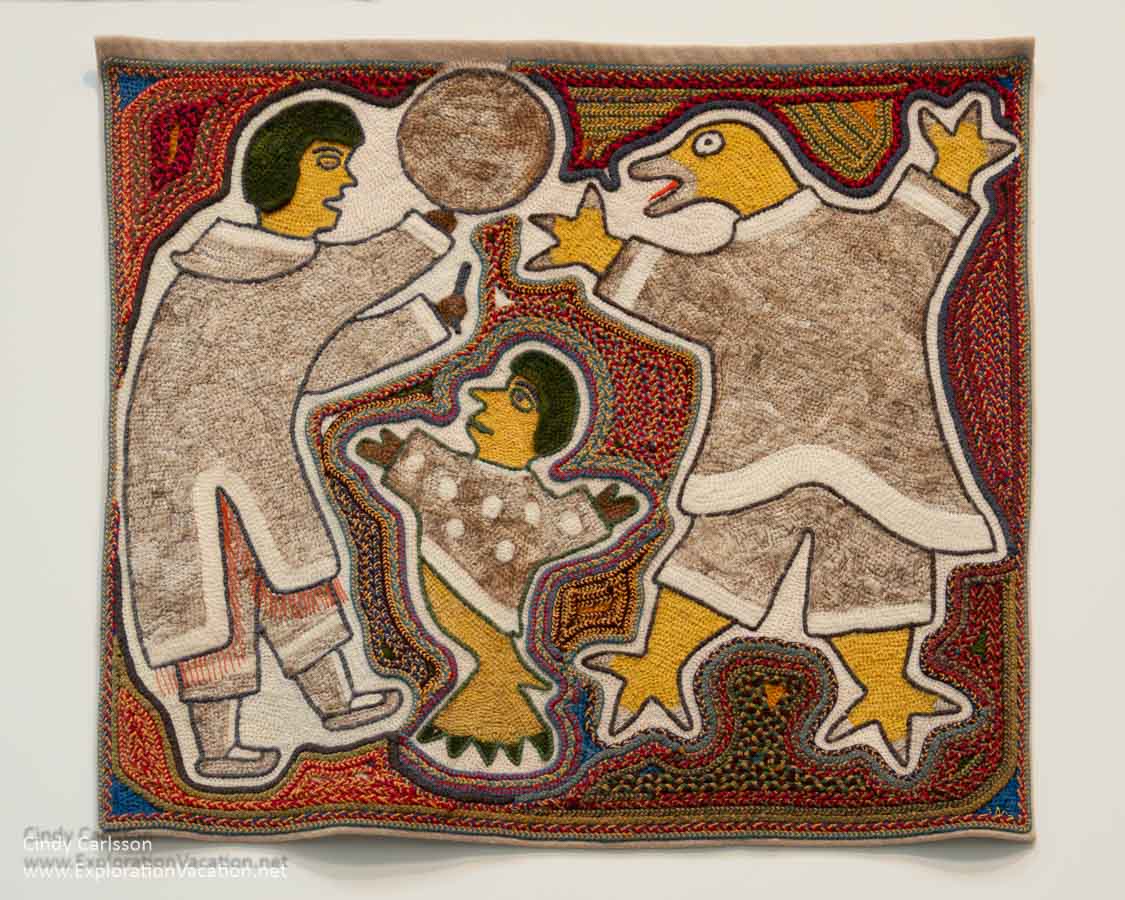
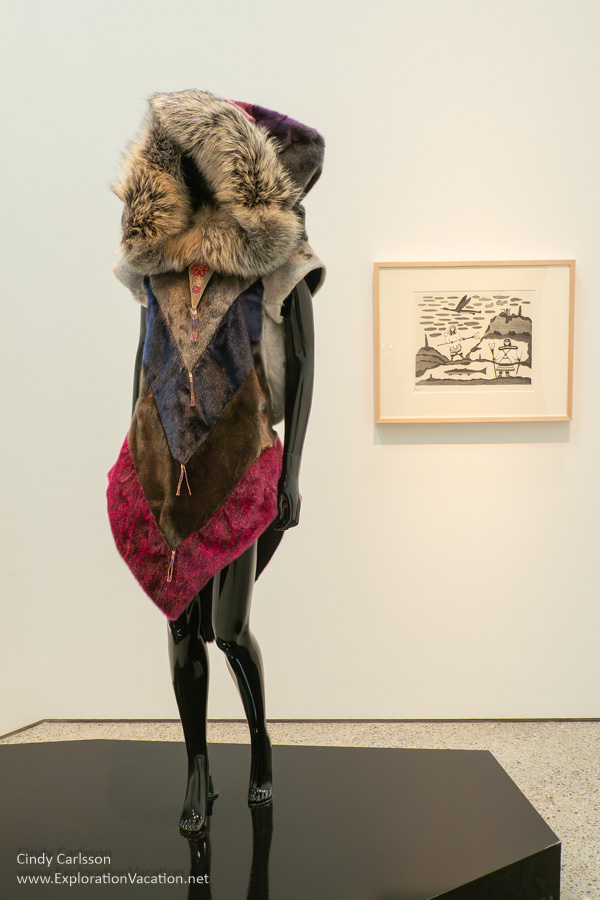
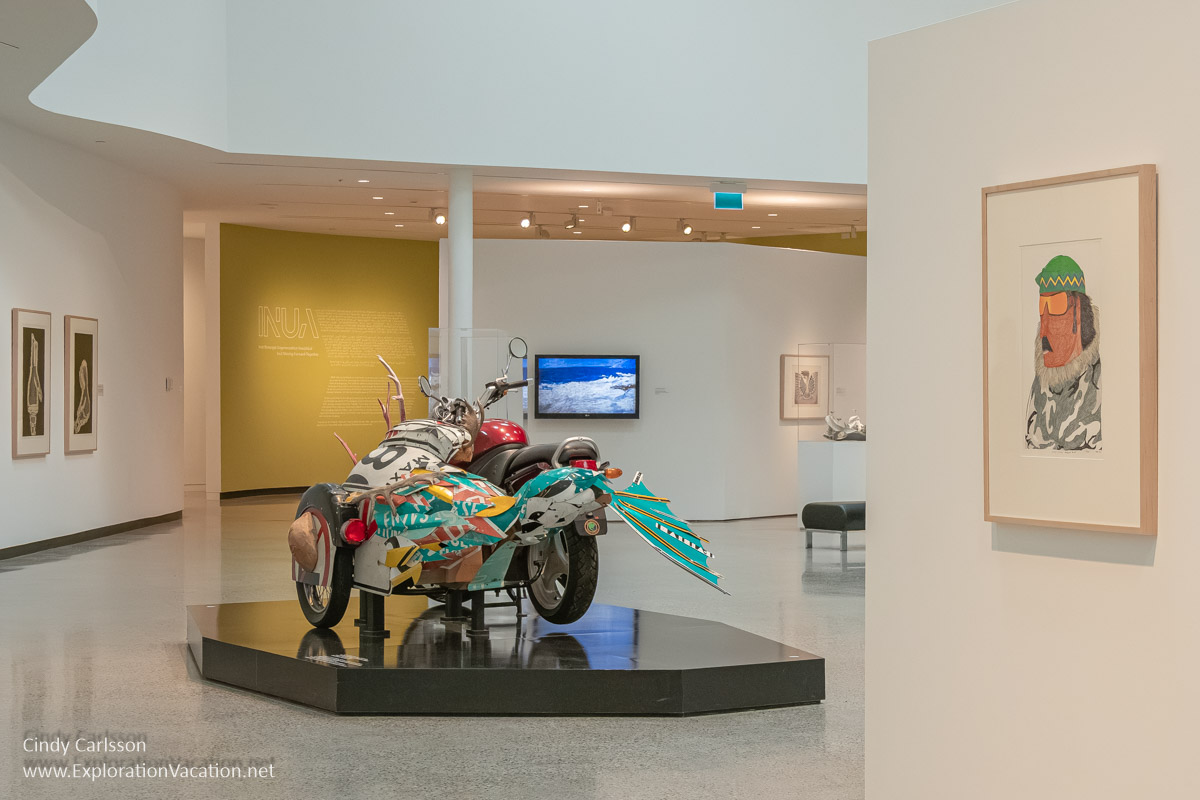
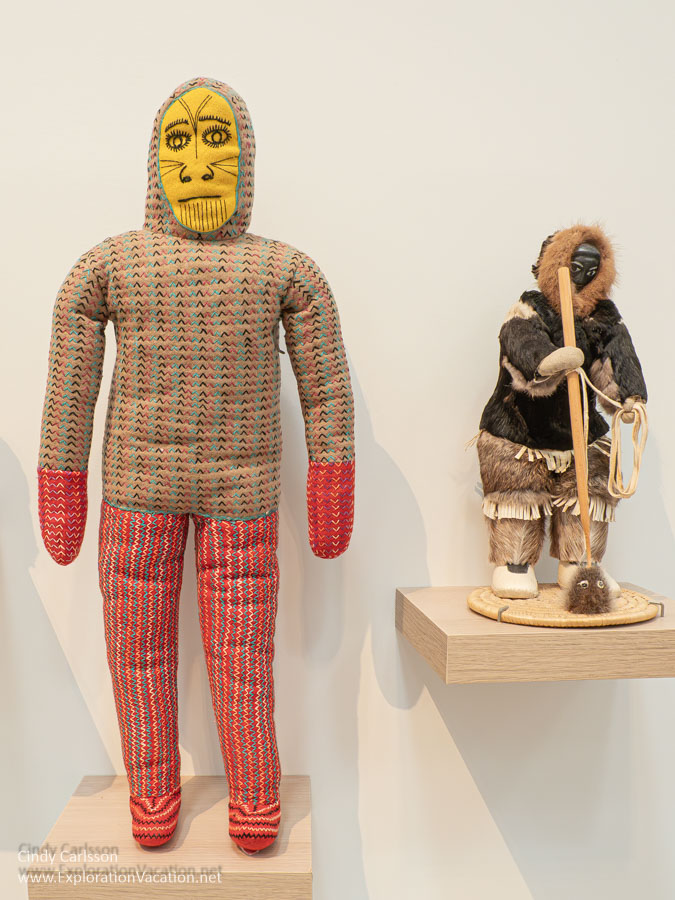
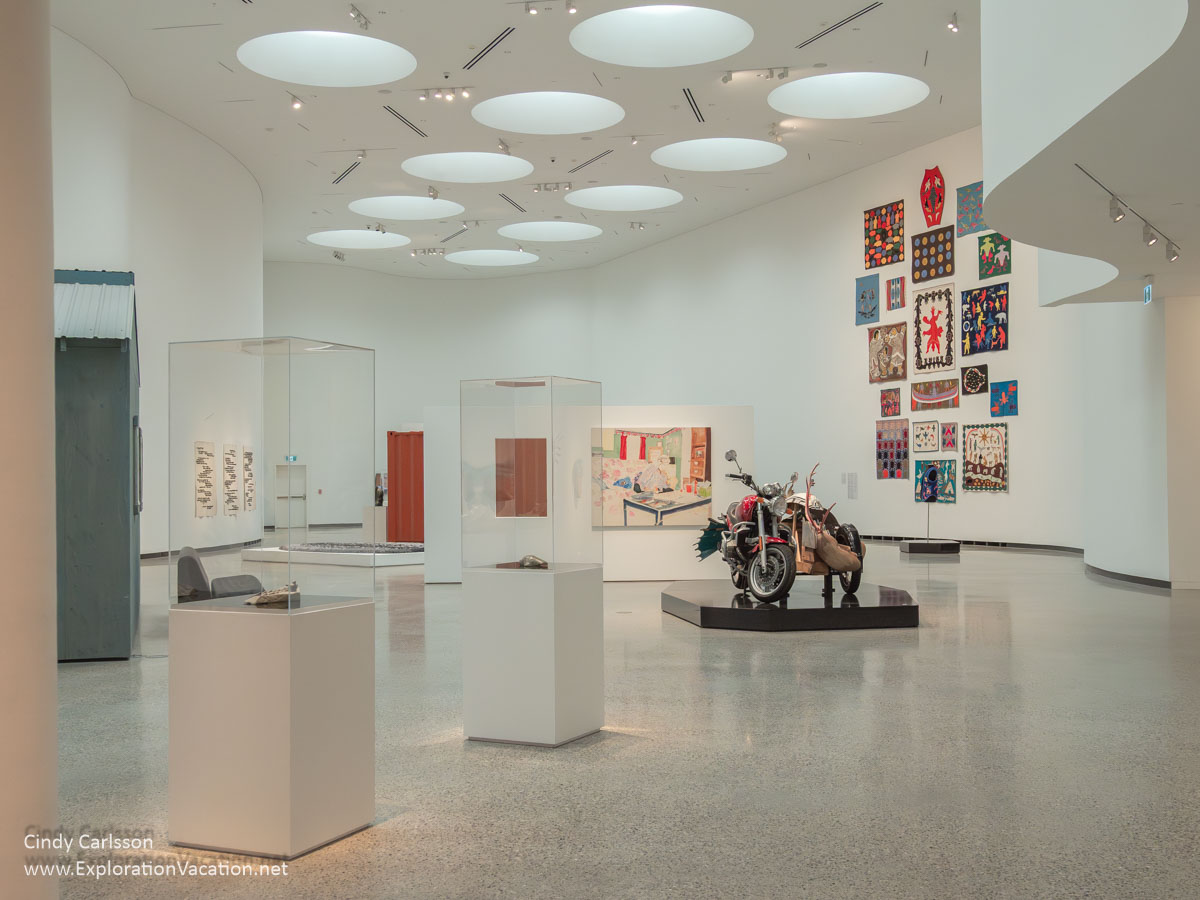

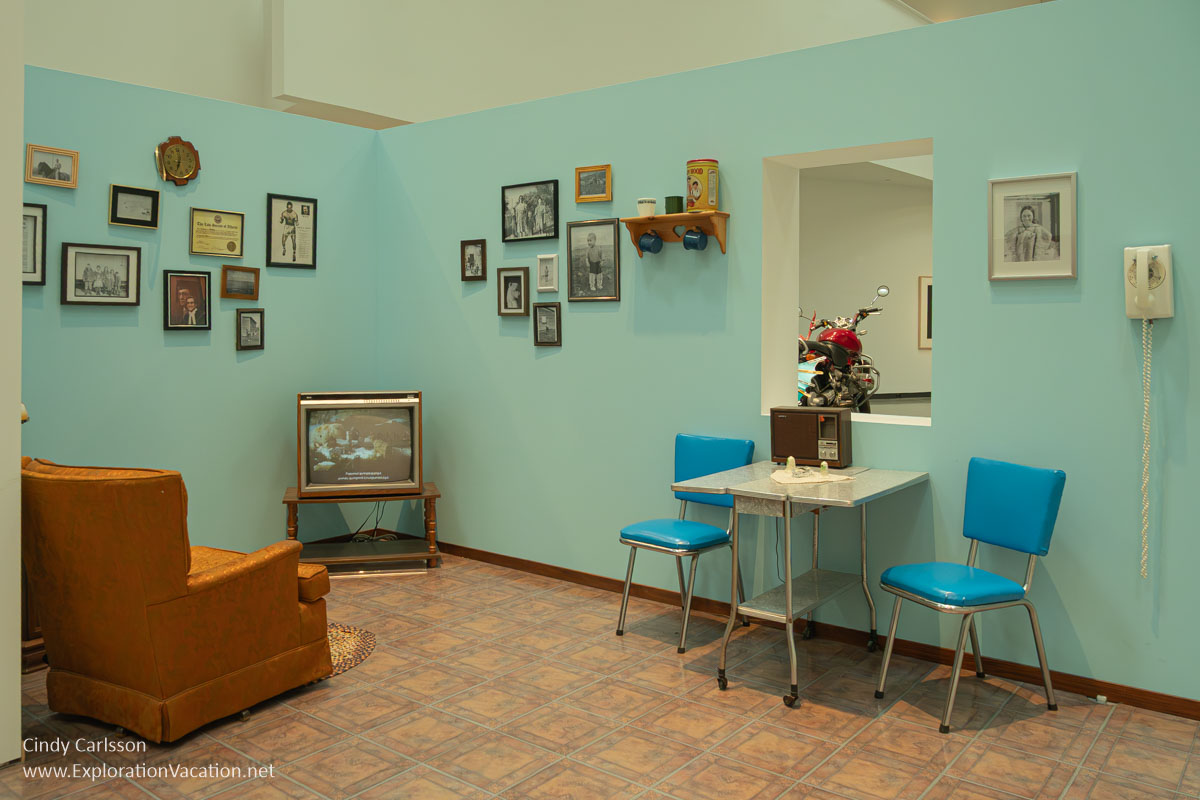
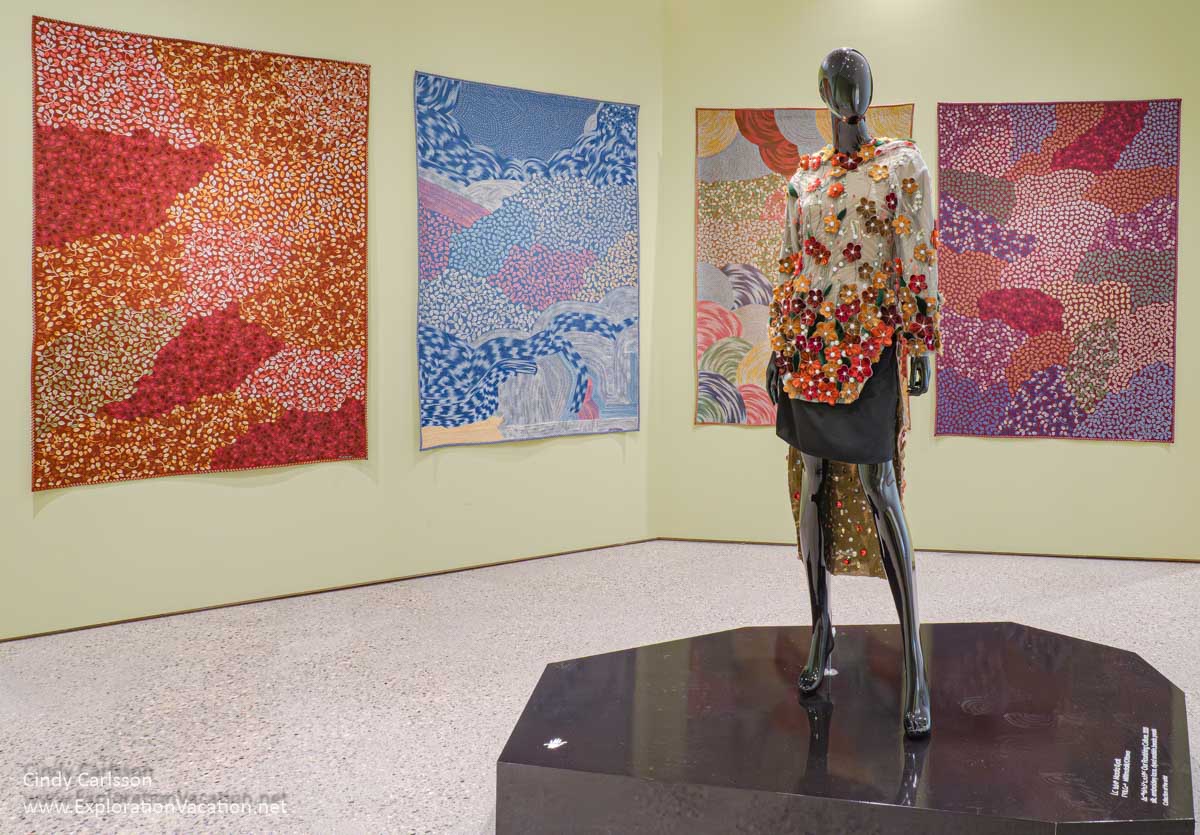
A sampling of the INUA exhibit.
This was a fun show that felt very contemporary. And I mean that in a good way. It was fun to see work that was quite different from the usual Inuit art exhibit.
INUA was curated by an all-Inuit team representing the four regions of Inuit Nunangat, the Inuit territories of Canada. A first in Inuit art exhibitions!
- Heather Igloliorte (Happy Valley-Goose Bay), Special Advisor to the Provost, Advancing Indigenous Knowledges; University Research Chair, Circumpolar Indigenous Arts; Associate Professor, Department of Art History, Concordia University; and Co-Chair of the WAG Indigenous Advisory Circle
- Asinnajaq (Inukjuak), filmmaker and curator; one of 25 artists selected to share the 2020 Sobey Art Award; curatorial team member for Canada’s Pavilion at the 2019 Venice Biennale
- Kablusiak (Somba K’e/Yellowknife), multidisciplinary Inuvialuk artist and curator; one of five artists shortlisted for the 2019 Sobey Art Award
- Krista Ulujuk Zawadski (Igluligaarjuk/Rankin Inlet), Curator of Inuit Art for the Government of Nunavut; multidisciplinary
Take a look around the rest of the museum too
Even if you are visiting the WAG-Qaumajuq specifically to see Inuit art, it’s worth taking at least a quick look to see what else is on exhibit over in the original WAG part of the building.
That’s particularly true if you have an interest in other Indigenous art. The WAG not only has a significant collection of Canadian First Nations art that shows up in various exhibits, but usually has at least one or two special exhibits that include work that is not part of the museum’s collection.
And, of course, they also have work from a wide variety of artists from Europe, Canada, the USA on exhibit.
First floor
On the first floor (which you are free to visit without a ticket), you’ll usually find a selection of sculptures by Inuit master carvers in the lobby/hall by the museum shop. Beyond those, the Main Hall featured the View From Here by Wanda Koop for what seems like a long time. It seems to have just disappeared. No idea what is replacing it.
Upper levels
There’s a gallery on the second floor, but most gallery space is on the third floor.
At any given time, these include a mix of temporary and permanent exhibits. You’ll always find at least one (and usually more) featuring work by an Indigenous artist or group of artists, classic European art, Canadian and other American art, contemporary art, and a few themed exhibits that could be almost anything.
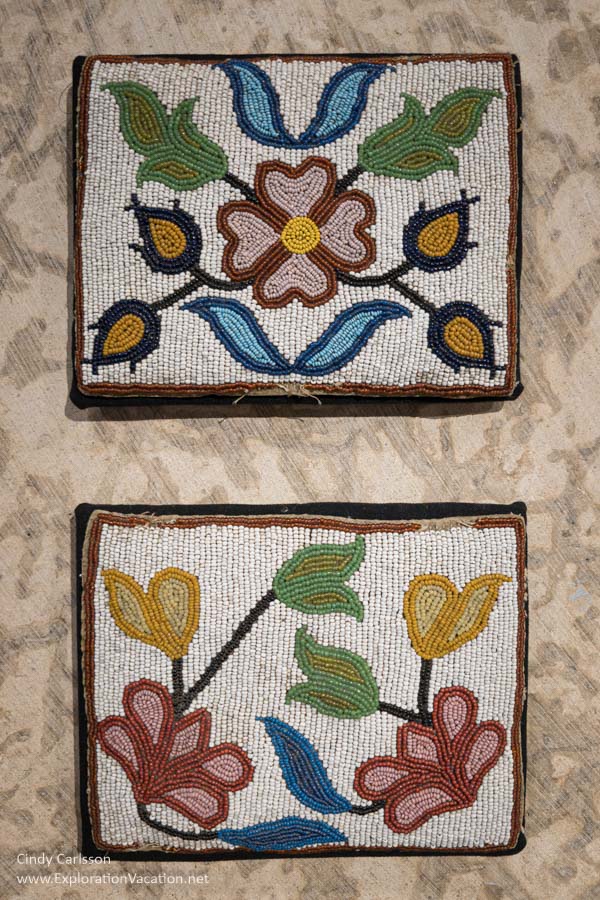
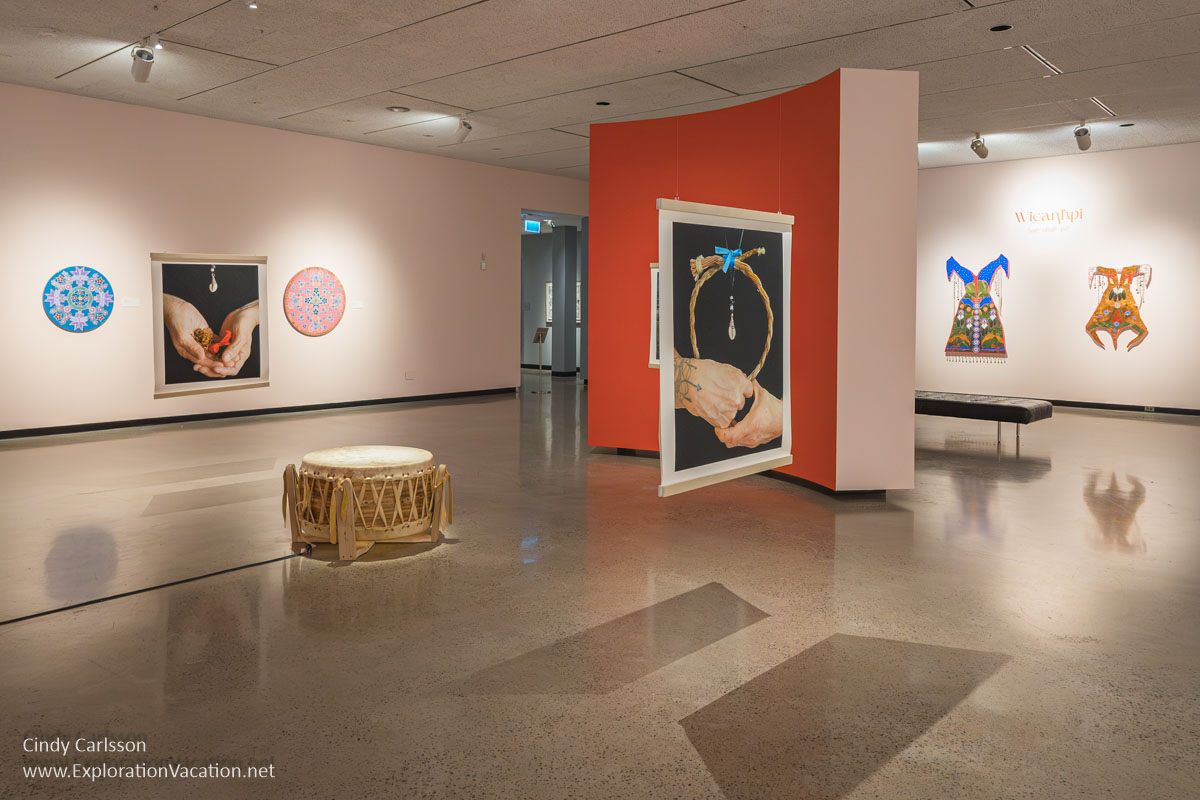
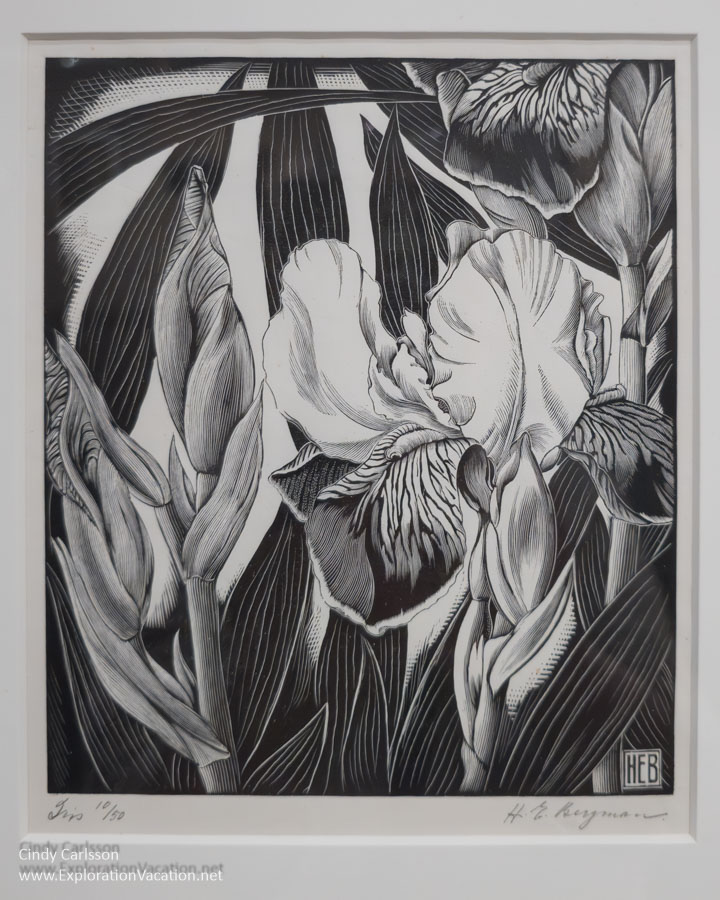
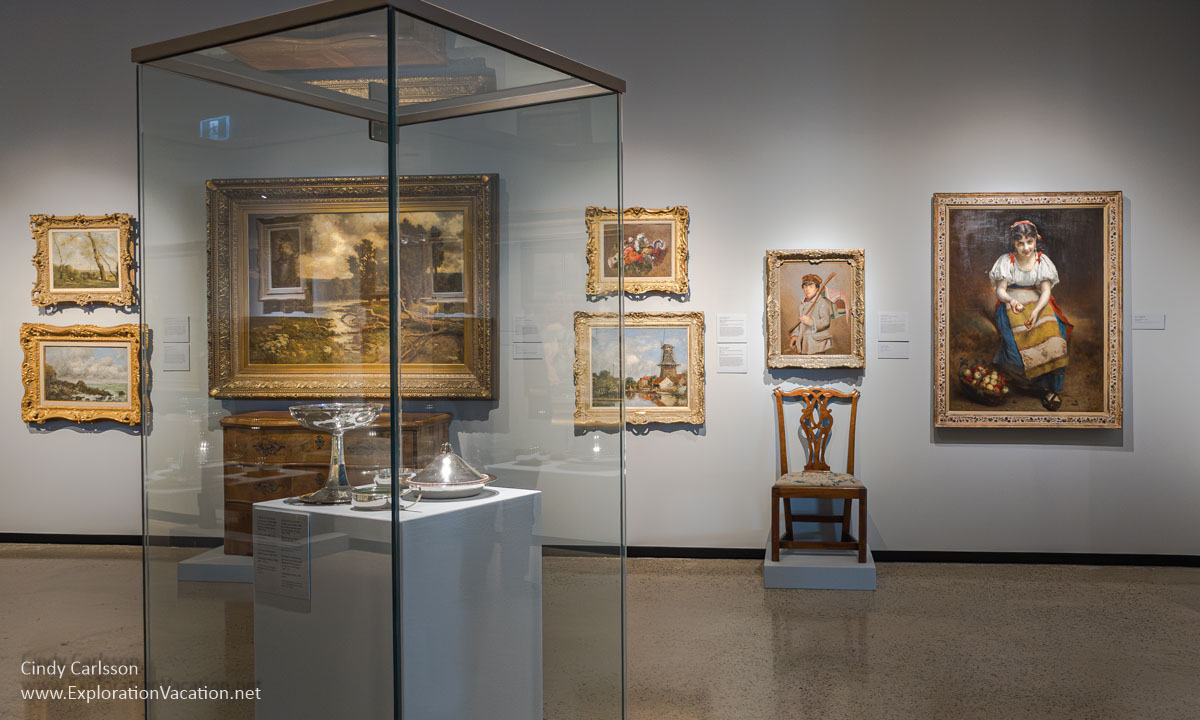
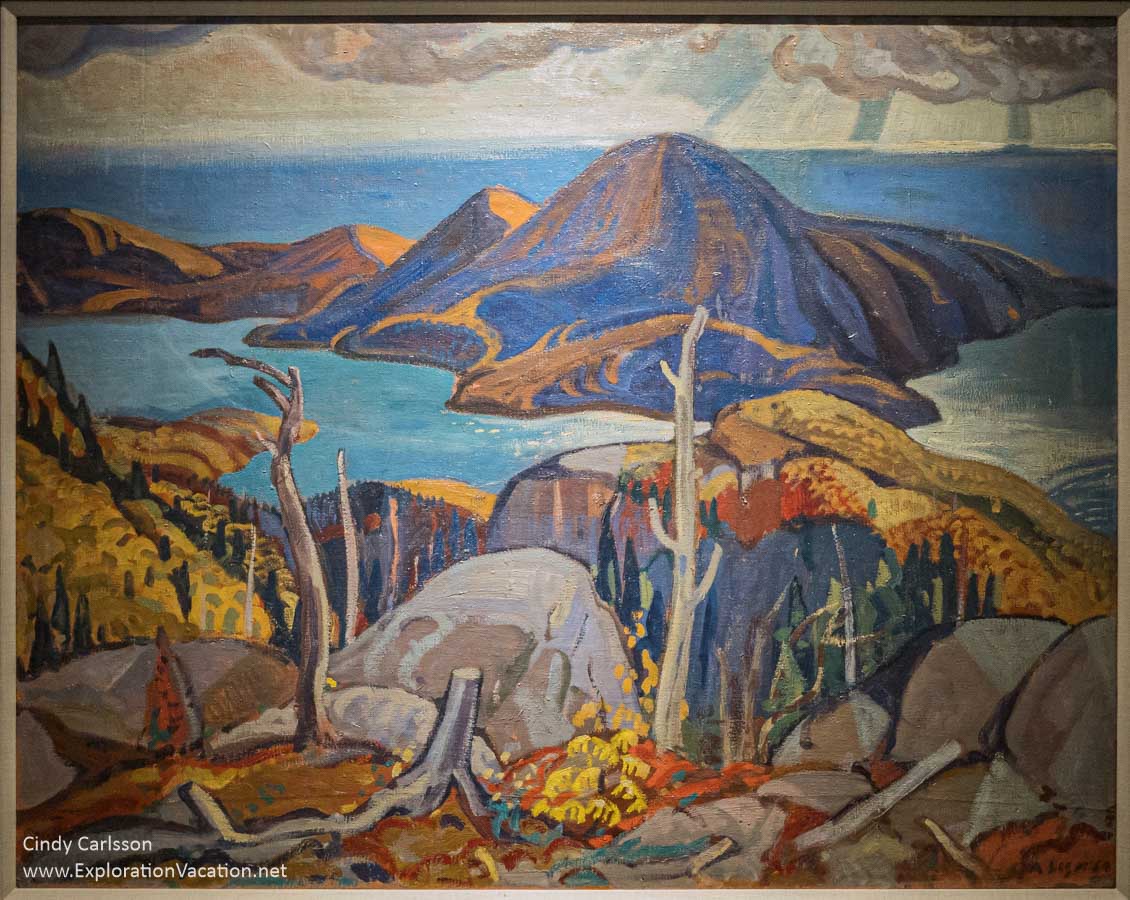
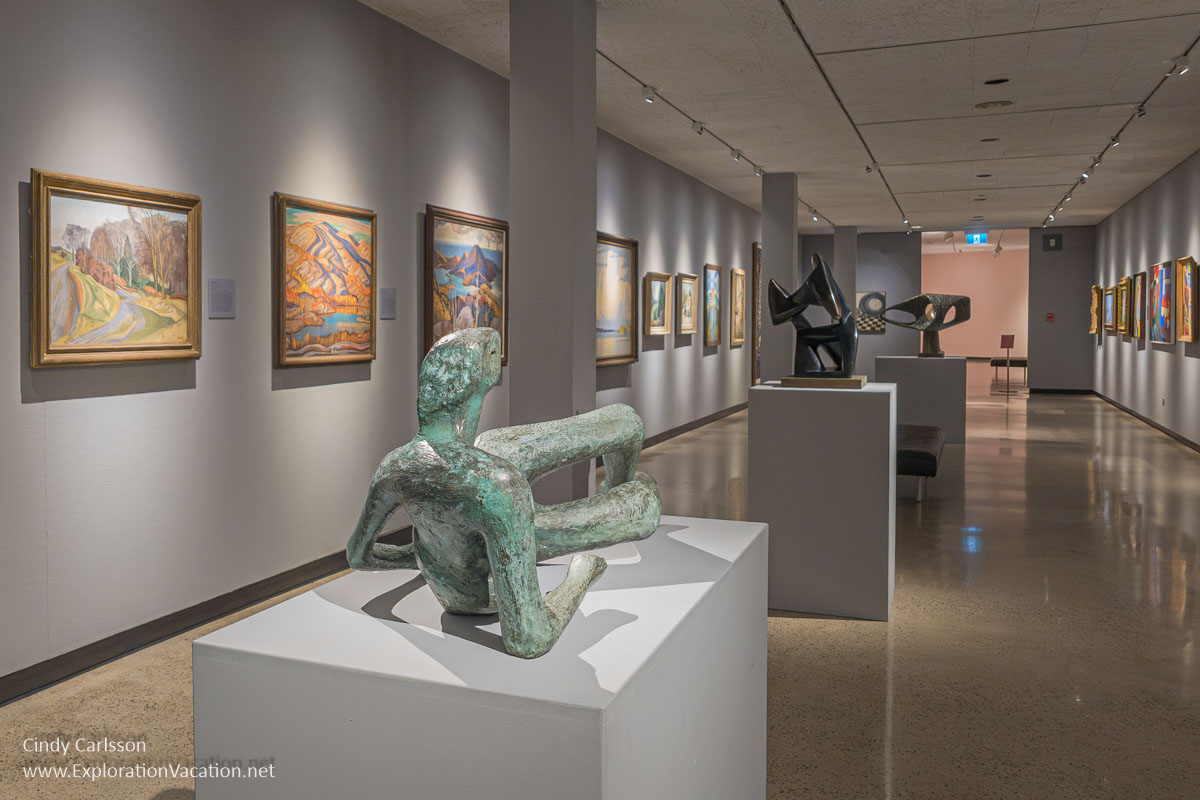
Some of what I’ve seen at the WAG in recent visits. (Most are still on display, although the Indigenous exhibits have changed since my last visit.)
Don’t forget to go outside!
You probably won’t miss the large Inuit sculptures outside the entrance to Qaumajuq.
But if you visit during warm weather, there’s also a Rooftop Sculpture Garden.
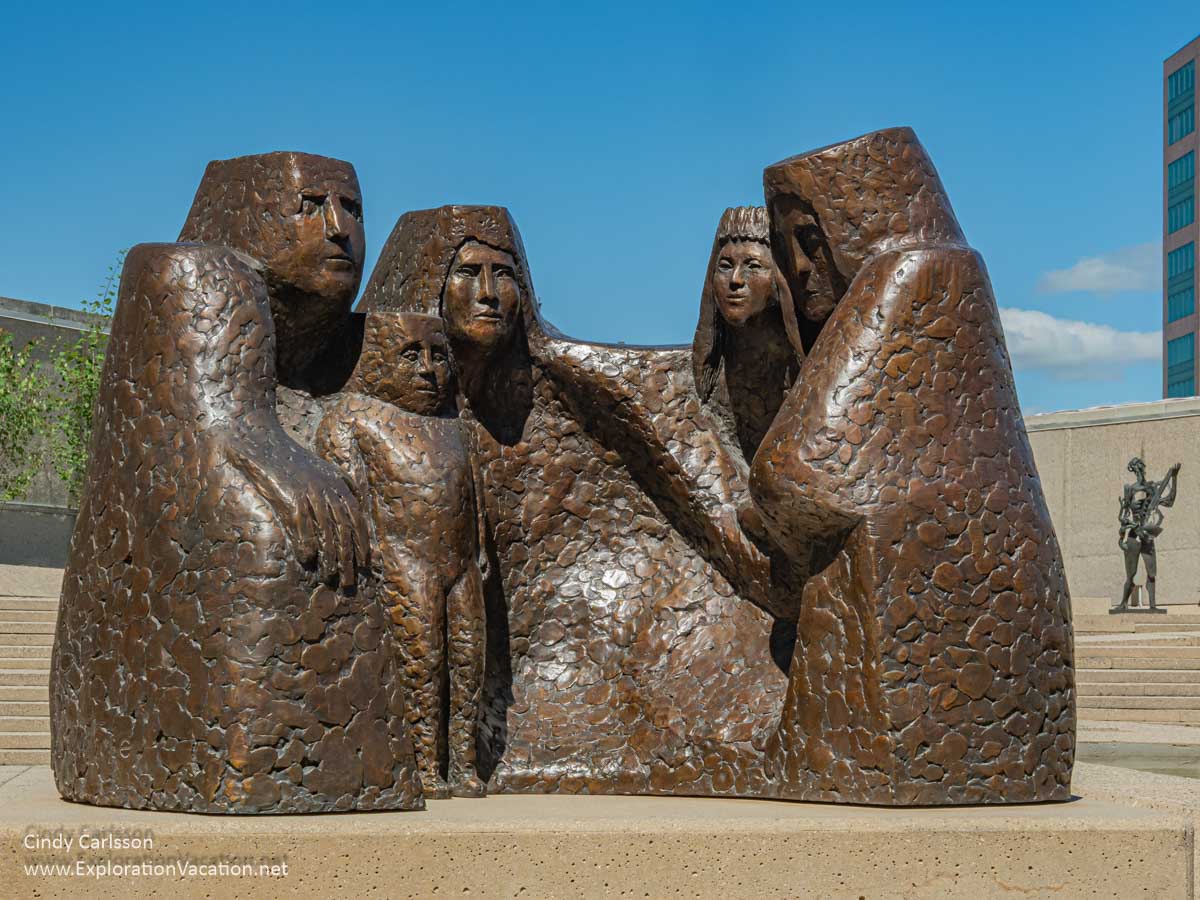
“Generation” by Eva Stubbs in the Rooftop Sculpture Garden.
Plan your visit to Winnipeg and the WAG-Qaumajuq
Winnipeg is located where the Assiniboine and Red Rivers meet in southern Manitoba, Canada. That’s about 50 miles north of the US border, although the drive to a border crossing is a bit farther.

Manitoba has a lovely visitor center shortly beyond the Pembina-Emerson border crossing, but it seems to have limited hours.
Winnipeg is also in Treaty 1 territory, the ancestral lands of the Anishinaabeg, Cree, Oji-Cree, Dakota, and Dene peoples, and the homeland of the Métis Nation. You’ll see those Indigenous cultures represented throughout the city, not just in museums and art galleries.
Winnipeg has plenty of museums and other indoor activities to keep you busy for a few days at any time of year. But visit when the weather is pleasant and you will also find many outdoor events and activities.
- May through September are usually great times to visit Winnipeg. The days are long, the weather is usually comfortable, and there is a lot going on.
- Winters tend to be cold and dark and sloppy from snow. But it’s pretty when there is fresh snow on the ground. And you might have a chance to see the northern lights! (Not that the aurora has ever made an appearance when I was in town. Just saying.)
Check WAG-Qaumajuq’s hours and tips for visiting before you leave home. Actually, take a look at all the happenings in the city that might interest you. That might include a concert or play, special museum exhibit, food or music festival, Winnipeg Jets game, or any number of other activities.
Getting to Winnipeg
I live in Minnesota. So, for me, visiting Winnipeg is pretty straightforward. Drive west from Minneapolis for 3 1/2 hours, spend a few hours (or a night or two) visiting friends in Fargo/Moorhead, then drive another 3 1/2 hours to Winnipeg. (Or longer if I stop at a park or museum along the way.)
From the USA, Interstate Highway 29 runs north from Kansas City all the way to the Canadian border crossing north of Pembina. (It’s a good, fast road, but expect a lot of truck traffic along the way.) From there, Manitoba Highway 75 takes you north right into Winnipeg.
👉 Learn more about getting to Winnipeg . . .
You’ll also find border crossings farther west in North Dakota and to the east in Minnesota. Most of these have limited hours, so be sure to check the hours if you want to cross anywhere other than Pembina. And expect a few questions if you are crossing at an odd location for where you are coming from. (I crossed at Neche-Gretna last time, which made no sense to the Canadian border guard until I explained I was coming from Icelandic State Park – at which point it made perfect sense!
Winnipeg is located right on Canada Route 1. But it’s a multi-day drive from Toronto and 15 hours or more from Calgary.
Flying to Winnipeg
If a road trip isn’t in the cards, Winnipeg’s James Armstrong Richardson International Airport makes it relatively easy to fly in from many locations in both the USA and Canada.
If you are in the USA, you’ll find a few direct flights on Delta out of Minneapolis, United out of Denver and Chicago, and WestJet out of Las Vegas. WestJet also runs seasonal flights through Palm Springs, Phoenix, Atlanta, and Fort Lauderdale that mostly serve Canadian snowbirds. Otherwise you’ll need to make a connection, in which case you will have many more options.
Canadians will find that several Canadian airlines serve Winnipeg from various hubs around the country.
Rail Canada
There is no rail service between the USA and Winnipeg.
If you are already in Canada, you can take the VIA Rail Canada to Winnipeg, with daily service from Toronto and twice-weekly service west as far as Vancouver and north to Churchill.
👉 Read less
Getting to WAG-Qaumajuq
The Winnipeg Art Gallery-Qaumajuq is in the heart of the city, near the Manitoba Parliament building at the edge of the downtown business district. (The other major museums are closer to the river.)
On foot, bicycle, or bus,
In pleasant weather, WAG-Qaumajuq is no more than a 20-minute walk from either the downtown business district or the Forks area. And, while the WAG-Qaumajuq isn’t directly on any of the city’s indoor walkways, it’s only a block or two away. (There’s a link to a good map on the museum’s website.)
Bike racks are available at the museum. (You’ll see plenty of people biking in around Winnipeg.)
The museum is also served by several bus routes.
Driving and Parking
It’s easy enough to drive to the WAG, but parking can be a bit of an issue.
While there is street parking available in the neighborhood around the museum, free parking is usually only available on Sundays and for a limited period on Saturdays. But it’s usually all but impossible to find a spot on a neighborhood street at any time.
There are some private paid parking areas near the museum. There is a public parking ramp right across the street. While that ramp looks pretty scruffy, it’s looked like that for years now, and we’ve never had any issues parking there. And it’s really handy – just be careful crossing the street. They were messing with the pedestrian crossing for months last year, and it was a little odd (and rather dangerous) at that point. Even in the best of cases, you need to be careful, as three streets and six lanes of traffic come together here.
Once you arrive at the museum
The entrance to the whole complex is located on the street-side corner under the white marble of Qaumajuq’s facade. (There’s another entrance along the long street side, but that’s only for tour groups or school kids on a class outing.)
You’ll see the Visible Vault through the glass where you enter. There are also a couple of nice sculptures out there, so you might want to check those out before you enter.
The First Floor/Main Level is always free
You don’t need a ticket to visit the first floor. It’s always FREE. That lets you access the Visible Vault and some other art in the lobby area and beyond. Basically anything you can get to on that level, including the coffee shop, theater, and museum store.
Museum Admission
The ticket desk is across the lobby by the coffee shop.
Gallery Map
If you didn’t download the digital gallery map available on the Tips for Visiting page, do that now or get a paper copy. You’ll need it to find your way around this odd-shaped museum!
Lodging in Winnipeg
Winnipeg is a sprawling place. Not only do two rivers meet within the city, but modern Winnipeg includes several smaller cities, including the French-Canadian city of Saint Boniface. That makes it a conglomeration of land use patterns with a few bridges connecting it all. The result? A city with a wide variety of interesting neighborhoods linked by horrendous traffic that backs up pretty much all day, every day. That makes it important to choose a base that minimizes driving through the city.
If you are looking for lodging that is within easy walking distance of the WAG-Qaumajuq, you have several good choices. The newly remodeled Hampton Inn (Hilton) and the nearby Delta Hotel (Marriott) are both about four blocks away. The Hampton Inn is less expensive, and the walk is slightly shorter and more interesting than the Delta. However, the Delta is more upscale and has a parking garage. The Hampton Inn offers private surface parking.
- You can check reviews and book the Hampton Inn Downtown through Booking.com or Expedia and get cash back through Rakuten. Of course, you need to book directly through Hilton if you want to use/collect points. (Note that rooms with balconies are not available on the top couple of floors.)
- Likewise, you can check out and book the Delta Hotel through Booking.com or Expedia or directly with Marriott to use/earn points. Unlike Hilton, Marriott also participates in the Rakuten cash back program, so any of these booking options will give you cash back.
Of course, there are many other options. Over the years we’ve stayed in an apartment right in the heart of downtown and a condo in the Exchange District. VRBO is a good place to search for private rentals like this and get cash back.
If you want to stay somewhere kind of hip and don’t mind a longer walk or driving to the WAG-Qaumajuq, I really like the Mere. And it’s in a great location for other things in the city.
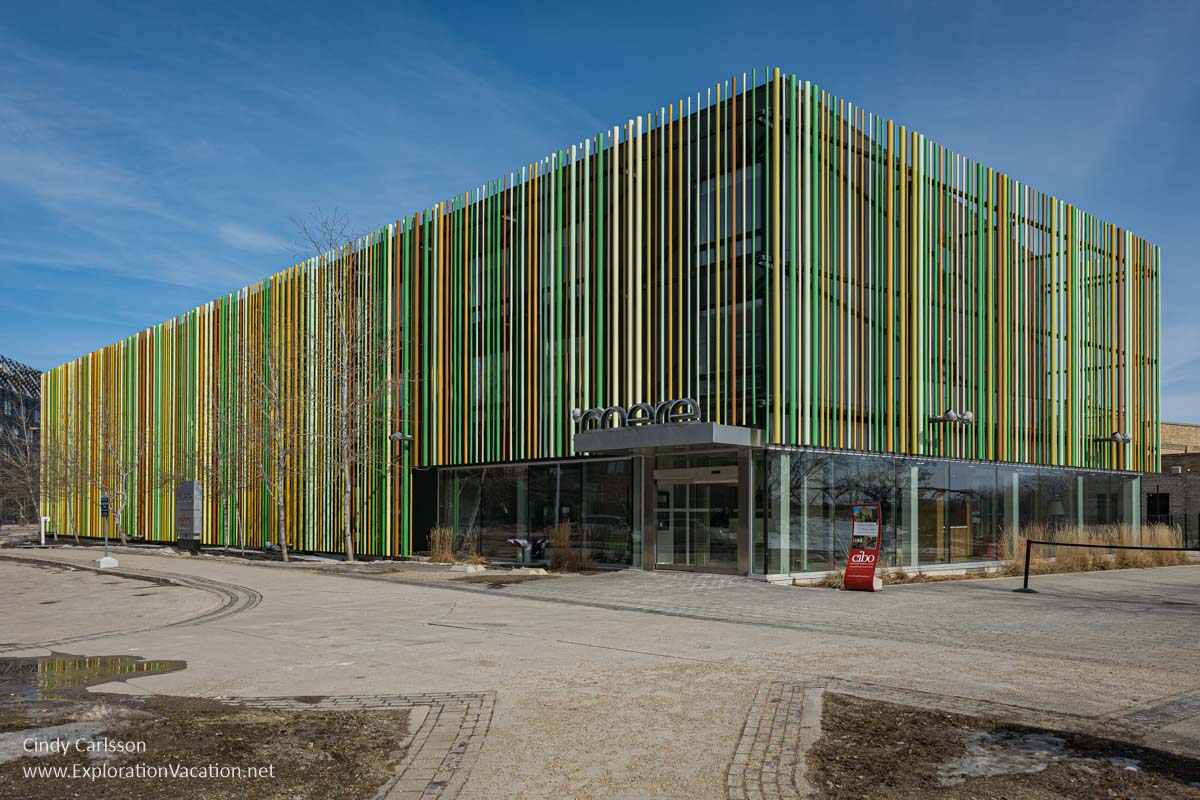
It’s hard to miss the Mere Hotel.
The Mere is pretty cool and located along the riverside parks and trails. It is also just a quick walk to some great restaurants and breweries in the Exchange District. But it is at least a half-hour walk from the WAG-Qaumajuq. (It’s near the Human Rights museum and the Manitoba Museum.)
- You can check reviews and book the Mere Hotel on Booking.com or Expedia.
Looking for a historic classic? The Fort Garry Hotel opened in the closing weeks of 1913. Over the decades it attracted elite guests from across Canada and far beyond. It’s seen some hard times too, but appears to be on track for another 100-plus years. You are truly part of Winnipeg’s history here!
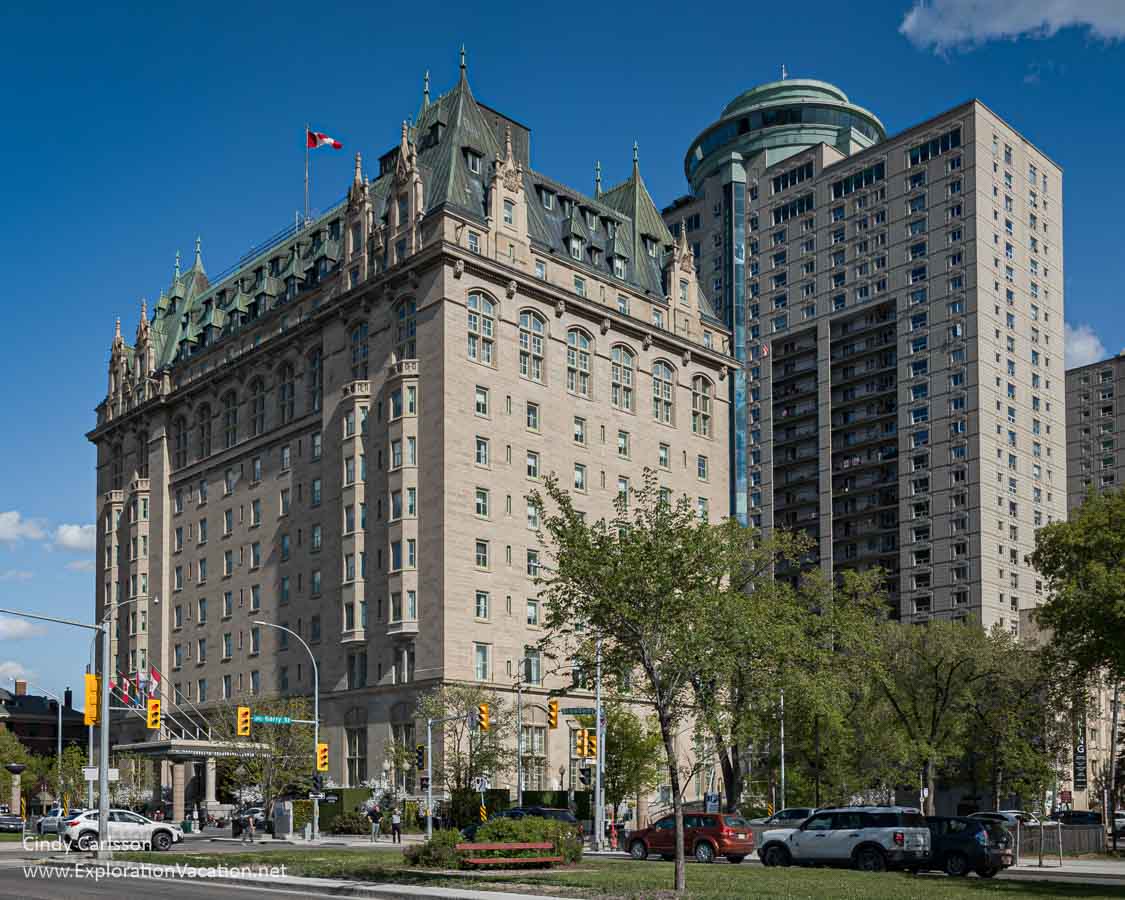
The Fort Garry Hotel is one of Canada’s classic railroad hotels. (The large development behind it is far more recent.)
I have not stayed here, mostly because it’s always been more than I wanted to pay for a room. (I did plan to check out the bar, but discovered the times it is open to the general public didn’t fit into my schedule.) It’s in an area with plenty of restaurants and would be a pretty reasonable base for getting around. Beyond that, I can’t vouch for the experience and whether it is worth the price.
- You can check reviews and book the Fort Garry Hotel on Booking.com or Expedia.
History and architecture buffs can learn more about the hotel’s history (and the challenges its various owners have faced) on the Manitoba Historical Society website.
Other things to do in Winnipeg
Winnipeg has a lot to offer visitors these days, with great things to see, do, eat, and drink.
I’ve listed a few I recommend below, but there are a lot more. You build on my list by taking a look at Donna Janke’s wonderful book 111 Places in Winnipeg That You Must Not Miss. (You should also check out the Winnipeg and Manitoba Guide on her website, Destinations Detours and Dreams.)
And I’d love to hear your thoughts on things to do in Winnipeg! Check these out and then let me know: What do you love? Know any hidden gems? Any places or things you think are over-rated?
👉 Learn more about other museums, historic areas, parks, and more in Winnipeg . . .
Check out a few more museums
Winnipeg has a number of (mostly small) museums I haven’t gotten to yet, but here are a few I really like and one that I’m eager to get to.
Be sure to check museum hours early in your planning. The schedules aren’t always what one might expect – the reason I haven’t gotten to the Manitoba Museum.
Canadian Museum for Human Rights
I know a museum focused on human rights sounds like it could be depressing, but the Canadian Museum for Human Rights in Winnipeg tells many uplifting stories as it addresses the wrongs done to a wide variety of people past and present. And the exhibits that tell those stories are innovative and engaging.
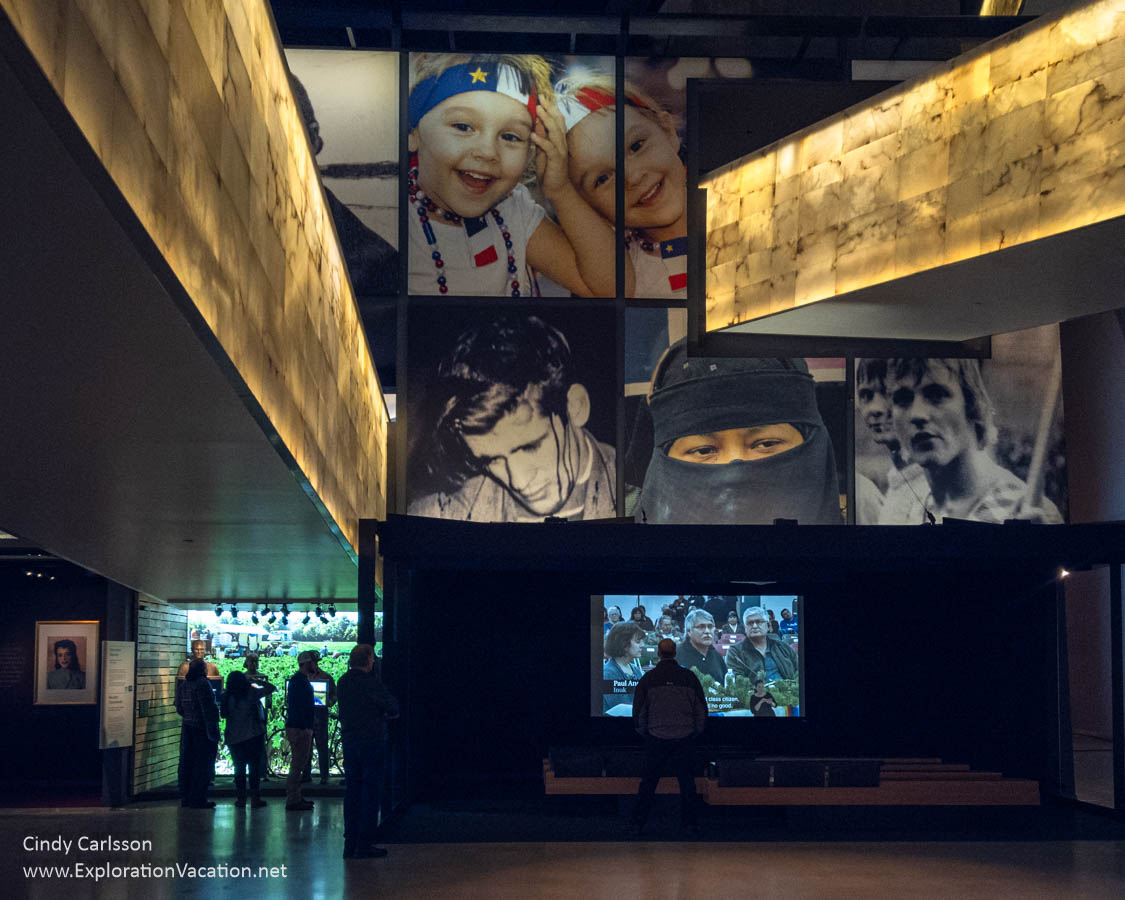
While you’ll find traditional exhibits in the Human Rights museum, technology and dramatic spaces also tell stories in ways that really draw you in.
It’s actually worth visiting for the building itself, which is architecturally interesting with all sorts of odd spaces and design features.
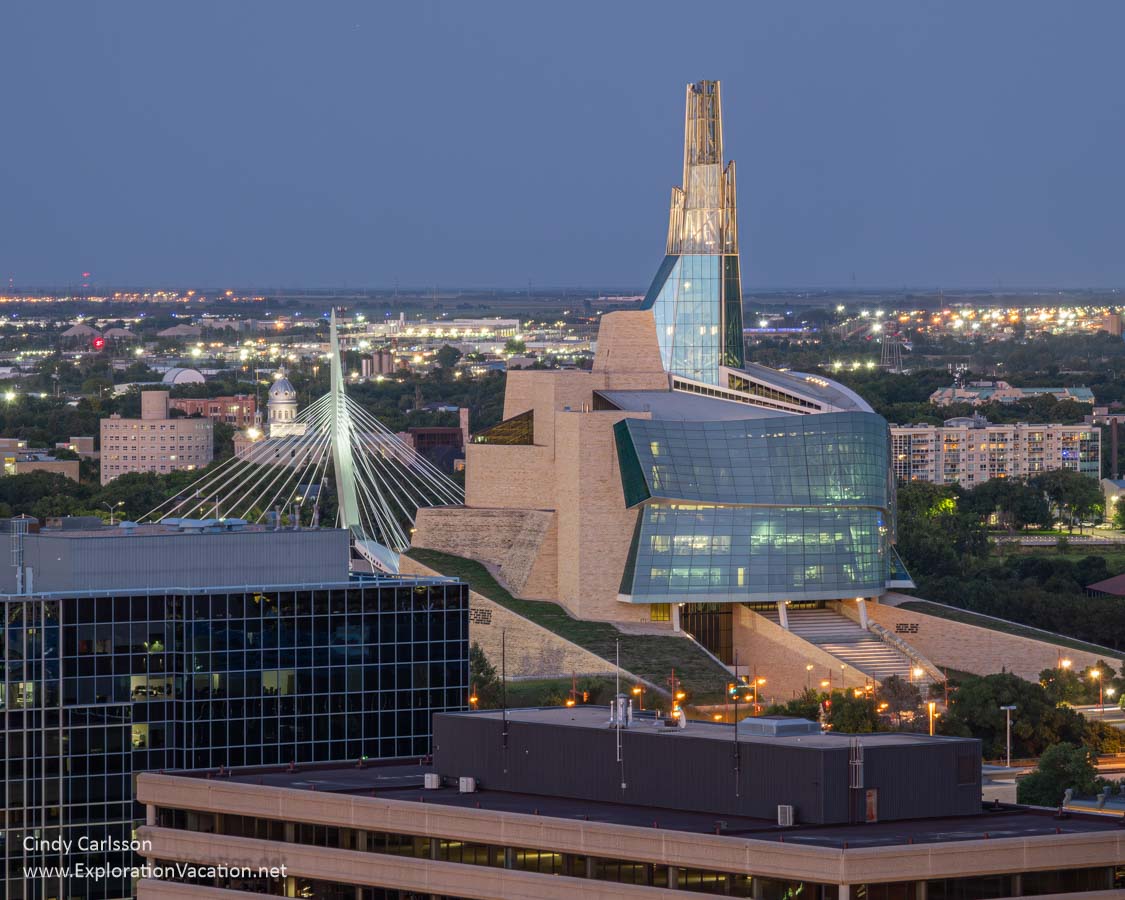
The Human Rights museum is a stand-out architectural monument as well as an important and engaging museum.
Allow more time than you think you will need. The exhibits will draw you in and the physical structure will keep you exploring a lot longer than you will expect. (We thought we would spend an hour or two here and ended up spending so much time we didn’t get to the rest of our planned activities for the day!)
The Saint Boniface Museum
Here’s another museum that turned out to be way more interesting than I expected. I went to the Saint Boniface Museum to learn more about the history of the Francophone part of the city. And I did learn a bit about the French-Canadians who settled here, but I learned a lot more about the Métis and Louis Riel, as well as the Indigenous people of this area.
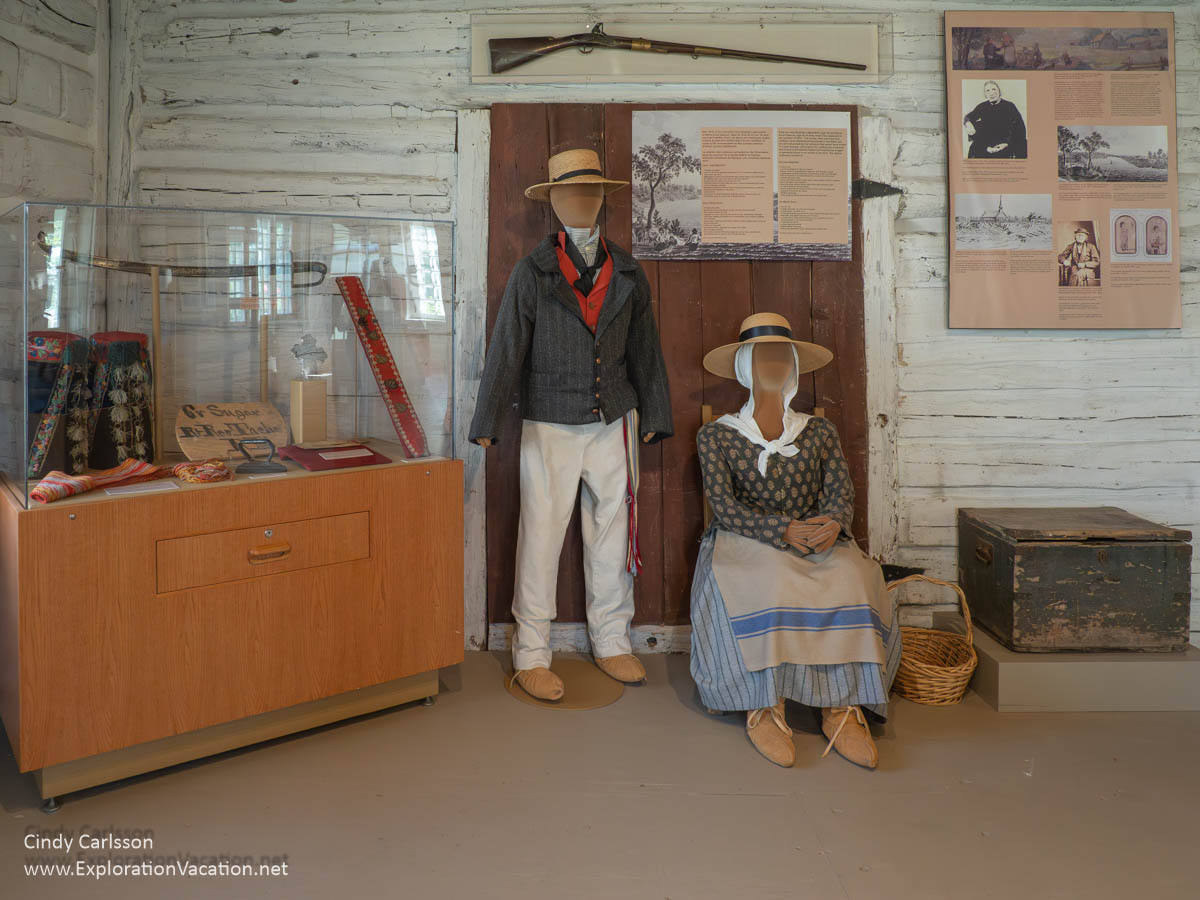
The exhibits are pretty traditional, but they tell some fascinating stories about Canadian history. Some of which are not so well-known. (Especially if you are from the USA.)
The museum is housed in a former convent and is the oldest building in Winnipeg.
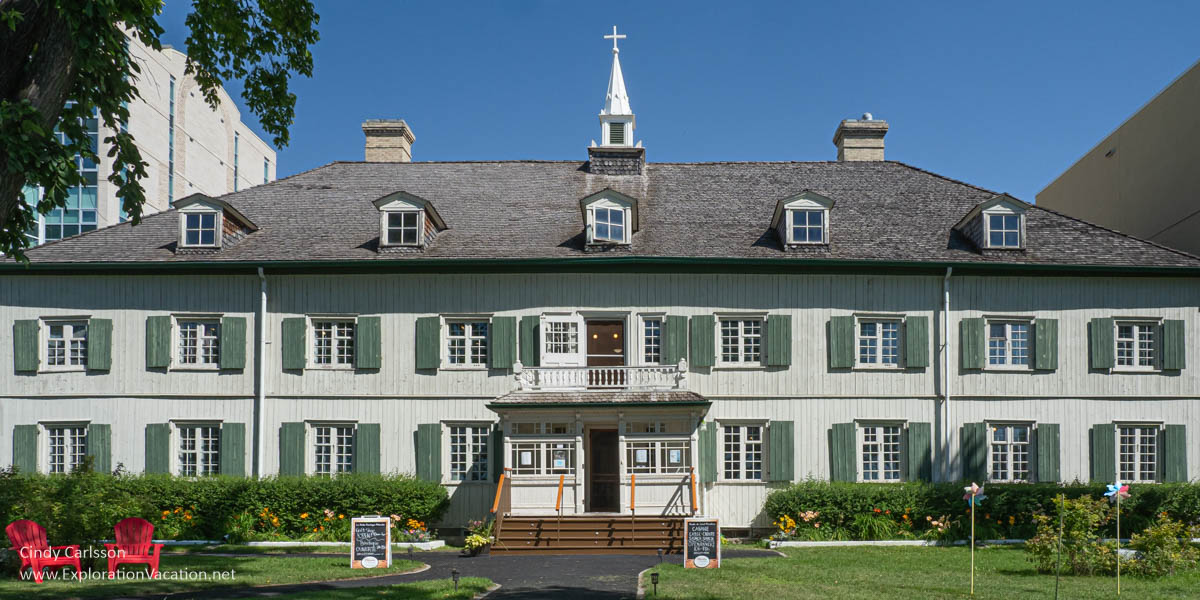
The exterior of the Saint Boniface Museum before renovation.
Like the Human Rights Museum, there is a lot of difficult history here. But it is an interesting museum that tells important stories in an engaging way. And it left me thinking about what could have been.
The Saint Boniface museum has been closed for a couple of years as the building undergoes a complete restoration. It is supposed to reopen in 2026, but that has not happened as I write this in March 2026.
Manitoba Museum
I haven’t gotten to the Manitoba Museum yet, although I’ve had many people recommend it. It’s one of those everything-including-the-kitchen-sink museums that covers natural and cultural history from the time of the dinosaurs to the present day. There’s also a science gallery and a planetarium, to ensure nothing is left out. All of it appears very geared toward families, but everyone I’ve talked to says it isn’t just for kids. Apparently the quality of the artifacts and how they are exhibited is very high. It’s on my list for next time, but I’d love to hear your thoughts on it if you’ve been.
Seek out the city’s public art and street art
You’re likely to come across some of Winnipeg’s public art and street art even if you are simply hurrying from one spot to another. There’s a lot of art scattered around the city. That includes everything from massive sculptures to small paintings along the street to artful bike racks!
- The Winnipeg Arts Council has a map and guide to public art created through various official programs. They also offer public art tours.
- The Exchange District Biz has a relatively recent page on street art in this part of downtown.
- The Forks has a page on public art in this area of the city.
- The WestEnd Biz offers tours of their part of the city.
Admire historic architecture
Downtown Winnipeg has quite a mix of beautiful historic buildings, architecturally striking modern buildings, and a few ugly monstrosities that appear to largely date from the 1970s. But you can generally walk down any street and discover something architecturally interesting without really trying. The Exchange District and parts of Old Saint Boniface probably have the greatest density of historic buildings. But seriously, there is cool architecture all over the place.
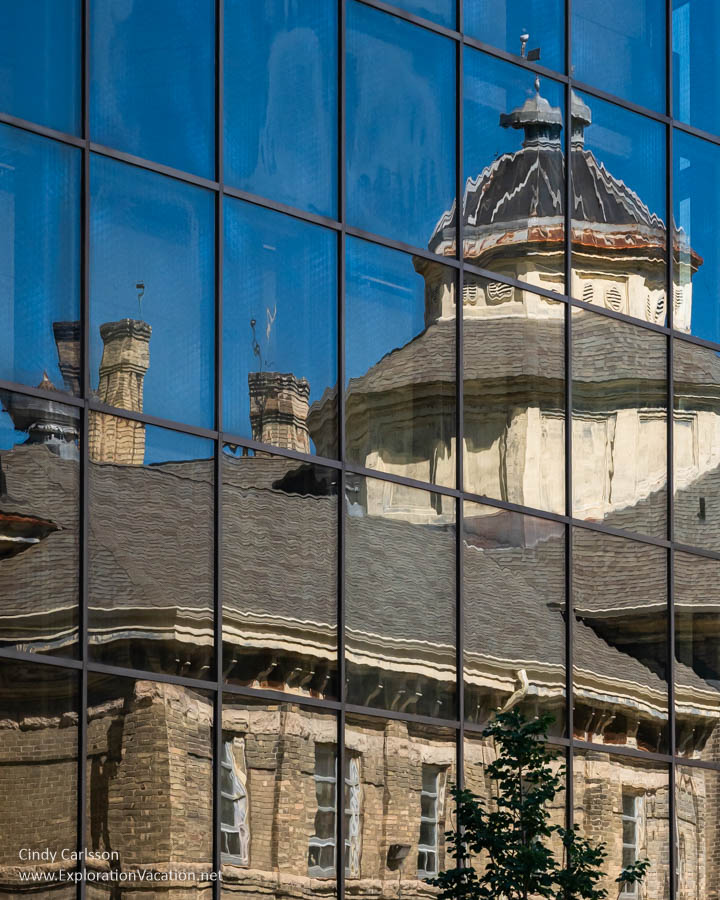
Winnipeg’s mix of old and new buildings leads to some interesting juxtapositions, like this reflected view of the Old Vaughan Street Jail.
Visit Assiniboine Park’s zoo, gardens, and more
Winnipeg has a lot of green space, but Assiniboine Park, established in 1904, is the granddaddy of them all. Covering over 1000 acres (450 hectares), the park includes a zoo with a notable Arctic exhibit, an English Garden, sculpture garden, outdoor stage, the historic Pavilion (with an art gallery exhibiting items from the WAG and a Pooh Gallery with Winnie the Pooh memorabilia), several children’s areas (including a duck pond that becomes a skating rink in winter), lots of open space for picnics and games or just relaxing, the Gardens at the Leaf, and the Leaf bio-dome.
I confess, I don’t think I’ve visited the zoo since grade school, and it’s been a decade since I visited the English Gardens. But I got to the leaf the other winter, and that alone is worth the trip to this side of the city. And, unlike much of the rest of the park, it’s best in the dead of winter!
The Leaf
I was completely blown away by The Leaf. It’s a smaller version of the enormous bio-dome on the Singapore waterfront. (Something I wasn’t expecting in Winnipeg!)
The Leaf is a relatively new attraction, having opened only in 2022, but the plants are already of a size that you would think it has been here longer than that.
It houses a lush tropical garden, Mediterranean garden, butterfly garden, and a rotating floral garden (featuring orchids when I visited). The most dramatic is the multi-level tropical garden with its lush vegetation and towering waterfall.
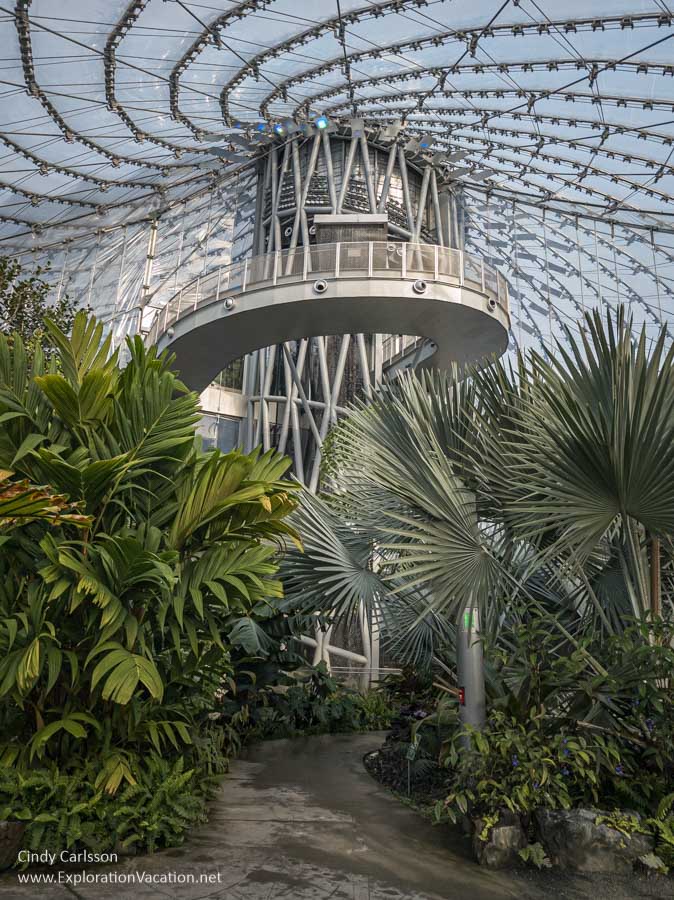
It’s hard to see in this photo, but there’s actually a waterfall flowing down to the main floor from the looping walkway up there. The butterfly garden is also back behind the central tower.
Hear traditional music and more at Folk Fest
I’ve never made it to Winnipeg for the Folk Fest, even though it’s been on my “I need to do this list” since I was in college. (A roommate from Winnipeg kept trying to get me up there, but I worked at camps most summers, so a trip up to the festival wasn’t in the cards.) I’m not so crazy about big, crowded festivals anymore, but I still think about it every year.
However, if you like outdoor music festivals and want to hear a wide mix of music from traditional to contemporary by a mix of Canadian and international artists, you should check out the Winnipeg Folk Fest.
👉 Read less