Last updated on June 11th, 2026
On Hawaii’s Big Island, the Puʻuhonua o Hōnaunau National Historical Park is a partially restored example of a very old royal compound that includes a place of refuge for long-ago lawbreakers, defeated warriors, and civilians escaping war.

The site’s reconstructed heiau (a temple and mausoleum) and ki’i are visitor favorites at Puʻuhonua o Hōnaunau.
“Puʻuhonua o Hōnaunau” means “sacred place of refuge at Hōnaunau.” It is the largest and best preserved (now reconstructed) of the many sacred refuges once found on the island.
Refuges such as this existed because every aspect of life in Hawai’i was once controlled by vast arrays of sacred laws that governed every aspect of life. The punishment for breaking even the most minor-seeming of these laws was usually death. The only escape was to get to a place of refuge before being captured.
While other refuges existed at various times, Puʻuhonua o Hōnaunau may have been the largest and most important of them. Like all Hawaiian refuges, this was a spiritual sanctuary where those who reached it were protected by Lono, the god of life. After a process of spiritual cleansing, refuge-seekers were free to return to their villages without punishment.
But Hōnaunau was also an important religious and government center where high-ranking chiefs lived, ruled, celebrated, and honored the sacred bones of their ancestors.
While little remains of the royal residences once located here, Pu’uhonua of Hōnaunau is a rare example of a historic refuge that is more or less intact. With its reconstructed temple (heiau), it is both a fascinating historic site and a sacred place for Native Hawaiians.
I have tried to properly use Hawaiian terms and explain Hawaiian concepts throughout this story. However, I am neither Hawaiian nor an expert on the Hawaiian language or the history of the Hawaiian people. If you are and would like to share some of your knowledge as it relates to Puʻuhonua o Hōnaunau National Historical Park, I would love to hear from you.
This story has affiliate links. I use links to provide additional information, but some also may pay me a small amount if you use them to make a reservation or purchase. You don’t pay extra, but it helps keep this website running without intrusive ads. To learn more, see my policies and disclosures.
Kapu and the quest for sanctuary
Tourists visiting Hawai’i today quickly fall in love with the warm, easy-going culture of the islands.
However, over time, Hawaii’s original settlers from what is now French Polynesia (the ancestors of today’s Native Hawaiians) developed a quite brutal warrior culture with a rigid social hierarchy and strict rules governing even the most mundane aspects of daily life.
Until 1819, Hawaiians lived under a system of sacred laws that declared many people, places, things, and activities “forbidden” (kapu). These laws were intended to keep society in balance, both functionally and spiritually. Many, such as laws regulating fishing, planting, and harvesting, protected vital food supplies and resources. Others existed to maintain the (very rigid) social order. All of these laws were particularly restrictive for women, who, among many other requirements, were prohibited from eating many of the most common foods available. Under these laws, seemingly mundane actions like accidentally casting a shadow on a chief or a husband and wife sitting together to eat were also kapu. And the punishment was usually immediate death.
To avoid being killed for breaking kapu (or for fighting on the losing side of a battle), you had to get to a sacred place of refuge – a pu’uhonua. For those who succeeded, the pu’uhonua provided purification through physical, mental, and spiritual healing. Once completed, it was safe to return home. (Killing someone who had been cleansed in this way was itself a violation subject to immediate death.) Some refuge-seekers might even study with a master craftsman at the refuge and learn a new skill before returning to their village.
👉 Read more about kapu and the quest for sanctuary
However, getting to a place of refuge was a physically difficult undertaking that few accomplished. As at Puʻuhonua o Hōnaunau, those seeking refuge usually had to cross many difficult miles on land and then swim through rough seas while those seeking to punish them followed.

Escape to a pu’uhona was treacherous, but it was the only way to avoid certain death.
The end of kapu
Traditionally, the death of a high chief offered a brief reprieve from kapu while in mourning. It was the new ruler’s responsibility to reinstate kapu after a suitable period. However, that changed after the death of Kamehameha I in May 1819.
As expected, Kamehameha’s 21-year-old son Liholiho became King Kamehameha II soon after his father’s death.
However, he didn’t become the sole ruler. His guardian Queen Ka’ahumanu, the politically astute favorite wife of his father, gave herself the role of chief counselor at Liholiho’s installation ceremony. And then she explained she did not intend to follow the laws of kapu anymore. Both actions must have shocked those assembled. However, while the new king’s failure to oppose Ka’ahumanu naming herself as regent allowed that to become reality, he had some time to think about kapu while mourning.
Ka’ahumanu was powerful in her own right, both for her political ability and as one who had the power to grant sanctuary. The new king likely needed her support to retain his position. And he was very familiar with European ways and knew they broke kapu all the time without consequences. But he must have feared what might happen to a king who abandoned hundreds of years of sacred law.
And then his mother stepped in.
Keōpūolani was not just Liholiho’s mother. She was also a member of Hawaii’s highest-ranking elite and a sacred person. In the days following Liholiho’s installation as king, she made her position on kapu perfectly clear: She sat and ate a meal with her younger son. This was a taboo act. However, because she was considered a sacred person, her breaking the taboo ended it for everyone. And it would seem it made her own position on reinstating kapu abundantly clear.
In November 1819, after consulting the islands’ highest religious leader and returning some trading rights to other leaders, King Kamehameha II unexpectedly sat down at the women’s table at a grand feast. After the feast, he announced the end of kapu and ordered the destruction of all temples (heiau) across the islands. The islands’ ranking religious leader set fire to many of them himself. (It’s not clear to me why he supported this decision, but clearly he was fully on board.)
Only the heiau at the Puʻuhonua o Hōnaunau escaped destruction, likely because it contained the bones of many generations of powerful chiefs, including those of the king’s ancestors. The site was abandoned, but wasn’t burned like others.
👉 Read less
What to see at Puʻuhonua o Hōnaunau National Historical Park
Puʻuhonua o Hōnaunau National Historical Park includes the ancient Puʻuhonua (Place of Refuge), Royal Grounds where high chiefs lived, other ancient and historic remains (including a village site farther down the coast), and a modern visitor center.

The heiau as seen from inside the pu’uhonua.
It’s not clear exactly how long a royal grounds (a royal residence) and pu’uhonua have existed here. However, it’s likely the pu’uhonua was established round 450 years ago by ʻEhu kai malino, the ruling chief of Kona at the time.
While stone platforms and wood structures on the site changed over the centuries, the overall site remained in use until the death of Kamehameha the Great (King Kamehameha I) in 1819. Later that year the entire site was abandoned, leaving just the temple for another decade before the royal bones were removed and the wood structure destroyed. Over the following decades tsunamis damaged the remaining stone platforms on the site.
The Puʻuhonua o Hōnaunau site became a National Historical Park in 1961. (It was authorized by Congress in 1955.) The Puʻuhonua o Hōnaunau Historic District was added to the National Register of Historic Places (PDF) in the 1970s.
The first “restoration” at Puʻuhonua o Hōnaunau was in 1902, when the platform of the Hale o Keawe was reconstructed. However, the site as it looks today largely dates from projects late in the 1960s. Those later projects included replacing the 1902 work with a more accurate reconstruction of the temple’s platform.
While most visitors (including me) mainly stick to the historic Royal Grounds and Place of Refuge, you can walk the full length of the park along a segment of the 175-mile Ala Kahakai National Historic Trail. That segment includes the remains of an old fishing village that was inhabited until the 1930s.
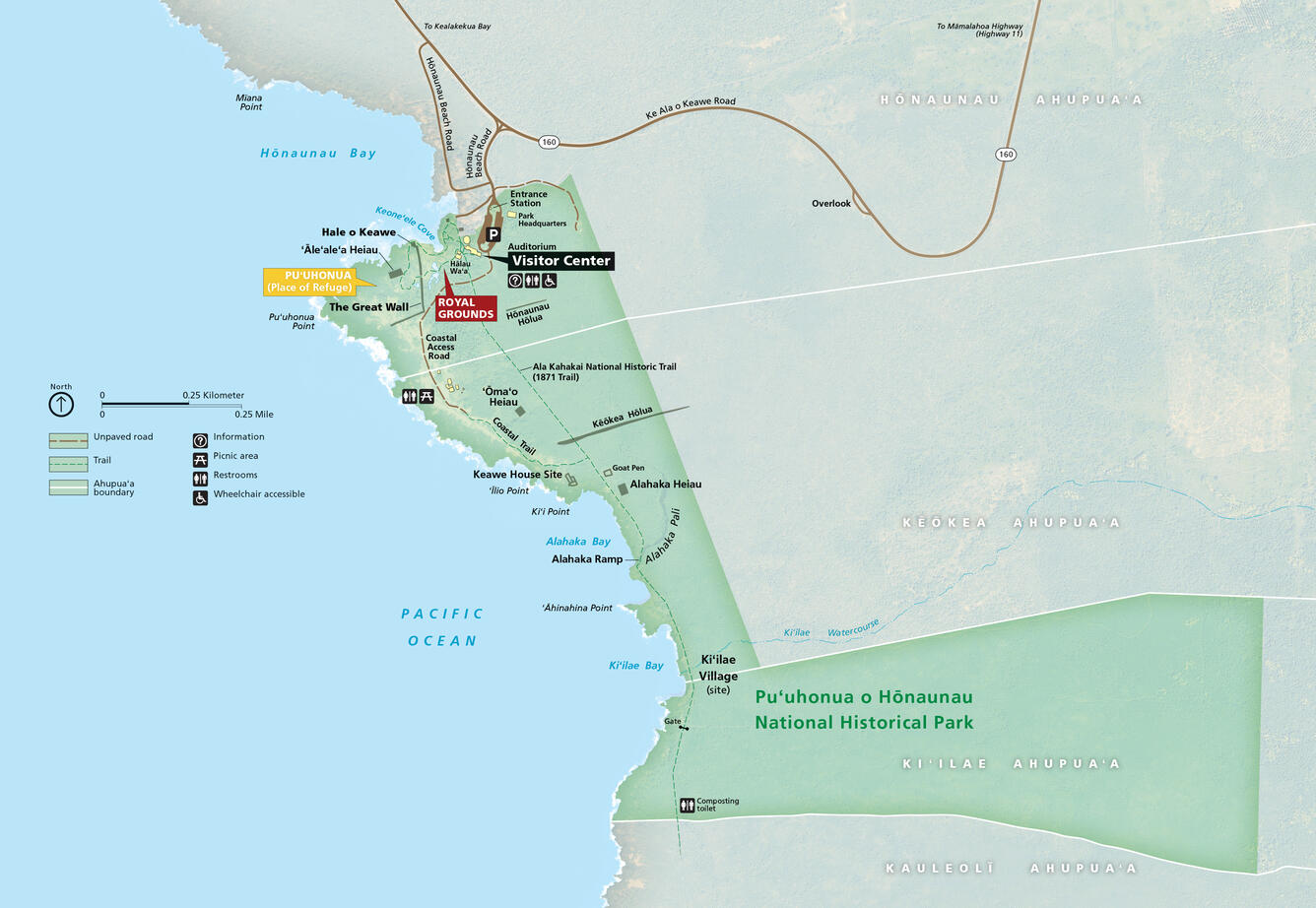
Most visitors (including me) only visit the small area where the royal grounds and pu’uhonua, but there are historic sites in other parts of the park as well. You can access this map on the NPS website.
Visitor Center
Puʻuhonua o Hōnaunau has a relatively small contemporary Polynesian-style visitor center. Inside, you will find books and a few other items for sale. But mostly this is where you can get a good map of the park and information about special events and demonstrations.
A shady breezeway connects the visitor center to an open-air theater. Take a few minutes here because the ceramic wall art tells the story of the ancient Hawaiian people and this place. The five murals are: Polynesian Immigration, Hawaiian King and Polynesian Plants, Kapu Breaking, Place of Refuge, and the Island.
Ranger talks start here, and craft and other demonstrations are also set up in this area.

The Polynesian Immigration mural at the visitor center.
The pavilion at the end of the breezeway plays a video that follows a frantic race to reach the Puʻuhonua. It’s rather dramatic, but it gives you a good sense of this place and its history, so worth watching before you enter the site. Or you can watch the movie on the park website before you arrive.
Ki’i
I’m starting with the ki’i and giving them their own section because you will find them in a couple of spots around the park. And they tend to be visitor favorites.

Kiei and Hālō, who represent Kāne and Kanaloa, the gods of creation and life, gaze out over the sea near the heiau at Puʻuhonua o Hōnaunau.
👉 Read more about the ki’i at Puʻuhonua o Hōnaunau
Ki’i represent the akua, which include a large number of Hawaiian gods, deities, and venerated ancestors. Of these, four major gods are most often represented:
- Kāne is associated with life and creation and is often seen with Kanaloa.
- Kanaloa is associated with creation, the ocean, and long-distance voyaging.
- Kū is associated with governance, warfare, industry, building, labor, fishing, and farming.
- Lono is associated with agriculture, growth, fertility, natural weather phenomena, wisdom, enlightenment, healing, music, and peace.

Akua Pā Lāʻau representing family gods and Lono-kīnaʽu, Lono-mōʻī or Haku ʻŌhiʻa, Lono-iki-aweawealoha, Lono-ʻōpuakau, and Lono-i-ke-ʻeke Ki’i (representing attributes of the god Lono) in the courtyard of the heiau or temple.
The same god can be represented in many ways. You can see that at the park’s reconstructed heiau, where Lono is represented by the figures inside the palisade fence as:
- Lono-kīnaʽu, the one who notices defects, is associated with healing, medicine, and childbirth.
- Lono-mōʻī (or Haku ʻŌhiʻa) is a figure that encompasses all aspects of Lono. This is the central figure at the temple and a focal point for rituals.
- Lono-iki-aweawealoha represents the compassion needed for healing and restoring balance.
- Lono-ʻōpuakau is associated with clouds and cloud omens.
- Lono-i-ke-ʻeke is the god of provisions and good harvests.
The small figures on the palisade (there are four) are Akua Pā Lāʻau images representing the family gods and venerated ancestors of those who worked within the temple.
The National Park Service has a page with links (double click on the images, not the text links) that describe most of the Ki’i at the historic site.
Ki’i were created using a wide variety of materials, from stone to feathers. However, they were usually carved in wood. But wood doesn’t last indefinitely, so the ki’i you see at Puʻuhonua o Hōnaunau are contemporary creations by local carvers using traditional knowledge and skills. These ki’i figures are replaced over time as they decay.
👉 Read less
Royal Grounds
From the visitor center you’ll enter the Royal Grounds. This area once was open only to the area’s high chief, his family and guests, and the people who worked for him.
Today much of this area is open land, but it once had thatched houses and other buildings, as well as the fishponds and several heiau (temples). Only the last heiau on the site was reconstructed. (Earlier temples were built and destroyed over the centuries.) While it looks rather empty today, this site was used by generations of Hawaiian chiefs who lived and governed from here for hundreds of years until 1820.
A marked path leads visitors through the site. You can get information on each stop along the way using the park map or app.
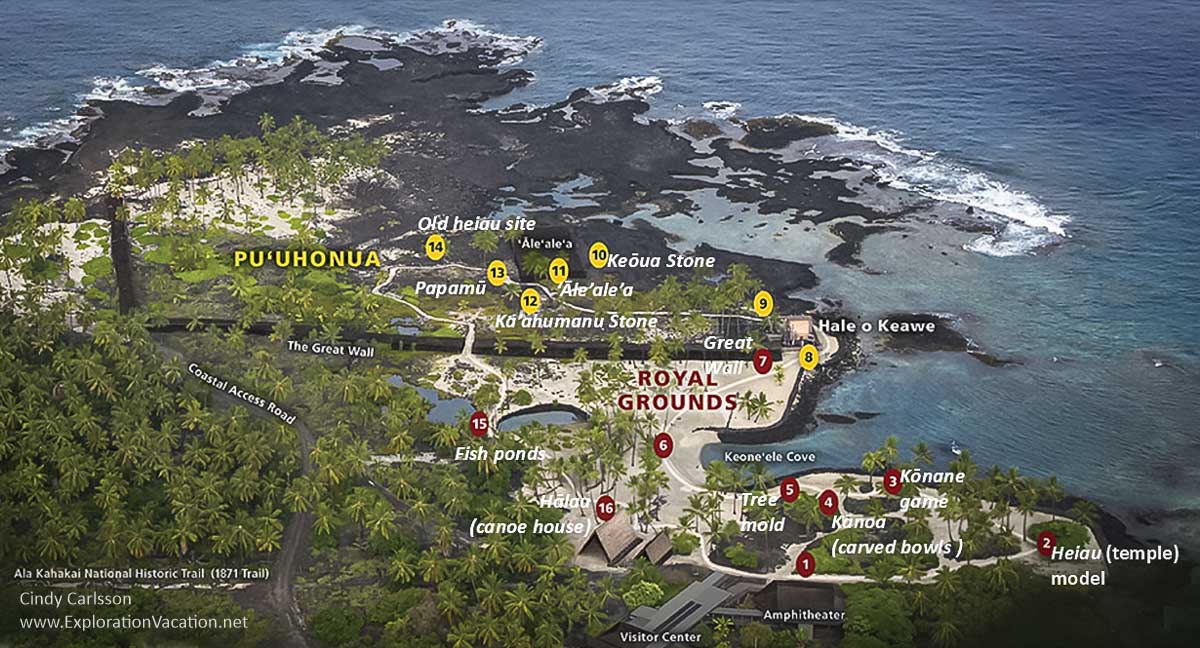
This map is on the Puʻuhonua o Hōnaunau park website. (You have to switch from “Standard Map” to “Brochure Map.”)
I’ll follow pretty much the same route here to give you an idea of what you’ll see.
Heiau (temple) model
While the whole area stretches out before you, if you follow the path in the park map or app, the first place you come to is a smaller-scale model of the Hale o Keawe, the place of worship at the heart of this historic site.

A model lets visitors see how the original temple was constructed.
Like the reconstructed version in the Puʻuhonua itself, it’s built using traditional techniques and materials. It has an ōhi’a wood frame and a roof thatched with kī leaves and trimmed with ama’u (ferns).
Unlike the reconstructed one, this model has an open end so you can better see how it is constructed.
Kōnane game
Kōnane is a strategy game played by the ali’i (chiefs and other elite) of old Hawai’i. The game was usually played on a “board” made of depressions carved into lava stones. Bits of lava and light-colored coral or seashells served as game pieces.

Ready for a game of kōnane?
This game is played a lot like checkers, with players jumping and taking each other’s pieces until no more moves are possible. The one with the most pieces on the board at the end wins. You can learn how to play this and other old Hawaiian games on the National Park website.
Kānoa and tree molds
As you walk along, you’ll see signs marking the location of kānoa (bowls carved into the lava rock) and tree molds (hollow impressions left behind where lava flowed around trees before the island was populated). The bowls would have been used for a variety of different purposes needed for daily life or ceremonies.
Keone’ele Cove
The ancient lava flows extend out to the sea here, making boat landings treacherous. In the old days, this protected cove gave the ali’i a safe and easy-to-control spot to land their canoes.
While the cove’s shore is protected within the national park, the rest of it is not. Unfortunately, there’s a popular beach right next door that draws big crowds. It makes for an odd and sometimes uncomfortable relationship.

The sacred sites at Puʻuhonua o Hōnaunau are quite a contrast to the popular beach next door.
At this point you’ll probably continue along the shore to the temple. However, I’m going to deviate from the main route here, as a couple sites you will see on the return loop are also part of the Royal Grounds.
Royal fish ponds
Fish ponds ensured a regular supply of food for the those living at or visiting the royal compound.

One of the fish ponds on the royal grounds.
You’ll still see fish in the ponds today, but they are invasive tilapia. The circles you’ll see on the bottom of the pond are their nests.
Hālau (Canoe Shed)
This is a small structure is used to store a traditional outrigger canoe and provide artisans with a shady place to work. There are a couple of ki’i around on one side.

A ki’i near the traditional shed where you’ll often find both a canoe and artisans at work.
The Great Wall
Separating the sanctuary from the Royal Grounds, the Great Wall is truly massive. Thought to have been constructed around 1550, it seems to have expanded an older settlement to create a fortified complex at Hōnaunau. The wall is 10 feet high, 17 feet wide, and almost 1000 feet long!

A portion of the Great Wall as seen from the area near the fish ponds.
The entire wall is built of dry-set stones. There’s no mortar to hold it together.

A much closer view of the great wall.
Legends say it was built in five days. Researchers say it was constructed in at least seven segments and, with at least seven crews working simultaneously, the wall may have been built in five days!
Puʻuhonua (Place of Refuge)
Now we get to the heart of the park site, the refuge with its reconstructed heiau, ki’i figures, and ruins. Although only the reconstructed Hale-o-Keawe is well-documented in the contemporary historical record, Native Hawaiian tradition and archaeological evidence indicates there were at least three and maybe four heiau at various locations here over the last 450 years or so.
Hale o Keawe
The Hale o Keawe is a reconstruction of the site’s hale poki, a royal mausoleum and place of worship. It’s a copy of the building and surrounding ki’i that stood here when King Kamehameha I died in 1819. (This heiau is thought to date back to about 1700.)
This was a royal mausoleum for the rulers originating from this area. It housed the venerated remains of 23 high chiefs, including ancestors of King Kamehameha I. The remains of such powerful ancestors were believed to imbue a site with divine power. As such, it remains an active spiritual site for Native Hawaiians.

The Hale o Keawe is the spiritual heart of this historic site.
This heiau appears to be the only one that wasn’t destroyed when the old beliefs were abandoned after Kamehameha’s death. Although no longer maintained, it continued as the royal mausoleum until 1829. That’s when the remaining royal bones were relocated to a mausoleum in Honolulu. The heiau was then destroyed.
👉 Read more about the Hale o Keawe
Even after the wood hale poki (the wood structure) was destroyed, its platform probably remained intact until damaged by tsunamis in the 1860s and 70s. In any case, by 1902 nothing remained but piles of stones.
Restoring the Hale o Keawe
The heiau platform was “restored” in 1902. However, it’s not clear what that restoration was based on, as the results were inconsistent with historical records of the site.
Another restoration occurred in the 1960s. This one was based on site excavations and historical records.
The Hale o Keawe and the rest of the heiau were also reconstructed in the 1960s. This was based on detailed historic sketches and notes on materials and construction techniques, as well as the cultural knowledge of Native Hawaiian craftsmen.
Visiting the Hale o Keawe
Visitors are not allowed in the courtyard or building. You have to take a close look at the model by the visitor center to see what it looks like inside and how it is constructed.
Please be particularly respectful in this area. Despite too many selfie-taking tourists laughing and yelling, this is still a sacred place for many Native Hawaiians. You’ll often find reminders of that in the form of offerings left outside the temple.
This is a good place to remain quiet and take in the sounds of the sea and the breeze in the palms. Perhaps then you too will feel the god-like power of Kona’s leaders of long ago.
👉 Read less
Keōua Stone
Tradition says this large stone was the favorite resting place of an 18th century high chief who would could easily observe his farmland and fisheries from here. Other stories say he actually slept here while the fishing fleet was out. Post holes suggest there may have been a protective canopy over it at one time.
The stone itself is over 12 feet long and has been shaped. Its size and shape suggest it may have been cut in the 1600s for a grand mausoleum that was never constructed.
(You can see the stone off to the side of the Āle’ale’a near the sea in the photo below. It is a very large rectangular stone with sunlight reflecting off of it.)
Āle’ale’a
A massive restored rock platform called Āle’ale’a (named for a star) is thought to have been the principal heiau before the Hale o Keawe was built.

The massive Āle’ale’a platform with the Keōua Stone visible near the corner closest to the sea.
Archaeologists think this structure was expanded multiple times over the centuries before reaching its current size. It may have been a complex of temple houses (hale poki) complete with ki’i and surrounded by wood palisades much like Hale o Keawe today. Or it could have been a single temple that was expanded many times.
While it’s pretty certain it was once a heiau, that may have been very long ago. The most recent stories say the platform was used for entertainment and that King Kamehameha sat up here to watch hula performances.
Ka’ahumanu Stone
Legends say that Queen Ka’ahumanu (the favorite wife of Kamehameha who pushed for the end of the kapu system after the king’s passing) swam to the Puʻuhonua o Hōnaunau after a quarrel with the king. She reportedly hid in a space within these rocks. However, her barking dog alerted the king to her hiding place.

It doesn’t look like a particularly well-concealed or comfortable hiding place, but she didn’t need to hide very long.
Fortunately for the queen, they quickly reconciled.
Old Heiau Site
Today it’s mostly a pile of stones spread across an ancient lava flow, but long ago this was once another heiau.

Being so near the sea, this ancient hiau is now mostly a pile of battered rock beneath the palms.
It’s not much to see today, but what’s left is one of the oldest structures in the park.
Tide pools
The whole area between the Āle’ale’a and the Old Heiau has tide pools scattered about.

Shoreline with tide pools beyond the old heiau site.
You can walk out to the tide pools, but tread carefully! The lava rock here is very uneven and extremely sharp – and an unexpectedly large wave can roll in at any time. It’s hard to imagine an exhausted refuge-seeker coming ashore here. But it was the last obstacle to overcome.
(We skipped the tidepools.)
Return to the Royal Grounds or continue on along the shore
Once you’ve passed the Old Heiau, you should be able to continue over the rock along the shore to the picnic area (we didn’t do this) or just continue on the loop trail through a break in the wall and back to the Royal Grounds and the Royal Fish Ponds like we did.
From the fish ponds you can:
- Continue on the main path to see if there is a demonstration underway at the canoe shed OR
- If you want to see more of the park, take either the Coastal Road/Trail or the 1871 Trail. (The Coastal Road becomes the Coastal Trail and ends at the 1871 Trail, so either will take you further into the park.)
-
- Follow the unpaved Coastal Access Road back toward the picnic area along the shore and continue on from there OR
- Follow the Coastal Road the other direction and pick up the Ala Kahakai National Historic Trail (the 1871 Trail.)
-
Take the 1871 Trail to Kiʻilae Village
If you go back to the map at the very top of this page (or jump over to the map on the National Park Service page), you’ll see there are a few more sites in Puʻuhonua o Hōnaunau National Historical Park. We decided not to visit these on this trip due to both time constraints and the rocky terrain. (The hike is only two miles round-trip, but you should have good hiking shoes for this part of the park.) However, this area looks interesting and you’d likely have it mostly to yourself.
The 1871 Trail
While the 1871 Trail generally follows ancient footpaths, it gets it’s name from the date the route was improved and expanded to a road that allowed easy passage by horses and pack animals.
The 1871 Trail is a section of the Ala Kahakai National Historic Trail, a 175 mile trail that links ancient foot trails and historic sites that run from the northernmost point on Hawai’i, along the island’s western coast, around the south end of the island, and over to Puna on the east coast. You’ll run into segments of this trail all over the Big Island as you explore ancient Hawaiian sites.
Ki’ilae Village
Ki’ilae Village sites includes both ancient and more recent structures, including the ruins of a heiau, houses, and agricultural structures. While it’s not known when this area first became a village, it’s thought it might date back to the late 1700s or early 1800s. It remained in use as a traditional fishing community until the 1930s.
Historic sites are found all along this segment of the 1871 trail, and the NPS has a map of this area online (PDF) as well as an audio guide.
Plan your trip to Puʻuhonua o Hōnaunau
Puʻuhonua o Hōnaunau National Historical Park is an easy place to learn about early life in Hawai’i if you are on the west coast of the Big Island. And you can see the park’s highlights in an hour or two. Allow a couple more hours if you want to hike down to Ki’ilae Village or just want more time to enjoy this remnant of old Hawai’i.
Where is Puʻuhonua o Hōnaunau National Historical Park
Puʻuhonua o Hōnaunau park is located along the coast of Hawai’i about a half-hour drive south of Kailua-Kona. All of the most significant historical sites are located at the north end of the park along the marked walking path.
👉 Read more about planning a visit to Pu'uhonua
Park fees
As at all National Park sites with an entrance fee, pass holders and those with them (with some limits) can enter without charge. Along with the usual pass options, Puʻuhonua o Hōnaunau National Historical Park also accepts the Hawai’i Tri-Park Annual Pass.
Puʻuhonua o Hōnaunau National Historical Park only accepts payment for entrance fees by credit or debit card. No cash. (It appears other purchases in in the park store can be made with cash.)
Entrance fees include parking, thus it is free for pass holders.
Unlike many state and local parks in Hawai’i, there isn’t a discount or free entry option for Hawai’i residents.
Maps and tours
Besides printed maps, the park service has a walking tour audio guide for both the Royal Grounds/Puʻuhonua area and the 1871 Trail to Kiʻilae Village. (Download the National Parks App to get them.) Both printed maps are on the park website, but you’ll want to stop in the Visitor Center to get full-size versions.
Oddly, none of the big tour consolodators offer group tours from Kona that actually visit the national park, although both Viator and Get Your Guide have snorkeling trips that go to the adjacent beach. That would allow you to see the Hale o Keawe from the water, which would be cool.
If you want to actually visit the park and don’t want to drive, you’ll need to seek out a local guide (always your best option anyway) or book Get Your Guide’s rather pricy private shore excursion that visits the national park and a couple of other interesting historic sites.
Prohibited activities in the park
Visitors are not allowed inside the courtyard of the Hale o Keawe.
Do not touch offerings left at the site by Native Hawaiians.
Pets are not allowed in the Royal Grounds or Pu’uhonua areas. They ARE allowed in the picnic area and on the 1871 Trail as long as they are on a leash no longer than 6 feet at all times. Owners must properly dispose of all pet waste.
Snorkeling is not allowed in Keone’ele Cove in the national park. The popular snorkeling spot across the cove (known as Two Step), is NOT in the national park. Visitors to Two Step are not allowed to park in Puʻuhonua o Hōnaunau’s parking lot or use the Visitor Center restrooms to change clothes or rinse off. And snorkeling is not allowed in the cove along the park.

This popular snorkeling spot is NOT part of Puʻuhonua o Hōnaunau National Historical Park.
👉 Read less
Land Acknowledgement
Hawaiʻi is an indigenous land whose original people are now identified as Native Hawaiians. In 1893 her majesty Queen Liliʻuokalani was forced to turn the Kingdom of Hawai’i over to the United States in order to avoid bloodshed among her people. Generations of Native Hawaiians, their knowledge, and lifeways have shaped and continue to shape and care for Puʻuhonua o Hōnaunau to this day.
Looking for more information?
The National Park website for Puʻuhonua o Hōnaunau National Historical Park offers a wealth of resources for understanding this site and the people who created it and value it today. There is a fair amount of info on the park app and/or indexed on the website. However, there is a lot more information that appears to have been removed from the website’s table of contents sometime after 2015. You have to search for it, but some is far more in-depth than what is indexed on the site today. A few very much worth checking out include:
- A National Park Service History document has a long list of documents and studies related to Puʻuhonua o Hōnaunau.
- A Cultural History of Three Traditional Hawaiian Sites on the West Coast of Hawai’i Island produced for the National Park service by Linda Wedel Greene in 1993 provides a wide-ranging look at Hawaiian history and pre-history as part of a study of Pu’ukohola Heiau National Historic Site, Kaloko-Honokohau National Historical Park, and Pu’uhonua O Honaunau National Historic Park.
- Hoʻonāʻū – Prolonging an Ancestral Breath is a series of NPS videos about traditional perspectives on Oceanic cosmologies, origin stories, place-based practices, and traditional methods of remembering history.
Punahou School’s online exhibit Eia Hawai‘i: 1819 – 1841, offers a short and very readable account of the dramatic changes happening in Hawai’i up to and through 1841. I relied heavily on the section on Ending the Kapu for this post.
Lodging near Pu’uhonua O Honaunau
There is no lodging or camping available within Puʻuhonua o Hōnaunau National Historical Park.
Most visitors to Puʻuhonua o Hōnaunau stay in the resort areas north of the park at Kailua-Kona, However, if you want a more local experience, see what you can find near the park. You won’t find a lot of big resorts, but there are private homes, smaller lodges, bed and breakfasts, and guesthouses in the area. Most are just to the north of the park in an area that is far more lush and green than Kona.
You’ll have to play with the map view to limit your search to the area around Captain Cook and south, but there are some great options on VRBO and Expedia.
Enter your travel dates for current prices.
See more photos of Puʻuhonua o Hōnaunau National Historical Park on CindyCarlsson.com.