Last updated on June 10th, 2026
Art fans, and particularly fans of glass art, need to head north of Minneapolis and Saint Paul to the Cafesjian Art Trust (CAT) Museum in Shoreview.
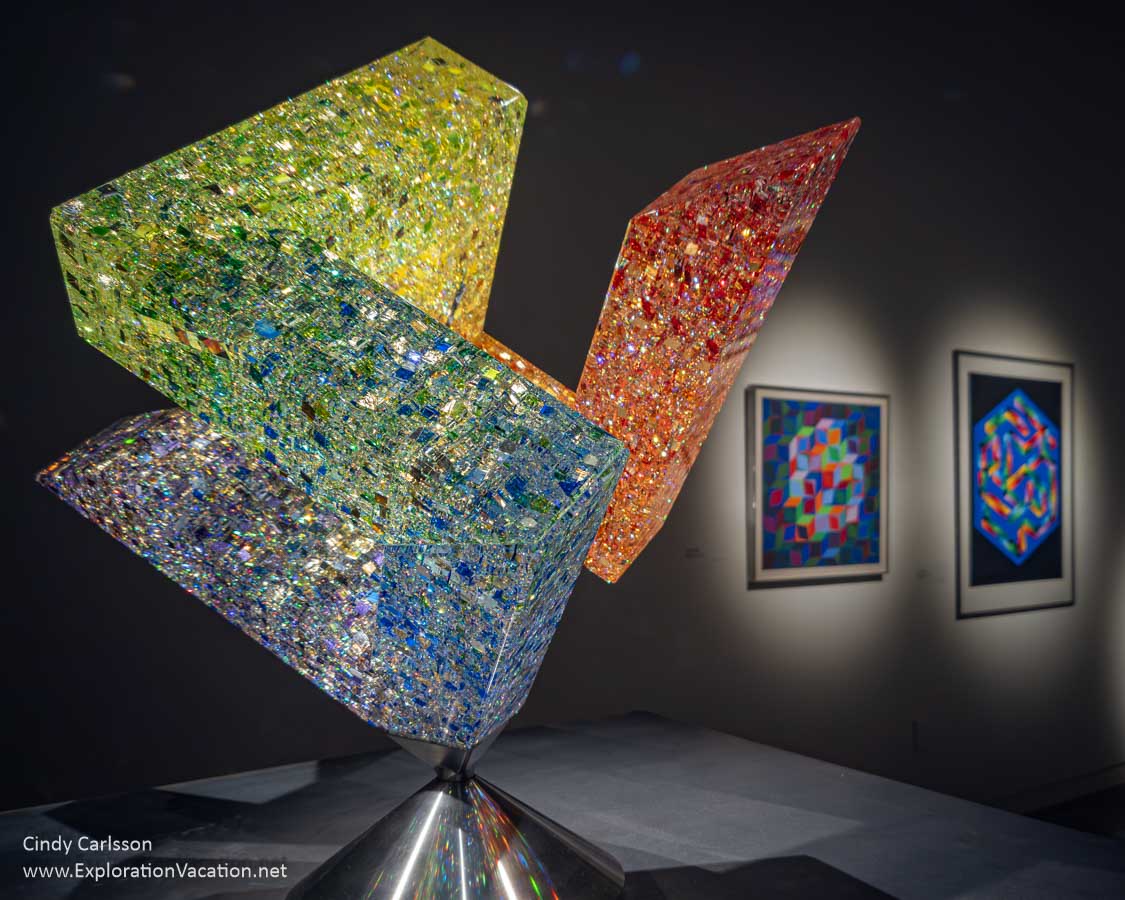
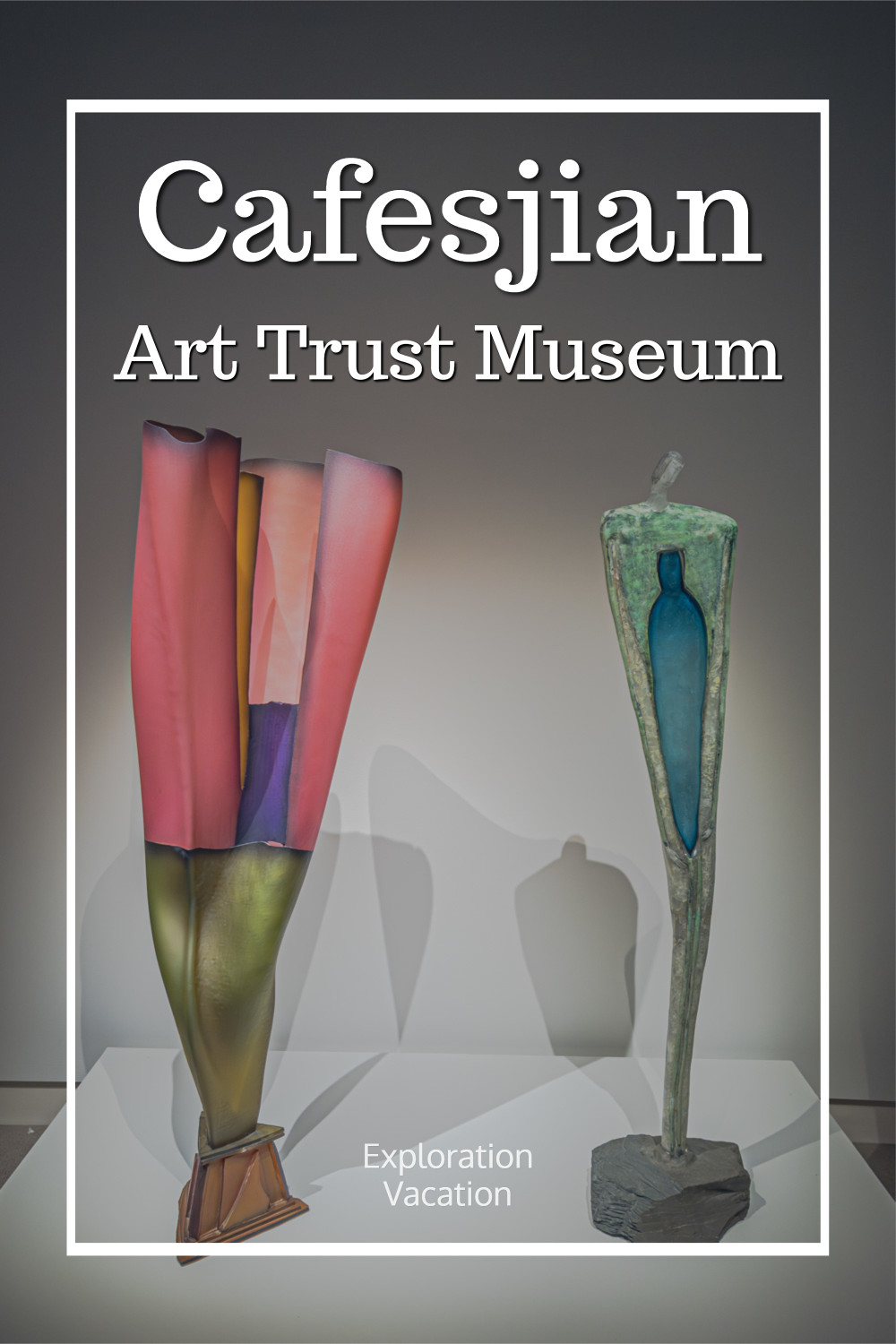
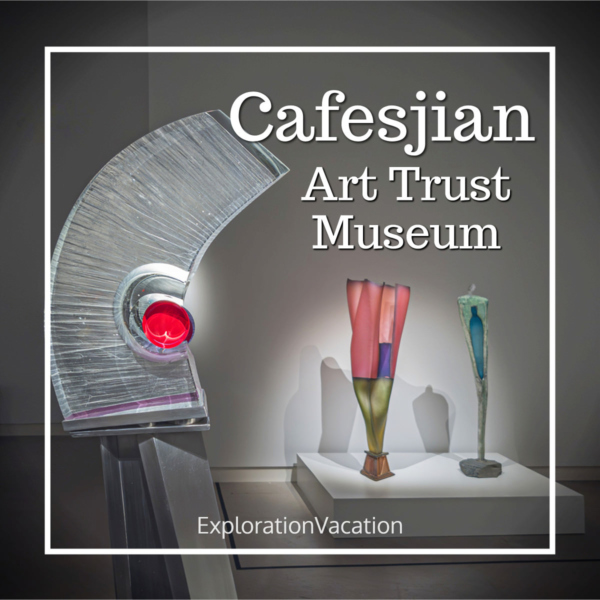
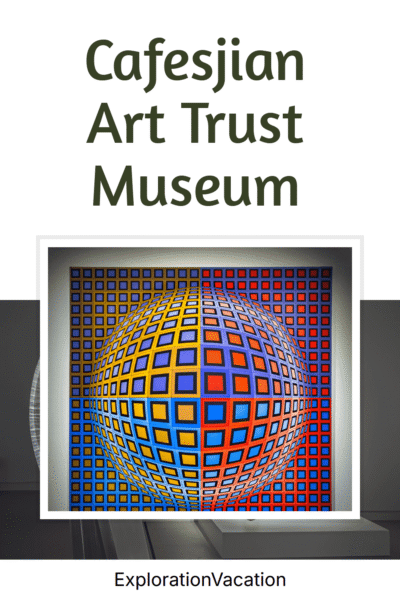
“Joseph Ribbon,” by American artist Jon Kuhn and two images by Hungarian artist Victor Vasarely at the CAT’s “Fooling the Eye” exhibit in 2024.
This small museum features thoughtfully curated exhibits of art in many forms (but especially glass) by artists from across the USA and far beyond. And every exhibit changes regularly (there’s no permanent exhibit), so you’ll want to return for each one to see what’s new!
I use links to improve your experience using this website. Some may be affiliate links that pay me a small commission if you use them to book a room, rent a car, or purchase goods or services. You don’t pay extra, but it helps keep this website running. To learn more, see my policies and disclosures.
Inside the Cafesjian Museum
The building housing the museum has a mosaic of blue and gray glass panels that give it a very contemporary feel.
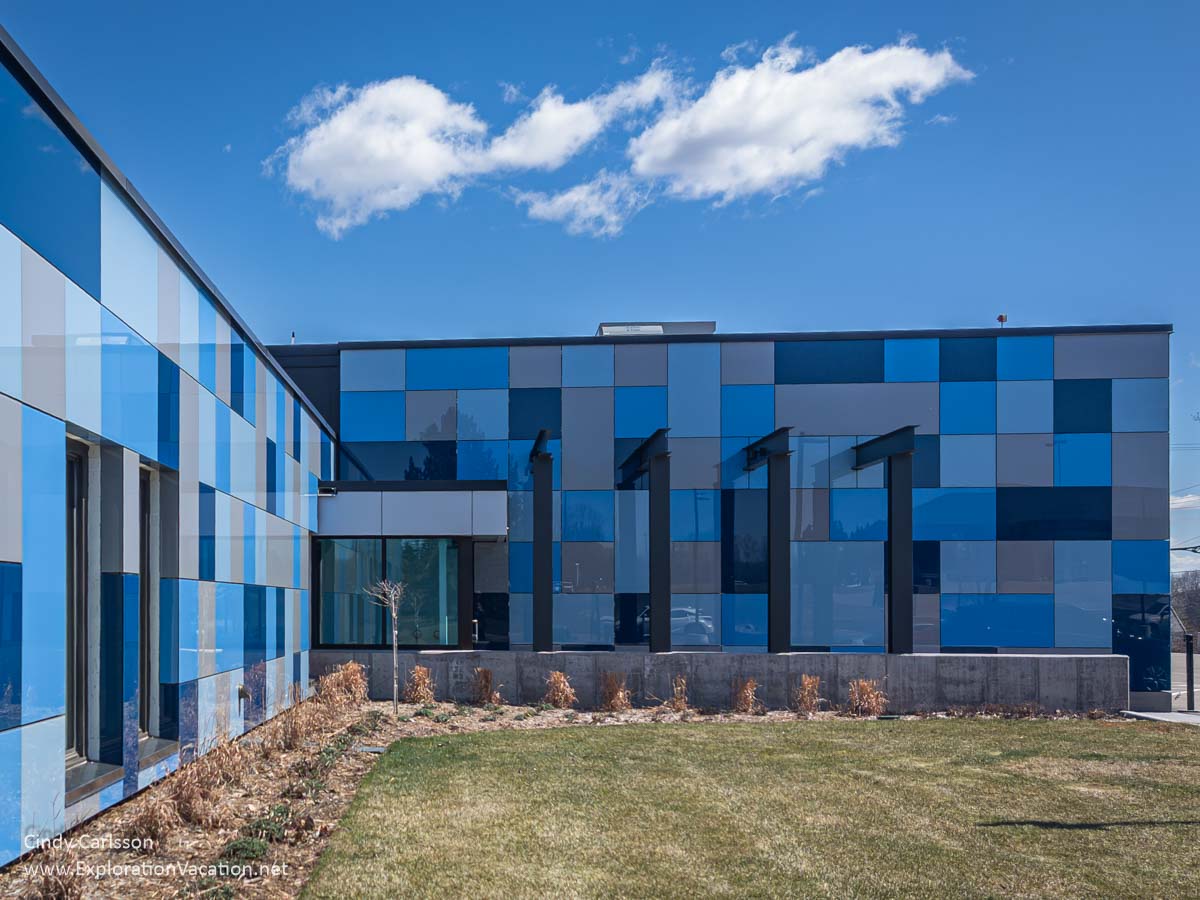
The museum’s artsy building in Shoreview.
However, the building wasn’t built as an art museum. It started as the home of an engineering firm. The Cafesjian Trust purchased it because they needed storage space for Gerard Cafesjian’s massive art collection. But the building had enough extra space to accommodate a public gallery too.
A major renovation not only added artistic appeal to the exterior, but also renovated the building to include the required storage space, offices, an “art conditioning” room, and a gallery designed to support hanging thousands of pounds of art in any area. (The Chihuly chandelier in the lobby weighs 2,000 pounds.)
Once inside the door, you’ll turn to the left if you need to check in for a tour.
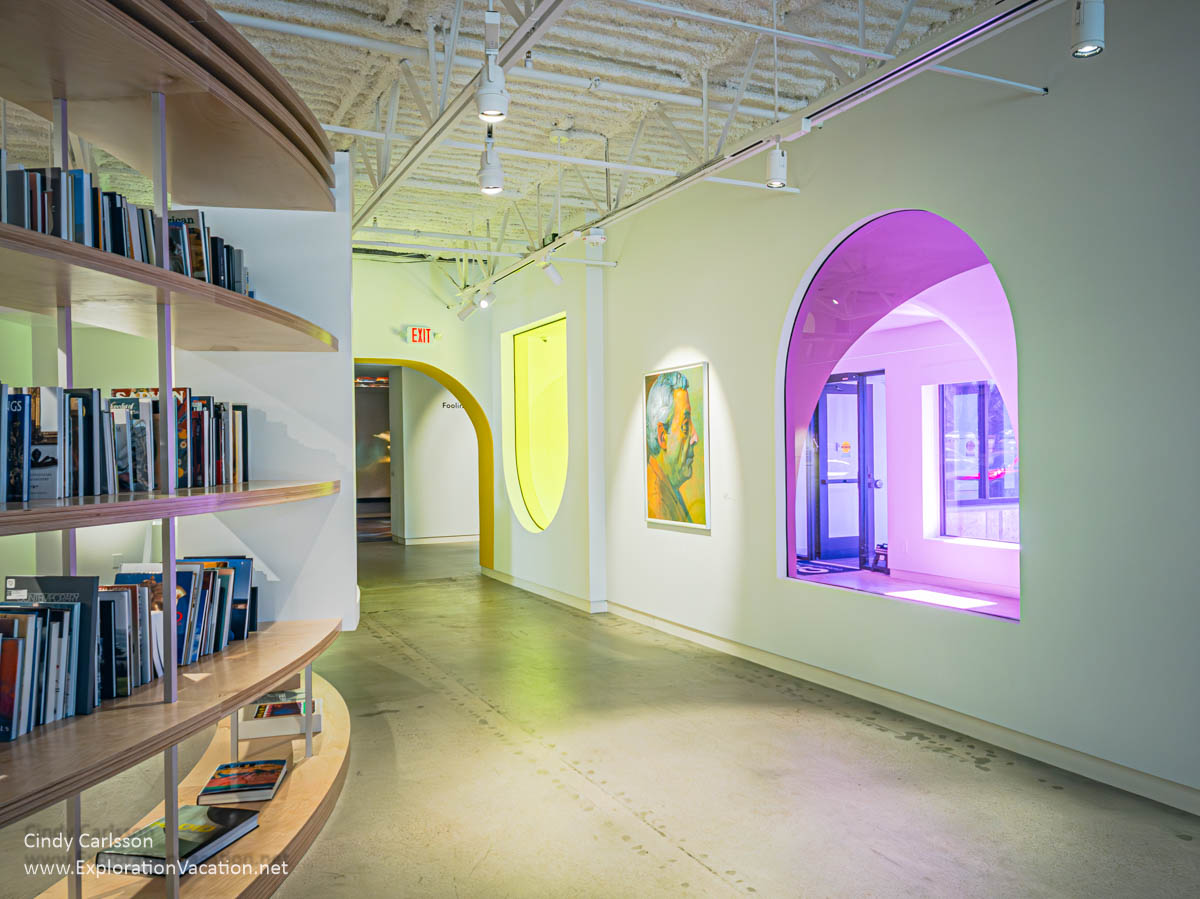
View back toward the entrance to the galleries from near the reception desk. The library is on the left, and the building entrance is that door visible through the purple arch on the right.
While the entrance area is a bit confusing, once you turn to the left, the check-in area is obvious. (And you’ll be excused if you get there and are then completely distracted by the enormous Chihuly chandelier in the lobby.)
The mostly glass-walled library is egg-shaped. It has books about artists included in the collection, as well as an ever-changing selection of art.
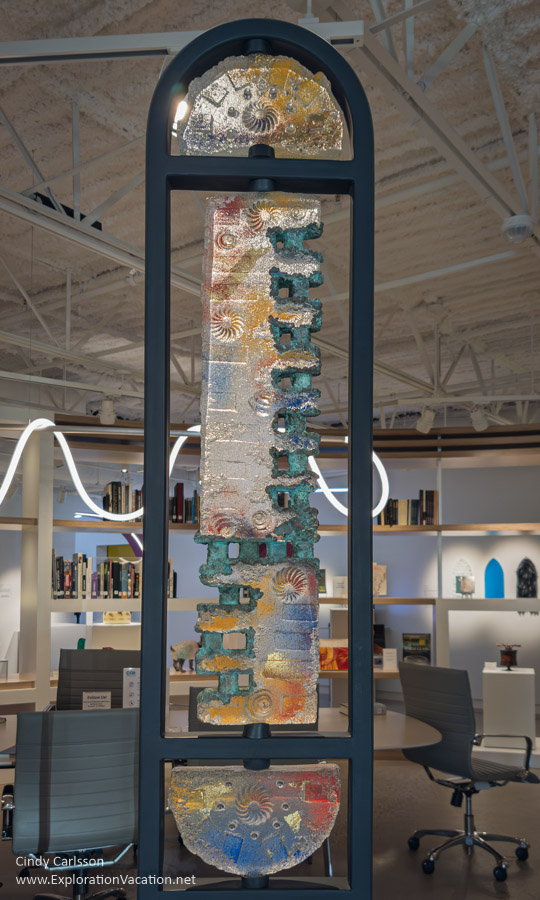
The library (almost hidden behind a piece by Minnesota artist Douglas Becker) not only has an interesting array of books, but it also serves as gallery space.
Visitors are welcome to browse through the books while at the museum, but extended time in the library requires a separate reservation.
The exhibition gallery is located beyond the library. There are other rooms tucked back here as well: A quiet room featuring the Chihuly ceiling designed for Cafesjian’s dining room, a children’s area, and a very cool area where you could hold small receptions.
Gallery spaces have changed!
The museum had several designated “gallery” spaces, as well as spaces in and around the library. There is now only one gallery.
The Main Gallery is often left as one large, open room.
It’s pretty jaw-dropping when you first see it.
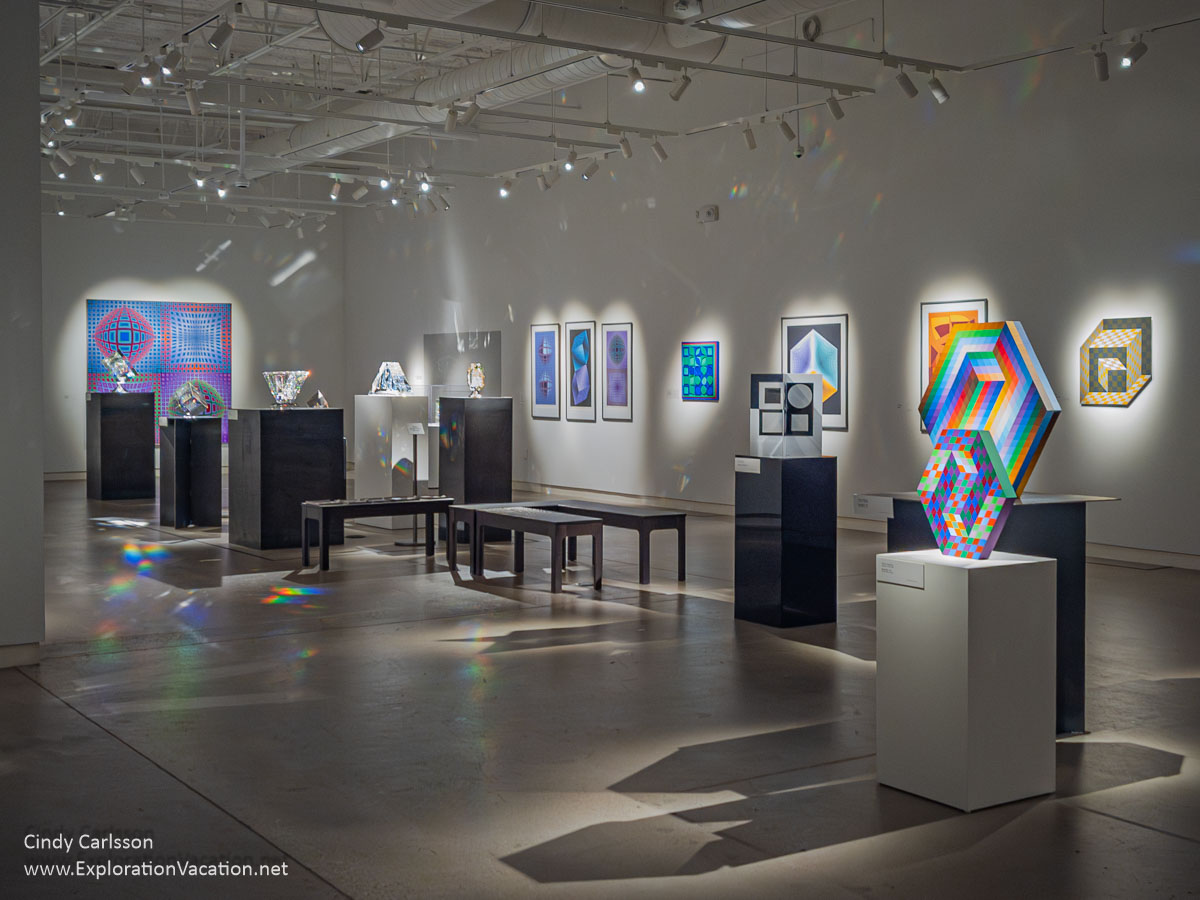
Part of the Main Gallery during “Fooling the Eye: Optics of Vasarely and Kuhn.”
Part of what makes this otherwise stark gallery so stunning is that usually most pieces are out in the open. Only the smallest, most delicate pieces are secured in glass boxes.
And the clarity of the glass used both on framed art and on cases that protect small and/or particularly delicate pieces is spectacular. It is stunningly clear and clean. I’ve visited a lot of glass galleries and museums, and I have never seen glass display cases of this clarity. Not only is it kept unbelievably clean, but the glass itself seems both brighter and clearer than what is generally used. (I get that this is a new museum with new glass, but I hope a certain large Minneapolis art museum takes note and improves both their glass cases and picture frame glass.) And everything is usually beautifully lit. (My photos do not do the lighting justice.)
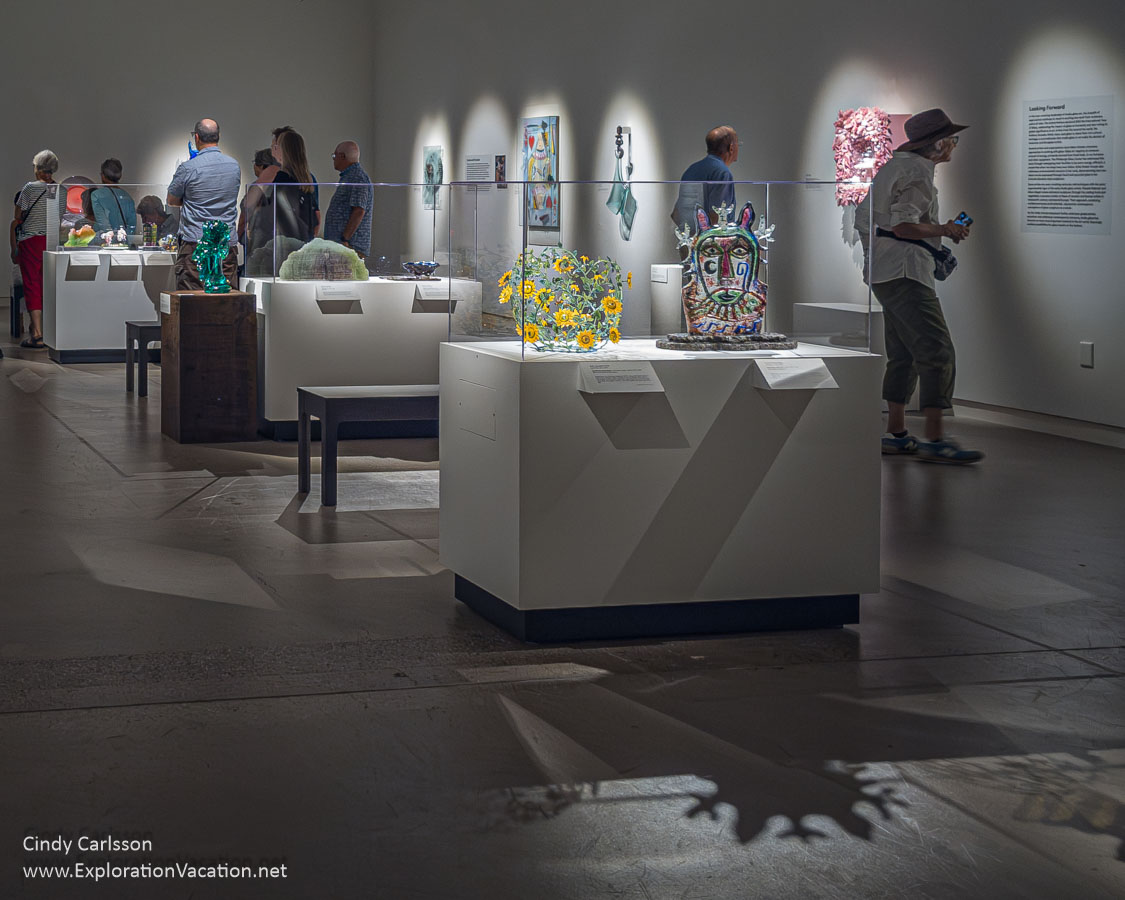
There were plenty of glass boxes in the American Studio Glass exhibit, but they were bright and crystal clear—no dulled or ultra-reflective glass and no scratches, dust, fingerprints, or other grime. Aside from corners, I never really noticed the glass between me and the art.
I really can’t rave enough about the presentation at the exhibits I’ve seen. It’s just fantastic.
Art at the CAT Museum
The Cafesjian Art Trust Museum held their first exhibit in 2022, filling the galleries with work by American artist Dale Chihuly.
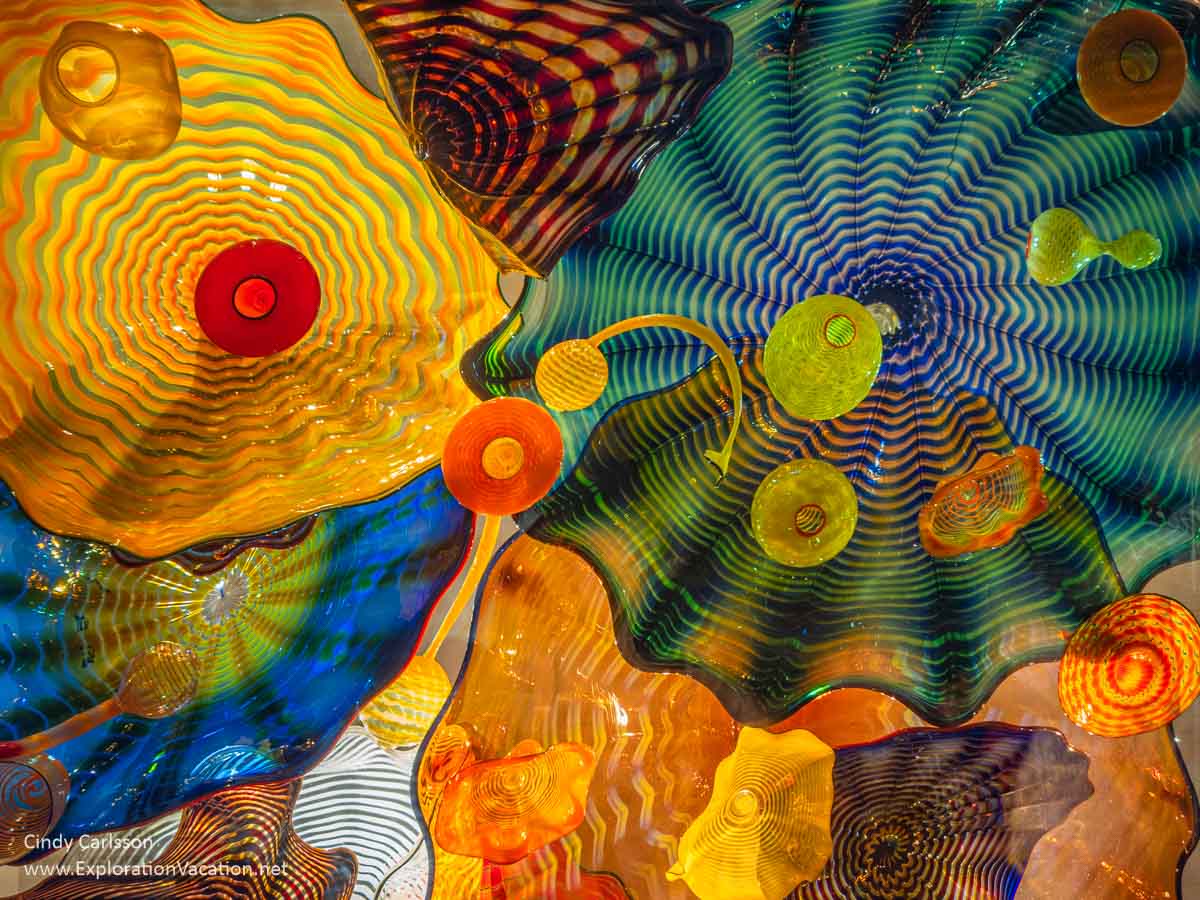
Created to hang over Gerard Cafesjian’s dining room table, the Chihuly ceiling is a permanent exhibit at the CAT.
Sure, Cafesjian was particularly interested in glass art and he and Chihuly were friends for almost 30 years. But opening with Chihuly also shows that the Trust knew how to draw a crowd: Chihuly is by far the best-known and most broadly popular glass artist in the USA. (Even people who don’t know his name know his work.) So, if you want people to show up at a new art museum, a Chihuly exhibit is guaranteed to draw a crowd!
Past exhibits at the Cafesjian museum
The museum’s initial exhibits consisted largely, but not entirely, of items from the Cafesjian Art Trust collection.
Exhibits through 2025 included:
- “A Lasting Friendship: Gerard Cafesjian & Dale Chihuly” (October 2022 – April 2023)
- “Highlights of the Collection” (June – October 2023)
- “Fooling the Eye: Optics of Vasarely and Kuhn” (November 2023 – May 2024) – story below
- “Midwest Voices in Contemporary Glass” in the Focus Gallery (June – October 2024)
- “From Origins to Horizons: The American Studio Glass Movement” (June-December 2024) – story below
- “Vantage Points: Landscapes from the Collection” in the Focus Gallery (October – December 2024)
- “Out of the Box: The Glass Art of Kyohei Fujita” in the Focus Gallery (January – April 2025)
- “Echoes of Life: Paintings from the Collection” (January – September 2025)
- “Spiral: A CAT Teen Council Exhibition” in the Focus Gallery (May – June 2025)
- “Collidoscope: de la Torre Brothers Retro-Perspective” (October 2025 – February 2026) – story below
Fooling the Eye: Optics of Vasarely and Kuhn
Fooling the Eye is the exhibit that finally got me to make the effort to figure out how to get a tour reservation and finally get out to the new museum that several friends raved about. Actually, it was a rather surreal photo a friend posted that suddenly made this a must-see. And for good reason!
The exhibit featured the work of two artists completely unfamiliar to me: American Jon Kuhn and Hungarian Victor Vasarely. While they work in very different mediums, both are interested in perception and how to fool the eye.
Through the use of shading and linear elements, these ingenious works play with the illusion of movement and the relationship of color and light.” (CAT Museum)
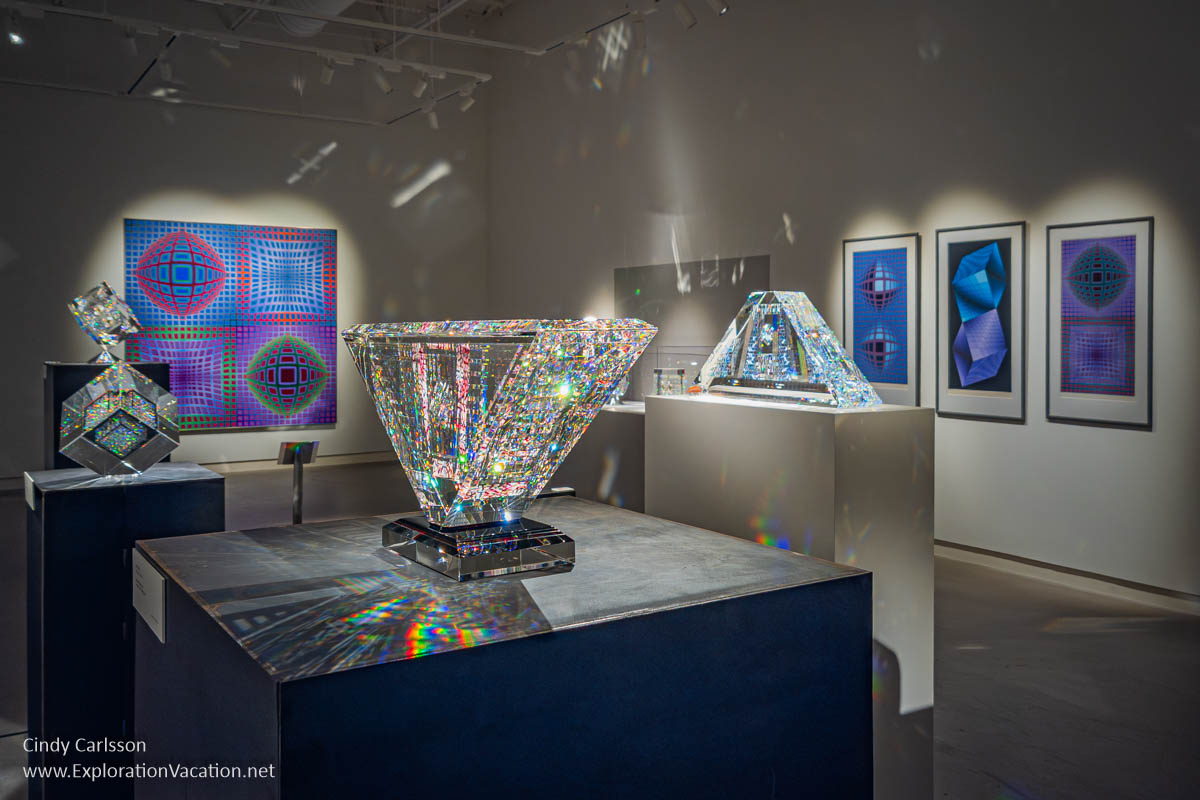
Work by Jon Kuhn (foreground) and Victor Vasarely at the CAT.
Jon Kuhn is all about expressing deep meaning through intricate geometry created by repeated cutting and polishing and layering and polishing, repeated over and over and over again.
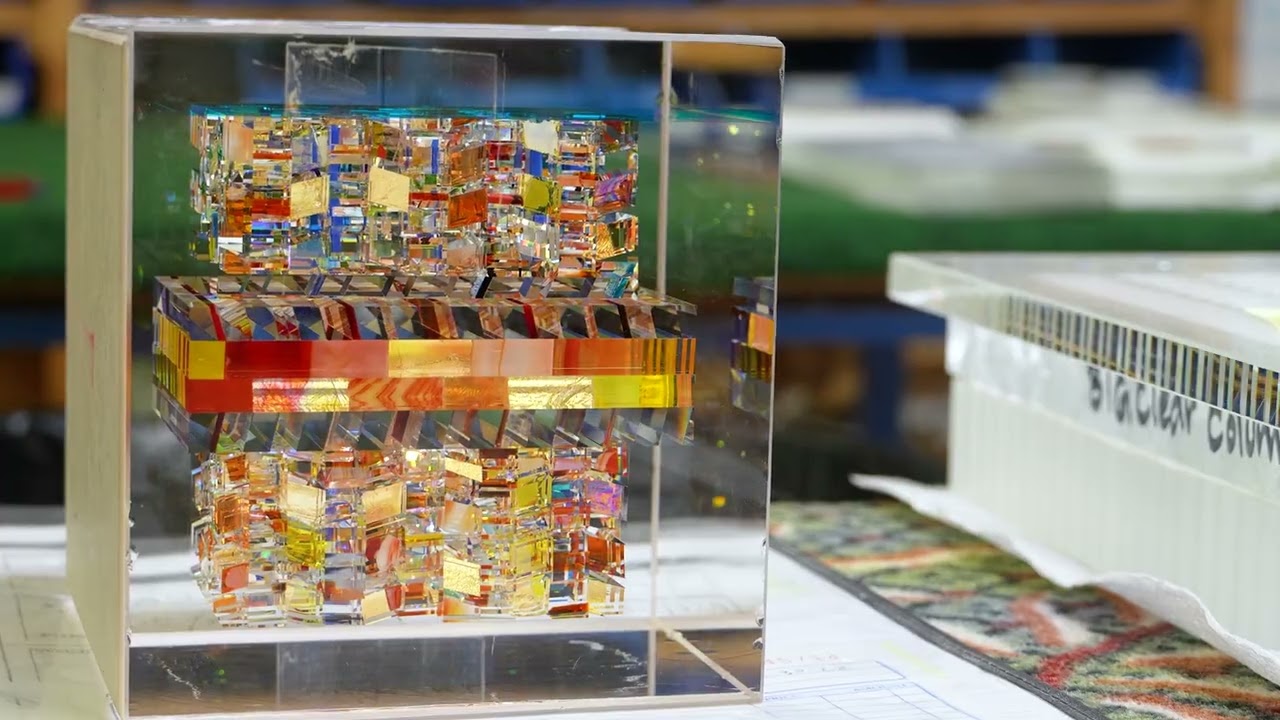
I was surprised to discover Kuhn collaborates with one of my favorite artists, Paul Stankard.
👉 See more of Fooling the Eye . . .
Stankard’s work is also intricate, but in a very different way. He’s all about curving lines and organic elements. His realm is tiny worlds with perfect glass flowers, leaves, fungi, and bugs. At first glance, the two artists’ work couldn’t seem more different. However, since the early 2000s, Stankard and Kuhns have co-created Stan-Kuhns, art that beautifully mixes their very highly detailed, but very different approaches to glass.
StanKuhns are a combination of Stankard’s intricate encased organic motifs and Kuhn’s reflective prismatic elements, creating a glittering finished product that showcases the artists’ work in a new way.” (CAT Museum)
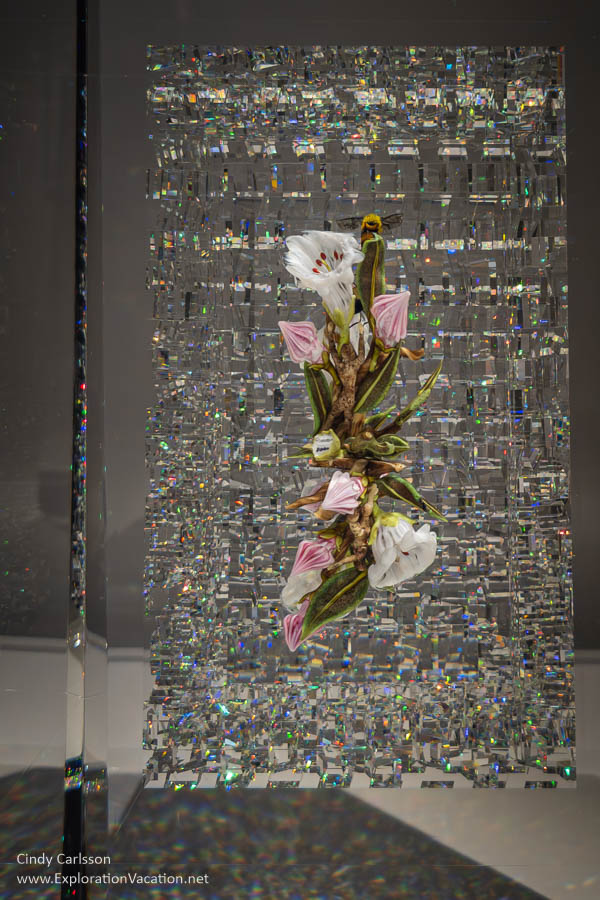
Detail of Paul Stankard’s work embedded in a piece by Jon Kuhn.
Of course, Kuhn’s work was only part of the exhibit. Victor Vasarely’s glowing geometric images and sculptures are impossible to miss even when paired with Kuhn’s glittery creations.
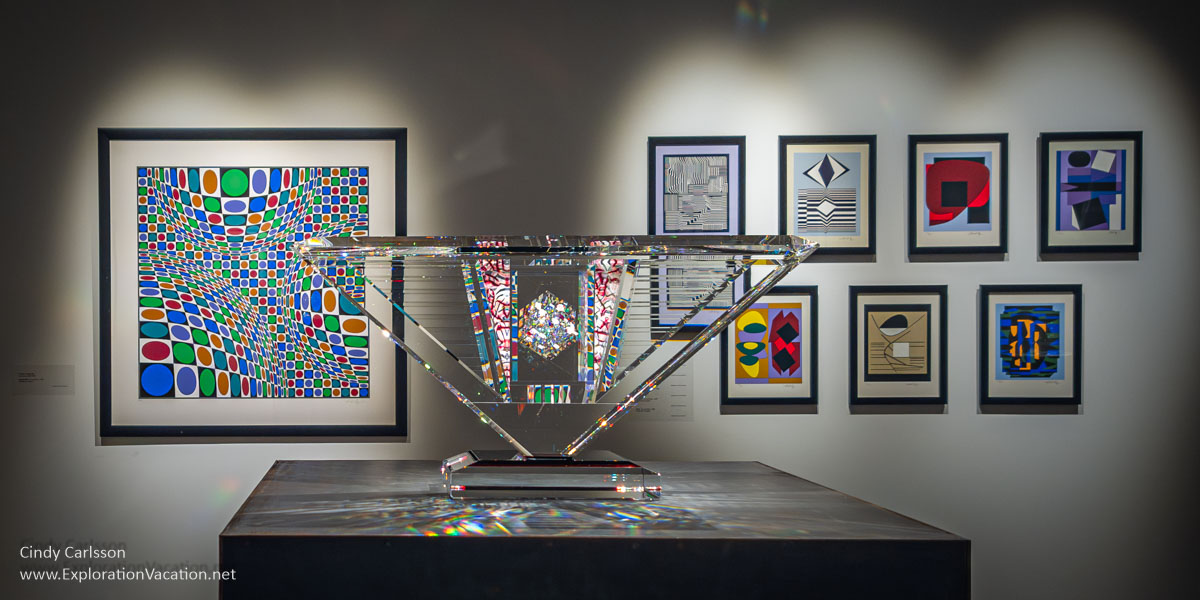
Vasarely’s work doesn’t exactly recede into the background!
Born in Hungary, Vasarely discovered abstract art while studying in Budapest. However, he spent most of his life working in France, where his experiments with geometric abstracts and perception made him the father of optical art.
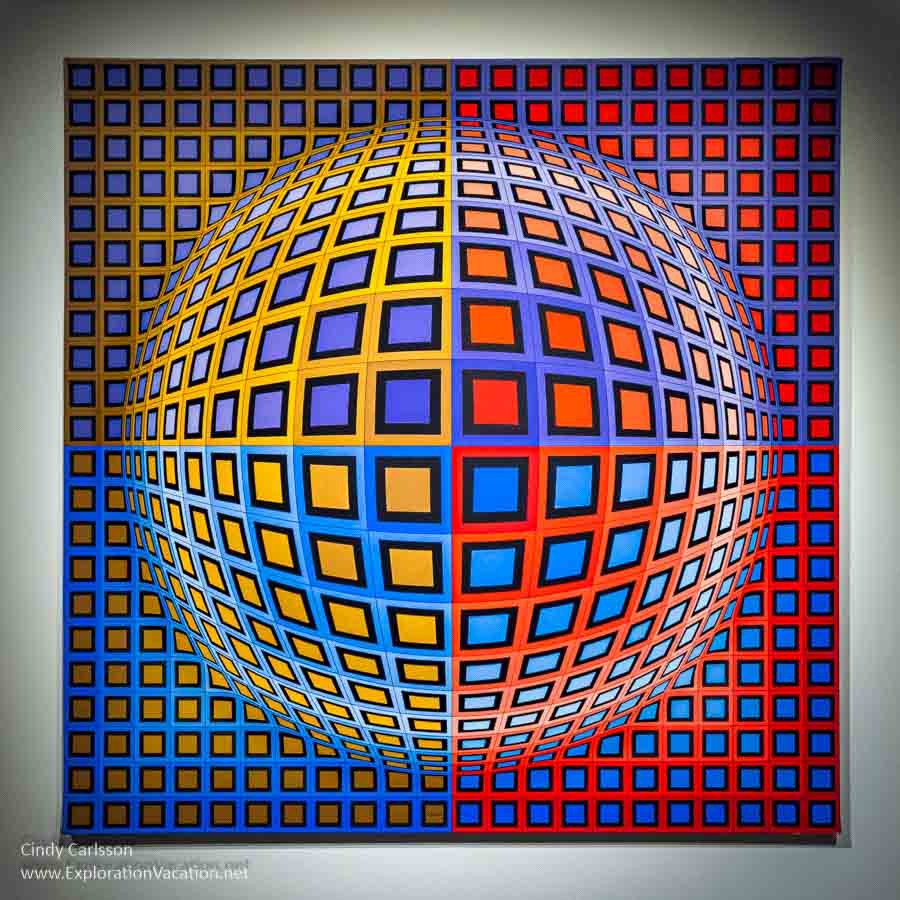
This is a painting on canvas. Vasarely’s work often fools your eye into seeing depth and movement where none exists.
👉 Read less
From Origins to Horizons: The American Studio Glass Movement
While I really had no idea what to expect with the “Fooling the Eye” exhibit, I had a better idea of what I might see when it came to an exhibit focused on American studio glass. And, overall, the pieces included in the show were generally fabulous and pretty much what I expected: A wide range of styles and techniques by some of the USA’s top artists.
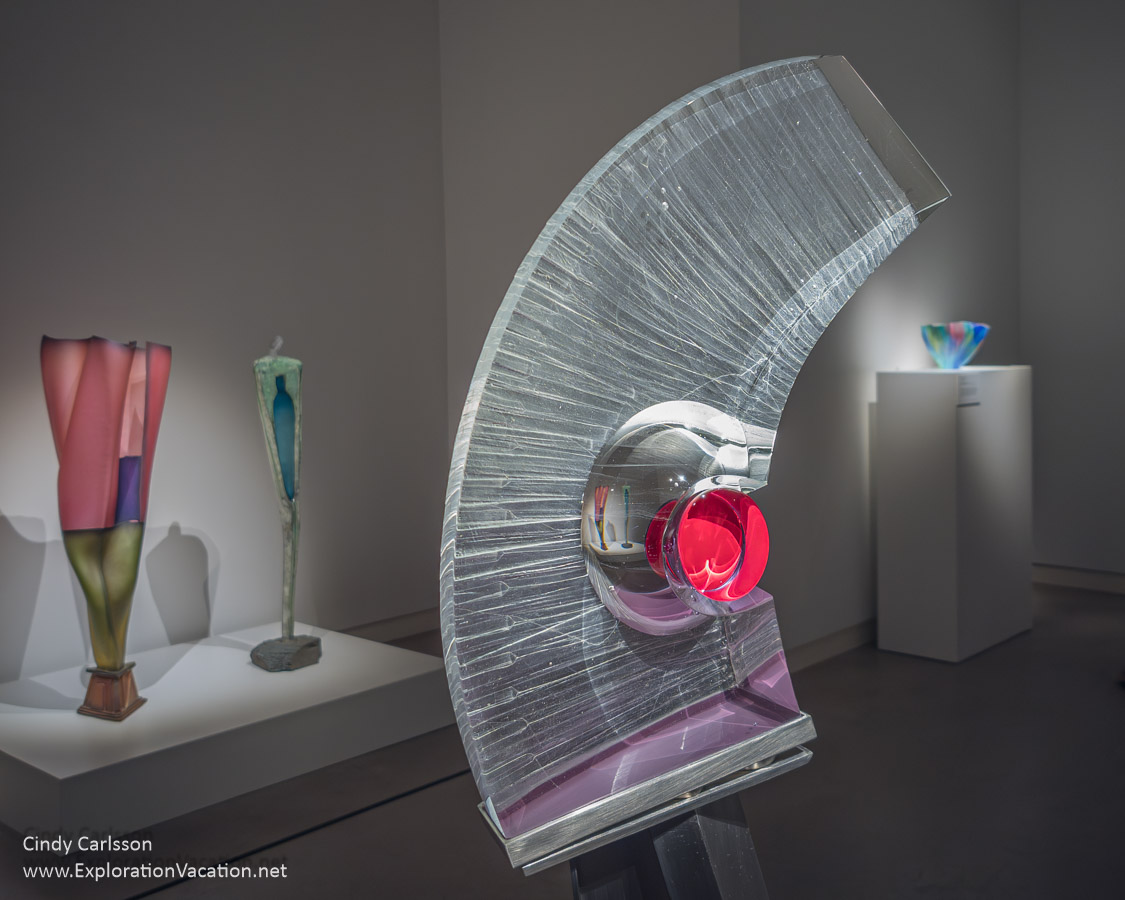
A large freestanding piece by Jack Schmidt, with work by Danny Perkins, Robin Grebe, and Toots Zynsky in the background
In case you aren’t familiar with Toots Zynsky’s work, here’s a better look at that bowl in the background.
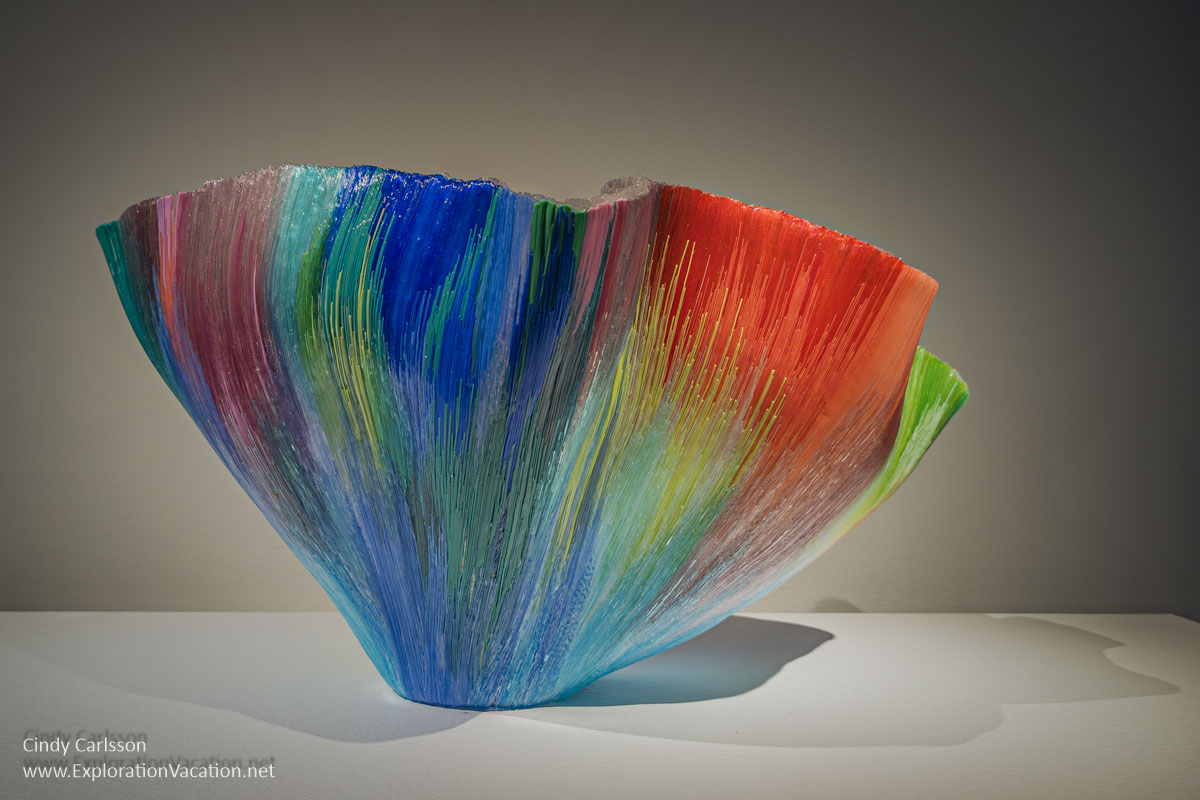
Using a technique she invented, Zynsky fuses thousands of glass threads together, layering them over hand-built molds so the threads merge and slump when heated.
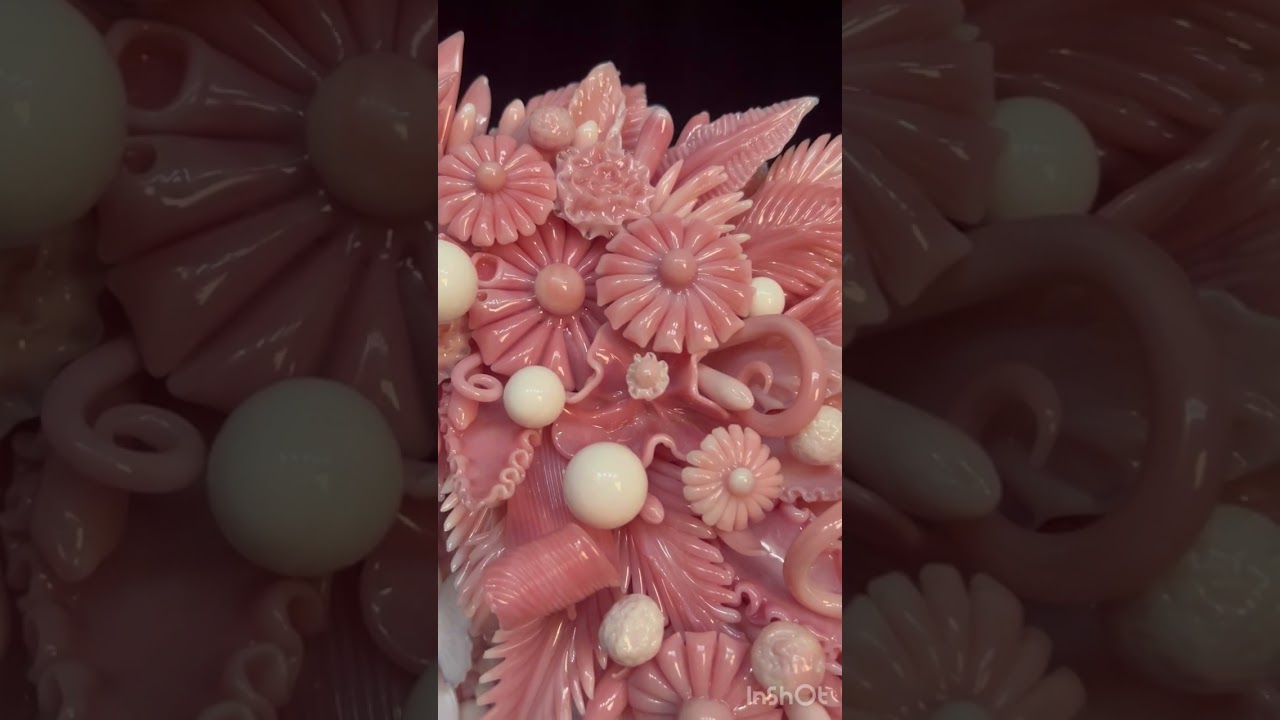
There was also a piece by Amber Cowan, who takes old pressed glass, reworks it, and combines it with glass objects, metal, and other bits to create incredibly complex sculptures, often in the form of dioramas.
And for fans of more “traditional” glasswork, there was a gorgeous Venetian-style goblet by Dante Marioni.
There really was a little of everything.
But, along with the art, the exhibit included a history lesson on studio glass. It had a lot of good information, including examples of early studio glass before Italian glass-making techniques were understood. That was a good reminder of how far we’ve come in a relatively short time.
Overall, the history lessons were a good introduction to what studio glass is and how it came about. That’s important now that we are surrounded by so much amazing glass that it’s easy to forget how far glassmaking in the USA has come since the 1960s. However, among other quibbles, the history lessons presented generally minimized the role of female artists – or ignored them completely. By the time I was three-quarters of the way through the exhibit, my husband was repeatedly telling me to just look at the art and ignore the history panels. After all, the art on display was truly wonderful and included plenty of work by women.
But I don’t want to leave a negative impression of an exhibit filled with fantastic art. So, I’ll end with a fun piece by Ginny Ruffner who was re-thinking a glass of red wine by making the “wine glass” out of metal and the “wine” out of glass.
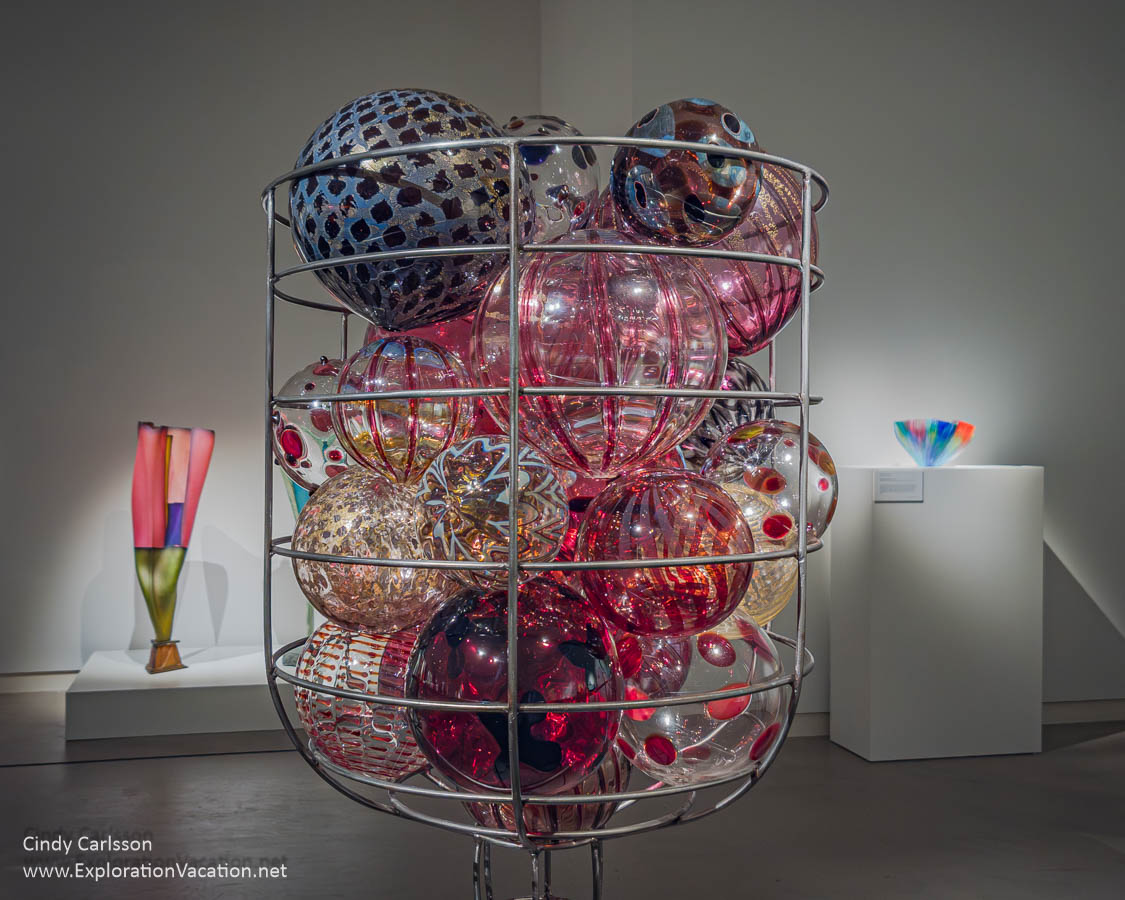
Anyone looking for a glass of red wine?
Collidoscope: de la Torre Brothers Retro-Perspective (Current)
The exhibit through early February 2026 is “Collidoscope: de la Torre Brothers Retro-Perspective.”
This exhibit is NOT from the Cafesjian Trust’s collection. It’s a traveling exhibition organized by the Cheech Marin Center for Chicano Art & Culture of the Riverside Art Museum and the Smithsonian’s National Museum of the American Latino. As such, it’s the first exhibit at the Cafesjian museum not drawn largely from their own collection.
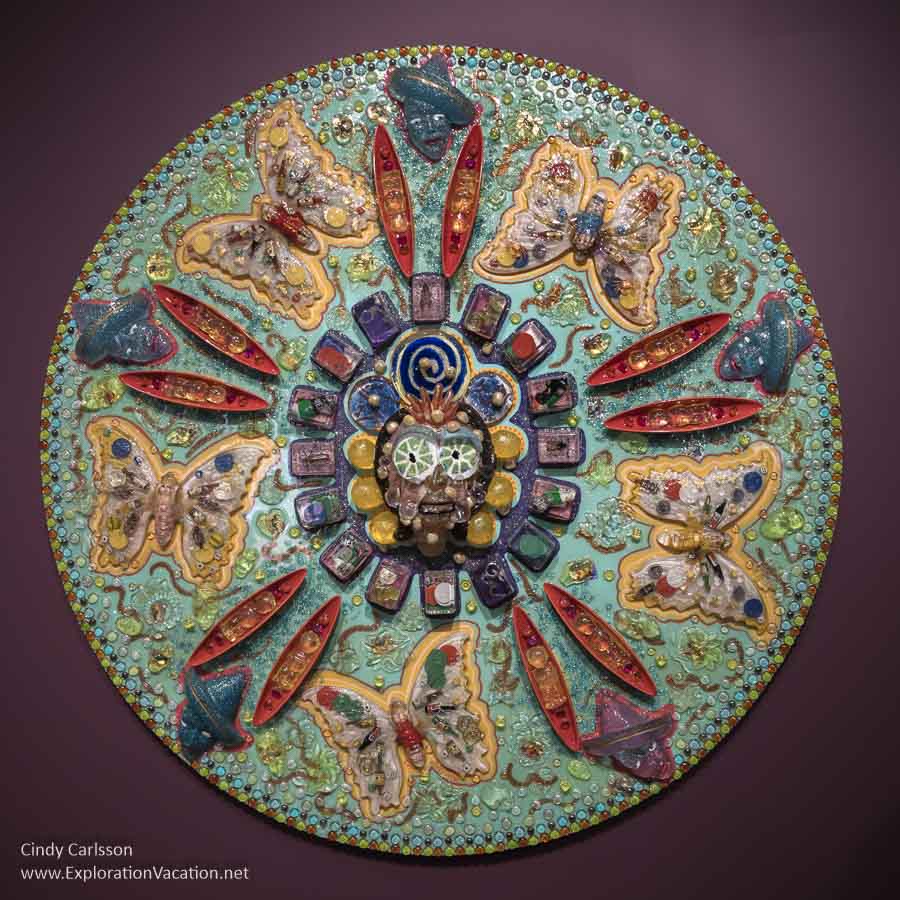
Llorando de Felicidad (Crying with Happiness)
It’s described as:
The first major touring exhibition for artists and brothers Einar and Jamex de la Torre (b. 1963 and 1960, Guadalajara, Mexico), Collidoscope: De la Torre Brothers Retro-Perspective presents 37 works of sculpture and installation described by The New York Times as art of “dazzling complexity.” As residents of both Mexico and the United States, the artists draw upon their witty observations of life from both sides of the border. Pulling from ancient Mesoamerican iconography, Mexican folk art, and Baroque art, their work blends art history and pop culture with daring social and political commentary, presenting art with celebration, irreverence, and play.”
The de la Torre brothers (or at least one of them) started as glass artists. Today they work with glass, resin, lenticular photography, metal, and found objects.
👉 See more of Collidoscope . . .
Most of the work on display isn’t “beautiful” in a traditional sense. It’s complicated, colorful, opinionated, and often funny. However, not being either Hispanic or particularly up on pop culture in general, few pieces really resonated deeply with me. I did appreciate some of the humor, but what really blew me away was the skill and creativity required to create these pieces.
That’s particularly true of the lenticular prints, which are fascinating.
Created by editing digital images into thin vertical slices and then combining them into a single printed image with a plastic lens over the top. The lens allows the images to be seen at different angles by moving slightly from one side to another.
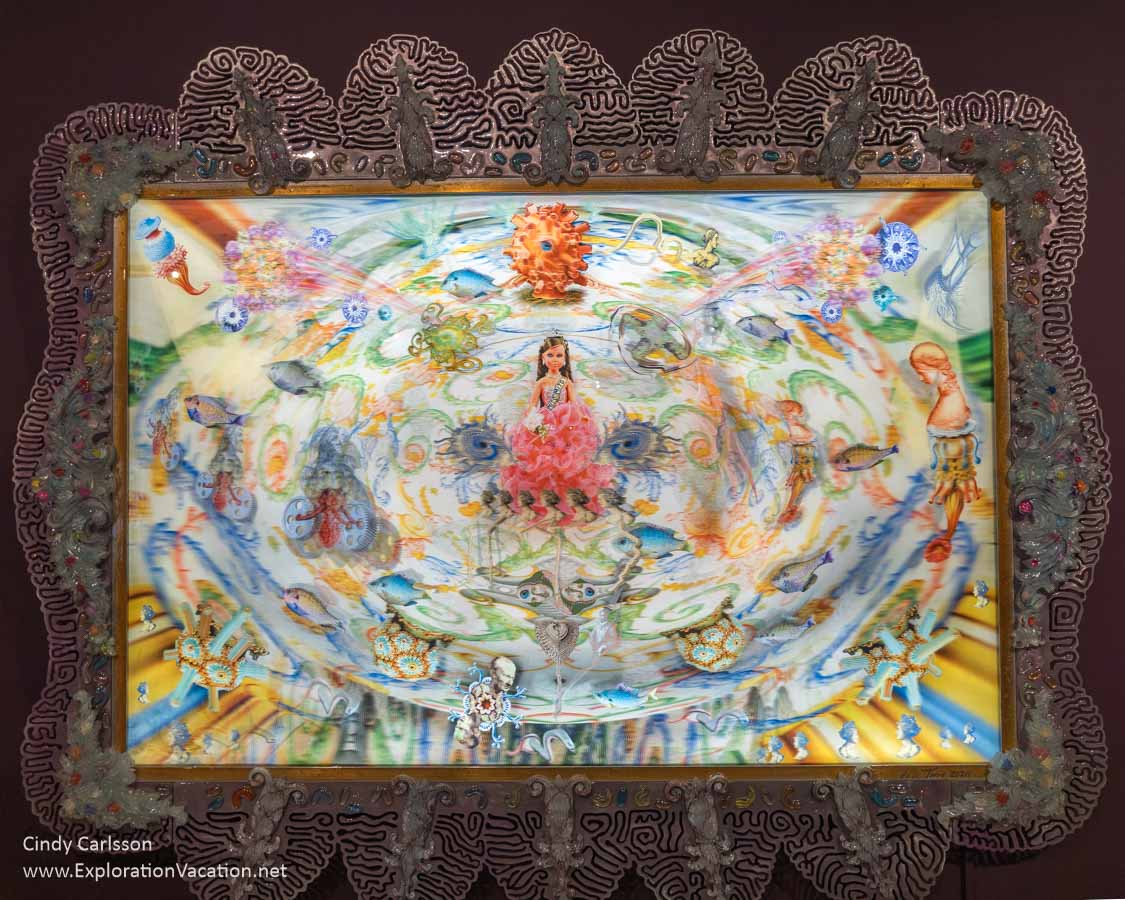
A 15-year-old beauty dressed up for her quinceañera.
This image, Miss Mito, came out of a collaboration between the la Torre brothers and Dr. Gerald Shadel at the Salk Institute in California.
Dr. Shadel studies the role of mitochondria in the aging process. The brothers depicted these changes over time as a girl celebrating her quinceañera (15th birthday) that transforms into an old man attacked by demons representing viruses, bacteria, and toxins that damage mitochondria and cause aging.
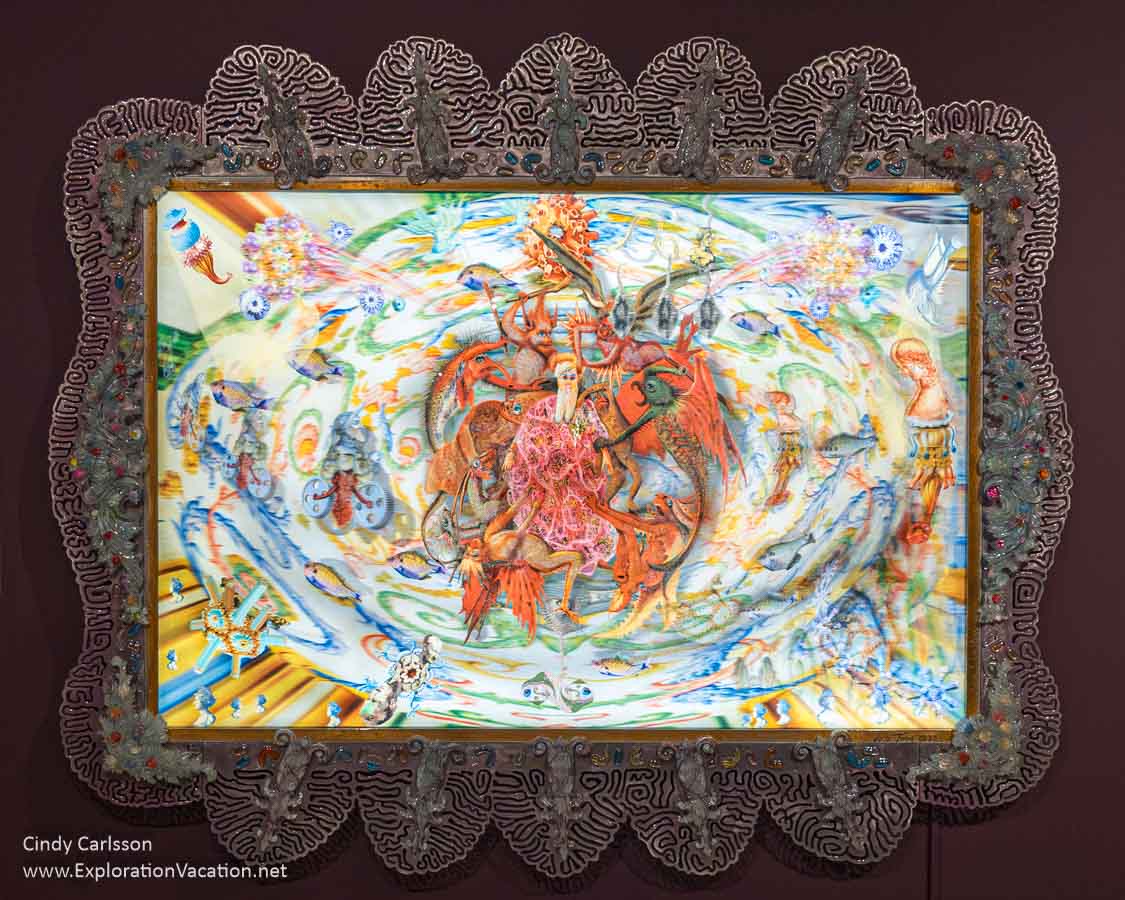
The demonic attacks that cause aging. (That’s Dr. Shadel down at the bottom.)
I could have spent the entire afternoon in front of this and the other lenticular prints, slowly rocking from side to side, watching the layers shift, and trying to understand how the images relate to each other.
But there are other cool things as well.
Sharp-eyed visitors may notice a familiar face among the slightly more traditional pieces on display.
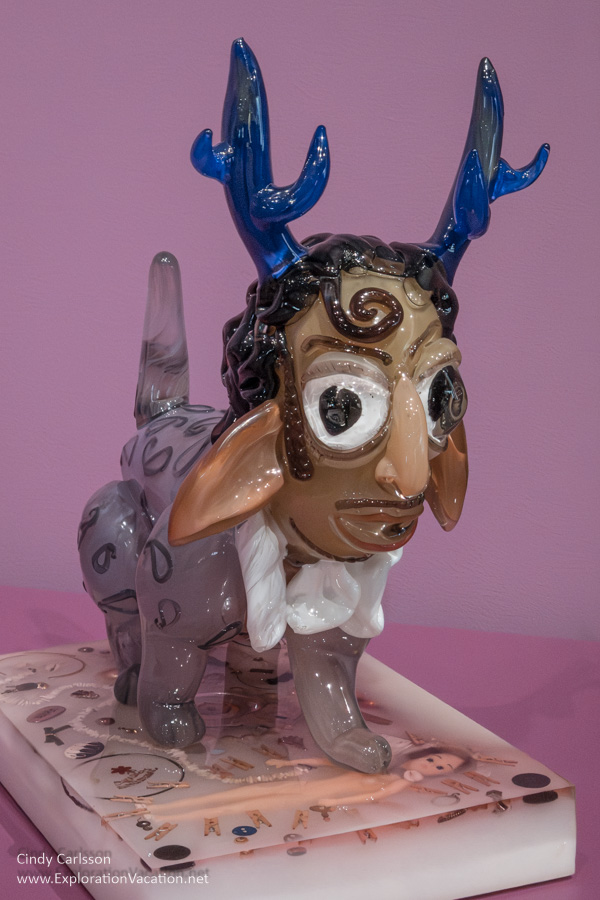
An imaginary tonali (spirit animal) for Prince.
“Prince Tonali” was created in 2016, when the brothers were in Minneapolis for a glassblowing demonstration shortly after Prince’s death. They looked back to Aztec traditions that identified a personal animal spirit (a tonali) for each person at birth to create an imaginary tonali for Prince.
It’s a fun exhibit. And it’s one where a tour is helpful to understand both the technique and the meaning of each piece. Of course, docents are always available, so you can still access some of that information when visiting on your own.
👉 Read less
What is the Cafesjian Art Trust?
The name Gerard Cafesjian might sound familiar if you are from the Minneapolis-Saint Paul area. The American-born son of Armenians who immigrated to New York, Cafejian spent most of his career at West Publishing in Minnesota. After leaving the West, he turned his full attention to philanthropic projects in the USA and Armenia. In Saint Paul he helped fund the rescue and restoration of the historic carousel now in Como Park. (And tried to keep it a secret.) In Arizona, he founded the always intriguing Scottsdale Museum of Contemporary Art. And he funded many projects tied to Armenia, including an arts center.
And he collected art. A lot of art. Thousands of pieces of art went to Minnesota, Florida, and Armenia. Art of all types, but especially glass.
The Cafesjian Art Trust allowed the family to gather all that art together in one place after their father was gone. The museum is a way to share it with the public as part of his ongoing legacy.
The Trust has around 3,000 pieces. And, while Gerard Cafesjian is no longer with us to collect more, the Trust is acquiring additional pieces to expand and broaden the permanent collection.
Plan your visit to the Cafesjian museum
The Cafesjian Art Trust (CAT) Museum is located in an easy-to-access suburban area. You can visit for free, but it is only open Thursday, Friday, and Saturday. And Friday evening and Saturday are the only times you can visit without a reservation. For other days, you may need to make a reservation up to a month in advance.
While the museum is only open a few days a week, major exhibits are generally (not always) on display for about six months.
Both the museum and parking are free.
There’s no cafe or coffee shop at the museum, and the surrounding area is mostly filled with light industrial and service businesses. However, Churchill Street Restaurant is located on the other side of the museum’s north parking area. It’s a casual spot with a light lunch menu, full evening menu, coffee shop, and what appears to be a full bar. It’s a pleasant order-at-the-counter spot with good food, but it isn’t cheap and there’s a surcharge to use your credit card.
The basics of what you need to know to plan a visit are below. You can find additional information on the CAT website.
Where is the CAT museum?
The Cafesjian Art Trust is located in Shoreview, Minnesota. That’s about a 20-30 minute drive from either downtown Minneapolis or Saint Paul. Longer if you travel during rush hours.
You can get there by bus. There’s a route from downtown Saint Paul that can get you there in just over an hour. From downtown Minneapolis you’ll have at least one transfer, with a travel time of about 1½ hours. Both options require about a 15 minute walk along a busy road to get from the bus stop to the museum. But I’m pretty sure there is a sidewalk.
Do you need a reservation to visit the CAT?
The CAT Museum is NOT a place where you can check the hours and just stop in without a reservation – unless you visit on a Friday evening or a Saturday.
As part of a change in 2025, you can now visit on Friday evenings and on Saturdays without a reservation.
During the day on Thursdays and Fridays, visitors are welcome only as part of a pre-reserved guided tour.
If this seems off-putting, I get that. I felt that way until I actually went to the museum. This system actually provides a good museum experience. You get information about the art and no crowds. The only downside was the very limited number of reservations available. I hope that will be less of an issue now that there are times you can visit without a reservation.
Tours for the current exhibit are limited to 20. And it’s only partially guided. Reservations are basically for a two-hour block of time, with the actual tour taking less than half of that time. The rest of the time is yours to explore on your own. Given the small size of the museum, it is plenty of time for most visitors.
The tour usually serves as a good introduction to the museum and the work on display, so it is well worthwhile.
I don’t know if they always do this, but the current exhibit has tours available in Spanish.
No reservations available?
Reservations open one month in advance. If there is a specific day you want to visit, be sure to check for reservations as close as possible to one month before the date you want to visit.
Are all reservations for the date you want already booked?
Because there is no charge to visit and reservations are so limited, people make reservations just to hold a date, figuring they can decide to cancel later. They’ll also make reservations for small groups, and then cancel some or all of those if not everyone can actually attend. (I’ve done both.)
While that makes it harder to get an advanced reservation, it also means spots often open up as the tour date gets closer.
To nab those openings, check back regularly. That includes checking a couple of days before you’d like to visit. (I managed to snag a reservation for three this way.)
And (now) you don’t need a reservation to visit on Friday evening or on a Saturday. There won’t be a tour, but there will be docents to answer questions.
Families are welcome
I think I’d be terrified to bring children to a museum with so many glass objects, but families with children are very welcome at the CAT. The museum has a family room and other spaces designed with families, including families with special needs children, in mind.
Check their tips for bringing kids to the museum before you arrive.
Using the library
The Cafesjian Art Trust library is a research library. While they have books out that you can look at while visiting, most materials are not available to the general public. And none of the materials can be taken out of the library.
Researchers, artists, curators, and students can make a reservation to use the library.