

Last updated on June 15th, 2026
From the street, the Satie House and Museum (Les Maisons Satie) in Honfleur, France, looks like any other half-timbered medieval house in the city. However, step inside and you’ll discover a dreamlike world set to the words and music of composer and pianist Erik Satie.

Never heard of Erik Satie?
That’s ok. You’ll still enjoy this highly innovative and experiential museum.
I use links to improve your experience using this website. Some may be affiliate links that pay me a small commission if you use them to book a room, rent a car, or purchase goods or services. You don’t pay extra, but it helps keep this website running. To learn more, see my policies and disclosures.
The Erik Satie museum is not your ordinary museum
I had a passing familiarity with Erik Satie’s work before visiting the Erik Satie museum. That translates to: I knew he was a relatively modern composer of quiet, sort of melancholy piano music.
Yeah, that’s it.
I also knew the Satie museum was often described as surreal, but I couldn’t imagine what that meant when applied to a museum. Particularly when applied to a museum about a composer, rather than a visual artist.
I soon found out what it meant.
A feast for the senses
In the reception area at the Satie museum, we put on headphones and entered the first of what would turn out to be several darkened rooms.

The headphones provide a flowing background of Satie’s music, environmental sounds, the words of Satie and his friends, and the occasional commentary on Satie’s life and work.
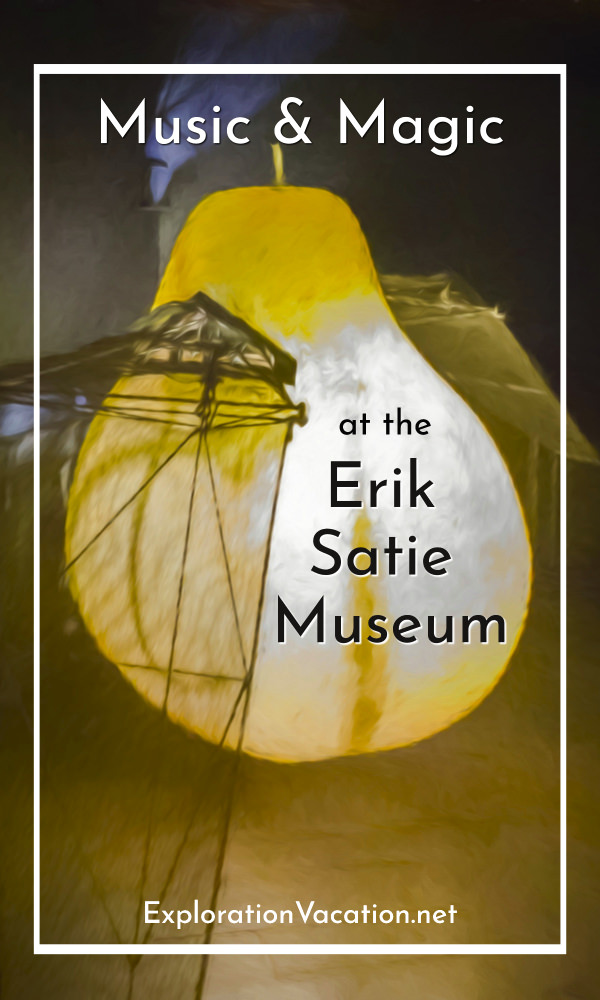
That soundtrack changes as you move through each room, and it took me a while to understand how to get the most out of it. That means I’m not really sure what the winged pear represents. Looking back on it, I assume it relates to Satie’s composition “Three Pieces in Pear Form,” which he composed after being accused of writing music that lacked form. And which, in what turns out to be typical Satie style, actually has seven sections.
The Satie House and Museum consists of a series of these mostly dark rooms with a (usually small) selection of items. It’s a museum where the story is told through the music and “voices” of Satie and his contemporaries. The physical objects on display (few of which have any direct connection to Satie himself) tie the soundtrack to the space. Indeed, the lighting in each room is probably as important as objects.
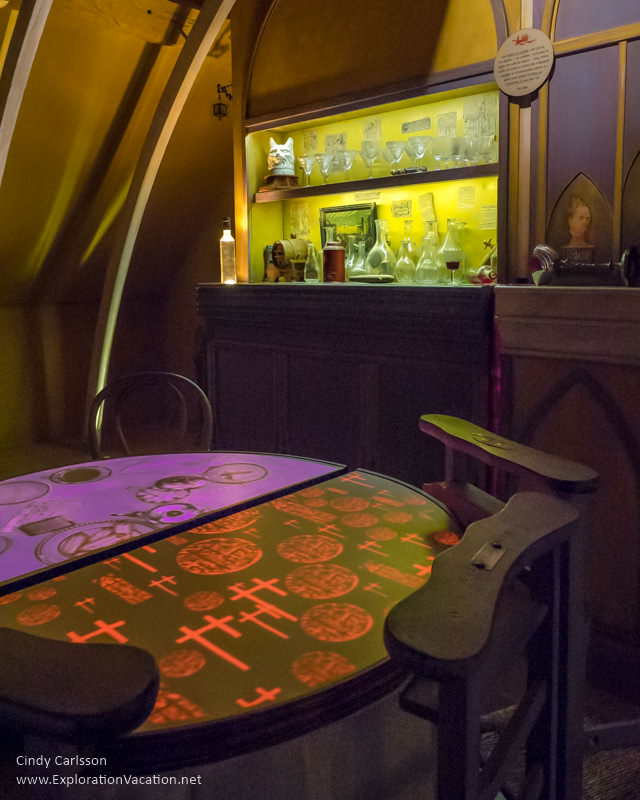

It is a museum for the emotions, not the rational mind.
Each room addresses a broad theme in Satie’s life: His youth and introduction to music, his development as a composer, religiosity, the artistic and political milieu in which he moved, and more. Sounds and images float in the air as visitors move from one room to another, from a raucous party to medieval-sounding church music, from political discord to a chaotic living space.
A musical interlude
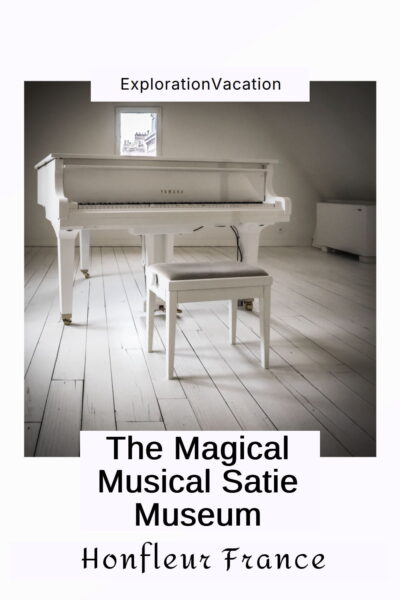
At what seems like the end of these rooms, a white piano sits in the middle of an otherwise empty white space, natural light streaming down from clerestory windows. An invisible force plays the piano, creating an endless stream of the soothing, formless music for which Satie is best known today. It is a space that invites contemplation.

While it seems like it will be the last room in the museum, it is not.
Ready for a carousel ride?
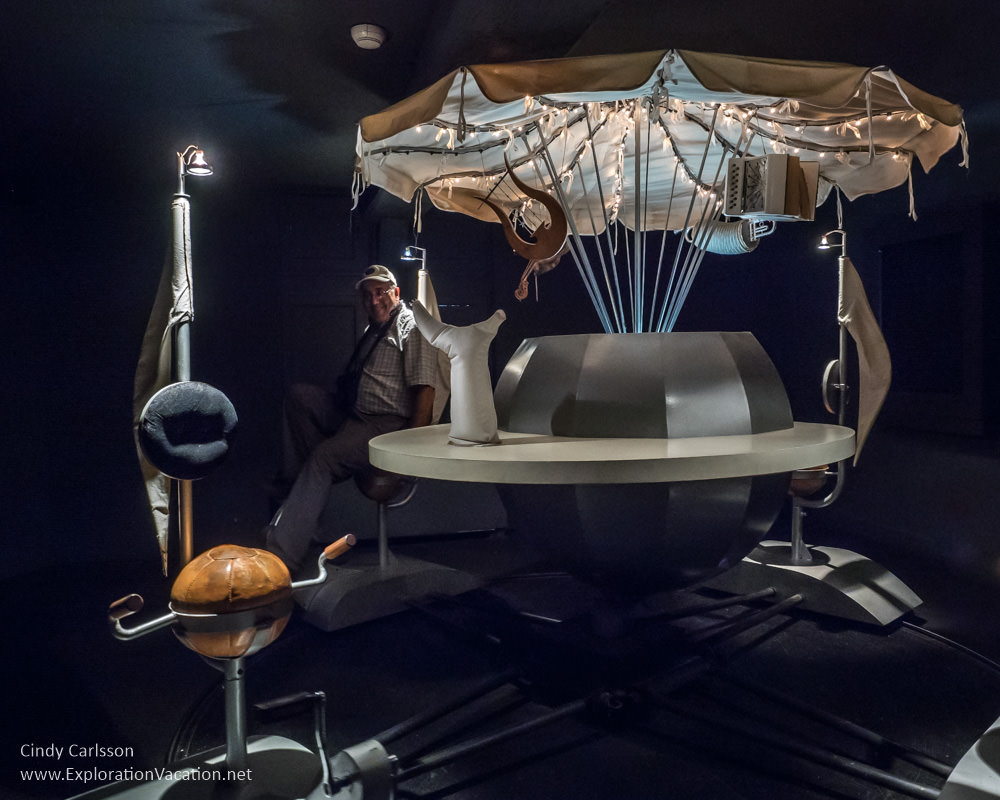
In the next room a pedal-powered carousel comes to life whenever anyone takes a seat and begins pedaling. The carousel turns, lights up, and actually expands as one of Satie’s boisterous carnival pieces begins to play. The faster you pedal, the brighter, bigger, and louder the contraption becomes.
Off to the cabaret
The final room is a darkened cabaret, with plenty of seating and a large screen on stage. Here visitors can watch one of the short surreal films for which Satie composed the music near the end of his life.
We are nearly alone here this afternoon, but I can imagine this room filled with people chatting as they watch the screen. From there it is only a short step to imagine the room filled with the avant-garde of Paris loudly commenting, critiquing, and complaining as they grapple with the future of art in the changing world around them.
The film itself is strange, jolting, and without context. It leaves me wondering what exactly I just saw, which is probably the perfect way to end a visit to a museum about Erik Satie.
So who was Erik Satie anyway?
In the notes for the Eve Egoyan recording “Erik Satie: Hidden Corners (Recoins),” Professor Robert Orledge of the University of Liverpool begins thus:
Erick Satie remains one of the most bizarre and fascinating composers in the history of modern music.
Satie’s life and music
Erik Satie was born in 1866 and came of age during the Belle Époque, a highly romanticized period between 1871 and the beginning of World War I in 1914 that was later viewed as the epitome of style and sophistication in Paris.
I have come into the world very young into an era very old.

👉 Read more about Satie's life and work. . .
Having learned to play piano from his stepmother, Satie attended the Paris Conservatory. His time as a student there was unsuccessful, as he was either the school’s laziest and least talented student or a genius unmotivated by the traditional musical forms being taught. . . Or perhaps something in between. (At age 40 he would enroll in another conservatory where he was a very good student.)
As a young man, he lived in the center of Bohemian culture in Montmartre. There he mixed with other artists and composed a variety of music, including religious music and the formless Gymnopédies for which he is best known today.
After ten years in Montmartre, Satie moved to an industrialized working-class suburb of Paris, where he would live for the rest of his life. For some time, he earned a living as a popular cabaret pianist and arranger, a pursuit he later claimed to despise.
Of course, he also continued to experiment with his own compositions, eventually becoming popular for humorous piano miniatures before moving on to other forms. And at the end of his life he wrote music for a few surrealist films and ballets, including collaborations with Pablo Picasso.
Satie was an original in every way
Satie’s personal habits and practices were at least as unconventional as his compositions. As a young man he was deeply religious and for a while led his own one-man religion. At one point he purchased 12 grey velvet suits, which were all he wore for years until switching to a black suit, bowler hat, and umbrella for all occasions. (He is said to have worn the grey velvet suits one at a time until each wore out, and there were still a few unworn ones left when he died. . . Along with 100 or more umbrellas.) Satie drew imaginary buildings on cards, occasionally taking out anonymous ads offering them for sale as if they actually existed. (He also liked to advertise performances of music that didn’t exist.) He refused to use the Metro and carried a hammer to protect himself when he was out and about.
An eccentric in all ways, Satie is also famous for the odd form of his musical scores, many of which are written without bar lines and bear inscrutable directions like “Open your head” or “Work it out yourself.”
Despite his eccentricities, Satie was an important member of Paris’ artistic and intellectual avant-garde throughout his life. He was friends with Claude Debussy and other composers, along with a number of Paris’ leading thinkers and writers. As part of the Dada movement, his group of friends included Picasso and other Cubists.
Learn more about Erik Satie
Whether you like his music or not, Erik Satie is a fascinating and influential figure, and his peculiar life makes for great reading.
Read more about Satie’s life on the web:
- A couple of other short biographies can be found online at Musician Guide and Music Academy Online. In addition, Minnesota Public Radio has an engaging older piece on Satie’s life and work. (Every biography seems to mention different facets of Satie’s strange life.)
Learn more about Satie’s music:
- From CBC Music, Essential Erik Satie: 10 pieces you should know provides great (often very funny) background information on each piece, a link to a recording of it, and PDFs of scores, art, and other related material.
- Erik Satie’s Crystal Ball is a website that explores the idea that Satie’s music provided a glimpse of the music that would follow over the next 50 years. The site is packed with research and bibliographies.
👉 Read less
Plan your visit to the Satie Museum
You do NOT need to know anything about Erik Satie or classical music to enjoy this museum. The museum is a fascinating sensory experience in and of itself and is unlike any other museum you’ve visited.
And you’ll come away knowing a bit about a composer whose work has been described as “indispensable” to those who followed him.
This is not a traditional house museum
The Satie House and Museum (Les Maisons Satie) in Honfleur, France, is not a traditional house museum.
Unlike a traditional museum, where rooms would either be designed to replicate spaces from Satie’s life or serve as display space for artifacts, photographs, and written descriptions about Satie’s life and work, the Satie museum brings visitors into his world without replicating its appearance. Instead, the museum sets visitors adrift in a series of sounds and images designed to invite you into “the soul of Erik Satie.”
This approach makes a lot of sense, given that Satie only spent part of his childhood here. It seems unlikely that this house played much of a role in his development as a musician. These are not the rooms where Satie played the piano or wrote his music. The museum’s decision to use the house as a stage set to evoke Satie’s world through artful images and sound seems both obvious and completely unexpected.
Getting to Honfleur’s Satie museum
The Satie House and Museum is located in the heart of the old trading port of Honfleur, in Normandy, France. It can be accessed from either of two streets, with the uppermost entrance along a pleasant street lined with half-timbered homes that now have shops on the main floor.
Located a couple of hours drive west of Paris, Honfleur is a gorgeous city and well worth a visit. Honfleur attractions include winding historic streets, a lovely old harbor lined with restaurants and cafes, and a 15th century wooden church, as well as the Satie museum.
By automobile
The drive from Charles de Gaulle Airport (CDG) in Paris to Honfleur is easy, although there are plenty of worthwhile stops along the way (including Monet’s gardens at Giverny) that could make your trip take much longer than a few hours! You have the option of taking the major highway or more scenic smaller roads.
By train and bus
Trains to Normandy leave from the Gare St. Lazare in Paris. There is no train service to Honfleur, so travelers who don’t want to drive have to take a train to Le Havre or Trouville/Deauville and then a bus to Honfleur. Those interested in spending time in Rouen could travel there by train, and take a bus from Rouen to Honfleur. It’s a longer trip, but Rouen is also a lovely place to visit.
Inside the Satie Museum
The website for the Satie House and Museum clearly lays out admission fees (which are under $10 and include the use of headphones) and opening hours.
The museum is closed on Tuesdays.
It’s an audio tour
You have to be able to hear the audio track to have any idea what is going on. There are no explanatory signs or other written information cards to explain what you are seeing.
The headphones included with your admission are actually pretty nice and are available with soundtracks in English or French. Mine were comfortable with reasonably good sound quality. They were much better than headphones I’ve had at other museums.
The system allows visitors to move around freely (you don’t have to move through a room in any particular order) and spend as little or as much time with each exhibit as desired. However, it took me a couple of rooms before I understood how to move around to get the full soundtrack.
Be aware of the fact that the soundtrack you hear is based on where you are standing in each room. As you move, the track changes. That means that you can miss some if you move too fast or don’t walk into part of a room. However, visitors who walk through a room without exploring all parts of the exhibit will still get the most pertinent information. Visitors who move more slowly and walk all the way around the exhibits will hear additional information, music, and stories.
Accessibility
Due to its design, not everyone can tour the Satie museum without accommodation.
- Many of the rooms and the connections between them are very, very dark. Visitors with poor night vision may want to have a small flashlight handy as they move between rooms.
- This is a very old house, and it has narrow doorways and stairs. The usual path through the museum is not fully wheelchair accessible and could be a challenge for anyone who has mobility issues. The good news here is that I believe there is an elevator available that allows visitors using wheelchairs or with other mobility limitations to see much, if not all, of the museum.
If accessibility issues are a concern, contact the museum directly so they can accommodate your particular needs.
Linger in Honfluer
Honfluer is located on the English Channel at the mouth of the Seine. Once a bustling little port, the heart of this historic city is unbelievably picturesque and romantic.
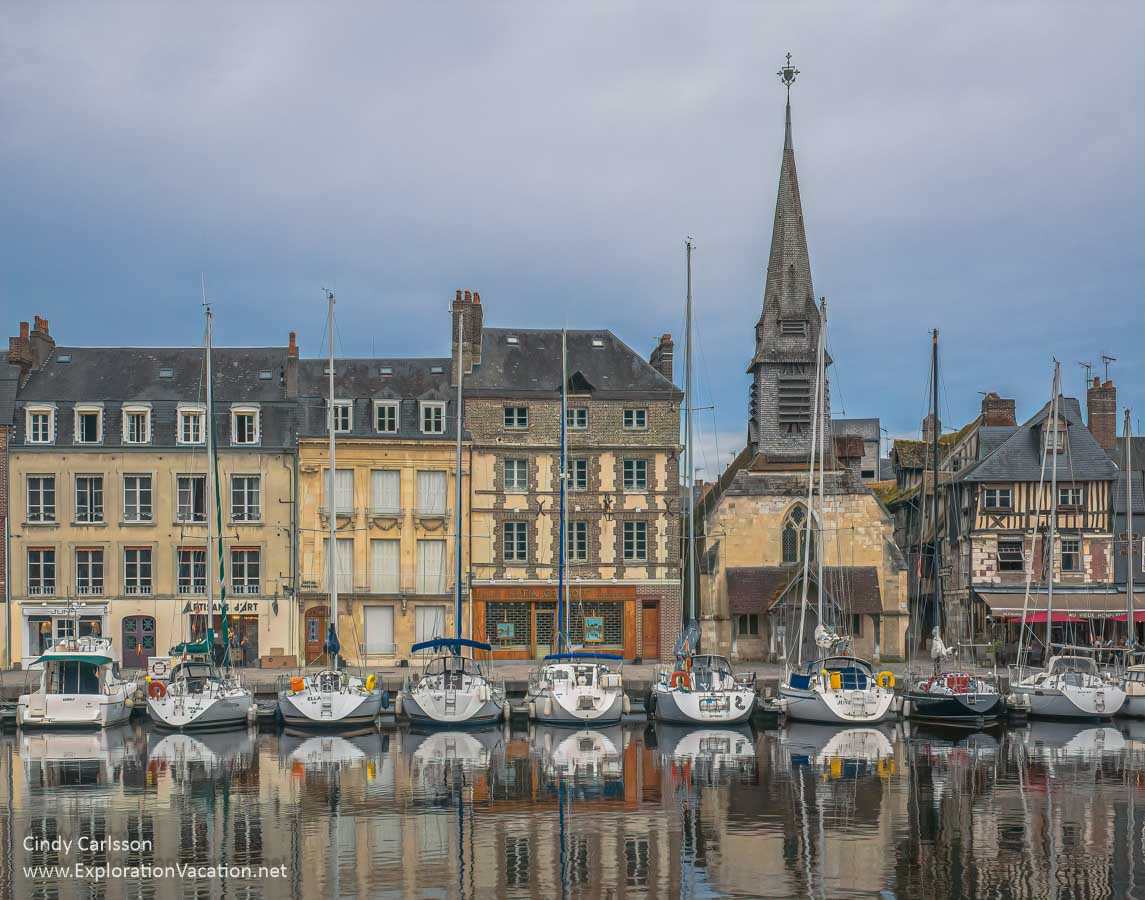
Vieux Bassin (Honfleur’s historic small harbor) on an exceptionally quiet evening.
Whether you want to sit along the water and enjoy a meal, wander the city’s medieval streets, explore its historic buildings and museums, or just relax in a picture postcard come to life, Honfleur will not disappoint. We only spent one night here. It should have been two or three. It’s a beautiful place just to wander!
You can find more details on things to do in Honfleur on their tourism website.
Lodging in Honfleur
I recommend you stay as close to the historic center of town as you can. There’s nothing better here than to get up in the morning and step out onto a charming medieval street!
Many of the best lodging options here are small and privately owned. You won’t find many of them on third-party booking sites, but if you want to take advantage of membership discounts and/or Rakuten cash back, start your search on Booking.com, Expedia, and/or Agoda to see what they offer. From there you can decide if there is something you want to go ahead and book online, or if you need to use a local booking agent or contact properties directly.
And don’t forget to check sites like VRBO to see if there are any private homes or apartments available.

His Seven Gnossiennes, which are probably his most familiar works (often used as haunting music in TV and movies), have no time signature or measures. Very avant-garde!
Other wonderful music museums are the MIM, or Musical Instruments Museum, in Brussels (in a fabulous Art Nouveau former department store) and the Espace Georges Brassens in Sète, France.
Yes, I’ve heard there is a wonderful musical instrument museum in Belgium. but I have yet to get there. (There is also an amazing one in Phoenix, Arizona, although I found their headphones quite uncomfortable.) I was not aware of the Brassens Museum. It sounds wonderful. Thank you for the suggestions!
I don’t know anything about Erik Satie, but his museum sounds kind of amazing. I’d love to go!
It’s very different from the museums you usually visit, but it is very cool and odd, so I definitely think you should visit if you get to that part of France. And Satie is just so odd and interesting!
We are dogging you! We just got back from Honfleur, where we BYPASSED the Satie Museum. Big mistake, huh? We walked along the chalk coast at Etretat, instead because we wanted to appreciate that rock layer from the other side, and to see if it, too, had flint. (It did.) Nice post, Cindy.
Yes, Sue, you should have stopped in the Satie museum. But then, we didn’t get to Etretat . . . There are so many things to see and do in France!